Written by: TechFlow TechFlow
The theme of Binance Blockchain Week (BBW) 2025 is: The Next Era.
As the officially defined "most ambitious Blockchain Week to date," this year's BBW closely adhered to the theme of "The Next Era" in terms of personnel reshuffling:
Wearing a bright yellow battle robe, the top female CEO announced her appointment as co-CEO, ushering in the era of Binance's dual CEOs with Richard Teng;
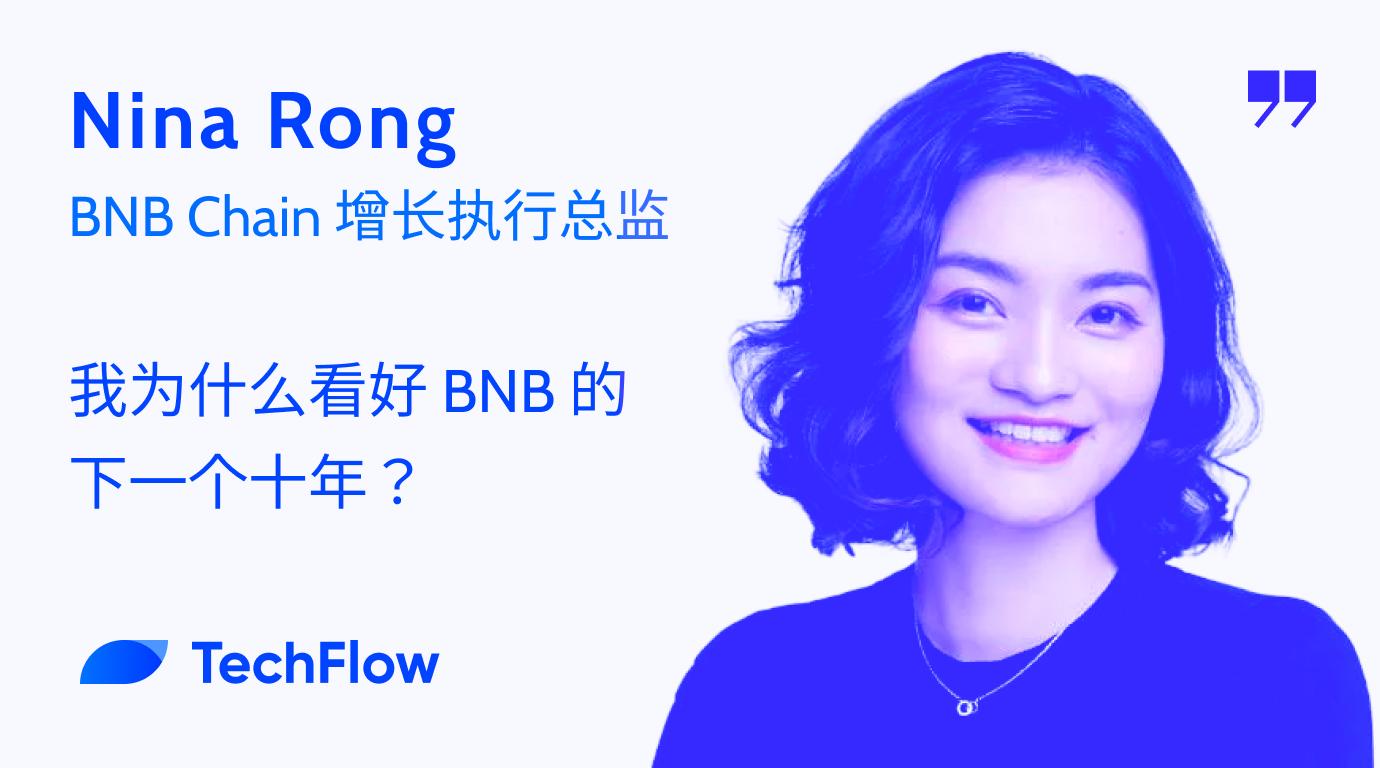
On the same day, Nina Rong, the newly appointed Executive Director of Growth at BNB Chain, took to the main stage for the first time to share how BNB Chain is driving the next wave of ecosystem growth.
After finishing the BNB Hackathon in Abu Dhabi, TechFlow had the opportunity to have an in-depth conversation with our old friend Nina Rong.
Speaking of the hackathon that received such a warm response from the community, Nina smiled and said:
The top spot went to a student team from a programming school in Abu Dhabi. This is a very important signal: developers outside the industry, with the help of AI and mentors, were able to quickly create a project on-site that was recognized and had practical application potential. This is a crucial signal.
Hackathons are essentially a forum for brainstorming and inspiration. They are not only technical events but also highly effective social platforms that bring people together to discuss interesting and meaningful topics for the industry.
As the Executive Director of Growth, the topic inevitably returns to "growth" itself. Nina's career path, transitioning from Arbitrum (a leading L2 blockchain) to BNB Chain (a leading exchange blockchain), spans two different ecosystem logics and growth models. Meanwhile, according to BNB Chain's recent 2025 year-end review: DAU stabilized at around 3.7 million, peaking at 5 million, ranking first among all L1 blockchains; DEX trading volume exceeded $2 trillion; and stablecoin supply rose to $14 billion.
Faced with already impressive results, how to begin the next chapter of growth? Nina, with her extensive experience in growth, offered a "back-to-basics" answer to this question:
As a foundational infrastructure product, a public blockchain's user base can be broadly categorized into three groups: retail investors, institutional users, and developer users. Therefore, the growth director is responsible for better serving these three groups.
BNB's technical team is outstanding, and it boasts a massive user base and well-developed infrastructure. I believe it will become increasingly difficult for other competitors to reach BNB Chain's current scale in the future.
Finally, as a seasoned industry professional, Nina offered the most direct and sincere advice to those who want to join the Web3 and BNB communities:
Cultivate a founder's spirit, possessing the determination and tenacity to get things done; at the same time, never detach yourself from the market, actively participate in transactions to maintain a fresh perspective on the market and an awareness of market trends.
In this episode, let's follow Nina's sharing and explore the winning strategies for growth in the crypto world.
The following is a transcript of our conversation. The audio version of the podcast is also available online. Please subscribe to "Let's Flow" on Xiaoyuzhou.
Click the "Little Universe" link or scan the QR code in the image to listen:
A successful hackathon is an efficient social connection.
TechFlow TechFlow: Congratulations Nina on joining BNB Chain. We've noticed you've been busy with Binance Blockchain Week and the BNB Chain Hackathon for the past week or two. Could you share your recent work experiences?
Nina:
Hi everyone, I'm Nina, currently serving as the Executive Director of Growth at BNB Chain. I'm grateful for the invitation from my old friend TechFlow, and I'm also very happy to have this opportunity to communicate with you all.
It's been quite busy since I joined the team, but I've also deeply felt everyone's enthusiasm. Especially at the recently concluded Binance Blockchain Week, I could personally feel the high level of attention and vibrant atmosphere from the community and developer groups.
The success of this hackathon exceeded my expectations. It not only brought together numerous technology, product, and KOL partners, but also attracted many industry friends I hadn't seen in a long time. Overall, we could feel the vitality of the BNB ecosystem and the close connections within the community.
Our Marketing team was fantastic at this hackathon. I mainly played a supporting role, and the overall execution was mainly led by the Marketing team, which fully demonstrated their professionalism – they were able to make a relatively small event exceptional.
TechFlow TechFlow: BNB Chain's hackathon was very popular. Did you see any projects or ideas that caught your eye?
Nina:
Many of the projects at this hackathon were outstanding.
The team that ultimately won first place was a student team from a programming school in Abu Dhabi. They were not developers in the industry and did not understand blockchain technology. They were just a group of students, yet they managed to complete the project in a short period of time.
Several mentors at the event provided them with inspiration, such as "creating a DeFi on-chain mining APY dashboard," and they quickly built the product.
In my view, this is a very important signal: developers outside the industry, with the help of AI and mentors, are able to quickly create a project on-site that is recognized and has the potential for implementation. This is a crucial signal for the entire industry.
TechFlow TechFlow: May I ask if the team has compiled statistics on the number of Web2 developers or students participating in this hackathon? What was the approximate percentage? Has there been any improvement?
Nina:
We don't have specific statistics on the student ratio yet, but this hackathon was held at a programming school, which makes it closer to the student population. We will also be collaborating with many universities in the coming year.
I believe that hackathons cannot guarantee that outstanding projects will emerge. It's a probabilistic event where "a talent is given by God." The essence of a hackathon is a platform for sparking inspiration. As a public blockchain provider, what we can do is provide developers with as many and as good a platform as possible to explore more innovations.
Many ecosystem advancements don't originate from hackathon participants, but rather from mentors working together, mentors interacting with visiting guests, or other ecosystem teams, as this opportunity allows them to rekindle discussions about collaboration. For instance, some projects that originally belonged to another ecosystem, after participating in the BNB Chain hackathon and finding the atmosphere appealing, are considering joining the BNB ecosystem.
Therefore, hackathons are not only technical events, but also highly effective social platforms that bring people together to discuss interesting and meaningful topics for the industry.
TechFlow TechFlow: On a side note: Many people think the location of your hackathon event was quite interesting. Could you share the story behind the location selection?
Nina:
The reason we chose this venue was because one of our team members happened to know the founder of this programming school, and the venue really matched the theme of this hackathon, so we all hit it off immediately.
Then, the "industrial park" comment was just a joke. Because the school is in Abu Dhabi, we took a bus from Dubai, and when the bus was almost at its destination, some friends joked: "Hey, why does it feel like we've arrived at an industrial park?"
Haha, actually I didn't know it would be in such a remote location, but the school's facilities are very complete, helping everyone have a better experience during the hackathon.
Of all the public blockchains that still exist in 10 years, BNB Chain will definitely be one of them.
TechFlow TechFlow: What are some things that you found different from what you expected after you actually joined the team?
Nina:
Overall, the onboarding process went quite smoothly.
One thing that might be a bit unexpected is that I didn't expect to be able to do so much work. Maybe when you're in this position, there are really a lot of things to do, and you get all fired up, wanting to do everything perfectly.
So for me, it was a breakthrough that pushed my personal limits.
TechFlow TechFlow: Many friends are unfamiliar with the position of "Executive Director of Growth", so we would like to ask you to introduce your professional experience and what are the main responsibilities of the "Executive Director of Growth" in BNB Chain?
Nina:
Literally, the growth director is responsible for the growth of the public chain.
As a foundational infrastructure product, a public blockchain's user base can be broadly categorized into three groups: retail investors, institutional users, and developer users . Therefore, the growth director is responsible for better serving these three groups.
TechFlow TechFlow: So previously at Arbitrum, you mainly worked on the ecosystem, while now at BNB Chain, it's a role that covers all growth-related aspects?
Nina:
One way to understand this is that at Arbitrum, you might not have been responsible for as much marketing-related work; there was a dedicated marketing team for that. But at BNB Chain, you'll likely be involved in both business development (BD) and marketing-related tasks.
TechFlow TechFlow: Many people got to know you when you were in charge of the Arbitrum ecosystem. A few years ago, you witnessed the explosion of the entire Layer 2 track, and Arbitrum was one of the best in it. What were your considerations for coming to BNB Chain now?
Nina:
First of all, leaving Arbitrum and joining BNB Chain are two completely independent events. I left Arbitrum in March of this year and joined BNB Chain around the end of September or the beginning of October. The two events are completely unrelated. When I left Arbitrum, I did not expect to join BNB.
As for joining BNB Chain, I think it's a normal career development path. Staying in the same company and the same position for too long may not be the best choice for either the individual or the company. Of course, I still have a very friendly relationship with Arbitrum and its three founders, and I respect them very much, but at the time I wanted to take a break and also hoped that more new talent could join Arbitrum to help the project grow.
Personally, I think BNB Chain is a very promising public chain. If we're talking about which public chains will still exist in 10 years, I think BNB Chain will definitely be one of them. It has very strong technical resources, institutional resources, and a user base. It can be said that it has all the necessary elements, which I think is very rare in Crypto. I am also very honored to join the team.
TechFlow TechFlow: What do you think are the differences between the BNB Chain ecosystem and the Arbitrum ecosystem?
Nina:
I think Arbitrum's overall positioning is more technology-driven; while BNB Chain has a larger user base, and their respective advantages and focuses are different.
Of course, the ideal state of an ecosystem is to have both users and developers, so if I were still at Arbitrum, I would probably prioritize user-side issues; but now at BNB Chain, I will prioritize developer-side issues and serve the developers in the ecosystem well, which is the focus of my work going forward.
TechFlow TechFlow: We saw that you also shared your insights. Listening to Sister Yi's sharing is very rewarding; it's always refreshing. What kind of person is Sister Yi in your eyes? What inspirations or lessons has she given you?
Nina:
Actually, I haven't had much communication with Sister Yi yet. It was only after we invited her to speak at the hackathon that I had the opportunity to actually meet her. So, like many others, my understanding of her is primarily from the perspective of a "fan."
Ordinary people may never have the opportunity to stand in the position of a top influencer, whose every word and action can even affect the entire industry. Therefore, their perspectives on things and their ways of handling problems will be very different. But from my perspective, I feel that many of the views expressed by the top influencer resonate with people at any stage of their lives, and many of the experiences she has summarized are very inspiring for my own life.
For example, one of the top sisters' remarks left a particularly deep impression on me:
God will keep dealing you the same hand until you find a better way to play it and win; once you find a solution, God will stop dealing you the same hand.
I think this statement is a source of strength for people facing challenges in life. If you encounter great difficulties right now, since God keeps dealing you the same cards, you should play your hand well this time instead of giving up. Often, the views expressed by Sister Yi can inspire courage in people facing difficulties.
Technology, user base, and robust infrastructure: Three major hurdles that prevent new public blockchains from surpassing BNB
TechFlow TechFlow: When discussing public chain competition, in the current market cycle (especially when facing competition from Solana and Base), where do you think BNB Chain has untapped potential?
Nina:
I think the most underrated aspect of BNB Chain is that BNB's technical team is outstanding.
I specifically mentioned this point in my speech at Blockchain Week: Although the BNB technical team rarely appears in public, they are all very talented engineers and researchers.
At the same time, I also hope that during my term, I can better represent them, convey the results of our technological research to the industry, and let the outside world better understand our technological contributions to the entire Crypto industry.
TechFlow TechFlow: In your opinion, do public blockchains have moats? Why? If so, where are BNB Chain's moats?
Nina:
I believe one of BNB Chain's biggest advantages is that it has a very large user base.
For developers, they are essentially driven by the users. As developers, they may not care so much about the infrastructure on which the program is built, but rather whether users are using the product. Therefore, the number of users is itself a kind of moat.
Another key point is the robustness of the public blockchain's infrastructure, ensuring easy access for users. This requires extensive work, including integration with exchanges, cross-chain bridge connections, communication with RPC service providers, and the development of developer tools. Thorough preparation is essential to empower developers and users, and BNB Chain completed all of this five or six years ago.
Once the infrastructure is mature, at least the basic needs of the ecosystem can be met. In the current highly competitive public blockchain market, new public blockchains need to spend a lot of money on infrastructure, which can lead to a long-term decline in their finances. Many new public blockchains cannot even provide the most basic support for their developers. However, from the current perspective, BNB Chain does not have this problem.
Putting aside the concept of a moat, I think it will become increasingly difficult for other competitors to reach the size of BNB Chain today.
TechFlow TechFlow: Do you think there are still opportunities for new public blockchains?
Nina:
I think it will be very difficult for new public blockchains to launch. As I just said, providing developers with basic sustenance is already very expensive. If, on top of that, a new public blockchain cannot prove itself to be better than existing public blockchains at the product level, then why would developers and users use it?
This is why I haven't joined a new public chain, because I can't convince myself that the market really needs another new public chain.
TechFlow TechFlow: We've observed some trends before. Some projects aren't independent public chains; they might provide certain services to public chains, but they do have their own chains. Do you think there's a chance for this kind of trend?
Nina:
I don't think this counts as a public blockchain; it should be categorized as an application blockchain.
From this perspective, I think there's potential in this direction, including within the BNB ecosystem itself. BNB actually consists of three chains: BSC, opBNB, and the storage solution Greenfield.
As a public blockchain, if it needs to run smart contracts, it may not be suitable to simultaneously bear certain specific loads in certain scenarios. In such cases, these specific scenarios can be handled by the application blockchain, which I think is reasonable.
The Chinese-speaking market is our strength; the focus is different in the European, American, Latin American, and Middle Eastern markets.
TechFlow TechFlow: A consensus among Chinese-speaking users is that Chinese-speaking users and developers make up the majority of users on BNB Chain. Is this true? Is the proportion of Chinese-speaking users really that large? Are there any relevant user profiles or data?
Nina:
I don't have any specific data at the moment. Because blockchain itself is permissionless, it's actually quite difficult to accurately determine which users or developers are from the Chinese-speaking market.
It can only be said that BNB is very popular in the Chinese-speaking world, which is an objective fact, and I believe it is an important advantage.
For me, BNB Chain is still in a relatively early stage. We have a lot of things to do, and the entire blockchain industry also needs everyone to work together to raise the ceiling and make the pie bigger.
In this process, the Chinese-speaking market is an extremely important user group, and we will not give up this advantage. At the same time, we will continue to expand into markets such as the United States and Europe, which will be a very important focus for us next year.
TechFlow TechFlow: Regarding the growth of the BNB Chain ecosystem, in which regions or directions are you currently focusing your work? What growth strategies do you have?
Nina:
Europe, America, Latin America, and the Middle East will all be key areas of focus, but the specific areas of emphasis will differ in each region:
In Europe and America, especially in the United States, we may focus more on institutional cooperation and university cooperation;
In Latin America, we may focus more on individual developers;
In the Middle East, where regulations are more relaxed and favorable, we may pay more attention to areas such as RWA.
Each region will have different areas of focus, and will recruit different talents to be responsible for different sectors.
TechFlow TechFlow: What growth metrics/data do you personally value most?
Nina:
Basically, all public blockchains have similar growth metrics, including TVL, trading volume, number of projects, number of tokens, and so on.
TechFlow TechFlow: What are your views on Chinese-speaking communities and East Asian communities? What areas do you think deserve particular attention?
Nina:
Looking at the global market, the Chinese-speaking market is one of the very few regions with strong developers, strong users, and strong institutions. Therefore, we will not focus on just one aspect, but will exert our efforts in all areas.
In addition, we also have community managers for the Korean market. Currently, the focus in Korea is mainly on community operations, and we will do more content and activities related to traders. However, this is not absolute. We also serve Korean developers, and if we see an increase in the number of Korean developers in the future, we will also start to do more developer-related content. However, the demand we see at present is still mainly for traders.
Cultivate a founder's mindset and never lose touch with the market.
TechFlow TechFlow: As a seasoned industry professional, what advice would you give to entrepreneurs who want to enter the Web3 field from scratch?
Nina:
I feel that my career development has been watched by many friends as I've grown. From a newbie just entering the industry, I've learned and grown together with everyone. I'm grateful for everyone's support.
Over the past few years, I have been trying to introduce some outstanding talents from outside the industry to Crypto, but not many have stayed. Many people feel that the Crypto industry is still in its early stages, and they already have a decent job in Web2 and are unwilling to delve deeper into Web3.
Therefore, my first piece of advice is to give yourself a chance to try, don't be afraid of losing, and really try to see what kind of results you can achieve in Web3 in six months or a year.
Secondly, I think Web3 is an industry that heavily relies on self-discipline and independent learning. This is one of its barriers to entry. Unlike Web2, you can't simply obtain a certificate through courses or exams to get a job in Web3. Currently, most people are still primarily following information on Twitter; for example, some people can hear today's content while others can't. The industry currently lacks systematic education and summaries, so personal learning ability is crucial. If you really want to enter Web3, you must establish your own high-quality information flow as early as possible and ensure you have an efficient learning methodology to continuously grow with the industry.
TechFlow TechFlow: Do you have any important workplace experiences or insights to share with those who are building their careers in the industry?
Nina:
The most important takeaway is: never lose touch with the market.
I recommend that all Web3 practitioners set aside a small amount of money, perhaps even just $1,000, to actually participate in the market, trade, try out new projects, and stay informed about market trends and current hot topics. In the long run, this will be very helpful for career development and industry control.
TechFlow TechFlow: We've seen many people online asking "Can I join the BNB Chain team?" What are your talent criteria? If someone wants to join the BNB Chain team or develop projects based on BNB Chain, what channels can they use to contact you?
Nina:
I believe there are two core aspects to BNB's talent recruitment criteria.
First is the Founder Spirit. Specifically, it refers to the determination and perseverance to get things done, the drive for continuous self-improvement, the willingness to push projects through in highly uncertain environments, and even turning seemingly impossible things into reality.
Secondly, it's about understanding the essence of the industry, which, as I just mentioned, means not operating in isolation from the market. If you're in marketing, you must truly understand marketing: what effective strategies exist in the market? What kind of content or activities can drive users to interact? If you're in business development, you need a deep understanding of the entire ecosystem: which projects are competitors? Which are more suitable for in-depth cooperation? Who are the key players in different sectors? In recruiting talent, I particularly value candidates' industry insights and their ability to truly translate those insights into decisions and actions.
TechFlow TechFlow: What channels are available for ecosystem projects to enter the BNB ecosystem Build?
Nina:
For ecosystem projects, you can submit information through a link on our official Twitter account, and many of our business development partners also have public accounts on Twitter, so you can DM them directly.
If you're looking for a job, we're hiring for BD and Marketing positions. If you're interested, feel free to send me your resume via private message. I read all your messages and comments, and if you're a good fit, I'll reply directly. If not, well, maybe we'll meet again someday, haha.