Written by: Wenser ( @wenser2010 ) Odaily
Another 20x opportunity at the start of 2026, but we still failed to seize it!
Just yesterday, Binance Alpha launched the Chinese meme "我踏马来了" (I'm here!) , a concept originally from Binance co-CEO and co-founder He Yi Year tweet. The meme coin quickly rose, with its market value soaring from around $4 million to over $16 million in just half a day, once again demonstrating the wealth-creating effect of "Binance-related memes".
What pains me even more is that on January 1st, when the market capitalization of Meme coin was less than $800,000, I saw a fellow group member forwarding CA, but I didn't follow suit! I can only say the market gave me a chance…
Meanwhile, opinions on this matter in the market are clearly polarized: negative views hold that the listing of this meme coin on Alpha is a product of Binance's listing team's "Shandong-style guiding ideology," a sycophantic act of "only following superiors," and is despicable; positive views, on the other hand, believe that although the meme coin is somewhat vulgar, given the upcoming Year of the Horse, it possesses meme attributes and is therefore acceptable. Is it another glorious new work of Chinese memes, or a shameful example of BSC memes pandering to He Yi? Odaily Odaily will analyze this in this article.
"I'm here!" becomes the focus of the market: Celebrity quotes are always an inexhaustible source of Meme Coin.
Like other celebrity meme coins, "I'm here" also had a rather coincidental yet intriguing beginning.
On January 1st, at the beginning of the new year, Binance Co-CEO and Co-founder He Yi amessage to celebrate the start of the new year, with the caption "2026, a new beginning; 2026, here I come!" The accompanying picture showed her riding a white horse on the beach, exuding a sense of renewal. The comments section was filled with praise and congratulations.
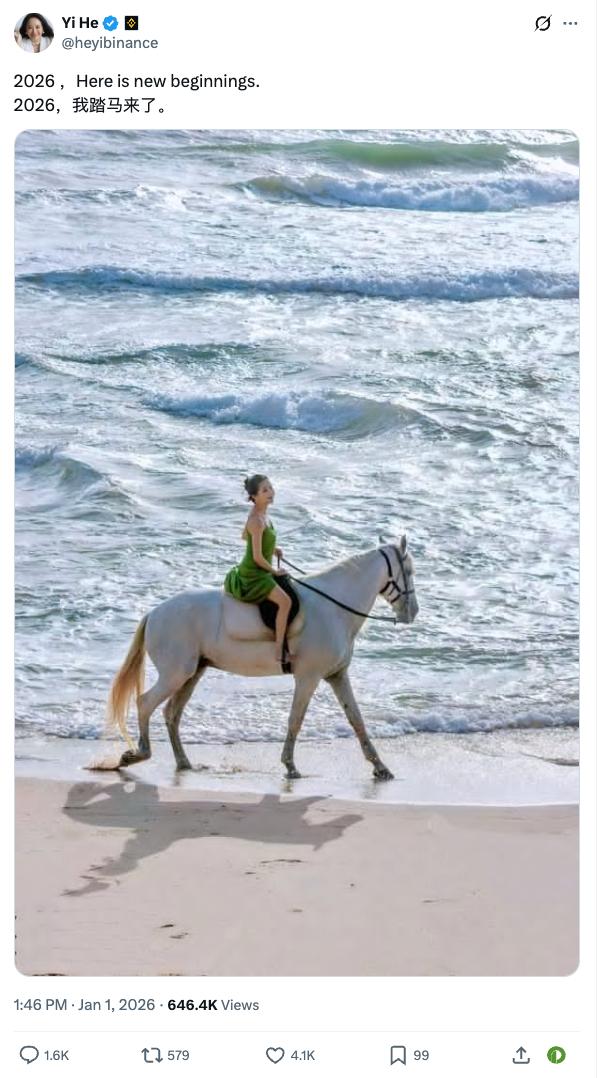
The coin of the same name, Meme, was launched on December 30th last year, and some people in the comments section have explicitly mentioned CA to "reveal" it .
And so, a "lucky saying for the Year of the Horse" that sounds a little vulgar but also contains a touch of good wishes began to spread and rise in value, thanks to the appearance of Meme and the form of Meme coins.
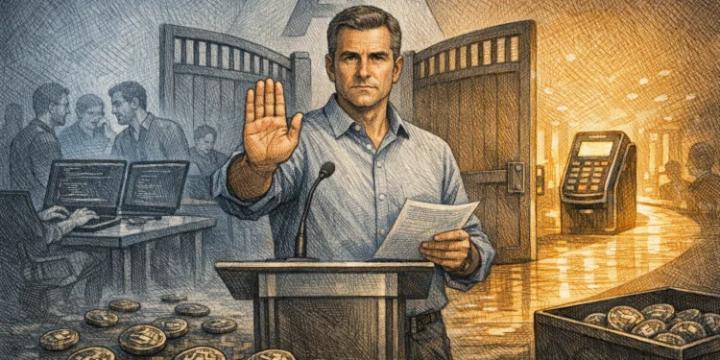
What truly made "I'm here!" a hot topic and a subject of speculation within the crypto community was Binance's official announcement yesterday that this meme coin would be listed on Alpha . Then came yesterday's classic meme image – "The Shandong School of Crypto."

In this picture, He Yi has become the "guest of honor at the Shandong dinner table," while the listing team and KOLs have become the main and secondary hosts at the table, following He Yi lead. Everyone is sharing a piece of the pie in the "dish" of market liquidity and wealth creation of Meme coin.
Some people made a fortune, some ate their fill, while others missed the opportunity and never got rich. Consequently, opinions in the market are divided regarding the "I'm coming to Binance Alpha" announcement. Here, we'll discuss a representative tweet.
The debate over "I'm here": Is it a disgrace to the Chinese language, or a new meme?
In response to this matter, a crypto KOL and observer commented from the perspective of exploring the purity of the Chinese language, "This is outrageous. BNB Chain won't even qualify as a state-owned enterprise chain anymore. At least state-owned enterprises have some cultural aesthetics. What are these listings? Are they just completely illiterate? The profoundness and beauty of the Chinese language are gone. Do the people at Alpha responsible for listing these coins even understand Chinese?"
Subsequently, someone in the comments section retorted: "Have you bought enough of all the shit, testicles, X, condoms, cats, and dogs on SOL? You're so picky when it comes to Chinese people using their own memes? (Several uncivilized terms omitted) ." This statement garnered many likes and support from "nationalists," who considered it reasonable.
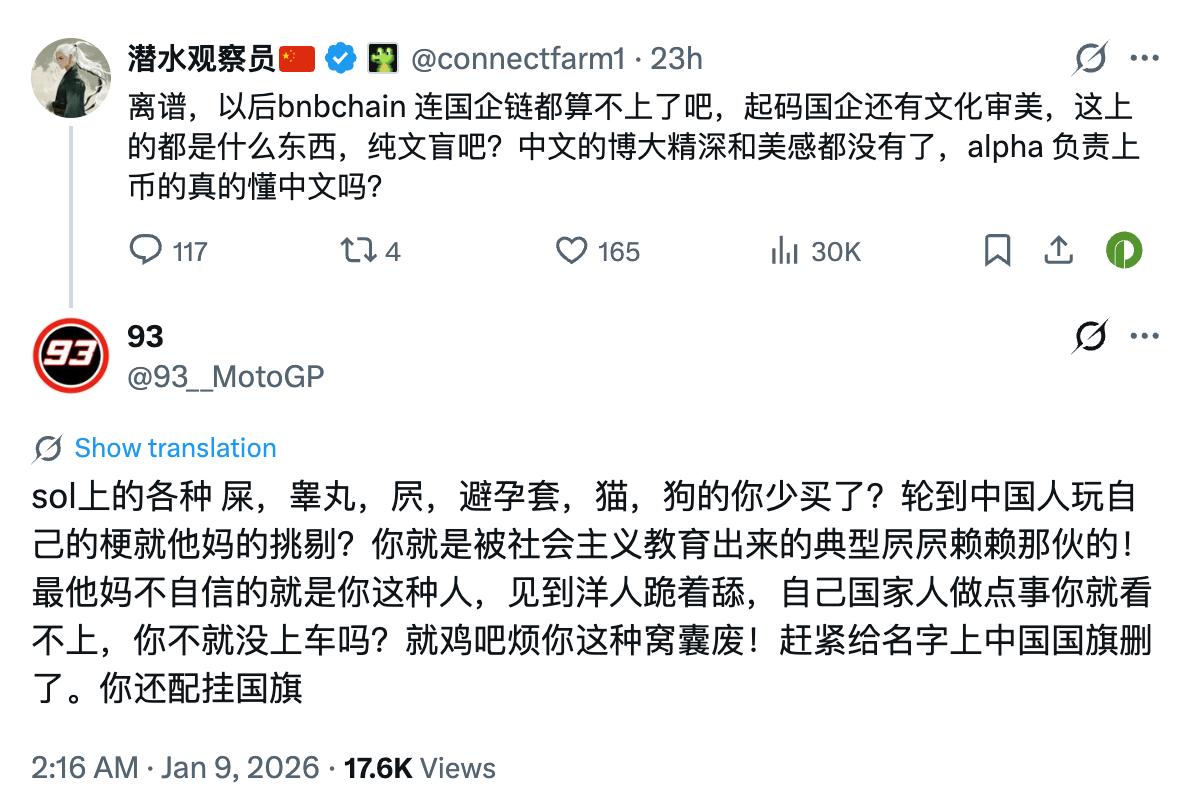
Subsequently, the diving observer posted another article clarifying that the above remarks were not directed at traders, but only at some people who believe that toilet humor can also reflect national self-confidence.
Crypto KOL @0xyukaz also posted, stating , "Binance's listing strategy will only lead to the decline of BSC and severely damage the genuine Chinese memecoin culture." The criticism directly accuses Binance's listing team of blindly relying on memes created by CZ and He Yi Yi to artificially boost the launch and price of Memecoin. This view was also commented on by OKX CEO Star, who believes that "compared to 'I'm coming,' 'I'm coming through the snow' is more civilized and better."
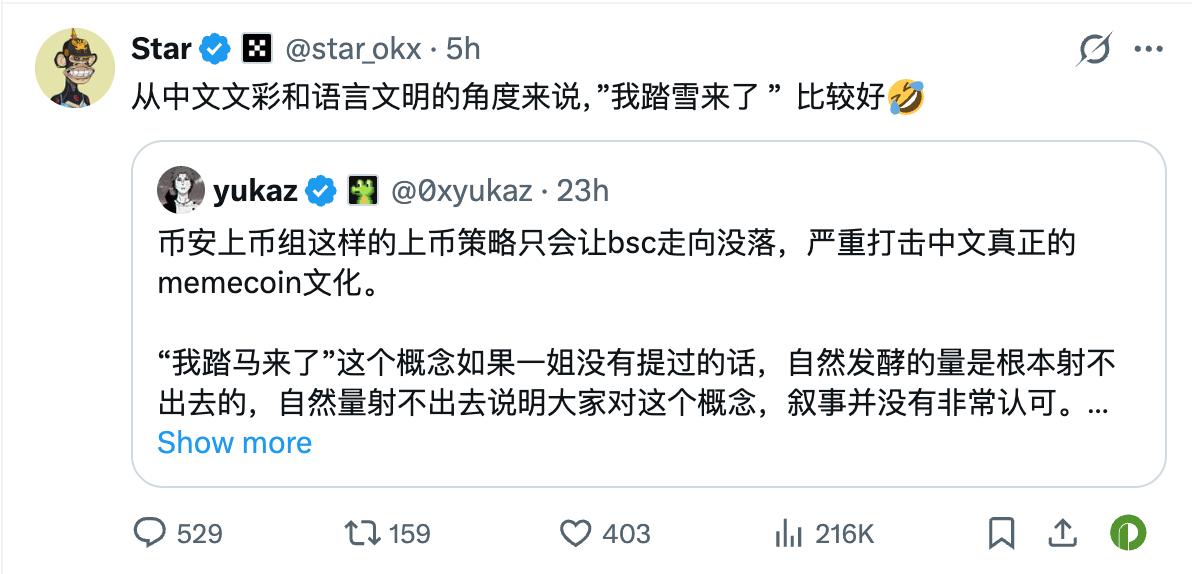
Following the lukewarm debate over whether "I'm here now" was good or bad, the market was flooded with Chinese memes that strongly reflected Binance's leadership, such as "Mom," "Dad," "Son," and "Grandson." Leaving aside the merits and demerits for now, let's discuss some more fundamental and in-depth topics.
From Meme Coin to Niche: Binance's Dilemma and What It Has to Do
To discuss the present, we must first talk about the past.
In September 2024, we discussed the changing trends in the Meme coin market in our article "Neiro and NEIRO Listed on Binance: A Turning Point for the Meme Coin Sector?" At that time, Binance simultaneously listed both uppercase and lowercase NEIRO/Neiro Meme coins, sparking heated discussions in the market. From then on, or even earlier, starting in March 2024 with BOME's "listing on Binance in 3 days", the Meme coin craze had already become unstoppable.
Faced with this market environment, regardless of its intentions, Binance seems to have many choices, but in reality, there is only one path— to join the Meme coin craze and boost platform trading activity, new users, and high-frequency trading. This is determined by Binance's industry ecosystem as the largest centralized exchange.
Just like the three essential elements for internet platforms (Odaily Odaily note: new users, usage time linked to advertising resources, and conversion rate linked to user consumption) , CEXs also need a continuous stream of new users (i.e., liquidity), more platform fees collected through high-frequency trading (i.e., platform business model), and a supply of projects based on the former two (i.e., newly listed tokens). Meme coin, with its large quantity, rapid updates, and high liquidity, naturally takes the lead.
So the question becomes: for Binance, is it better to launch its own internal ecosystem's Meme coin, or to provide a platform for external ecosystems or even competitors' related Meme coins to be "fed" and have their liquidity harvested? The answer is self-evident.
Perhaps it was from that time that Binance began its subtle but significant "Meme coin empire development"—from Binance Wallet to Binance Alpha; from its partnership with the Four.meme platform to last year's Meme Rush leaderboard. Since then, through a series of feature updates and ecosystem development, Binance has gradually built its own complete chain of "coin issuance-listing-Alpha-contract-spot trading," injecting new vitality into its platform profitability and CEX development.
Therefore, CZ and He Yi's frequent pronouncements on Meme coins, Binance's development, and BNB price, starting from the launch of the two Meme coins NEIRO/Neiro in the name of supporting the community, were inevitable.
As the famous saying goes, "If you don't occupy the battlefield of public opinion, the enemy will." In the crypto market where liquidity is king, "If you don't fight for the liquidity of Meme Coin, it will naturally flow into the pockets of your competitors."
Of course, in contrast, CZ and He Yi's every word and action will be amplified by the market and distorted attention. In the atmosphere of clamor and praise, the two inevitably feel more or less "enjoying being in the center of the stage and having the power of life and death".
In this respect, Binance differs significantly from L1 and L2 public chains such as Solana, Base, and Sui, which are more focused on infrastructure construction. Binance is not just a centralized exchange (CEX), but also a business complex that, together with BNB Chain (BSC ecosystem), BNB token, and community, relies heavily on CZ and He Yi public pronouncements to achieve "only growth, no stagnation." The inherent profit-seeking nature of CEXs further amplifies the market influence and meme effect of CZ and He Yi Yi.
After all, compared to the Solana ecosystem, with its throngs of Devs, abundant Memes, and a natural breeding ground for Meme coins—an "open and fertile ground"—the Binance and BSC ecosystems are relatively distorted, characterized by a high concentration of attention and liquidity—a "platform-type ecosystem." Therefore, the BSC ecosystem's current state of being considered one of the "two holy grails" is both accidental and inevitable.
In conclusion: With great power comes great responsibility; every achievement comes at a price.
For Binance and BNB Chain (BSC ecosystem), having embarked on this "individualistic" development path, they naturally have to bear the criticism and centralization that come with it. The pressure behind this is naturally on Binance's listing team and the Binance exchange, since this is the final destination of liquidity. And if they want more transaction fees and more casino players, they naturally don't need to distance themselves from it.
Finding a balance between market reputation and commercial interests, and ensuring that the frequent pronouncements by CZ and He Yi do not negatively impact Binance's own exchange, the restart of Binance's US operations, and the normal development of BSC ecosystem Meme coin and other projects, depends on the negotiation, communication, and compromise between the personnel organization and key figures.
Otherwise, if those who are dedicated to their work never receive the same rewards as those who flatter and fawn, then demoralization will inevitably occur.
Once morale is low, it becomes difficult to lead the team.