Foreword: When computing power is no longer the sole measure of performance
In 2026, the evaluation system for the Bitcoin mining industry is undergoing a dramatic transformation. Simply having "hash rate" is no longer the sole criterion for determining market capitalization. The capital market is looking for two types of targets: giants like Core Scientific that have successfully transformed into AI companies, and miners like CleanSpark that relentlessly pursue efficiency.
Beyond these prominent giants, Cango represents a third, atypical survival example. This article will combine Digital Mining Solutions' latest "2025 Bitcoin Mining Market Review" (hereinafter referred to as the "2025 Annual Report") to conduct an in-depth comparative review of three representative companies—MARA, CLSK, and CORZ—with Cango, analyzing the differences in their underlying business logic and significant pricing discrepancies.
I. Asset Expansion Model: Heavy Sword Without Edge vs. Guerrilla Tactics
In terms of computing power acquisition cost (CAPEX), the industry has diverged into two distinct paths.
1. The asset-heavy approach: CleanSpark & Riot Platforms
● Core Strategy: "Buy new, not old; build your own, not lease." CLSK and Riot tend to invest heavily in building large-scale mining farms and purchasing the latest S21 or XP series mining machines.
● Advantages: Extremely high energy efficiency ratio (low J/TH), long-term operational stability, and highly favored by institutional investors.
● Disadvantages: Extremely high capital expenditure (CAPEX). The cost of new equipment is typically $15-$25 per TH, which leads to a longer return on investment (ROI). Once the price of the coin stagnates, the huge depreciation pressure will eat into profits.
2. Value arbitrage: Cango
● Core Strategy: "Supply chain leverage for extremely low-cost expansion".
○ Low-cost asset accumulation: Cango did not blindly chase after new machines with extremely high premiums. The 2025 annual report specifically pointed out that Cango quickly entered the first tier of the industry by acquiring second-hand mining machines, obtaining computing power at an extremely low cost (about $8/TH), thus building a natural safety net compared to its peers.
○ Dynamic Upgrades: Cango does not always use old machines, but adopts a "Refresh" strategy. For example, in Q4, it upgraded its computing power from 6 EH/s to S21, only paying the price difference.
● Comparison Conclusion: CLSK excels in efficiency, while Cango excels in cost-effectiveness per unit of computing power. In today's highly competitive environment, Cango's unique "asset-light" model offers greater resilience against risks.
II. AI Transformation Path: International Freight Hubs vs. Same-City Express Delivery Networks
With mining revenue halved, AI has become a battleground for mining companies. Data from 2025 annual reports shows that companies with clear AI/HPC revenue streams significantly outperformed pure mining companies in terms of stock price. However, in this arena, Cango and the giants have chosen drastically different entry points.
1. Core Scientific: International Freight Hub
● Business Model: CORZ has signed a huge contract with CoreWeave to build Tier 3/4 level hyperscale data centers.
This is like building a massive "international airport cargo terminal." It is specifically designed to serve "giant containers" (large model training tasks), with an astonishing throughput. However, this type of infrastructure has extremely high requirements for runways and control towers (dual power supply, ultra-high redundancy), a construction period of several years, and a financial threshold of billions of dollars. Once completed, it becomes an irreplaceable core hub.
● Valuation Logic: The market views it as "core infrastructure" and gives it a very high premium because it controls irreplaceable and scarce resources.
2. Cango: Same-city express delivery network
● Business Model: Cango avoids the red ocean of building "airports" and chooses to focus on the long tail of "AI inference". Through low-cost and ultra-fast AI transformation, it converts scattered mining farms around the world into decentralized AI nodes.
This is like building a dense network of "same-city forward warehouses" or "ultra-fast delivery networks".
○ Flexible transformation: There is no need to build expensive airport runways. Instead, existing community sites (mining farms) can be used for simple power and network upgrades to achieve plug-and-play functionality.
○ Handling small packages: It does not transport giant containers, but is dedicated to handling massive amounts of "small packages" (reasoning requests and real-time response tasks for small and medium-sized enterprises) at high frequency and speed.
○ Intelligent scheduling: Through a middleware platform, scattered computing power around the world can be scheduled in the same way as dispatching deliverymen to form a distributed network.
● Comparison Conclusion: CORZ operates on "heavy infrastructure," earning profits from expensive tolls, but it's too cumbersome and slow; Cango operates on "last-mile logistics," earning profits from high-frequency turnover and flexibility. On the eve of the explosive growth in AI inference demand, Cango's "express delivery" model, which can quickly respond to the needs of SMEs, has gained a head start in terms of speed and reach.
III. Market Perception and Shareholding Structure: Crowded Trading vs. a Wasteland of Understanding
If fundamentals determine the long-term floor, then market perception biases determine short-term explosive potential. The institutional holdings data disclosed in the 2025 annual reports reveal the most striking contrast.
1. Wall Street's darlings: MARA & IREN
● Current situation: “Crowded transactions”.
○ Data: MARA has 484 institutional holders, and IREN has 433.
○ Logic: Almost all funds focusing on crypto or AI have already allocated funds to these leading companies. Their information is completely transparent, and expectations have already been fully priced into the stock price. To drive the stock price up further, extremely impressive earnings exceeding expectations are needed.
2. The Forgotten Corner: Cango
● Current situation: "A wasteland of cognition".
○ Data: Despite ranking among the top five globally in computing power (50 EH/s), Cango only has 35 institutional owners.
○ Logic: This means that the vast majority of institutional funds have not yet covered this company. This extreme information asymmetry is often the source of excess returns.
○ Catalyst: As Cango's AI business begins to be disclosed, or its Bitcoin holding value is re-examined, even if only a small amount of institutional funds begin to "fill the gap," it could have a huge marginal pricing impact on such a low-liquidity, low-valuation target.
○ Comparative Conclusion: Investing in MARA is following the consensus and earning industry beta; investing in Cango is anticipating cognitive repair and betting on the alpha brought by institutional entry.
IV. Summary: The Investor's Choice
Finally, let's return to the core valuation logic.
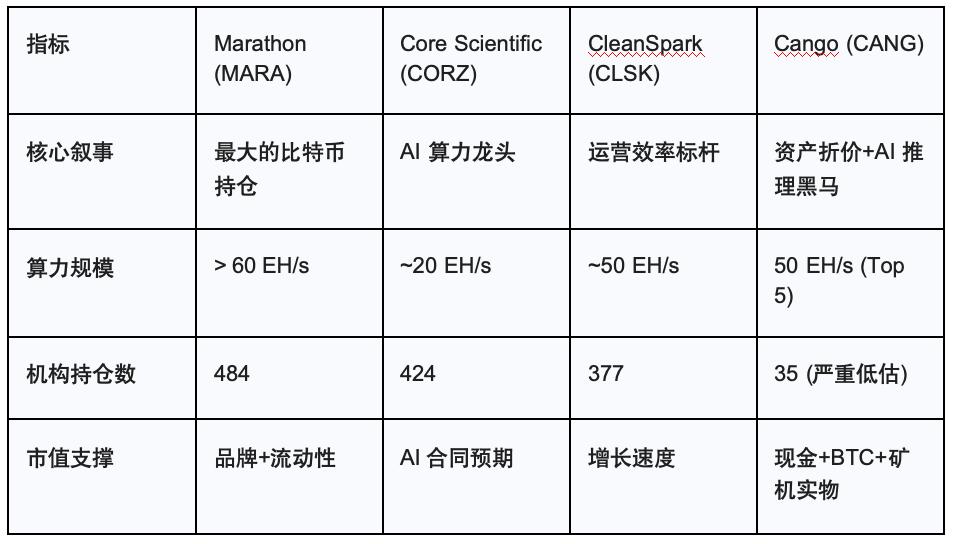
In-depth review:
The market's current pricing of CORZ and MARA includes an extremely high "expectation premium." Meanwhile, Cango's market capitalization is even lower than its on-paper "hard assets" (BTC holdings + mining equipment + cash - debt).
This means that the market has not yet given any positive valuation to Cango's 50 EH/s computing power and Tier 2 AI transformation.
Investment advice:
● If you believe in the herding effect of funds and pursue absolute liquidity and industry beta, MARA is still the first choice.
● If you are optimistic about the certainty of a breakthrough in AI training and don't mind a high valuation, CORZ is the purest target.
● However, if you are a value investor looking for high-odds targets with a solid asset base and the potential for AI transformation, then Cango clearly offers a very attractive entry point under the current pricing system.