In January 2024, Bitcoin spot ETFs were officially approved.
For the crypto industry, this is a milestone moment that has been awaited for more than a decade, and the news quickly captured the attention of the global financial market.
Two years have passed in the blink of an eye, and Bitcoin spot ETFs are no longer a new topic. A set of solid data is quietly reshaping the market's understanding of this asset class.
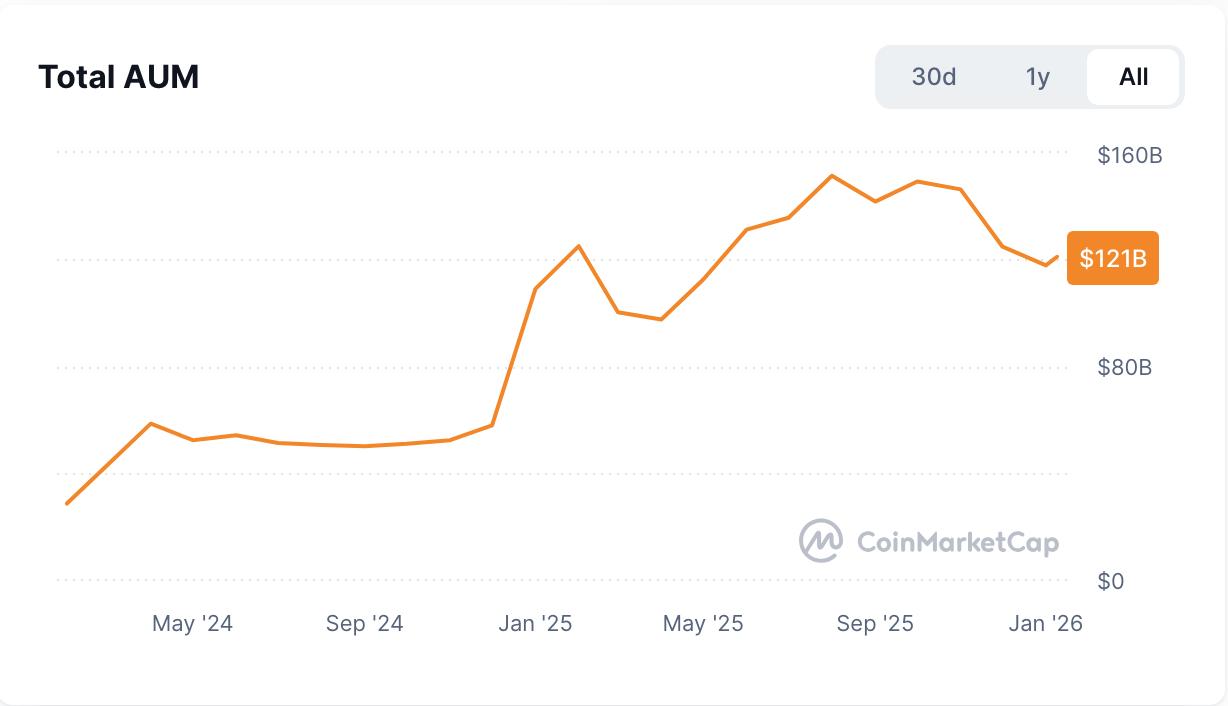
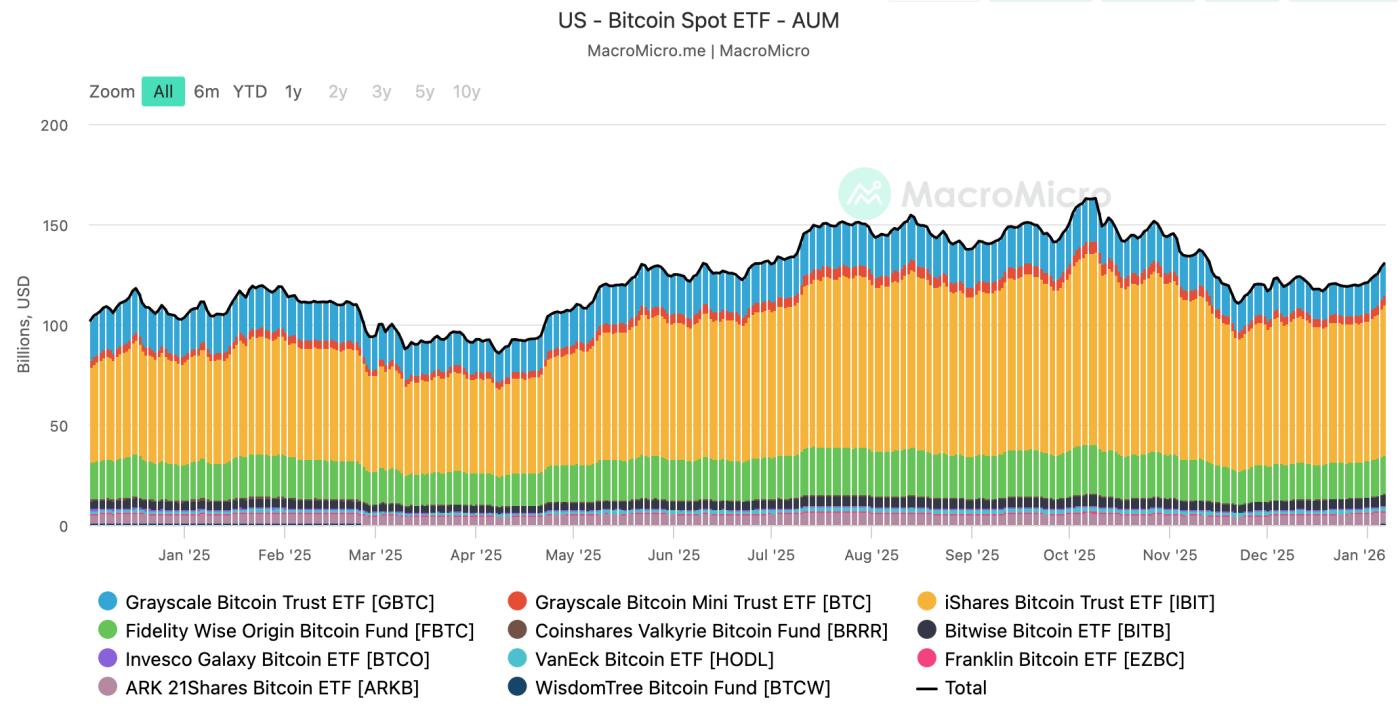
As of now, the total assets under management (AUM) of Bitcoin ETFs have climbed to $124.85 billion. The leading effect is extremely pronounced: IBIT ($74.11 billion), GBTC ($16.4 billion), FBTC ($18.89 billion), ARKB ($5.81 billion), and BITB ($5.35 billion) collectively manage $120.56 billion in assets, accounting for 96.6% of the overall market, clearly outlining a market structure dominated by institutional investors.
The trading activity also exceeded expectations. According to data from The Block, the cumulative trading volume of US spot cryptocurrency ETFs officially surpassed $2 trillion on January 2nd. Looking back at this process: it took a full 16 months to first reach $1 trillion on May 6th, 2025; however, it only took 8 months to go from $1 trillion to $2 trillion, more than doubling the growth rate. BlackRock's IBIT remains firmly in first place, accounting for a staggering 70% of the trading volume.
The divergence in fund flows is also very clear. In 2025, US spot Bitcoin ETFs accounted for the majority of net inflows into the cryptocurrency ETF market, significantly outperforming Ethereum ETFs and further solidifying Bitcoin's dominant position in the crypto ETF sector.
If the approval of a Bitcoin ETF symbolized Bitcoin's formal entry into the mainstream financial system, then these figures prove that it has become a structurally significant asset in institutional investment portfolios. Behind these numbers lies not only a leap in scale, but also institutional recognition: Bitcoin is integrating into the regular operating framework of the global financial system at an unprecedented pace.
The History of Bitcoin ETFs: A Breakthrough That Was No Accident
The launch of Bitcoin spot ETFs is not a sudden act of institutional goodwill, but the result of a long-term game.
Prior to 2024, the core concerns of regulators regarding the application and rejection of Bitcoin ETFs consistently focused on three points: whether the underlying market was mature and whether manipulation could be effectively prevented; whether the asset custody, clearing, and auditing mechanisms were reliable; and whether the investor protection system was complete. These issues were not related to the value judgment of Bitcoin itself, but rather to the institutional hurdles that any asset must overcome to be included in the formal financial product system.
Tracing back the timeline, the demand for Bitcoin ETFs can be traced back to 2013. At that time, Bitcoin prices began to enter the public eye, and some investors and brokerages found that ordinary investors had difficulty directly accessing this emerging asset within a compliant framework, thus giving rise to the earliest concept of a Bitcoin ETF. However, for many years afterward, the U.S. Securities and Exchange Commission (SEC) consistently rejected related proposals, repeatedly citing three core reasons: market manipulation risk, custody security, and information transparency.
It wasn't until October 2021 that the SEC finally relented and approved the ProShares Bitcoin Strategy ETF (BITO), a Bitcoin-related ETF product. However, this product is anchored to futures contracts and is not a true spot ETF; it is more like a regulatory test.
The real turning point came on January 10, 2024. The SEC approved 10 Bitcoin spot ETFs in one go, including BlackRock, Fidelity, Grayscale, Ark Invest, and Invesco. This decision marked the official entry of U.S. crypto asset investment into the spot ETF era and became the most important institutional connection between the traditional financial system and crypto assets.
The arrival of this moment was no accident. By 2024, the infrastructure surrounding Bitcoin, including trading systems, custody mechanisms, compliance frameworks, and information disclosure standards, had developed to a stage acceptable to regulators. The emergence of ETFs is essentially the financial system's recognition and response to this market maturity.
From a longer-term perspective, this is by no means the end of Bitcoin's financialization, but rather a clearly visible and officially confirmed stage in its financialization process.
Beyond Gold: Bitcoin ETFs Accelerate
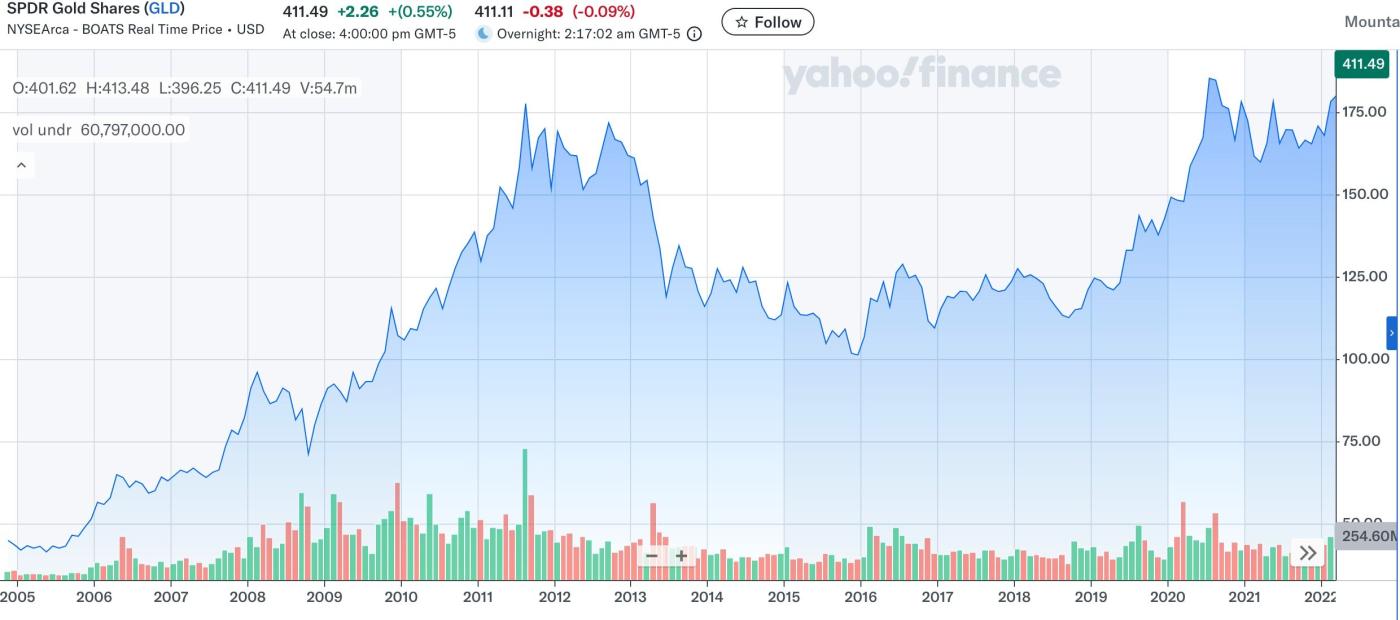
In 2004, the SPDR Gold Trust ETF (GLD) was approved, becoming the first physical gold ETF in history. At that time, the global market value of gold was approximately US$1 trillion to US$2 trillion. Subsequently, driven by ETFs and related financial instruments, the financialization of gold began to accelerate. By 2025, the global assets under management of gold ETFs had climbed to US$559 billion, while the average daily trading volume of the gold market reached approximately US$361 billion, both setting new historical records.
Given this history, when the Bitcoin spot ETF was approved in 2024, many market participants naturally compared the two. Everyone shared a similar question: Could the ETF once again act as a "catalyst," injecting unprecedented liquidity and vitality into the Bitcoin market?
Now, two years later, the Bitcoin ETF has provided a clear answer.
According to Chainalysis, the pace of fund flows into Bitcoin ETFs has surpassed the early-stage inflow rate of the first net gold ETF (inflation-adjusted) launched in 2005.
Since the launch of gold spot ETFs, not only has the size of the ETFs themselves increased rapidly, but they have also boosted the activity of the entire gold ecosystem: the trading volume of spot, futures, options and even various derivatives markets has achieved exponential growth in the following years.
This journey provides a vivid reference for understanding the potential impact of Bitcoin ETFs. It confirms that ETFs, as a financial medium, inherently possess a certain "leverage effect," which can rapidly improve asset liquidity and attract broader market participation.
Therefore, Bitcoin ETFs are not simply following the same path as gold. They demonstrated faster market acceptance and received a more enthusiastic response from investors in a shorter period of time.
The significance of ETFs: an accelerator of financialization.
In the past two years, spot Bitcoin ETFs have promoted the financialization of Bitcoin on multiple levels.
First, the methods of participation have been institutionalized.
Spot Bitcoin ETFs offer investors a regulated and standardized pathway to participation, significantly lowering the technical and operational barriers. Investors can participate in price fluctuations without directly holding, storing, or managing Bitcoin, making Bitcoin investment more aligned with mainstream financial market practices.
Second, the investment process has been greatly simplified.
Investors can buy and sell Bitcoin ETF shares through market orders or limit orders, just like trading stocks or other ETFs. This improves both convenience and security, making it easier to incorporate Bitcoin into regular investment portfolios.
Third, Bitcoin's acceptance as a mainstream asset class continues to increase.
The rise of spot Bitcoin ETFs has significantly enhanced market recognition of Bitcoin as an independent asset class, gradually moving it from within the crypto market into the mainstream asset allocation and wealth management discussion framework, and beginning to appear in some long-term investment and retirement planning scenarios.
Fourth, institutional capital and participation in global markets have been systematically opened up.
The participation of top global asset management institutions, including BlackRock and Fidelity, has transformed Bitcoin ETFs from symbolic compliance products into a crucial entry point for institutional funds into the crypto market. Meanwhile, the rollout of spot Bitcoin ETFs in markets such as the US and Hong Kong indicates that this financialization process is spreading globally.
Structural Challenges and Diversified Participation Paths Under Accelerated Financialization
The rapid development of Bitcoin ETFs has significantly accelerated the financialization of Bitcoin, but it has also amplified some long-standing structural challenges.
First, from a market perspective, spot Bitcoin ETFs remain directly exposed to the high volatility of Bitcoin itself, and rapid price changes can lead to short-term valuation fluctuations. At the same time, the management fees and operating costs of ETFs will also affect the investment return structure in the long run.
More importantly, the high degree of financialization represented by ETFs is a double-edged sword. On the one hand, it significantly amplifies the market liquidity and participation scale of Bitcoin; on the other hand, it can easily lead the market to focus more on the price performance at the financial product level, thereby ignoring the fact that the Bitcoin network itself still requires continuous investment in computing power and infrastructure construction to maintain its long-term security and stability.
From an investor's perspective, participation in Bitcoin is not limited to price-based trading and holding. In addition to profiting from price fluctuations through spot trading, spot ETFs, or trading strategies, cloud computing power offers another approach: participating in Bitcoin by locking in costs and generating stable returns.
Through cloud mining, investors can lock in computing power and costs in advance, obtaining a relatively stable output of Bitcoin over a certain period. This model is essentially equivalent to locking in the cost of acquiring Bitcoin for a future period in advance, enabling investors to establish a more controllable cost structure and return expectations in a market with large price fluctuations, and also providing another possible path to outperform spot prices over a period of time.
At the same time, this approach allows individual funds to continue participating in the Bitcoin network's computing power system, rather than just remaining at the level of price-based financial transactions. Cloud computing power is both a way to acquire Bitcoin and a form of continuous support for the network infrastructure. Against the backdrop of increasing financialization, it preserves a richer and more diverse participation structure for the market.
As Bitcoin continues to integrate into the global financial system, different levels and forms of participation will collectively form an important foundation for its long-term operation and development.

Conclusion
Two years is enough time for a new financial product to undergo a full market test. The journey of the Bitcoin spot ETF clearly tells us that Bitcoin is entering the mainstream financial arena much faster than most people initially imagined.
But this is clearly not the end. ETFs are more like a beacon that has been lit, making the path to the financialization of Bitcoin clearer and indicating that more institutionalized forms will emerge in the future.
In the future, Bitcoin will continue to evolve across financial markets, technological systems, and infrastructure. Different forms of participation will collectively shape its long-term position within the global financial system.
Two years is just the beginning. The journey continues, and the truly worthwhile new chapter may have just been turned.