Original title: Where DeFi Goes From Here
Original author: @0xKolten
Compiled by: Peggy, BlockBeats
Editor's Note: DeFi is once again approaching its all-time high, but has yet to make a significant breakthrough. This reveals not a lack of products, but rather a bottleneck in user growth. The expansion of stablecoins, interest-bearing stablecoins, and RWA indicates that the demand for putting funds on-chain and earning yields remains strong; it simply hasn't been truly brought to the mass market yet.
This article argues that the next step for DeFi lies not in more complex structures or speculative designs, but in simple, secure, yield-centric products and user-friendly usage and distribution methods. A new growth cycle can only truly begin when DeFi starts targeting fintech users, rather than just serving the crypto-native population.
The following is the original text:
status quo
In 2025, the total value locked (TVL) in DeFi reached a new all-time high, but it wasn't significantly higher than the peak in 2021. As the market gradually cools down, a question worth re-examining is: where will the next wave of funds and users come from?
Fueled by the DeFi Summer, TVL (total value) climbed to $204 billion by the end of 2021. Subsequently, with the collapse of events like FTX and the market entering a bear market, the fund size declined steadily. DeFi then experienced a difficult recovery, reaching $225 billion in October 2025. However, this represents only about a 10% increase over four years, hardly explosive growth. Those who participated in DeFi earliest—primarily crypto natives and traders—may have already approached their "ceiling."
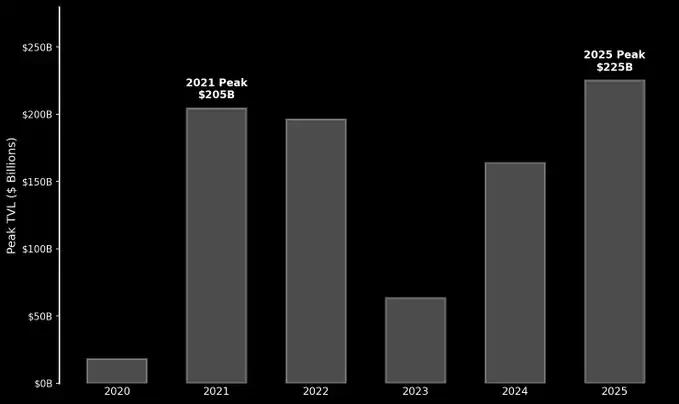
The fact that the two peaks are so close is certainly cause for concern, but it doesn't yet constitute an "existential crisis." The current user base—despite being highly engaged and loyal—is not large enough to propel DeFi to the next level.
For DeFi to achieve a breakthrough, it needs to reach a much larger audience. The good news is that such an audience does exist—it's just currently off-chain, waiting to be truly "guided onto the blockchain" by the right tools and products.
A glimmer of hope
The stablecoin market has been one of the biggest beneficiaries over the past year. On-chain USD has reached an all-time high, an unprecedented amount. USDT and USDC have continued to grow steadily, with their combined market capitalization exceeding $260 billion—meaning that the size of stablecoins alone is larger than the entire DeFi market.
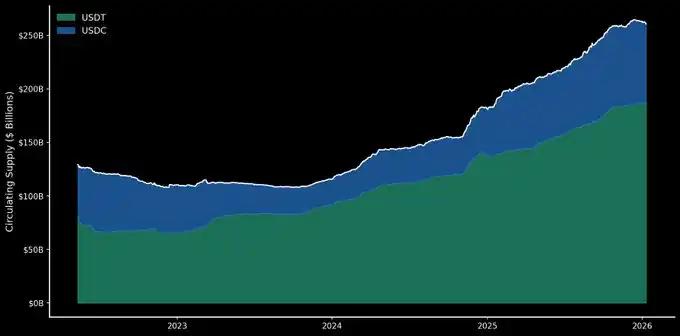
Even without the parabolic growth seen in DeFi, the continued minting of stablecoins demonstrates the strong demand for moving funds on-chain. Simultaneously, the increasing number of users earning yields from DeFi points to potential sources of growth in this sector.
The rise of interest-bearing stablecoins and RWAs (Real-World Assets) further confirms this trend. According to data from @stablewatchHQ, the market capitalization of interest-bearing stablecoins has exceeded $20 billion, with products like sUSDS and sUSDe gaining significant adoption over the past year or so. Alongside interest-bearing stablecoins, RWAs are also making on-chain progress: these products are backed by traditional assets such as government bonds, offering real yield and experiencing rapid growth.
The problem is that they currently primarily serve crypto natives and large on-chain users. As long as this is limited, their potential will be underestimated. If they can be productized and packaged in a way that is more accessible to everyday users, interest-bearing stablecoins and RWA have a huge opportunity in the mass market.
Retail investors have not yet arrived.
To understand the magnitude of this opportunity, consider comparing DeFi with FinTech. Currently, the total TVL (Value at Leverage) of DeFi is approximately $164 billion. In contrast, global mobile fintech applications manage over $2 trillion in customer assets; the top 100 neobanks alone hold $2.4 trillion in assets. By comparison, DeFi currently represents a negligible fraction.
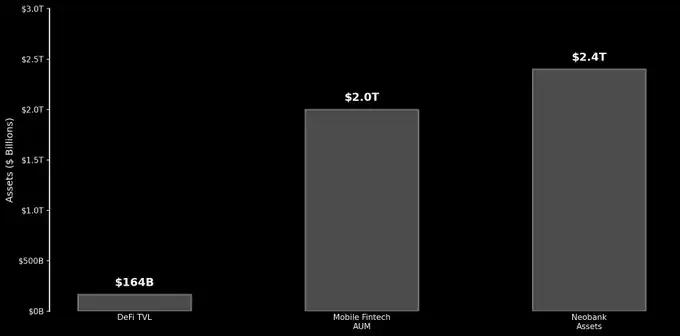
The idea that "build the product and people will come" has limited growth potential. If DeFi wants to continue expanding, it must attract the ordinary users who made fintech so massive.
The success of protocols like Aave, Ethena, and Pendle in 2025 has demonstrated the strong demand for returns among market participants. They were the highlights of their time, attracting significant funding and attention. If such products can be made accessible to the general public in a clear, easy-to-understand, and low-barrier-to-use manner, then trillions of dollars and tens of millions of potential users will be at stake.
Path of Progress
The real test for DeFi in the coming year lies in whether it can make yield opportunities easily and securely accessible to ordinary people. Growth won't come from more complex financial structures, the 100th mining pool, the 100th perpetual contract DEX, or the millionth airdrop. Growth will come from simple, reliable products—based on decentralized protocols—that solve real problems for ordinary people. And yield should be at the center stage (cough, Aave App, cough).
Today, hundreds of millions of people use banking and fintech apps daily, and they are already accustomed to managing their funds on their phones. If DeFi can capture even a small share of this, it would be enough to trigger a new wave of growth, and it wouldn't once again stagnate at the $200 billion TVL level.
Embedded DeFi will play a significant role – fintech companies and new types of banks will directly integrate on-chain yield capabilities into their products. But teams shouldn't stop there. Protocols that are truly consumer-facing and ahead of the curve will capture the greatest upside potential; while projects that continue to optimize solely for crypto native users will ultimately be fighting for a pie that may no longer expand.
DeFi will win.