


Two weeks ago, Lighter TGE allowed many people to witness a new "wealth creation story".
According to community statistics, Lighter's airdrop ranks 10th in cryptocurrency history, with a total value of $675 million. Social media is flooded with screenshots showing off profits: some people turned a few thousand dollars into a five-figure airdrop, while others received ten times their expected returns due to early engagement. Although the project team conducted a rather harsh "Synonyms purge" before the snapshot, most early participants and users still reaped the benefits.
Currently, the price of $LIT is stable at around $2.5-$3 USD. Although it has not replicated the crazy price of Hyperliquid and Aster during their time on TGE, Lighter's success has undoubtedly added fuel to the fire in the Perp DEX sector.
Behind this frenzy, the editors at BlockBeats were curious: how much did these users who achieved good returns actually invest? What were their strategies? BlockBeats BlockBeats interviewed three early Lighter users with completely different backgrounds and strategies. Their stories might provide some inspiration for your next batch of Perp DEX interactions.
Their costs and benefits
Chabusi (@mdzzi) is a name almost universally known in the Chinese Perp DEX community. As a major user of Hyperliquid, he was also the first tester and a leading user of Lighter in the Chinese region.
His connection with Lighter began during the testnet phase in September 2024, before Hyperliquid had even launched its token. "So I never thought about the Lighter airdrop; I just thought it would be fun," Chabusi recalled. At the time, he simply went to collect the testnet taps every day, received 500 USDC in test tokens, and started testing trading without spending any real money or investing much effort.
Chabusi even became the user with the highest transaction volume on the Lighter testnet. With such a simple operation, he earned more than 10,000 points after the testnet ended.
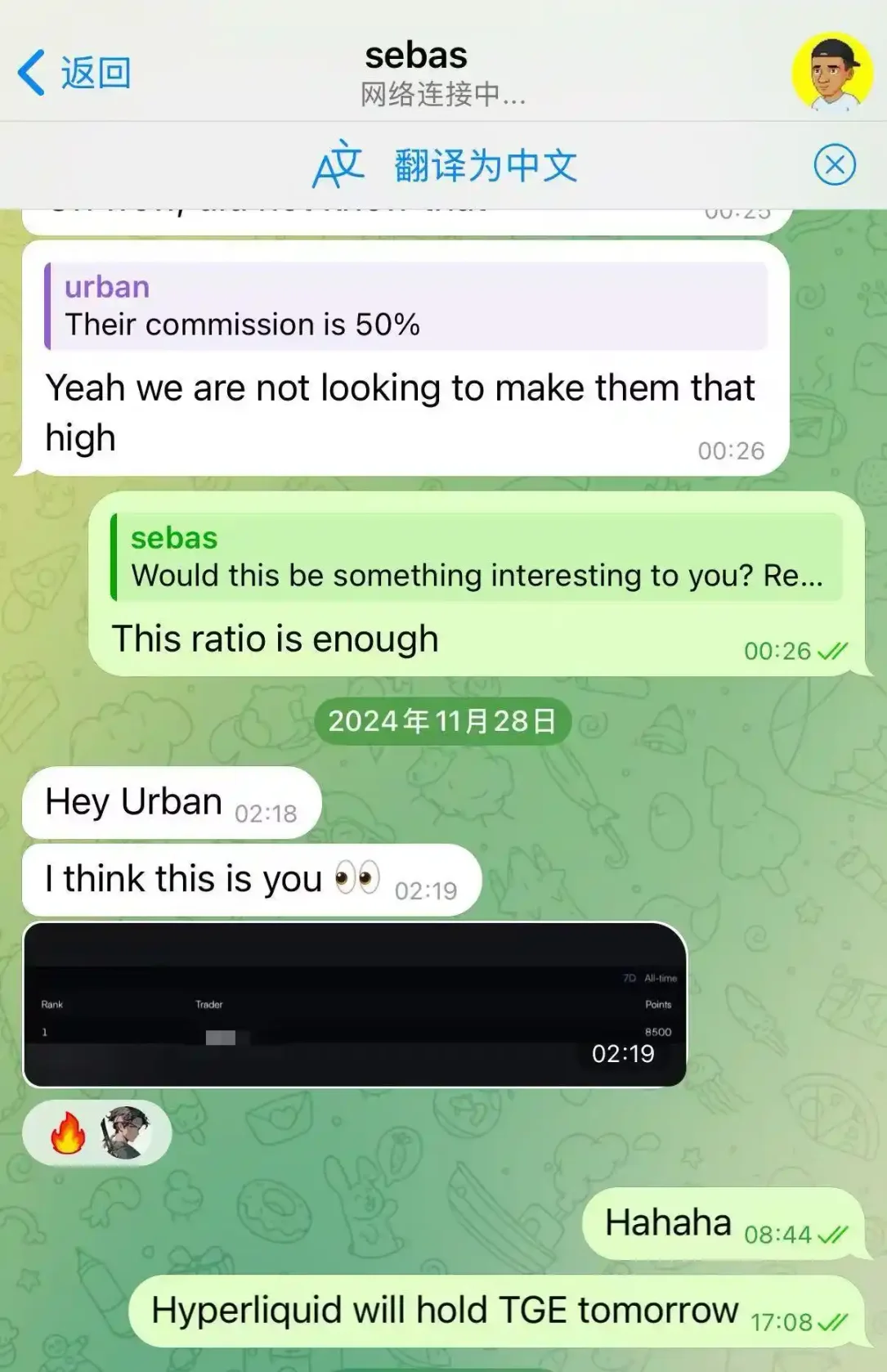
The image shows Sebas, a staff member of Lighter, sending a private message to Chabusi, asking if the account ranked number one was his.
Back then, Lighter was still a little-known project. Team members would often wait for everyone's output in various Spaces and would also actively contact active users on DM CT, both in the Chinese and English sections.
The connection between Chabusi and the Lighter team began at a Twitter Space in September 2024. Chabusi invited some well-known OGs from the Hyperliquid community to that Space, including NMTD, the Turkish tech mogul who later received nearly $100 million in airdrops, as well as active users from communities in South Korea and elsewhere, to discuss the future of Perp DEX and the development of Hyperliquid. "There weren't many people attending, only about twenty or thirty, but the Lighter staff were also listening and found our discussion very interesting."
After that Space event, the Lighter team contacted Chabusi to discuss the future of the Perp DEX track and their views on Hyperliquid. They even directly asked him if he would be going to Singapore to participate in TOKEN 2049 and if they could meet.
"I was quite wary at first, wondering why this person was so outgoing and whether he was a scammer," Chabusi admitted. His initial caution prevented him from engaging in deeper conversations. However, as he got to know them better, he discovered that the team was indeed working diligently and had a good background. In particular, their idea of combining ZK technology with Perp DEX piqued Chabusi's interest, leading him to become seriously involved in the project, communicating with the team about product details and offering suggestions.
After the testnet ended and the mainnet in alpha mode, Chabusi naturally became one of the first users to deposit real money to trade. "Actually, I had reduced my trading, maybe only made a dozen or so trades, but they gave me a lot of points." Most of his points came from the early days, and even though his participation decreased later, these early points still secured him a good share of the airdrop.
Interestingly, in January of this year, the Lighter team offered Chabusi a job, inviting him to take charge of Lighter's APAC marketing, but he declined. "On the one hand, the product experience was still relatively average at the time, there were few cryptocurrencies, and the market already had mature products like Hyperliquid, so everyone's attention was drawn to it."
Besides Chabusi, Jiufeite (@Dex_Jiufeite) is also a trader friend that the BlockBeats editor has known for a long time. In December 2024, after Hyperliquid launched its token and performed well in price, Jiufeite decisively sold a portion of HYPE and used the proceeds to continue trading on Lighter.
He started participating in Lighter in April 2025, when the project had just been launched and the points-earning efficiency was still quite good—"about one point for every two or three thousand transactions." He clearly remembers that the rule at the time was that you needed to accumulate 300 points to get your own invitation code, which became his first small goal for continued interaction.
Unlike many players who simply inflate their trading volume for the sake of airdrops, CoinFett had his own "trading system," the profits of which covered his costs on Lighter. Ultimately, CoinFett received 900 points. According to Lighter's distribution rules, 1 point corresponds to 20 $LIT, and at a price of $3, his airdrop was worth approximately $54,000.
Lighter is a zero-fee Perp DEX, leading many to believe that trading on Lighter is cost-free. However, Investor discovered that this doesn't mean trading is completely free: there are hidden trading costs such as spreads and slippage.
He observed that many people use scripts to batch hedge transactions to boost their scores, but they often overlook a key issue: "If all hedging is done with market orders, the slippage caused by delays may not be lower than the transaction fees." He specifically compared the overall execution costs of Lighter and several other DEXs and found that as market depth gradually decreases, the actual transaction execution costs increase significantly, especially for Altcoin with relatively small trading volumes on the Lighter platform.
Replicable interaction techniques, methods that ordinary people can use.
While the airdrop rules for each project are unique, the underlying logic for successfully landing airdrops is the same. Through in-depth conversations with these "veterans," we have summarized some universally applicable interactive experiences in the Perp DEX field. These methods are not only applicable to Lighter but can also be transferred to other potential airdrop projects.
Chabusi's advantage in Lighter lies in his "linear narrative" within the sector; he has focused on the Perp DEX sector since entering the industry. "I've watched this sector develop and benefited from its growth. As the sector's valuation has increased, my wealth has also grown." He admits that there's an element of luck involved, but more importantly, it's due to his continuous attention to and accumulated understanding of the sector.
"Back in September 2024, who could have known how good this thing would be? If I said I was optimistic about it back then, that would be hindsight. I was simply interested in the product, found the white paper interesting, and even talked to a friend from Tsinghua University who studies ZK to discuss the technical details."
This "not for the sake of exploiting" mentality allowed Teabus to seize the earliest opportunity. Therefore, Teabus suggests participating in low-cost, early-stage projects, exploring like prospectors in the gold rush. "If the cost is too high, it becomes gambling. Keep costs to a minimum, dare to explore what others haven't explored yet, and you might be pleasantly surprised."
This advice was actually quite useful for Lighter, because during the testnet phase, the Lighter team proactively messaged many users on Twitter to invite them to participate in the test, but many missed out because they were too wary. "Indeed, many people didn't expect that a team would use such an old-fashioned method of one-on-one private messaging for marketing. Actually, there are other projects that do the same thing; they might use their official accounts to send you private messages very early on, and then you miss out. There are quite a few cases like this," Chabusi said with a smile. "Everyone thought, 'How could such a good opportunity possibly come to me?' It's precisely this kind of thinking that caused them to miss out on the opportunity."
LeetCode can be considered a veteran in the Perp DEX field. He entered the crypto in 2016 and started trading contracts in 2018. From the earliest DYDX and GMX to later Aevo, Drift, Hyperliquid, and Lighter, he has tried almost all the mainstream products on the market, so it can be said that he pays great attention to product experience.
Hyperliquid is a prime example. Juffett initially tried it after seeing recommendations from other CT users, but what truly kept him was the product experience. "The on-chain transaction experience is exceptionally good. Compared to products like DYDX, Hyperliquid is truly exceptional. Although I had previously used Drift and Aevo on Solana, Hyperliquid's smoothness impressed me deeply."
This strategy of "only promoting products that are easy to use" allowed him to avoid wasting time on many low-quality projects. Good products not only offer a better user experience, but also often mean that the project team is more dedicated, resulting in a higher chance of success and greater value. "I never promote things I don't work on; I only promote projects that I have thoroughly experienced and confirmed to be good."
By selecting good products, thoroughly understanding the rules, and recommending them to friends, you can share the best solutions and earn commissions in the process. Friends are more likely to use his referral codes first, which is another major advantage of Jiufit in the Perp DEX sector. He doesn't simply send out referral links everywhere; instead, he has a very thorough understanding of the referral mechanisms of each platform.
"I'll tell you all the platform's mechanisms and rules, exactly what they are, no secrets." His logic is clear: no matter what, if you're going to use a particular project, there will always be the question of whose link to use. "So I'll tell you all the rules so you can find your optimal solution. You can get the best commission from me, and I can get the referral reward—a win-win situation."
Sell $LIT Or continue holding?
Regarding this airdrop, Chabusi has not yet sold any $LIT, and has even bought some himself: "I am quite optimistic about its roadmap. It's about doing L2 on Ethereum and then integrating DeFi projects like Aave into a unified account. This is probably more imaginative than Hyperliquid building its own DeFi ecosystem with its HyperEVM."
From a valuation perspective, he also made a comparison: "Hyperliquid is already very large, and doubling it again would be relatively difficult. But comparatively speaking, I think doubling $LIT shouldn't be a problem." Of course, he also emphasized that this was not investment advice. "After all, everyone's consensus is different, so it's hard to say. I'm not selling because my cost is very low, practically zero. But if you're thinking of buying, I think you should think twice."
Like Chabusi, Jiufei also believed that his interaction costs were minimal, so he did not sell his $LIT holdings. Based on his optimism about Lighter, he also opened some long positions on $LIT.
"The funds I used to trade other Perp DEXs later were mostly from Hyperliquid airdrops, and the $LIT from Lighter airdrops, I would sell and invest in the next Perp DEX." This strategy of "using airdrops to fund airdrops" allowed Investor to invest more freely in subsequent projects without worrying about losses.
Sam entered the game much later than Chabusi and Jiufeite. He started farming Lighter around September 2025. As a professional player in the farming studio, he was looking for new opportunities after finishing farming Aster, so they turned their attention to Lighter.
As a professional arbitrageur and airdrop hunter, Sam's strategy is the most aggressive; he basically sells as soon as he receives an airdrop. His logic is simple: since the initial purpose of participating was arbitrage, he should exit promptly after realizing the profits, rather than adopting an investor's mentality and betting on a price increase.
Sam's calculations showed that, assuming no margin call, a loss of $20-30 could earn them 1-2 points, covering slippage, spreads, hedging costs, and so on. In the OTC market, 1 point was worth about $55, and later even rose to nearly $100.
"In other words, we calculated that Lighter's ROI is about 2-3 times. Even though we didn't get involved early, there was still a clear arbitrage opportunity and a very suitable return on investment, so we decided to participate with a large amount of capital," Sam explained. This allowed him to obtain good returns even when he entered the project in the later stages.
"When I enter the market, I calculate the costs and returns, and my goal is to achieve 2-3 times my initial investment. Once I reach that goal, I exit without being greedy." The advantage of this strategy is that the risk is controllable, while the disadvantage is that it may cause you to miss out on subsequent surges. However, for professional short-term traders, a stable return is more important than betting on a big surge.
Looking for the next Alpha opportunity
Having mastered these skills, the next question is naturally: what other Perp DEXs are worth paying attention to and engaging with? We asked these three "veterans" what projects they were currently focusing on and received some interesting answers.
Chabusi is cautious about future opportunities in the Perp DEX sector.
"I probably won't pay much attention to Perpetual anymore, because Hyperliquid is already very mature and easy to use. With projects like Aster and Lighter, they've already captured 80% of the profits in this market." He believes that the users who enter the market later have been "very well filtered out," either those who missed out before or those who have already benefited and are continuing to use the existing products.
"This is actually a bit like the later Layer 2 phenomenon, a false data boom." Chabusi frankly admitted that he was a little worried about this phenomenon. When the expectation of airdrops in a track is over-consumed, most of the users who come in are just doing it for the sake of inflating the numbers, while the number of real users is decreasing, and it is becoming increasingly difficult for the project team to determine who are real users and who are just trying to get freebies.
His strategy shifted to finding new, untapped sectors. "Just like when Perp DEX first emerged, now we need to find the next area that hasn't been popularized by KOLs." This approach is indeed worth considering. When everyone is scrambling for one sector, the real alpha often lies elsewhere. The reason Perp DEX was highly profitable in its early days was precisely because there were few participants and the project team valued genuine users. Once it became a platform for everyone to artificially inflate their metrics, this advantage disappeared.
Unlike Chabusi, Jiufeit continues to focus on the Perp DEX track, but his selection criteria are very strict, and he only works on projects with obvious characteristics and advantages.
"EdgeX is great, the biggest reason being that it's very convenient for me to use during my commute to work." He valued the user experience of its mobile app, and the fact that it was incubated by the well-known market maker Arbor Group made him think it was a viable option.
In April of this year, Investor entered both Lighter and Variational, attracted by their respective strengths: Lighter's advantages are zero fees and extremely low latency, resulting in a truly excellent trading experience; while Variational adopts a unique Request for Quote mode instead of the common CLOB mechanism, with very obvious advantages and features that other platforms do not have.
Furthermore, what impressed me most about Extended was its tokenized vault, unified margin mechanism, future fiat currency deposit and withdrawal support, and vision to create a closed-loop trading ecosystem integrating prediction markets, spot trading, and lending. He also specifically mentioned the team's reliability, frequent document updates, and excellent trading experience on the product page. Detailed introductions to these Perp DEXs can be found in BlockBeats previous article: "After Lighter, the Next Batch of Perp DEXs Worth Trading".
In the relatively new field of Perp DEX, there are still many ordinary people who have the opportunity to gain substantial returns through early participation, continuous interaction, and rational investment. We also found that several interviewees actually provided several replicable paths for others.
Tea Without Thinking represents a deep, early-stage participant. It's not just about inflating metrics; it's about genuinely engaging with a sector, understanding the project, participating in the community, and even providing advice and feedback to the team. These users are often the first to discover good projects and are most likely to gain recognition and additional rewards from the team.
LeetCode represents a professional trading player. He has his own trading system, can support his airdrop costs through real trading, and has thoroughly researched referral mechanisms to earn rebates. The advantage of this type of player lies in sustainability; he won't lose everything due to the failure of a single project. His "using airdrops to fund more airdrops" strategy has created a positive cycle for him in this field.
Sam represents a professional arbitrageur. He precisely calculates costs and returns, achieving stable returns through arbitrage even when entering the market later in a project. The core competencies of this type of player are risk control, data analysis, and money management.
Who will be the next Alpha opportunity? There's no standard answer to that question. But by staying alert, curious, and rational, we might all be able to seize the next opportunity when it arises.
This article thanks the interviewees: Chabusi, Jiufite, and Sam.






