


Written by: Lawyer Liu Honglin
I've been quite busy with work lately and haven't been paying much attention to market trends. Yesterday, I opened a certain app and immediately saw a promotion for USD 1 , a stablecoin issued by the Trump family, which prominently displayed "20% annualized yield on flexible deposits".
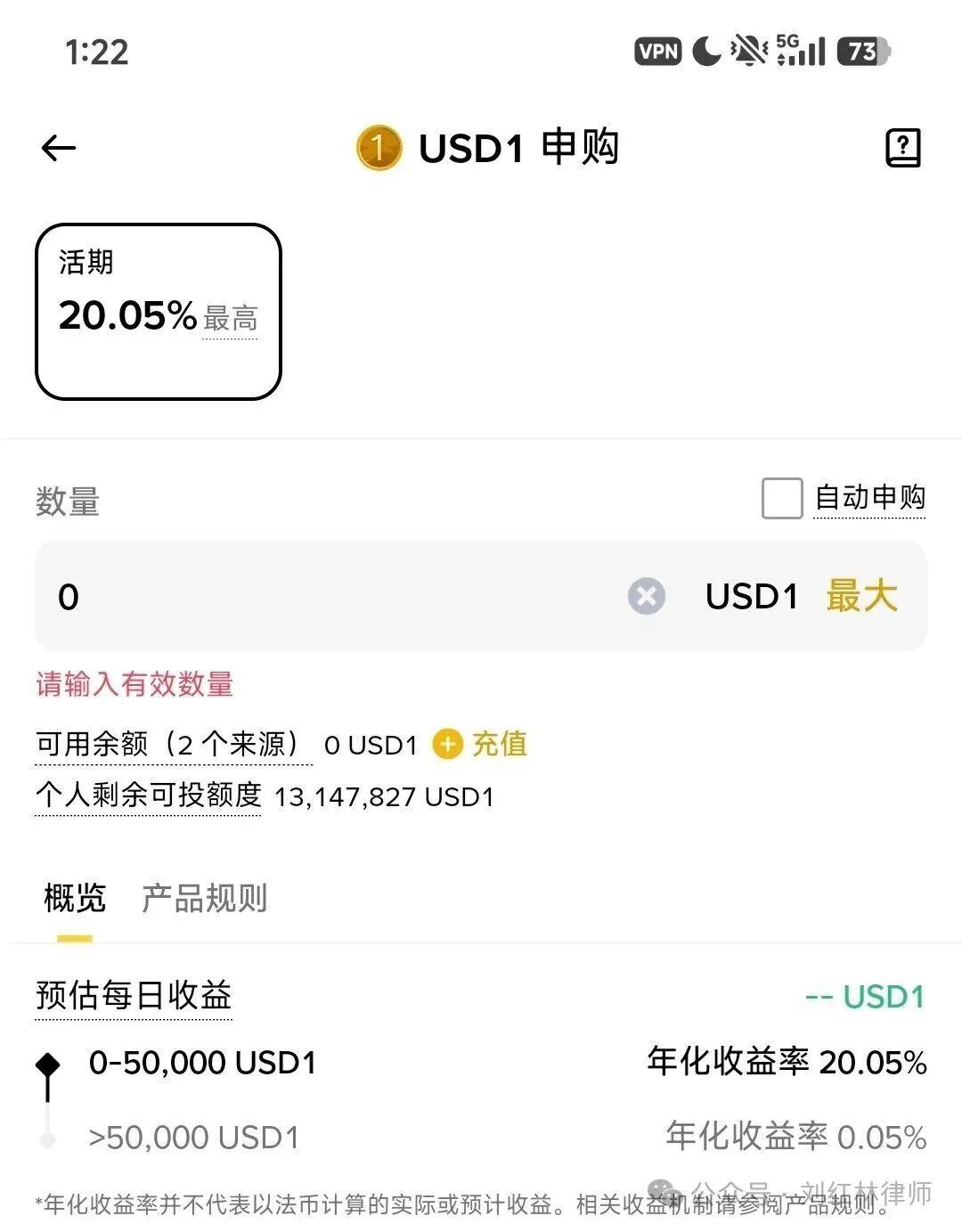
Recalling the recent 0.5% yield on digital yuan demand deposits, one can't help but lament how ruthlessly the American capitalist scythe has been wielded.
This reminds me of Circle's IPO in June 2025, when they also ran similar high-interest USDC giveaways on several platforms. Binance's strong recommendation of USD 1 suggests that CZ (Central Bank CEO) is once again trying to "pursue progress" in the US.
Of course, the purpose of writing this article today is not to gossip, but to talk about the essence behind the phenomenon. In the crypto world, similar stablecoin "high-yield airdrops" will continue to exist, but behind this is actually an unspoken cat-and-mouse game between global regulators and players in the stablecoin field .
What does this mean?
We need to understand a key context: Currently, whether it's the EU's MiCA Act or the US's "Stablecoin Clarity Act," the core logic of regulators boils down to one ironclad rule— stablecoin issuers are strictly prohibited from paying interest to users.
This is understandable. If Circle can directly pay USDC holders 5% of the government bond interest, then it becomes a de facto bank. How can traditional banks survive?
But the reality is that users' stablecoins are still earning interest, sometimes even dozens of times higher than bank deposits. Where does this money come from? It's actually a clever game of legal structure design.
Today, Attorney Honglin will examine, from the perspectives of legal compliance and business structure, how top players like Coinbase , PayPal, and Ethena manage to "legally" transfer money to users on the edge of the "no interest" rule.
Strategy 1: Coinbase & Circle – Turning “Stablecoin Interest” into “Marketing Expenses”
This is currently the most textbook-level compliance operation, a veritable art of "shifting funds from one hand to the other." We know that USDC is issued by Circle, but its largest distribution channel is Coinbase. According to publicly disclosed SEC documents (especially the "Cooperation Agreement" signed by both parties in August 2023), the profit-sharing mechanism between the two parties is very interesting.
On the surface , Circle appears to be earning huge amounts of interest by holding dollar reserves and purchasing government bonds. However, regulations explicitly state that Circle, as the issuer, is absolutely prohibited from distributing this interest to users who hold the tokens.
In practice , Circle and Coinbase signed a sophisticated revenue-sharing agreement. Circle would pay Coinbase a huge fee based on the amount of USDC held on the Coinbase platform. In the financial statements, this money was not called "interest sharing," but rather "distribution fees" or "platform service fees."
The final step in transferring the funds was that after Coinbase received the money, it launched the "USDC Rewards" program for users, offering an annualized return of approximately 4.7%.
Coinbase's User Agreement is quite cunning: "The rewards provided by Coinbase are not paid by the issuer Circle, but are loyalty rewards that Coinbase pays out of its own pocket as a marketing campaign."
See, the legal logic forms a perfect closed loop:
Circle doesn't pay interest; it pays B2B service fees.
Coinbase doesn't pay interest; it's issuing marketing coupons.
The money received by users has been legally classified as either "financial interest" or "gift" or "marketing proceeds."
This is why Coinbase recently even made the high yield an exclusive benefit for Coinbase One members—further confirming that it is a "membership benefit" rather than "deposit interest".
Strategy 2: PayPal & PYUSD – Using DeFi as a tool to generate compliant interest.
PayPal's PYUSD is also subject to the "interest rate ban." As a traditional financial giant, PayPal's strategy is to "borrow a flower to offer to Buddha," directing users to DeFi protocols.
In terms of architectural design , PayPal partnered with Spark, a protocol that is a shell of MakerDAO (now Sky Protocol). When users access PayPal or the partner wallet, they are actually depositing PYUSD into a smart contract of the Spark protocol.
The flow of funds becomes quite interesting : the returns do not come from PayPal's balance sheet, but from the operation of on-chain protocols (Spark uses these funds to lend on-chain or invest through the RWA mechanism).
This constitutes perfect compliance isolation . When questioned by regulators, PayPal can simply shrug and say, "We only provided a Web 3 gateway; the revenue is earned by users themselves within the decentralized protocol. That's the behavior of the code, and it has nothing to do with me." This approach cleverly utilizes the defense of "technology neutrality," isolating the centralized institution's compliance responsibilities through smart contracts.
Gameplay Option 3: Ethena (USDe) – The "Points System" is Great
While the former two were still operating within the framework of traditional finance, Ethena went straight to the chase, creating a "synthetic asset + points options" model. The reason USDe is so controversial in compliance circles is that it is not essentially a stablecoin, but rather a "structured hedge fund."
The revenue does not come from buying government bonds, but from earning funding rates by short ETH on exchanges. This revenue is extremely high during bull markets.
To circumvent securities laws , Ethena cannot directly distribute the profits from this transaction to users; otherwise, USDe would be 100% considered a "securities" (the Howey test would not be able to pass).
So Ethena invented the "points system" : I don't give you money, I give you "points". The official stance is that points have no monetary value, they are merely proof of activity. But the unspoken understanding in the market is that points will be airdropped in the future along with their corresponding token (ENA). Furthermore, some platforms (such as Whales Market) allow direct pricing and trading of points.
Ethena attempted to sever the chain of "reasonable profit expectations" in the Howey test by creating "uncertainty about returns" (the amount of currency that can be exchanged for points is uncertain). Before regulatory intervention, this "shadow interest" had already absorbed billions of dollars in liquidity.
Gameplay 4: "Freebies" from the Exchange – The Accounting Game of CAC (Customer Acquisition Cost)
Those who frequently take advantage of promotional offers know that exchanges like QQ often offer 10%-20% APR for depositing FDUSD or USD 1, which is clearly higher than the yield on government bonds. Where does this money come from?
In accounting terms , this is not interest expense, but customer acquisition cost (CAC) .
The underlying logic is Launchpool (new coin mining ) : exchanges distribute these assets to stablecoin holders for free through listing fees or token quotas provided by the project team.
From a legal perspective , this falls under the category of "airdrop" or "promotional giveaway." Users holding stablecoins do not directly generate fiat currency returns; instead, they acquire a volatile asset. Regulators find it difficult to prohibit companies from "burning money" on marketing. As long as exchanges are willing to subsidize users with this portion of their profits (even at a loss), it constitutes a legitimate commercial promotion.
Mankiw's summary
After reviewing these cases, you'll find that the regulatory requirement to "prohibit stablecoins from paying interest" has become a mere formality in practice.
As long as US dollar interest rates remain high, the time value of money cannot simply disappear. While regulators have blocked the door to "direct interest payments from issuers," capital will open countless avenues through "distribution protocols," "DeFi nesting," "points options," and "marketing subsidies."
For Web 3 entrepreneurs, the lesson here is clear: don't try to defy regulations by issuing "interest-bearing stablecoins," that's just asking for trouble; but you can use business design to turn "interest" into "service fees," "points," or "membership benefits."
This isn't called exploiting loopholes; legally, it's called structural compliance .
These business innovation and legal compliance structures are part of our daily work. If you also have needs for business innovation and compliance structure design for Web 3 projects, please contact Attorneys Mankiw.






