Written by: TechFlow, TechFlow
X has banned tweeting for cryptocurrency mining.
Product manager Nikita Bier announced yesterday that API access permissions for all apps that reward users for posting will be revoked.
He also thoughtfully added: "Developers who have been banned can contact us, and we'll help you migrate to Threads and Bluesky."
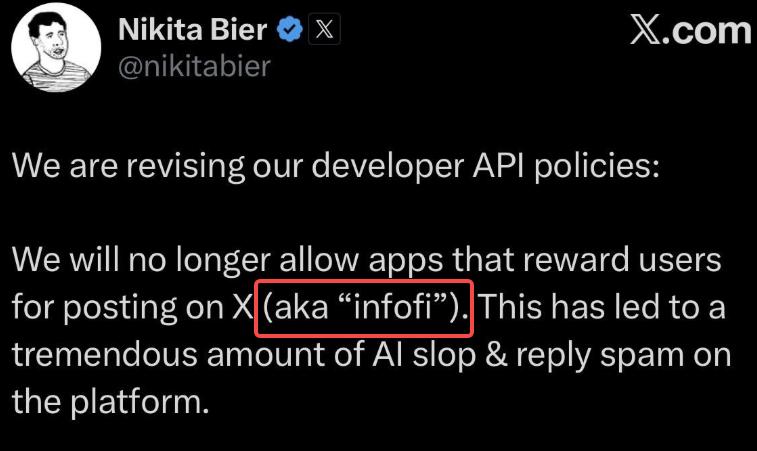
The landlord evicted the tenant and even helped them call a moving company.
Upon hearing the news, the InfoFi sector collapsed. KAITO fell by 20%, Cookie fell by 20%, and the Kaito Yappers community of 157,000 members was shut down.
However, less than an hour later, Kaito founder Yu Hu published a long article.
The article neither apologized to the community nor protested X's policies; its core message was simply:
Let's move to a different place.
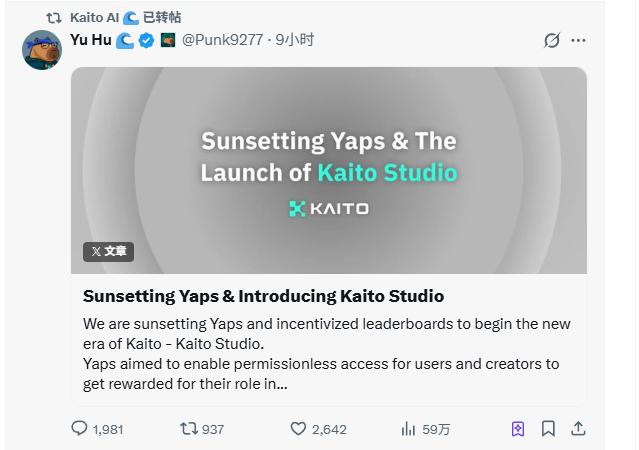
Yaps is discontinued. The new product is called Kaito Studio, which takes a traditional marketing approach, with brands and creators collaborating one-on-one, instead of an open model where anyone can earn points.
I'm done with Twitter; I'm going to YouTube and TikTok. I'm also done with the crypto world; I'm going to do finance, AI, and the entire creator economy—that's a $200 billion market.
We have the product, the direction, the data, and now we have a new story.
However, I don't think this is an emergency response that could be written in an hour. It's more like they knew this day would come, and the draft was sitting in a drawer, just waiting for X to make a move.
Meanwhile, there are even earlier signals on the chain.
Kaito's multisignature contract previously distributed 24 million KAITO tokens to five addresses. One of these addresses transferred all 5 million KAITO tokens to Binance a week ago.
It's more like a sure thing.
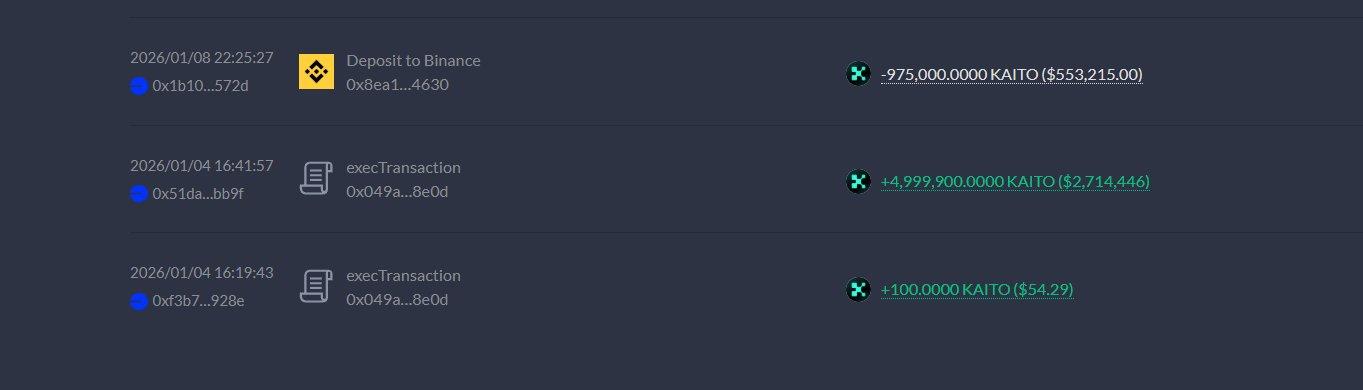
We communicated in advance, wrote the draft in advance, and transferred the coins to the exchange in advance—we did everything we were supposed to do.
Then, as soon as X made the official announcement, a long article immediately followed, presenting a very elegant stance, proactively transforming and embracing change.
In his statement, Yu Hu wrote, "Following discussions with X, both parties agreed that a completely permissionless distribution system is no longer feasible."
It is unanimously agreed.
Being kicked out is presented as reaching a consensus. A product deemed doomed is packaged as a strategic upgrade. We've seen this rhetoric far too many times in the crypto world.
The project team will never say "we failed". They say they are exploring new possibilities, that the market environment has changed, and that this is a planned transformation.
It's very respectable, but also very much about public relations.
Ultimately, the X ban was just the final blow. The oral masturbation business was already on its last legs.
Tweets for cryptocurrency sound appealing: tokenizing attention to provide creators with fair rewards and a decentralized information economy.
But once it actually started running, we all knew it completely changed.
If rewards are tied to posting, then post more. If AI can generate content in bulk, then let AI post. If there's no limit to the number of accounts, then create a bunch of fake accounts...
According to CryptoQuant data, bots generated 7.75 million encrypted tweets on X on January 9, a year-on-year increase of 1224%.
ZachXBT was already criticizing these InfoFi platforms last year, calling them the culprits behind AI-generated spam. He offered a $5,000 reward for user data to identify and eliminate bots.
Serious discussions have been replaced by a screen full of GM, LFG, and bullish comments. With real people and bots mixed together, it's really hard to tell who's who.
Nikita Bier, the product manager for X, actually tweeted last week: CT is dying from suicide, not from the algorithm.
Crypto Twitter committed suicide, not was killed by an algorithm.
At the time, the crypto community criticized him for being arrogant and kept responding to him with the "GM" meme.
Looking back now, doesn't it resemble a notification before an execution involving mouth-to-mouth masturbation and hand-to-hand contact?
Regarding spam content, Kaito founder Yu Hu said they've tried various methods: raising the bar, adding filters, and modifying incentive designs.
But it's not very useful.
Using token rewards to post is essentially offering a bounty to create noise. No matter how high the barrier to entry, it can't overcome the profit motive. Human nature is what it is. As long as the incentive exists, spam will never stop.
Even more critically, their lifeline is in the hands of others.
What kind of business does Kaito do? It leverages X's traffic, incentivizes users to create content with tokens, and sells the data to project teams for marketing purposes.
X represents the foundation, and Kaito represents the house built on top of it.
If the landowner wants to take the land back one day, the house will collapse. No reason is needed, no discussion is needed, a simple announcement is enough.
To put it simply, InfoFi tells a story of a decentralized attention economy. But the attention itself is never in your hands. The algorithm belongs to the platform, the API belongs to the platform, and the users belong to the platform.
You can put points on the blockchain and decentralize tokens, but you can't decentralize Twitter.
The parasite wants to overthrow its host. The host doesn't need a revolution; it can simply pull the plug.
In recent years, this entrepreneurial approach has become popular in Web3: leveraging the traffic of Web2 to create momentum for Web3. But while users, data, and attention are all on Twitter, the tokens are issued by themselves, and the money is earned by themselves.
That sounds very clever, using minimal effort to achieve maximum effect.
But other people's traffic ultimately belongs to them. The platform tolerates you today because you're not bothering them yet. But the day you start bothering them, this leech-like business model will truly become unsustainable.
This serves as a warning to all Web3 projects that started by leveraging platform traffic.
If your lifeline is in someone else's hands, then every penny you earn is something they haven't yet taken back.
Think clearly about whether you are starting a business or renting. Renters should not have a landlord's mentality, nor should they feel that the house belongs to them.
Kaito said he's going to go to YouTube and TikTok next.
Are the landlords over there easier to talk to than Musk?