AI is proving mathematical conjectures, and this time it's for real.
OpenAI's latest model, GPT-5.2 Pro, has just independently proven an Erdős conjecture.
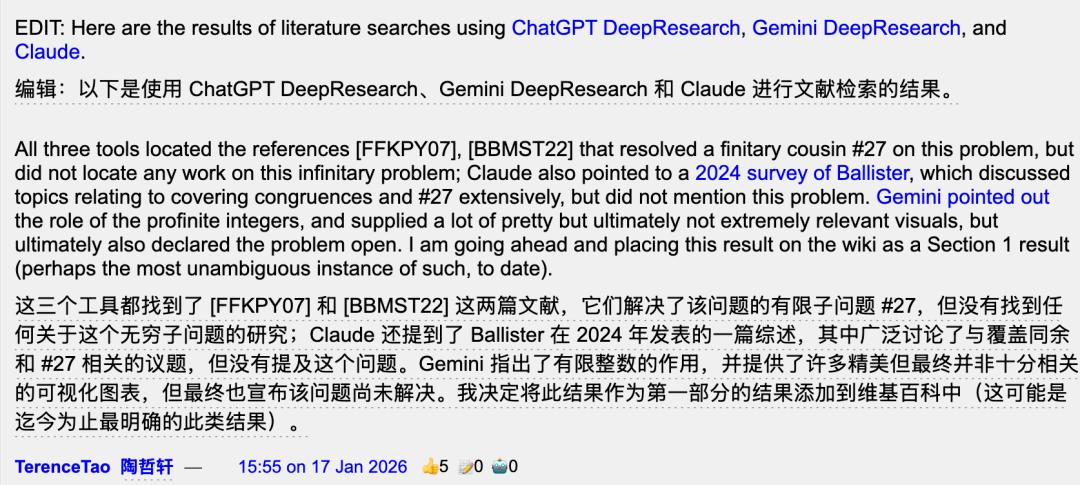
The argument was verified by Fields Medal winner Terence Tao and was also praised as "the clearest Class I result to date (AI's main contribution)".
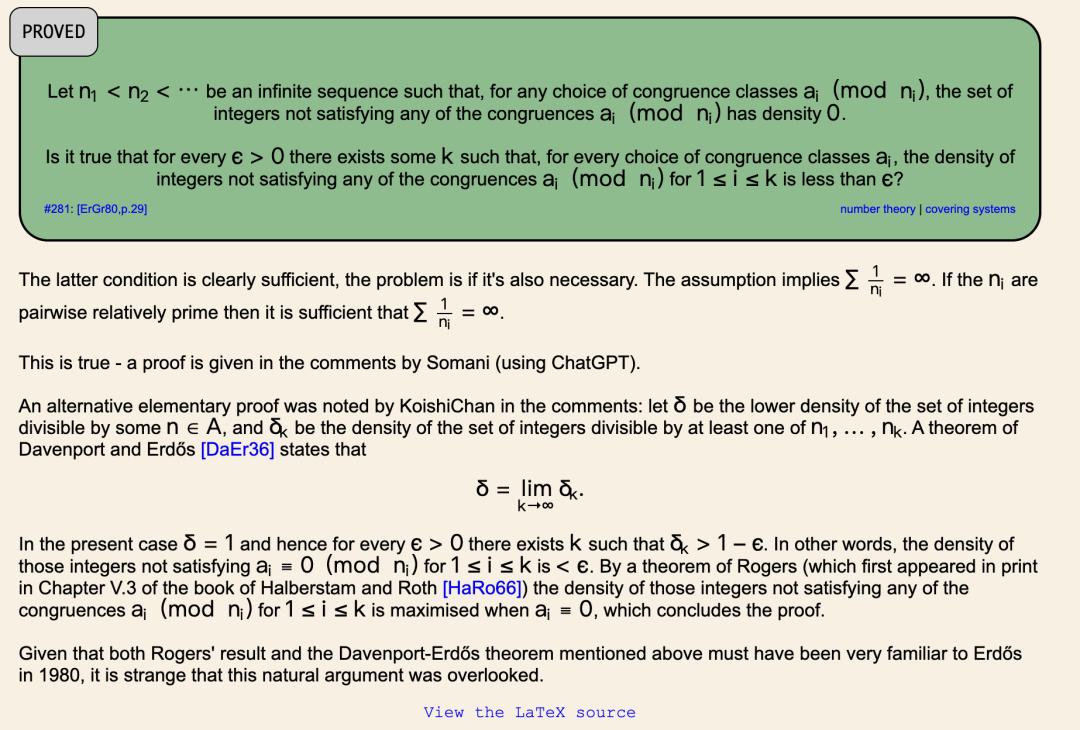
This problem is number 281 in the Erdős Problems Library, proposed in 1980 by legendary mathematicians Paul Erdős and Ronald Graham, and involves the deep relationship between congruent covering systems and natural density.
For 45 years, this question has been lying quietly in the question bank, waiting for an answer.
Until January 17, 2025, a researcher named Neel Somani submitted this problem to GPT-5.2 Pro.
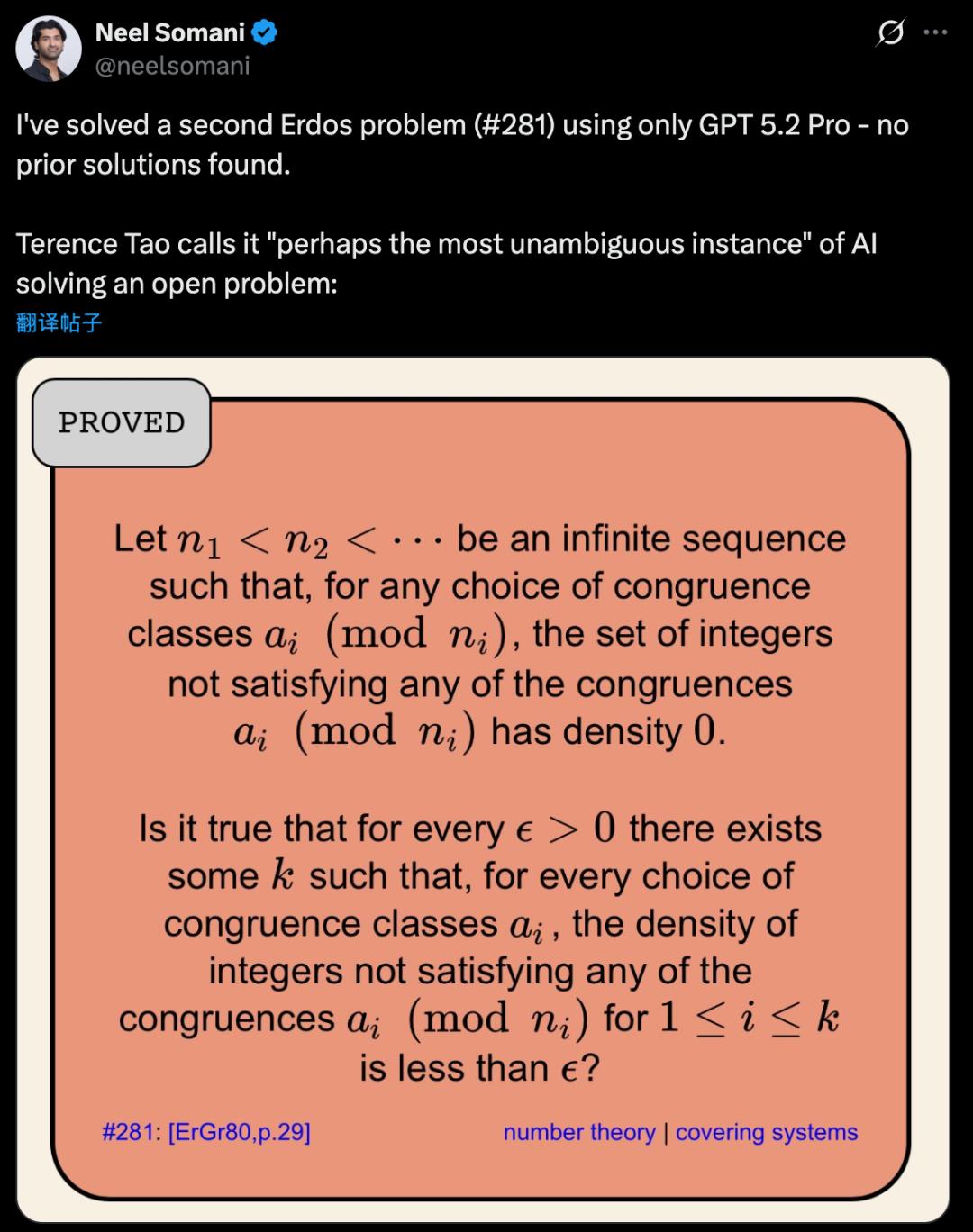
The proof only uses GPT 5.2 Pro.
The Erdős Problem website has included AI-proven results.
The entire argument unfolds on an infinite Adel integer ring, and with the help of Haar measure and point-state ergodic theorem, combined with compactness argument, it completes the transition from pointwise convergence to uniform convergence.
In Terence Tao's words, it is a variant of the "Furstenberg correspondence principle," a standard tool in the intersection of ergodic theory and combinatorics.
However, GPT-5.2 Pro is used in a slightly different way; it relies more on Birkhoff's theorem than the usual arguments.
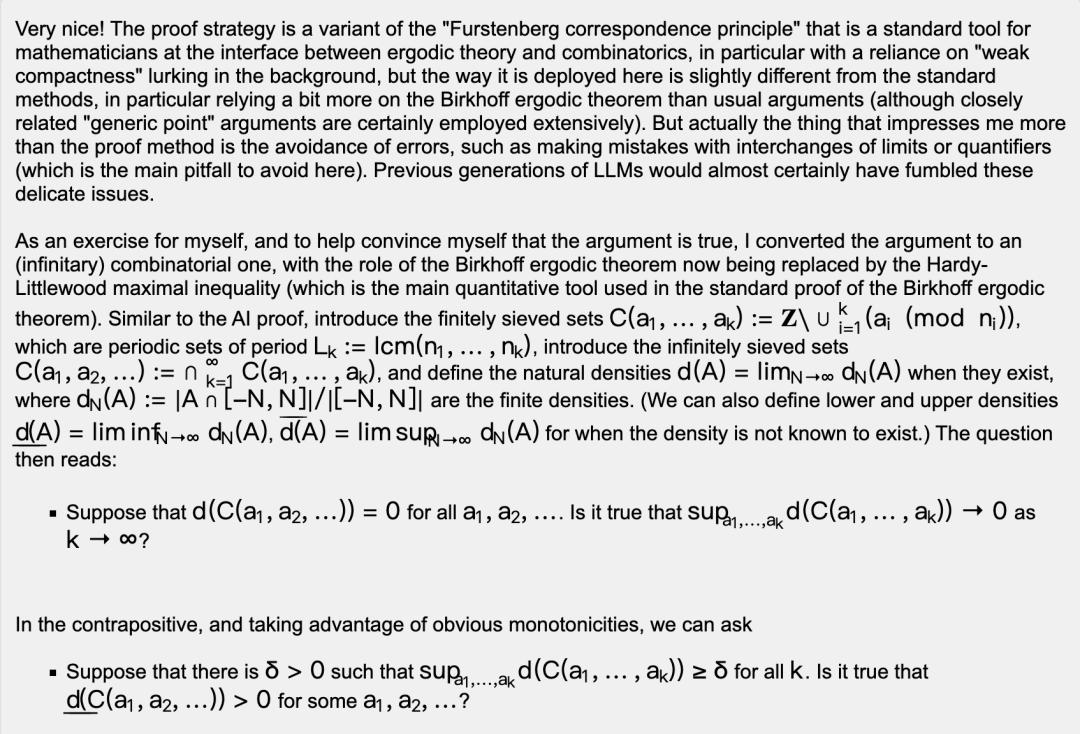
However, what truly impressed Terence Tao was not the proof method itself, but that the AI did not make any mistakes.
What surprised me even more was that it avoided errors, such as extreme swaps or mistakes in quantifier order, which are precisely the pitfalls most easily encountered in this problem. Previous generations of large language models almost certainly stumbled on these subtle points.
To verify this proof, Terence Tao personally translated the entire ergodic argument into combinatorics language, replaced Berkhoff's theorem with the Hardy-Littlewood maximal inequality, and redrew the entire derivation.
Conclusion: The proof is valid.
An unexpected discovery
While everyone was discussing the proof of GPT-5.2 Pro, a user named KoishiChan made an unexpected discovery in the comments section:
There is actually a simpler solution to this problem, and the two theorems required already existed in 1936 and 1966.
The first is the density convergence theorem, which Harold Davenport and Erdős himself proved in 1936.
The second is Rogers' theorem, first published in Chapter 5 of Halberstam-Ross's monograph *Sequences* in 1966. Combining these two classic results, problem 281 is almost a direct derivation.
This is strange. Erdős himself was a co-author of that 1936 paper, yet when he posed the question in 1980, he didn't realize the answer was so close.

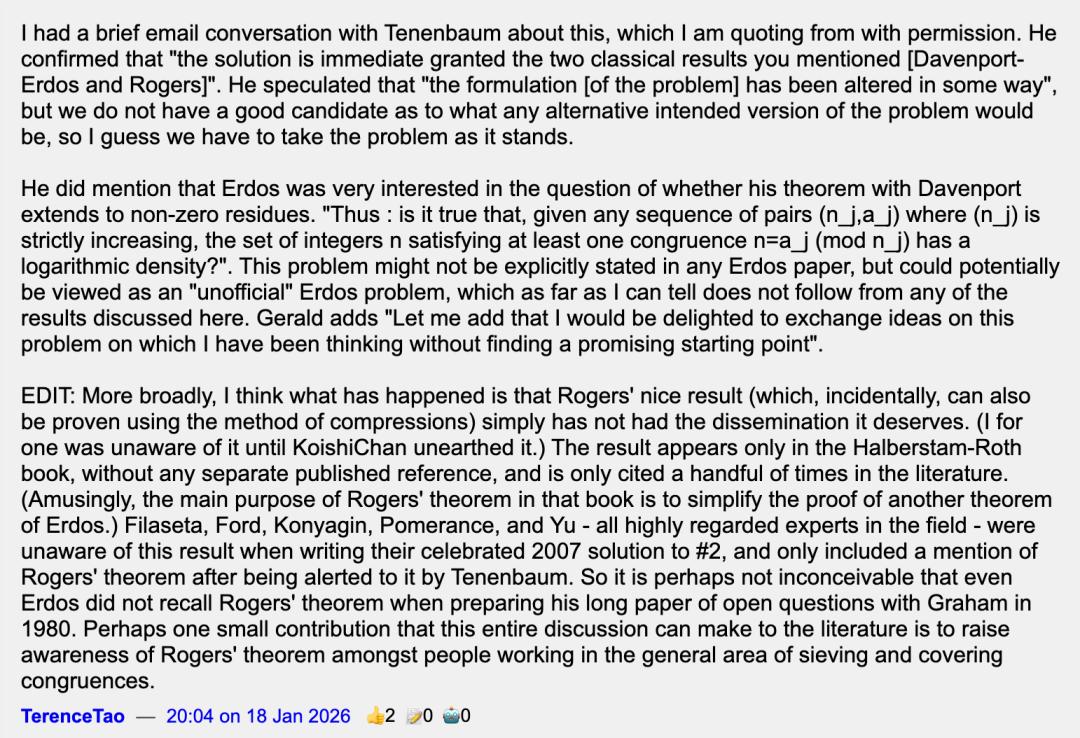
Terence Tao specifically emailed the French mathematician Tenenbaum to consult on this matter.
Turnenbaum confirmed that "the problem can be solved immediately as long as the two classic results you mentioned (the Davenport-Erdos theorem and Rogers' theorem) are satisfied," but he also speculated that "the formulation of the problem may have been modified at some point." However, no one has found any other version of the formulation, so it can only be treated as is.
Even more interestingly, in 2007, when five top experts, including Firaseta, Ford, Konyakin, Pomerans, and Yu, were solving another Erdős problem, they were also unaware of Rogers' theorem until Tnambaum reminded them to add it.
Terence Tao lamented, "Rogers' theorem has not received the dissemination it deserves. It only appears in Halberstam-Ross's book, without being published separately, and there are very few citations. Perhaps this discussion will bring this result to the attention of more researchers studying sieves and congruence covers."
Finally, there are now two proofs for this problem: one from the ergodic path in GPT-5.2 Pro, and the other from a combination of classic literature unearthed by KoishiChan.
Terence Tao confirmed that the two are "different proofs," although there is some overlap in concepts.
How to assess the true success rate of AI mathematics?
After the news spread, various AI models were brought in for cross-validation.
The Gemini 3 Pro indicated that the proof was flawless. Another researcher used the GPT-5.2 Pro to repeatedly check the details of the proof. The AI concluded that the only area requiring rigor was the second step, which could be bypassed using the Fatu lemma and completed directly without ergodicity.
However, Terence Tao pointed out that the direction of Fatu's lemma is reversed here: I just finished teaching graduate students in measure theory, and I have seen too many errors like this.
It was then confirmed that the normal graph lemma was applied to the complement set, the direction was correct, and the proof was valid.
But Terence Tao also offered a sobering reminder. He wrote:
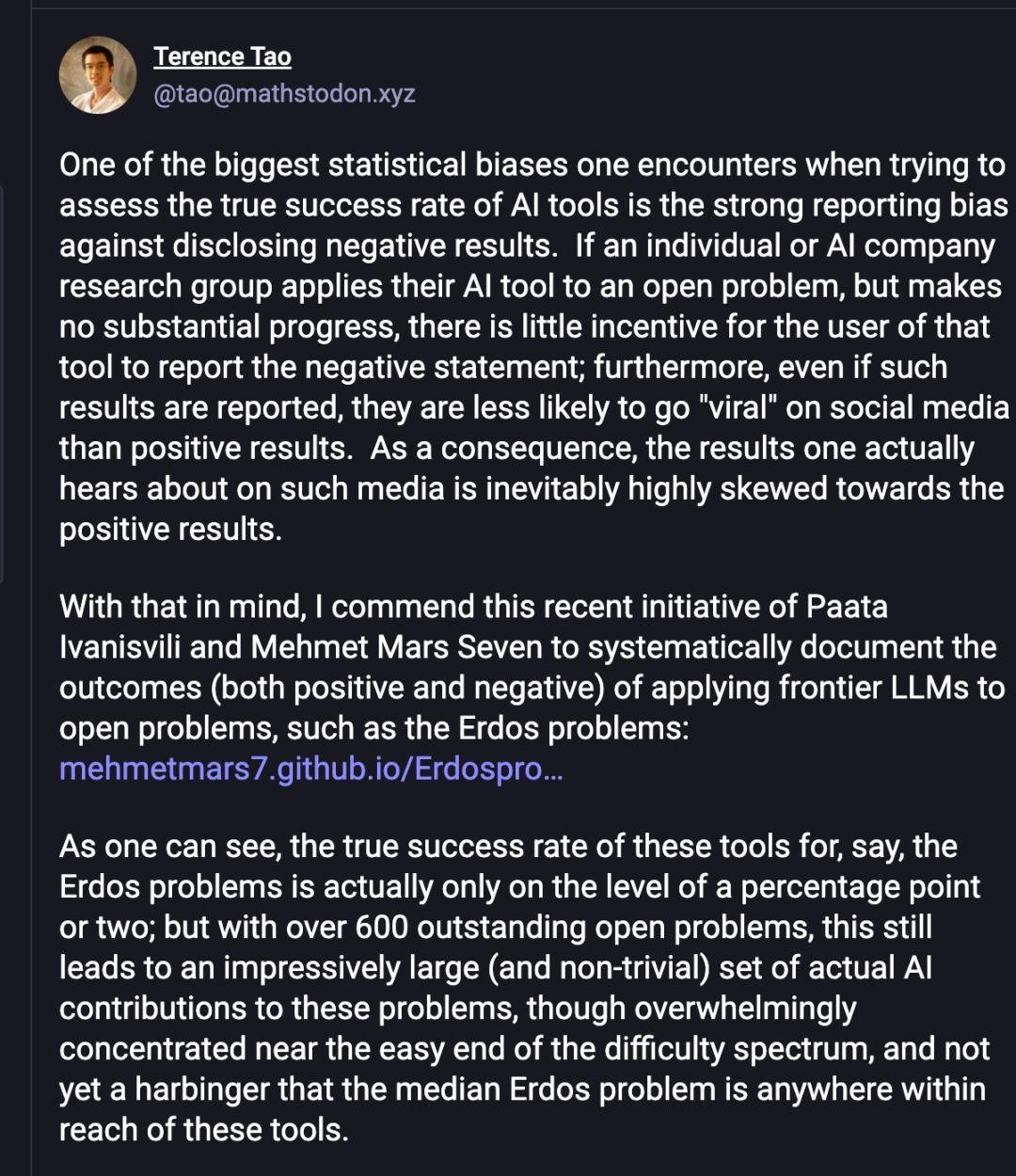
When assessing the true success rate of AI tools, the biggest statistical bias comes from strong reporting bias, with negative results almost never being disclosed.
If someone or an AI company uses tools on an open problem but makes no progress, they have no incentive to report the negative conclusion; even if they do, it is unlikely to spread on social media as much as a positive result.
Although the vast majority of them are concentrated at the easy end of the difficulty spectrum, this does not necessarily mean that the medium-difficulty Erdős problem has entered the AI's range.
He recommended an open-source project initiated by Paata Ivanisvili and Mehmet Mars Seven, which systematically records the positive and negative results of cutting-edge large language models on the Erdős problem.
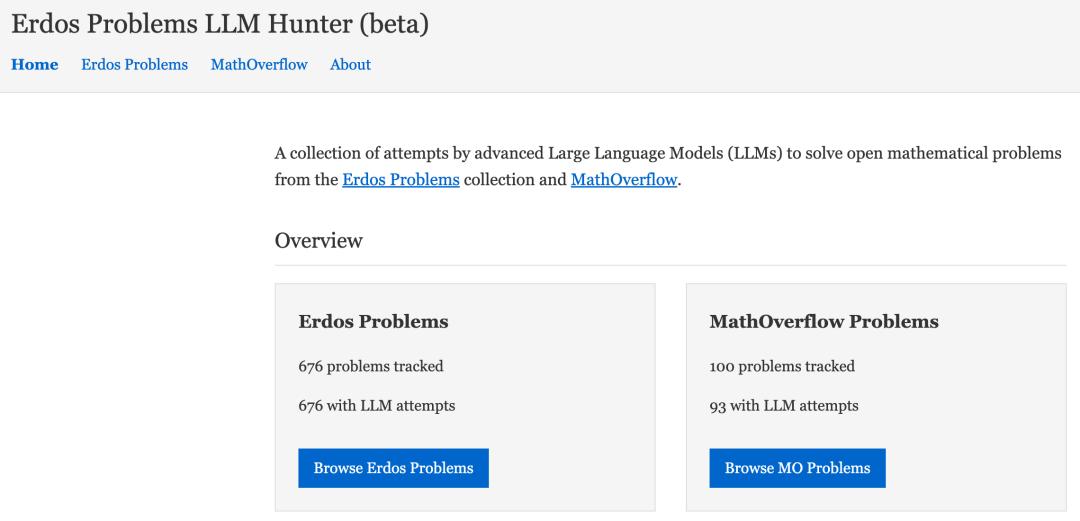
Data shows that these tools have a real success rate of only about one to two percent in dealing with the Erdős issue.
However, considering that there are more than 600 unsolved problems in the problem library, this proportion still represents a considerable and extraordinary number of AI contributions.
Reference link:
[1]https://www.erdosproblems.com/forum/thread/281
[2]https://x.com/neelsomani/status/2012695714187325745
[3]https://mathstodon.xyz/@tao/115911902186528812
This article is from the WeChat public account "Quantum Bit" , author: focusing on cutting-edge technology, published with authorization from 36Kr.