At 2 AM, Lee typed into ChatGPT: "Find me a face cream suitable for sensitive skin, under 200 yuan." A few seconds later, the AI compared prices, checked inventory, read reviews, and provided a recommended product link. Lee clicked the card and directly completed the payment and placed the order. The entire shopping process was completed within the chat page, without any external redirects. This isn't science fiction; it's a typical shopping experience based on Agentic Commerce in 2026. This shift from search to delegation signifies that consumers are relinquishing their purchasing decision-making power to AI agents.
A few years ago, when ChatGPT first entered the commercial arena, most brands categorized it as a "future variable"—worthy of attention but not yet sufficient to change the retail landscape. But today, looking at ChatGPT from that perspective is clearly far from enough; it is evolving from a search tool into a transaction portal that could potentially reshape the channel landscape.
From "We'll help you choose" to "We'll buy it for you directly": The migration of the checkout process
Initially, ChatGPT was more like an advanced search tool: consumers asked questions, compared parameters, looked at suggestions, and then jumped to an e-commerce platform to complete their purchase. Now, the checkout step is being directly "moved into the conversation."
OpenAI has officially launched its Instant Checkout feature, allowing users to purchase items directly within ChatGPT. This feature currently supports Etsy, Shopify, and Walmart products .
Target is exploring embedding the entire shopping experience directly into ChatGPT, allowing users to get personalized recommendations, browse products, add items to their cart, and place orders directly within the chat window;
Instacart has enabled a fully conversational shopping experience in ChatGPT, from fresh produce recommendations to shopping cart checkout.
One trend is very clear: the checkout process is rapidly shifting from apps and websites to conversational scenarios, and ChatGPT is becoming a new transaction entry point.
ChatGPT's Three Future Growth Paths
While the future trajectory of ChatGPT as a retail platform remains uncertain, Flywheel's model predicts that if ChatGPT captures approximately 50% of Google's current web traffic by 2030, its e-commerce scale would be enough to shake up the existing landscape. At that time, its GMV is projected to exceed $170 billion by 2030, placing it among the top ten e-commerce platforms globally.
Direction 1: A strong new entry point, but without disrupting the existing order.
While ChatGPT has become an important traffic and recommendation portal with conservative growth, most transactions still require redirection to third-party platforms. In this scenario, shopping-related searches account for approximately 10% of its total usage, changing how brands are "discovered," but it has not yet become a true transaction hub.
Option Two: Benchmarking against Regional E-commerce Platforms
At a moderate growth rate, ChatGPT is large enough to compete with regional e-commerce giants like Mercado Libre. Shopping searches account for approximately 13% of transactions, and in-platform transactions have increased significantly, with about 20% of transactions occurring within conversations. Its growth trajectory over the first five years is similar to that of early TikTok Shop and Temu: rapid, wide-reaching, and emerging as a significant force to be reckoned with.
Step Three: Becoming one of the world's top ten e-commerce platforms
With its rapid growth, ChatGPT could leap directly into the top ten global e-commerce platforms. Shopping searches will account for 15% of its revenue, and approximately 30% of transactions will be completed directly within conversations, making it one of the "default shopping gateways." Once this happens, the rules of the retail world will be completely rewritten.
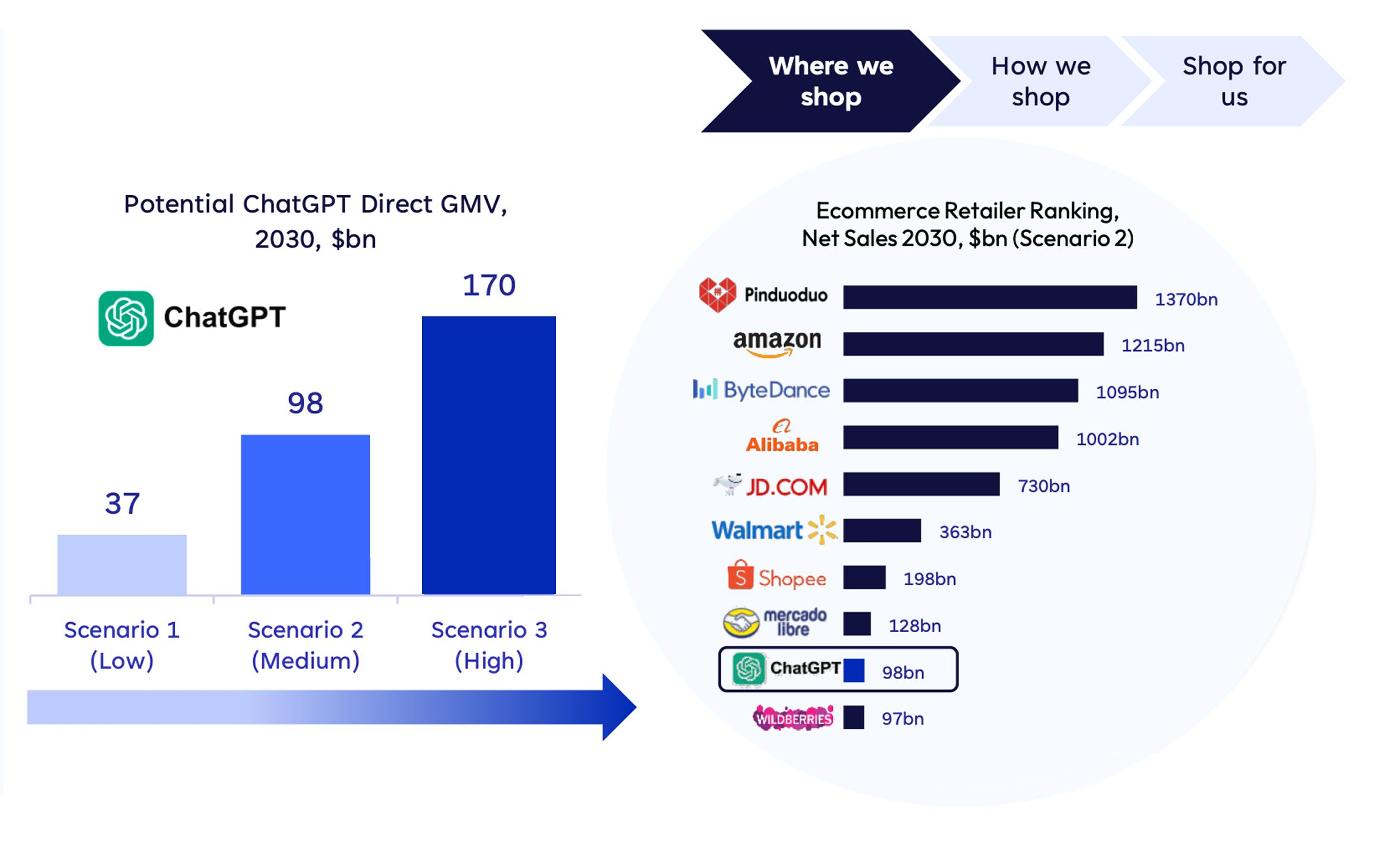
Data source: Flywheel Retail Insights' 2025 Agentic Commerce Report
GEO is becoming the new "digital shelf".
Regardless of ChatGPT's ultimate path, one trend is irreversible: the main battleground for product discovery is shifting from search engines (SEO) to generative engines (GEO). Consumers are no longer searching for "running shoes," but rather asking, "What running shoes are suitable for women's marathon training?" If your product information cannot be understood, accessed, and recommended by AI, then your product will be virtually "invisible" on the new digital shelf.
This is why GEO has become a new mandatory course. It's not simply an upgrade to SEO, but a completely new competitive arena. Across all scenarios, one trend is certain: AI agents will be deeply involved in every shopping decision. You no longer need to open a shopping app → search → filter → compare prices → place an order; you can directly ask ChatGPT which protein powder is suitable for running. This is no longer a concept, but a capability that is being implemented.
When intelligent agents become the subject of procurement, how should brands respond?
What truly disrupts retail isn't ChatGPT itself, but the underlying trend of Agentic Commerce . AI is becoming consumers' "digital purchasing agents." In the past, brands competed for search rankings and advertising space; now, you need to please AI. ChatGPT, Amazon Rufus, and Doubao are replacing traditional search as new traffic drivers. They don't look at ad creativity, there's no bidding system, only data: contextual relevance, price, inventory, logistics speed, and user reviews.
When ChatGPT and similar platforms become potential new retail platforms, the challenge for brands is not "whether to do it," but "how to do it right."
Brand Action Framework
- Conduct a comprehensive check for product content consistency: Examine product information across various retail platforms to ensure accurate descriptions and consistent information, thereby increasing the probability that the AI agent can identify and recommend relevant products in related queries.
- Actively analyze the recommendation logic of AI Agents: By asking different AIs questions, observe the product results and reasoning logic they provide, and understand how the algorithm "interprets" your product category, brand, and core selling points.
- Operate GEO as an independent channel: break away from traditional SEO thinking and use expressions that are closer to natural language and real consumption scenarios to ensure that you can answer the questions that consumers most often ask AI.
- Building AI capabilities at the organizational level: Preparing ChatGPTs in advance to become independent retail channels and cultivating the team's AI awareness and application capabilities.
The era of Agentic Commerce has begun, and ChatGPT is just the beginning. In the e-commerce battlefield of 2026, when consumers entrust their wallets to AI, your opponent will no longer be competing products, but the algorithm's recommendation logic. Brands that act first often don't wait for the answer to appear; they themselves are part of the answer.
This article is from the WeChat official account "Flywheel" , author: Flywheel, and published with authorization from 36Kr.