Written by: TechFlow TechFlow
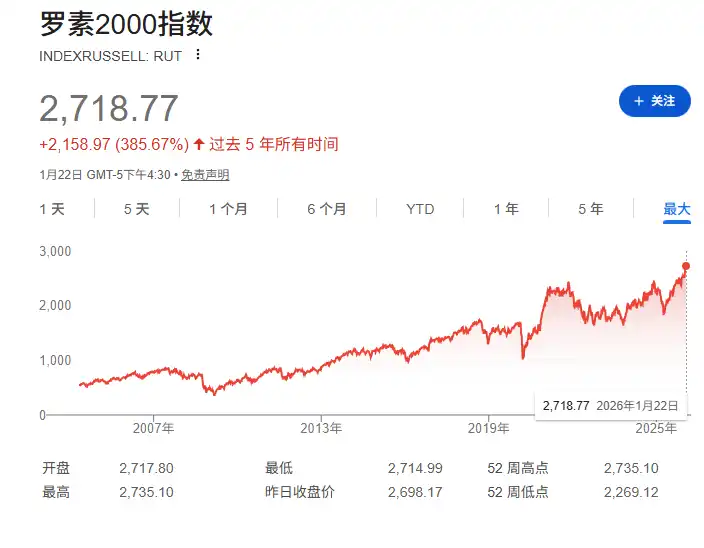
In the first three weeks of 2026, the Russell 2000 index rose by 9%, breaking through 2700 points.
This US small-cap stock index traded sideways for three years after its high at the end of 2021, only breaking out for the first time last November, and has now entered a "price discovery" phase. There are no historical resistance levels to refer to.
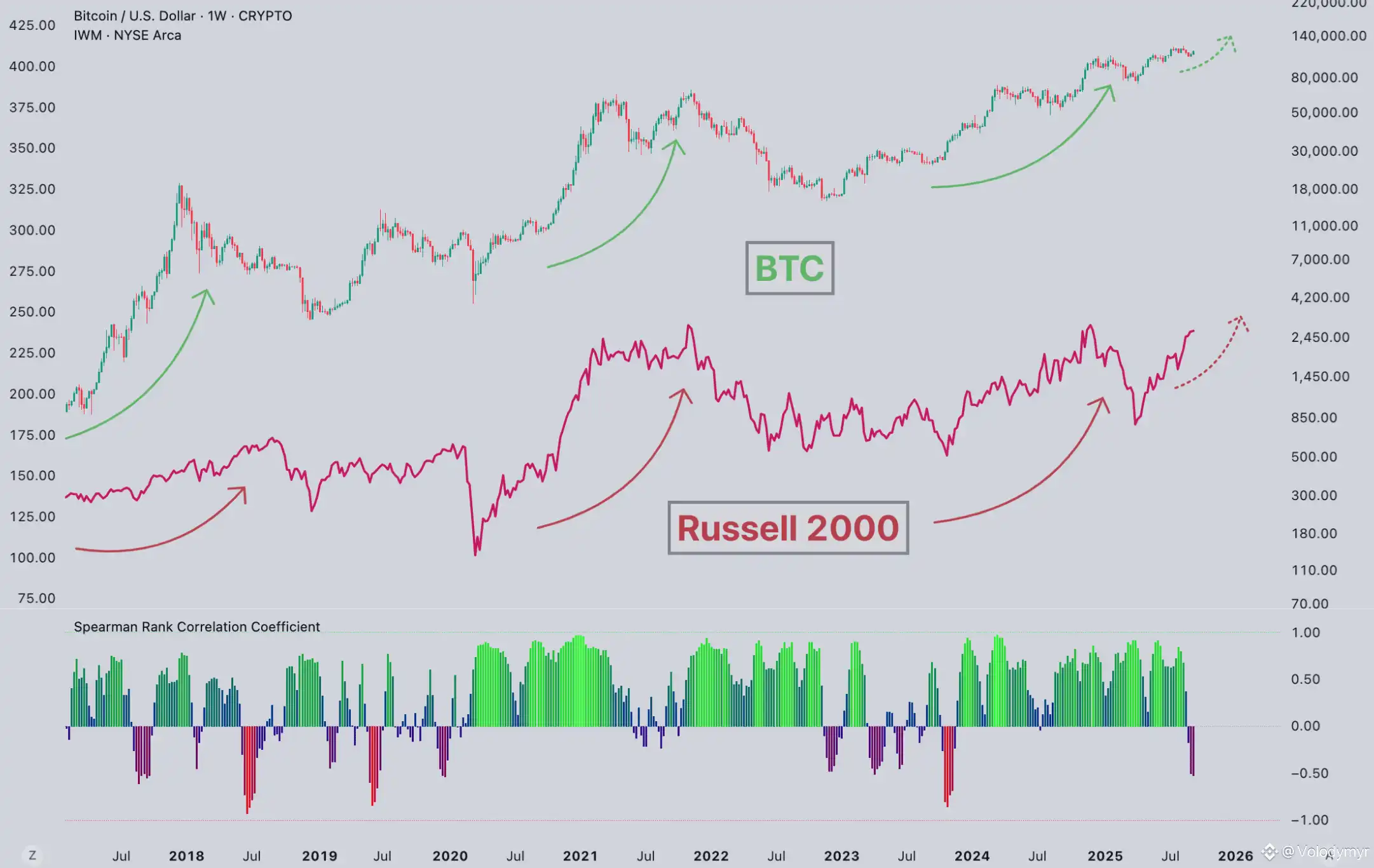
I recently came across an opinion piece that pointed out that when Russell 2000 broke out in 2016 and 2020, Bitcoin was also starting a bull market, catching the wave both times. Now that it's broken out again, will crypto follow suit?
Looking at the data, this does indeed seem like a leading indicator, at least historically it has proven true.
The Russell 2000 tracks the 2,000 companies with the lowest market capitalization in the U.S. stock market, with a median market capitalization of just over $1 billion. Compared to star stocks like Apple and Microsoft in the S&P 500, these smaller companies have one thing in common: they mainly rely on banks for loans, not on issuing bonds.
When interest rates rise, they are the first to suffer from unbearable financing costs; when interest rates fall, they are the first to benefit.
Therefore, traders like to use the Russell 2000 as a "risk appetite thermometer." When it hits a new high, it indicates that the market is willing to put money into high-risk assets.
There's another layer of logic. Small-cap stocks have businesses concentrated in the US, unlike Apple and Microsoft which are globalized. The rise in the Russell 2000 index, to some extent, reflects the perceived temperature of the US domestic economy.
In 2016 and 2020, the small-cap stock index broke through twice, and Bitcoin took off twice.
Let's start with the data.

In 2016, the Fed's interest rate hike cycle was nearing its end, and Trump's rise to power brought expectations of tax cuts, boosting risk appetite. Bitcoin had just completed its halving, and the supply contraction coincided with a recovery in demand, leading to the bull market of 2017.
The 2020 crash was even more dramatic. The pandemic created a massive trough, prompting the Federal Reserve to ramp up its printing presses and drive interest rates to rock bottom. Institutional investors entered the market on a large scale for the first time, with MicroStrategy and Tesla buying up shares, pushing Bitcoin from over $10,000 to $69,000.
The timing of the two Russell 2000 breakouts and the BTC bull market does indeed match.
But in fact there are only two historical samples.
Looking back to November 2024, Russell 2000 broke through its previous high in 2021 for the first time. At the same time, BTC was already around $100,000.
Since the halving in April 2024, BTC has risen from 63,000 to the current 90,000, an increase of about 50%. That sounds good, but compared to the 5 times and 27 times increases in the same period of the previous two halvings, the difference is obvious.
Several possible reasons.
First, institutional investors have entered the market, which has reduced volatility. After ETFs were approved in January 2024, large players like BlackRock and Fidelity entered the market, attracting tens of billions of dollars in ETFs alone. Unlike retail investors who chase highs and lows, institutional money doesn't chase trends, thus smoothing out volatility. The advantage is that the declines aren't as severe, but the cost is that the kind of vertical surge seen in 2017 is also absent.
Second, the marginal effect of halvings is diminishing. After the fourth halving, the annual inflation rate of BTC dropped from 1.7% to 0.85%. It sounds like half the supply was cut, but 94% of the BTC has already been mined. The dilution effect of new supply on the existing stock is becoming smaller and smaller, and the "supply shock" brought about by each halving is weaker.
Third, BTC broke its previous high in March 2024. This was the first time in history that a new high had been reached before the halving. ETFs anticipated and released a wave of demand in advance, so by the time the halving actually happened, most of the positive impact had already been priced in.
Coincidence, or the same liquidity logic?
Russell 2000 and BTC, one is a small-cap stock in the US stock market, and the other is a leading cryptocurrency. Why would they move in sync?
My understanding is that they are sensitive to the same set of macroscopic signals.
When the Federal Reserve signals easing, funds move outwards along the risk curve. First to Treasury bonds, then blue-chip stocks, then small-cap stocks, and finally high-beta assets like cryptocurrencies.
Russell's 2000 breakthrough is like a green light turning on in the middle of the chain.
A JPMorgan study last year found that Bitcoin (BTC) and the Russell 2000 small-cap tech stocks had the highest correlation. This was because crypto projects rely on VC funding, and blockchain innovation is concentrated in small companies rather than large tech giants. In short, people who buy small-cap stocks and those who buy cryptocurrencies have roughly the same risk appetite.
But I'm hesitant to consider this a causal relationship. Two samples aren't statistically sufficient.
Moreover, BTC itself had halving cycles in 2016 and 2020, so Russell 2000 may just be another macro signal that appeared at the same time, and it is not a matter of one leading the other.
Another interesting phenomenon is that although the Russell index is rising, money is flowing away.
In 2025, the Russell 2000 rose by more than 40%, but US small-cap ETFs saw a net outflow of nearly $20 billion throughout the year. This contrasts sharply with past bull markets—where funds flowed in as the index rose.
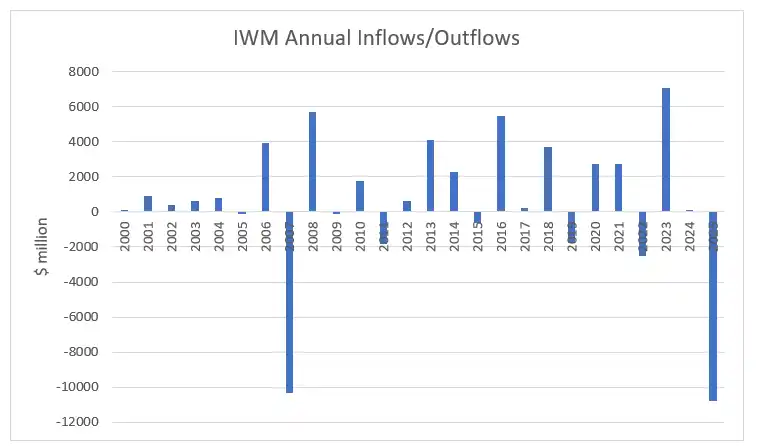
(Image source: etf.com)
Here's another set of data. About 40% of the companies in the Russell 2000 index reported negative earnings in the third quarter of 2025, nearing an all-time high. This percentage has more than doubled since 2007.
The index hit a new high, but the fundamentals are worrying, and funds are still withdrawing.
How can this be explained? One possibility is that a few stocks are driving the index, and another is that passive funds are rebalancing their portfolios. But regardless of the explanation, the narrative of "risk appetite returning to normal" is compromised.
Recently, if you follow macroeconomics and general finance content, you'll find that there are more and more voices on investment video bloggers and crypto Twitter saying that "the Russell 2000 launch is a precursor signal for BTC to rise."
The Russell 2000 breakout is indeed a signal that appeared before the 2016 and 2020 crypto bull runs, and it's happening again now. It has value as an observation window, but my view is not to use it as a trading signal.
Two samples cannot establish a causal relationship, and several variables are different in this cycle: ETFs have changed the capital structure, volatility has been flattened by institutions, and the halving effect is diminishing. The old script may not necessarily work.
The "resonance" between Russell 2000 and BTC may only be answered after this cycle is over.
Note:
Data sources: Yahoo Finance, TradingEconomics, JPMorgan Research, BeInCrypto. As of January 2026.