(This article is a compilation by IOTA and does not represent the views of IOTA, nor is it investment advice, buy or sell recommendation. See the liability warning at the end of the article for details.)
IOTA has moved beyond the speculative phase of cryptocurrencies, focusing instead on bringing real-world assets onto the blockchain through a trusted, regulated, and scalable infrastructure. Instead of competing in saturated speculative markets like memes or general DeFi, IOTA is concentrating on creating a unique "blue ocean" opportunity within the $35 trillion global trading sector .
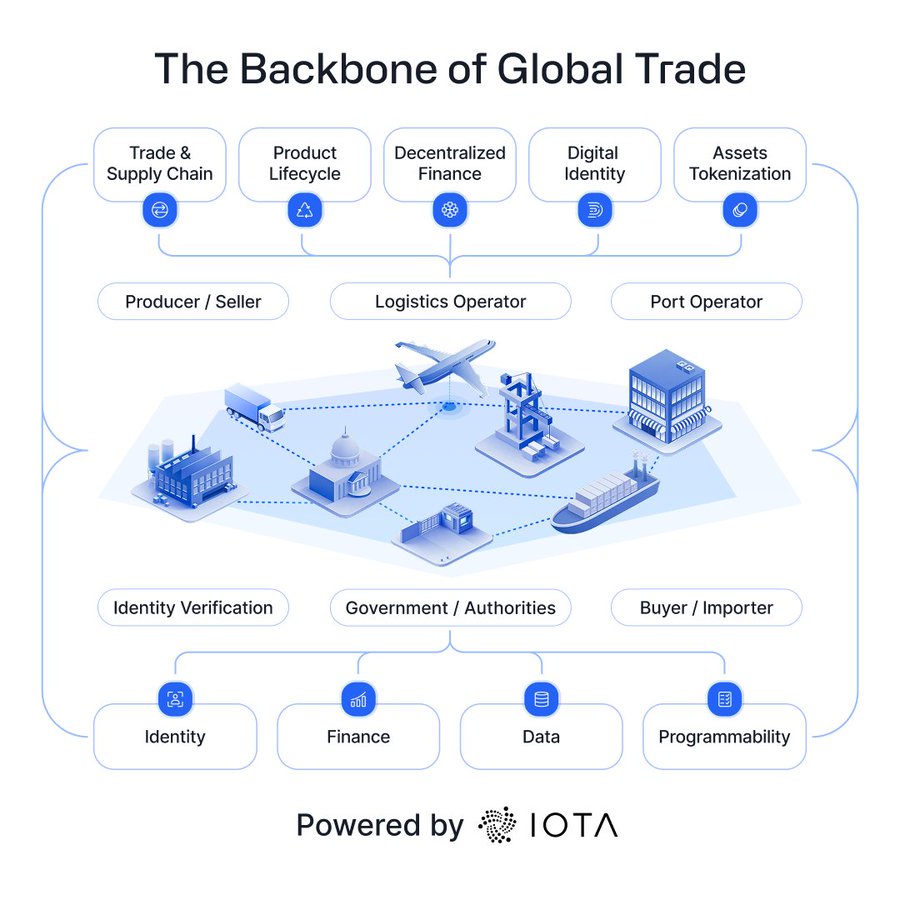
IOTA's mission is to be the single source of truth for the global economy. By vertically integrating digital identity, tokenized assets, and trade finance, IOTA is embedding its technology into the real economy. This is not just talk; it has been put into practice in Africa and the UK through initiatives such as TWIN Global ( @TWINGlobal ).
Vision: The infrastructure of the digital economy
Human prosperity and development are based on two fundamental technologies: Artificial Intelligence (AI) is like the brain, while blockchain is the nervous system. Cloud computing enables the digitization of data storage, AI is creating ubiquitous intelligence, and blockchain provides the necessary "programmable trust" to verify data and achieve value transfer without intermediaries.
Although blockchain is an emerging technology, its importance and market revenue are expected to rival those of cloud computing and AI. Global spending on blockchain networks is projected to reach $393 billion annually by 2030. IOTA believes this will not be a winner-takes-all market, but rather one dominated by specialized networks in specific economic sectors. IOTA's goal is to become the leading network in international trade and logistics.
Opportunity: Conquering the $35 trillion trade sector
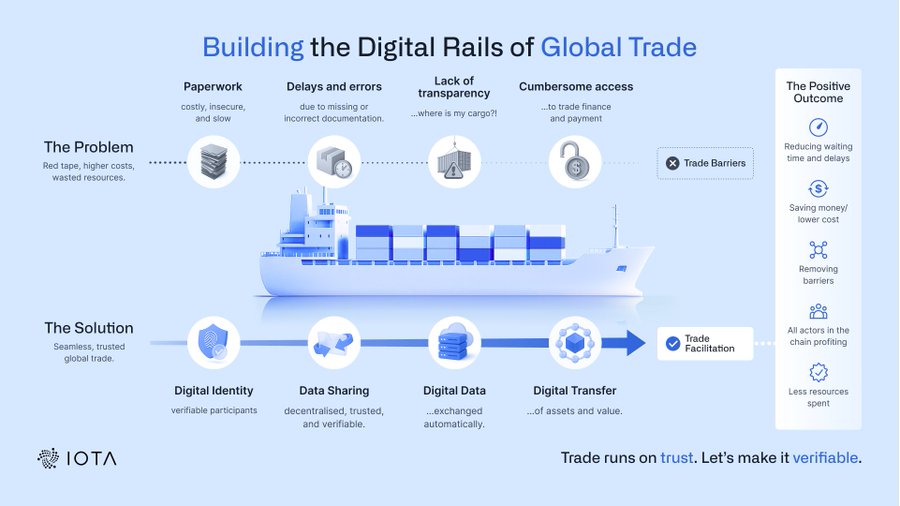
Global trade accounts for one-third of global GDP, yet it remains heavily reliant on outdated paper-based processes, the inefficiency of which is alarming.
- Paper-based operations are cumbersome: up to 4 billion trade documents circulate daily . A single trade can involve up to 30 units and approximately 240 copies of the documents.
- High costs: Administrative expenses for cross-border trade account for as much as 20% .
- Fraud and losses: Banks and traders lose between $2 billion and $5 billion annually due to document forgery.
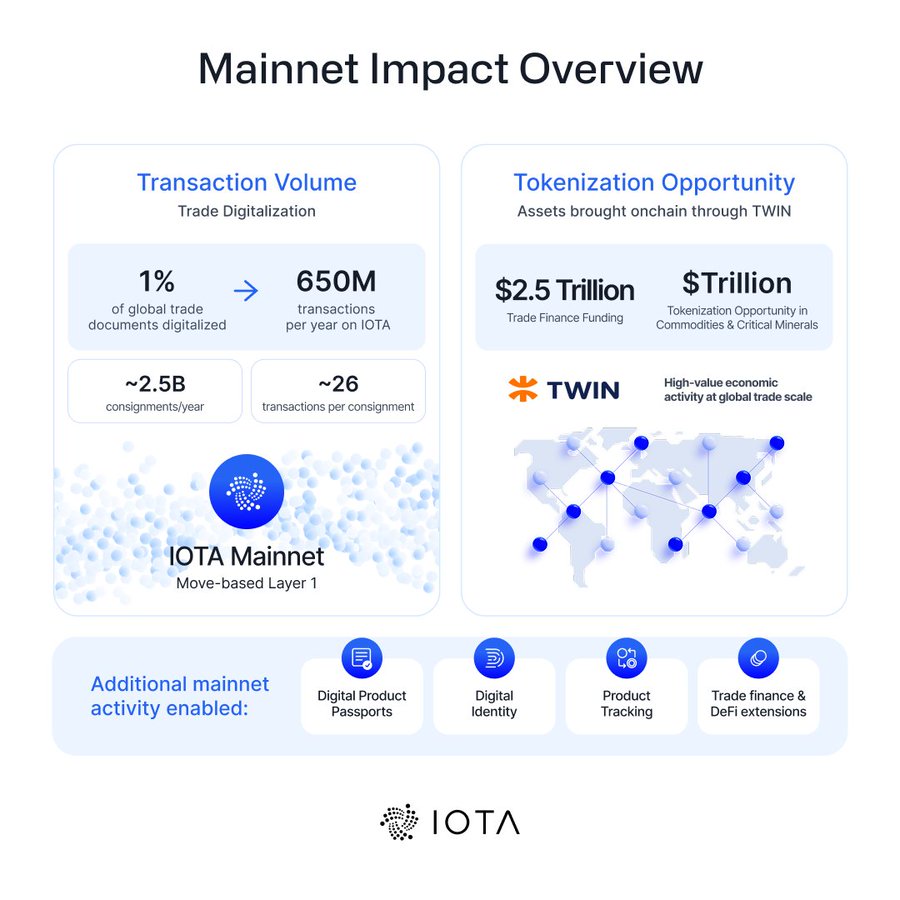
- Financing gap: There is an annual funding gap of $2.5 trillion in trade finance, preventing many companies from accessing the necessary capital.
Since the Model Electronic Transferable Records Act (MLETR) in 2017 provided legal validity for electronic documents, market adoption has remained slow due to the lack of a neutral infrastructure. Governments and businesses are reluctant to join private blockchains dominated by competitors (such as IBM and Maersk's failed TradeLens platform), and instead require a neutral, non-profit, and open-source underlying architecture. This is precisely where IOTA's product-market fits in.
Proof: TWIN and actual usage
IOTA is not only planning for the future, but has also taken immediate action through the global trade information network (TWIN) .
Practical application results
TWIN is a system built on the IOTA mainnet that is already in practical use and can digitize millions of documents and ensure the safe movement of physical goods.
In Kenya, TWIN has been implemented in the national trade system, initially piloted with flower exports, with plans to expand to all commodities by 2026. In the UK, the Cabinet Office is piloting TWIN to streamline freight processes between the UK and the EU, with thousands of shipments already tracked on the IOTA blockchain. Since 2024, TWIN has been fully integrated with the IOTA mainnet, enabling cross-border trade transactions to be officially recorded in the public ledger.
Another key milestone is the "Africa Digital Proximity and Public Trade Infrastructure" (ADAPT) project. Driven by IOTA, AfCFTA, the World Economic Forum, and the Tony Blair Institute for Global Change, this project aims to connect 1.5 billion people by 2035 and significantly reduce customs clearance times and cross-border payment costs. It is anticipated that by 2030, TWIN will be adopted by more than 30 countries, creating a significant network effect.
Economic impact: $IOTA token
IOTA's token economics are directly linked to actual usage, employing a strategy designed to create direct value for the $IOTA token through a deflationary and utility-based economic model. A single shipment typically generates dozens of transactions on-chain, and even digitizing only 1% of global trade documents could bring hundreds of millions of transactions to the mainnet annually.
With trade data being recorded on-chain, asset tokenization is the next step in development, encompassing commodities, key minerals, and trade receivables, a market with a combined size of tens of trillions of dollars. Through tokenization, these assets can be integrated into on-chain financial applications, providing new sources of liquidity to fill trade finance gaps.
In the past year, the IOTA ecosystem has launched several practical applications, covering the tokenization of key minerals, digital identities for physical goods, and digital product passports that comply with EU regulations. Instead, it tokenizes real-world assets (RWA) such as commodities, key minerals, trade receivables, and warehouse receipts, and integrates them into dedicated DeFi applications and stablecoins on the IOTA chain, such as Salus, ObjectID, and Orobo .
Token economics and moats
Token economics is designed for scarcity, ensuring the neutrality and security of the network. Its economic model employs a "deflationary design," meaning that the higher the usage, the scarcer the token and the higher its potential value. $IOTA uses a deflationary design; all fees generated from on-chain activity are used to burn tokens, and the existence of digital assets also requires locking tokens as collateral. Furthermore, staking mechanisms and corporate reserve requirements further enhance the token's utility.
Building on this foundation, IOTA, through partnerships with organizations such as the World Economic Forum, the Tony Blair Institute, and TradeMark Africa, has secured high-level government dialogue channels and market credibility, establishing a moat encompassing policy dialogue, technology deployment, and market reputation. Its technology stack is also specifically designed for enterprise-level trade applications, covering functions such as identity verification, notarization, organizational authorization, and fee payment.
technology stack
IOTA's technology stack is specifically designed for enterprise-level trade applications:
- IOTA Identity: Enables KYC/KYB compliance and provides verifiable credentials for trusted trading participants.
- IOTA Hierarchies: Simulates real-world corporate organizational structures and delegation of authority on the blockchain.
- IOTA Notarization: Anchors encrypted proofs to documents such as invoices and certificates, creating an unalterable audit trail.
- IOTA Gas Station: Provides a fee payment service, allowing non-crypto native users such as logistics agents to use the network without holding tokens.
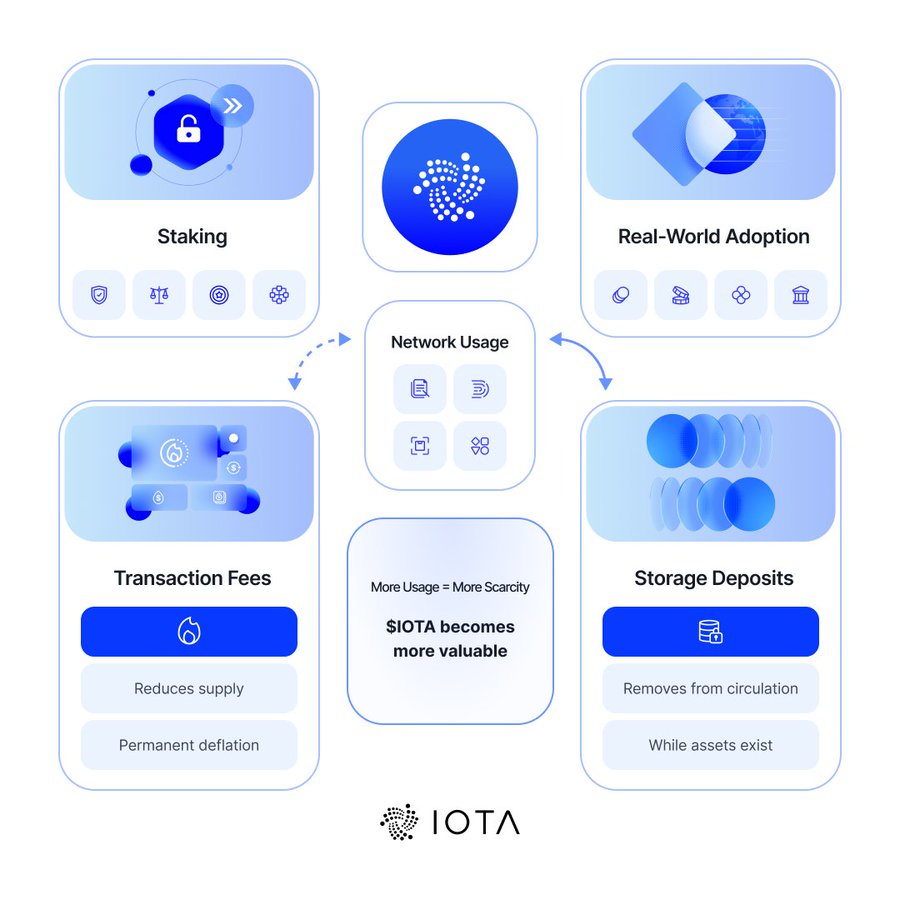
Conclusion: Flywheel effect
IOTA is at a critical turning point. While the market is still chasing trends and hype, IOTA is already building a foundational "trust layer" for the global economy. Its growth flywheel has already started: every additional country that adopts TWIN will enhance the network value of its trading partners; every batch of tokenized goods provides high-quality collateral for innovative financial products.
By solving real-world problems for governments and businesses, IOTA is gradually becoming an indispensable infrastructure for global trade, much like shipping containers or the internet. Partnerships are in place, technology deployment is underway, and the on-chain transformation of the global economy is beginning.
Read the full IOTA manifesto .