


Author: Nicky Sap
Compiled by: Felix, PANews
On January 22, Merkle Manufactory CEO and co-founder Dan Romero officially announced that Farcaster had been acquired by infrastructure provider Neynar, which will also take over the Farcaster app (formerly Warpcast) and Clanker.
It feels like even writing this sentence is foreshadowing the chaos to come.
So unsurprisingly, those outside the Farcaster circle received not clear information, but even greater confusion.
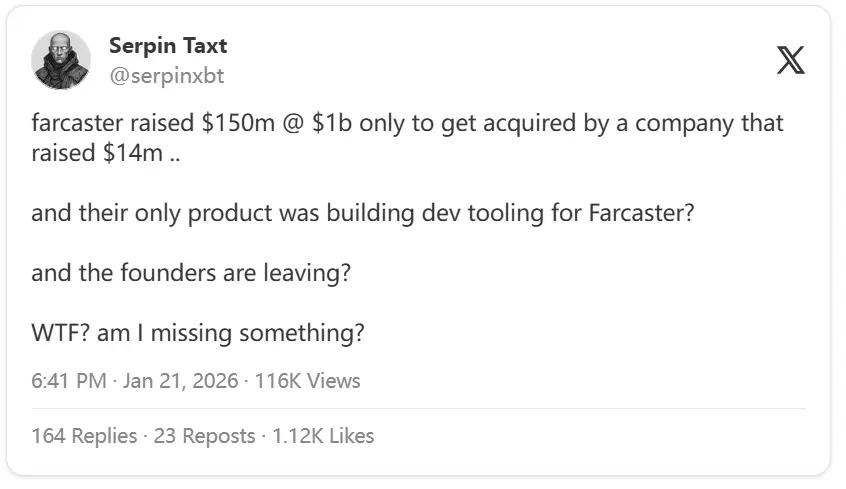
Many people thought that the entire Farcaster project had been shut down completely.
Some people also asked who Neynar is, or why a company that is only one-tenth the size of Farcaster would acquire a unicorn company valued at $150 million.
Some people even completely misunderstand the Farcaster architecture.
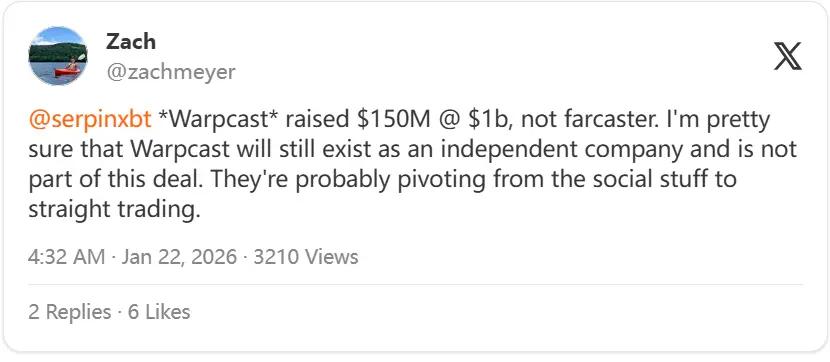
If you still can't understand it, congratulations, you've just personally experienced the core problem that Farcaster has always had: extremely chaotic information transmission.
Undoubtedly, Dan and Varun's achievements are remarkable. They successfully built an on-chain social protocol without issuing tokens, introduced many new primitives, and allowed developers to find product-market fit (PMF) before distribution.
The concept of Frames is indeed innovative, its protocol architecture is second to none, and the community that has formed around it is real and vibrant.
What truly brought Farcaster down was not its ability to execute its unique ideas.
In short, a series of unnecessary mistakes, investor pressure to meet Web2 social metrics, a lack of unwavering conviction within the team, and an inability to clearly communicate its vision all contributed to Farcaster's gradual decline.
From the outset, the confusing and almost mystical brand naming has puzzled the public. Merkle Manufactory is the for-profit entity that developed Farcaster (an open protocol), and its single client, Warpcast, was renamed Farcaster just months before the acquisition.
Every change has caused a stir, but outside the Farcaster ecosystem, these changes have almost never brought positive feedback. On the X platform, users frequently criticize Farcaster for constantly changing direction.
But rebranding isn't the only unexpected change.
Its lack of firm conviction in any ideology has consistently drawn negative attention to the platform. Let's review the timeline below.
Farcaster (also known as Warpcast) was originally a decentralized Twitter platform whose main users were early adopters, developers, and crypto natives looking to escape the noise of other platforms.
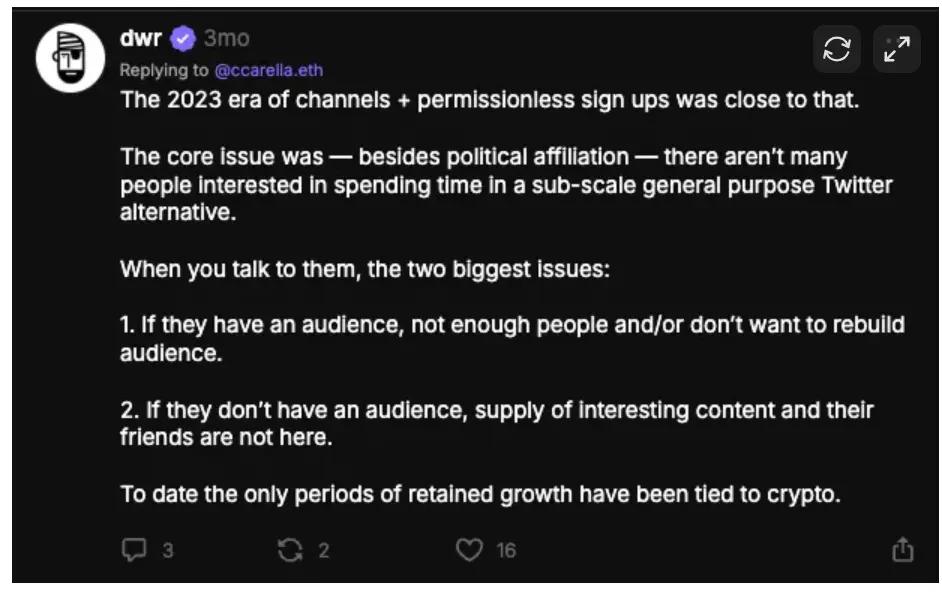
In 2024, Frames launched, creating entirely new social and on-chain primitives. Its focus on "full decentralization" (a point later criticized) attracted a large user base. Degen, a meme coin that later reached a market capitalization of $2 billion, was born from these primitives. However, because its vision was not centered on cryptocurrency, Frames overlooked its potential. Degen died out, and users left in droves.
The Farcaster Developer Day in September 2024 sparked another wave of excitement. Channels would become "Level 1 citizens," and Moxie was poised to redefine creator monetization. The slogan at the time was: "Coming for the community, staying for the network."
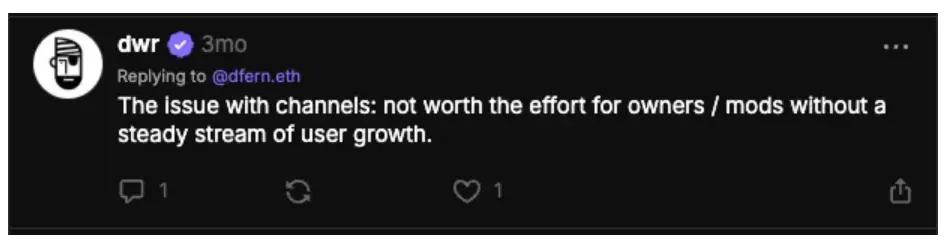
However, Channels was ultimately not included in the protocol because Channels owners lacked conviction and there was no meaningful growth to populate the Channels. Moxie's dream of revolutionizing creator monetization was also shattered by poor token design.
Farcon 2025: Miniapps seen as a growth engine. A large part of the conference will focus on helping more developers acquire their first users and monetize on Farcaster.
Later in 2025, it was reported that Farcaster's main client would be open source.
But by the end of 2025, the direction had completely shifted: from developers to transactions, with leadership admitting that decentralized Twitter had failed. This marked the beginning of its decline.
It's worth noting that the client application remains closed source.
In October 2025, they acquired Clanker, Base's flagship AI token issuer. Their financialization strategy was fully underway. Dan released a contract address, stating it was a random address, and anyone who activated it would be considered a low-age agent.
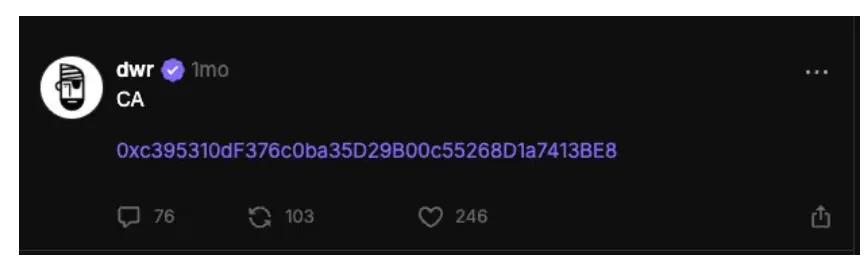
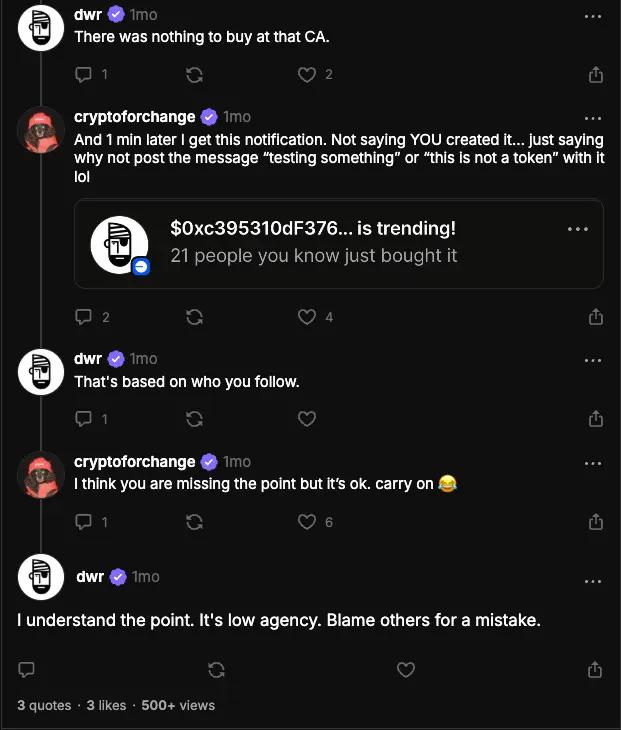
From this point on, things started to go wrong. Dan found himself in a dilemma, surrounded by enemies. His mood clearly plummeted, and he posted much less frequently. He was completely exhausted.
The app then spiraled out of control, inadvertently promoting RugPu, misleading users into blindly buying fraudulent tokens, and providing a poorly made list of low-quality tokens. They attempted the first Clanker pre-sale, which was completely sold out by a single wallet. Users were told this was the normal pre-sale process. The pre-sale was subsequently canceled.
Each event sparks heated discussions, with articles, podcasts, and commentary from onlookers pouring in. A good project isn't one that requires you to constantly update your knowledge to understand obscure details; rather, it should deliver a unified, coherent message and disseminate it systematically. Users don't need to know about Cook's private life to know that Apple will release a new phone in September.
If you look at all this from an outsider's perspective, you might think that all of this could have been avoided. But from an internal perspective, these changes may have had their rationale, given their isolated circumstances at the time. Merkle was seeking growth, and investors likely put constant pressure on the team to achieve metrics that were unreasonable from the start.
Farcaster is not Twitter, and never aspired to be the next Facebook. At its peak, it was simply a protocol with 100,000 active users. It shouldn't be considered a unicorn in the social media space. It's better suited to be social infrastructure within the crypto space.
This is precisely why this acquisition makes sense for the entire Farcaster network.
Neynar is a leading infrastructure provider in the Farcaster ecosystem. If you've ever developed a Frame or Miniapp, you've almost certainly used their services. Their API is excellent. They are one of only two Snapchain operators in a sufficiently decentralized network. Their vision aligns more closely with Farcaster's development direction than Merkle's haphazard growth strategy.
Now, a developer-centric leadership may take the necessary steps to expand the network's reach. They finally have the opportunity to open-source the client; reduce the difficulty (and even profitability) of running Snapchain nodes, thereby encouraging more clients and unique primitives to build on this powerful dataset. Neynar is no longer constrained by the pressure of venture capitalists chasing 100x growth and can truly build what Farcaster should be.
The timing is perfect. The vibe coding meta narrative is currently at its peak, with new ideas, applications, skills, and "Claude for xxx" popping up everywhere, and everyone just wants to build like crazy.
Neynar has launched a mini app studio, allowing non-technical users to build and deploy their first concepts on Farcaster in minutes.
Neynar doesn't need to tell stories. They just need to keep their infrastructure running smoothly. Perhaps that's enough.
The problem has never been the agreement itself, but rather the forced insertion of a story into something that doesn't need one.
Related reading:Is decentralized social networking dead? After five years of exploration, Farcaster transforms into a wallet provider.






