Original link: Big Ideas 2026
Original translation by CryptoLeo ( @LeoAndCrypto )

Recently, Ark Invest, founded by "Cathie Wood," released its annual "Big Ideas 2026" report. This report focuses on AI, robotics, blockchain, energy storage, and multi-omics (a research approach and strategy in biology), which ARK calls five major technology platforms. These five platforms will be interdependent and catalytic, accelerating technological convergence and creating newer platform functionalities. The report states that the world is entering an unprecedented technology investment cycle, with innovations on each technology platform having a profound macroeconomic impact and providing structural impetus for global growth.
The report also briefly touched on quantum computing, such as the long-standing concern about quantum computing cracking Bitcoin. ARK stated that performance improvements in quantum computing have been relatively slow, despite significant investment in its research and development. Google has only doubled the number of qubits in over four years. Even if its performance and cost improve dramatically, reaching the speed of Moore's Law, quantum computing will not be usable for encryption and decryption until the 2040s.
Odaily has compiled and organized the encryption-related content from "Big Ideas 2026". Enjoy!
1. Blockchain and Bitcoin
Once blockchains achieve mass adoption, all funds and contracts will migrate on-chain, enabling the verification of digital scarcity and proof of ownership. The financial ecosystem will likely be reconfigured to accommodate the rise of cryptocurrencies (including those connecting traditional finance and stablecoins) and smart contracts. These technologies should improve transparency, reduce the impact of capital and regulatory controls, and lower contract execution costs.
As more assets become more like currencies, and as businesses and consumers adapt to new financial infrastructure, digital wallets will become increasingly necessary. These wallets will evolve into AI-driven purchasing agents, and they may develop into distribution platforms for digital services.
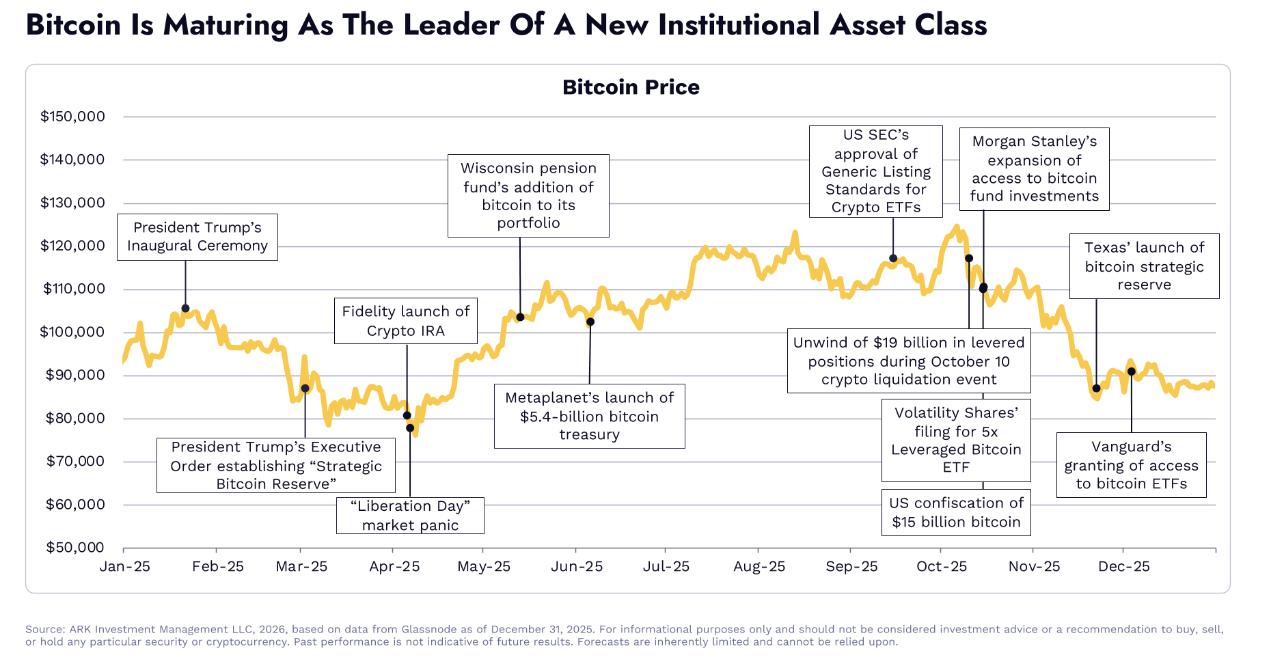
The chart above shows the price movement of Bitcoin throughout 2025 and the timeline of major Bitcoin-related events. It covers everything from Trump's inaugural address at the beginning of 2025 to the Bitcoin Strategic Reserve and Vanguard Group's involvement with the Bitcoin ETF at the end of the year.
Bitcoin is maturing as an emerging asset class. In the US, Bitcoin ETFs and publicly traded companies hold 12% of the total Bitcoin supply. By 2025, the balance of Bitcoin ETFs had grown by 19.7%, from approximately 1.12 million to approximately 1.29 million, while the Bitcoin held by publicly traded companies had grown by 73%, from approximately 598,000 to approximately 1.09 million. The proportion of circulating Bitcoin held by Bitcoin ETFs and publicly traded companies increased from 8.7% to 12%.
Bitcoin's risk-adjusted annualized return (Sharpe ratio) has outperformed the cryptocurrency market average over time. For most of 2025, Bitcoin's risk-adjusted returns surpassed most other large-cap cryptocurrencies, and since the most recent cycle low (November 2022), early 2024, and early 2025, its average annualized Sharpe ratio has also been higher than the average of ETH, SOL, and the other nine tokens in the top 10 by market capitalization on CoinDesk.
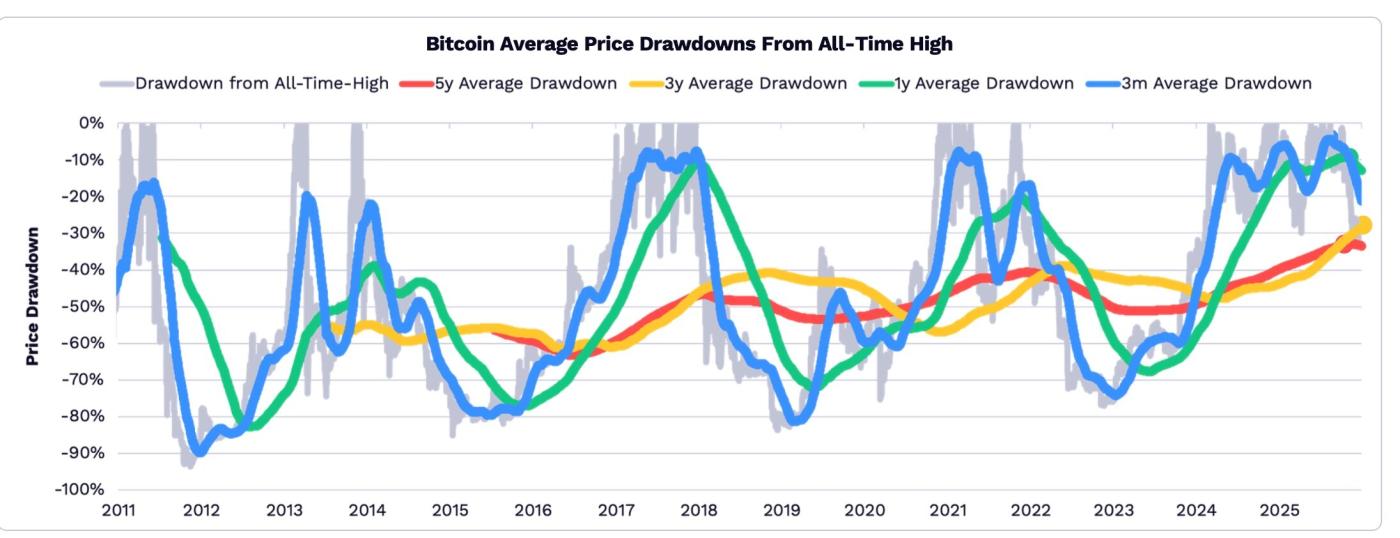
In 2025, the decline in Bitcoin's price relative to its all-time high narrowed, and its volatility decreased as Bitcoin's role as a safe-haven asset grew. Looking at timeframes of 5 years, 3 years, 1 year, and 3 months, Bitcoin's pullback in 2025 was not significant compared to historical pullbacks.
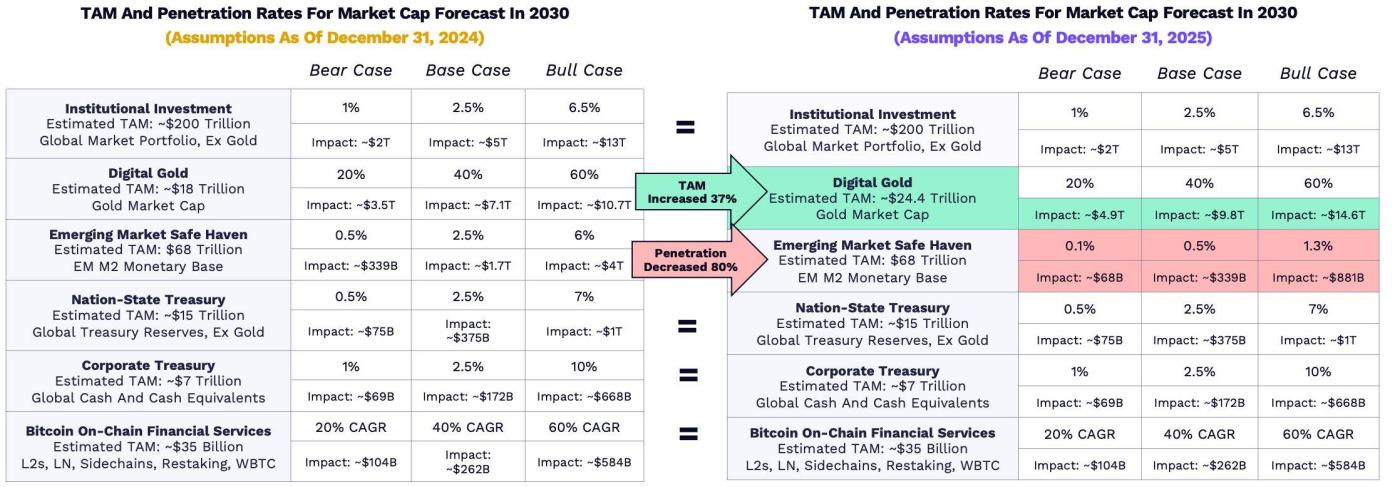
With the steady rise in gold prices and the accelerated adoption of stablecoins, two figures have changed in ARK's 2030 Bitcoin valuation model: the total digital gold TAM (Total Asset Value), after a 64.5% increase in gold's market capitalization in 2025, represents a 37% increase in its potential market size; and the penetration rate of stablecoins in developing countries has decreased by 80% due to Bitcoin's status as a safe haven in emerging markets.
Further reading: Ark Invest releases Bitcoin valuation model: BTC to start at $500,000 per coin by 2030 .
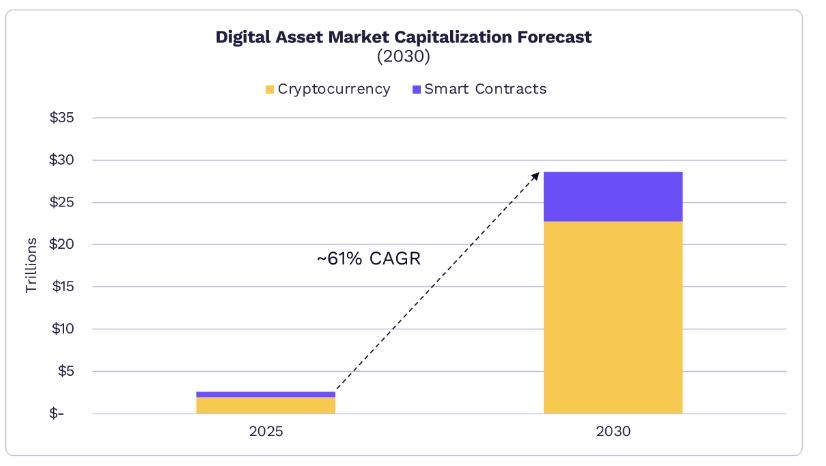
By 2030, the market value of digital assets could reach $28 trillion, with the smart contract and pure digital currency market potentially growing at an annual rate of approximately 61% to $28 trillion by 2030. ARK believes that Bitcoin could account for 70% of this market, with the remainder dominated by cryptocurrencies such as ETH and Solana.
Data shows that Ethereum remains the preferred blockchain for on-chain players, with assets on Ethereum now exceeding $400 billion. Among the eight major blockchains, stablecoins and the top 50 tokens on seven of them account for approximately 90% of the market value. On blockchains other than Solana, Meme Coin's market share is approximately 3% or lower. On Solana, however, Meme Coin's market share is approximately 21%.
According to ARK's forecast, Bitcoin is likely to dominate the cryptocurrency market capitalization, growing at a compound annual growth rate (CAGR) of approximately 63% over the next five years, increasing from nearly $2 trillion to $16 trillion by 2030.
By 2030, the market capitalization of smart contracts could grow at a rate of 54% per year to reach approximately $6 trillion, generating approximately $192 billion in annual revenue at an average fee rate of 0.75%.
Two to three L1 smart contract platforms should capture the majority of the market share, as their market capitalization derived from currency premiums (value storage and reserve asset characteristics) will exceed their discounted cash flows.
2. Tokenized assets
Thanks to the GENIUS Act, financial institutions are reassessing their stablecoin and tokenization strategies. With the clarification of the GENIUS Act's regulations, stablecoin activity has surged to record highs. Numerous companies and institutions have launched their own stablecoins, while BlackRock has disclosed plans for an internal tokenization platform. Large enterprises and fintech companies such as Tether, Circle, and Stripe have also launched or supported Layer 1 blockchains optimized for stablecoins.
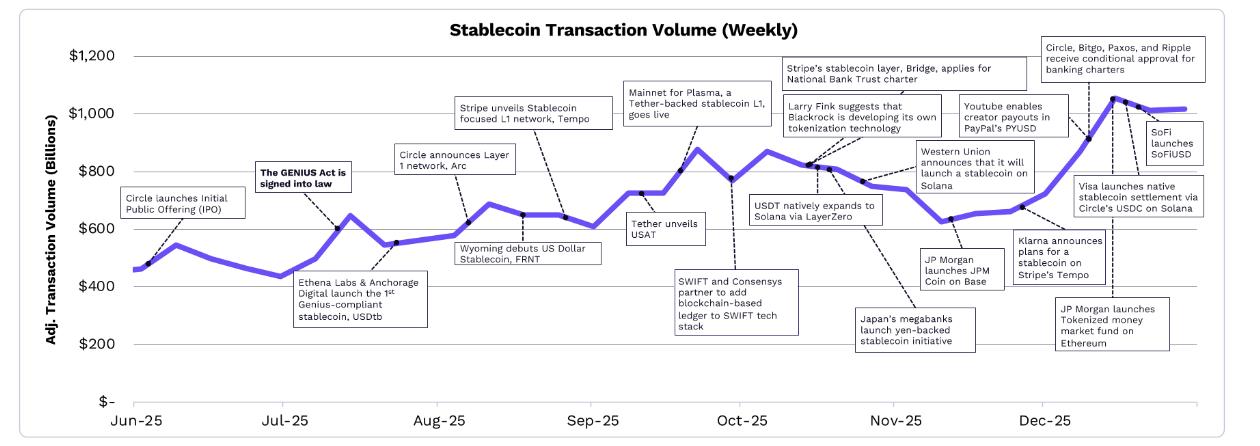
In December 2025, stablecoin transaction volume reached $3.5 trillion, far exceeding most traditional payment systems.
In December 2025, the adjusted 30-day moving average of stablecoin transaction volume was $3.5 trillion, 2.3 times the total volume of Visa, PayPal, and remittances.
Circle's stablecoin USDC dominates in adjusted trading volume, accounting for approximately 60%, followed by Tether's USDT at approximately 35%.
In 2025, the supply of stablecoins increased by about 50%, from $210 billion to $307 billion, with USDT and USDC accounting for 61% and 25% respectively.
Sky Protocol is a stablecoin issuer projected to have a market capitalization exceeding $10 billion by the end of 2025. Also noteworthy is that PayPal's PYUSD has seen its market capitalization grow more than sixfold, reaching $3.4 billion.
Driven by US Treasury bonds and commodities, the tokenized asset market is projected to triple in size by 2025, reaching $19 billion.
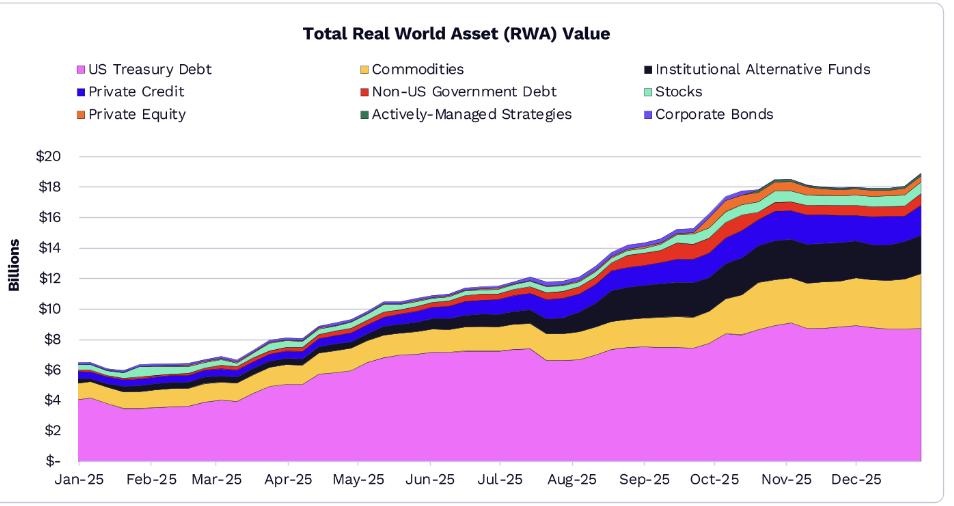
In 2025, the market value of tokenized real-world assets (RWA) grew by 208% to $18.9 billion.
BlackRock's $1.7 billion BUIDL money market fund is one of its largest products, representing 20% of $9 billion in U.S. Treasury bonds;
Tether (XAUT) and Paxos (PAXG)'s tokenized gold products led the rise in tokenized commodities, increasing to $1.8 billion and $1.6 billion respectively, accounting for 83% of the total.
Publicly traded stock tokens have raised nearly $750 million.
RWA is likely to become one of the fastest-growing categories, as off-chain assets still represent the biggest growth opportunity for on-chain adoption, despite decentralized assets accounting for the majority of global value.
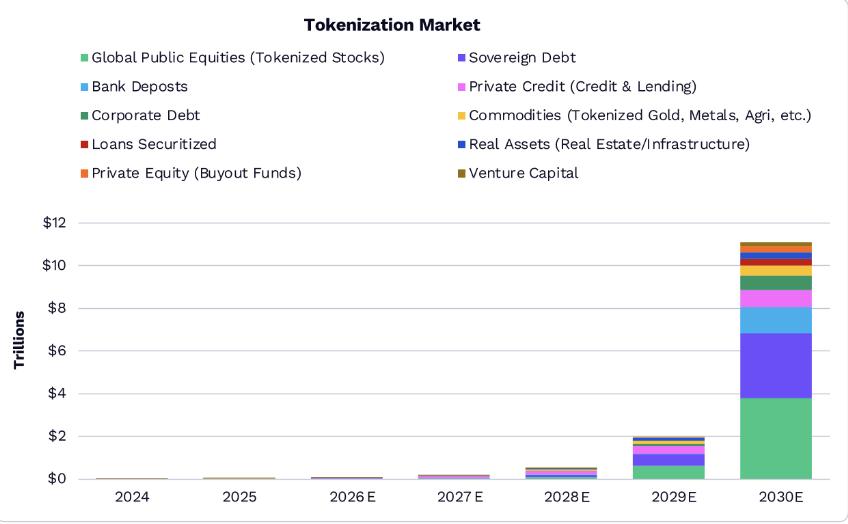
By 2030, the global tokenized asset market may exceed $11 trillion.
By 2030, tokenized assets could grow from $19 billion to $11 trillion, representing approximately 1.38% of global financial assets.
While sovereign debt is currently the primary area for tokenization, bank deposits and global public equity are likely to take up a larger share on-chain over the next five years. With regulatory clarity and the development of institutional-grade infrastructure, tokenization is likely to see widespread adoption.
Traditional companies are expanding their on-chain presence by launching their own infrastructure. For example, Circle (Arc), Coinbase (Base, cbBTC), Kraken (Ink), OKX (X Layer), Robinhood (Robinhood Chain), and Stripe (Tempo) are all launching L1/L2 networks under their own brand names to support their own products, such as Bitcoin-collateralized loans, tokenized stocks and ETFs, and stablecoin-based payment channels.
3. DeFi Applications
The acquisition of value from digital assets has shifted from the network to applications. The network is becoming a public infrastructure, no longer the economic layer, but rather pushing user economics and profits to the application layer. Led by Hyperliquid, Pump.fun, and Pancakeswap, total DeFi application revenue reached a record high of approximately $3.8 billion in 2025.
In 2025, one-fifth of app revenue was generated in January, the highest single-month revenue ever. Currently, 70 apps and protocols have monthly recurring revenue (MRR) exceeding $1 million.
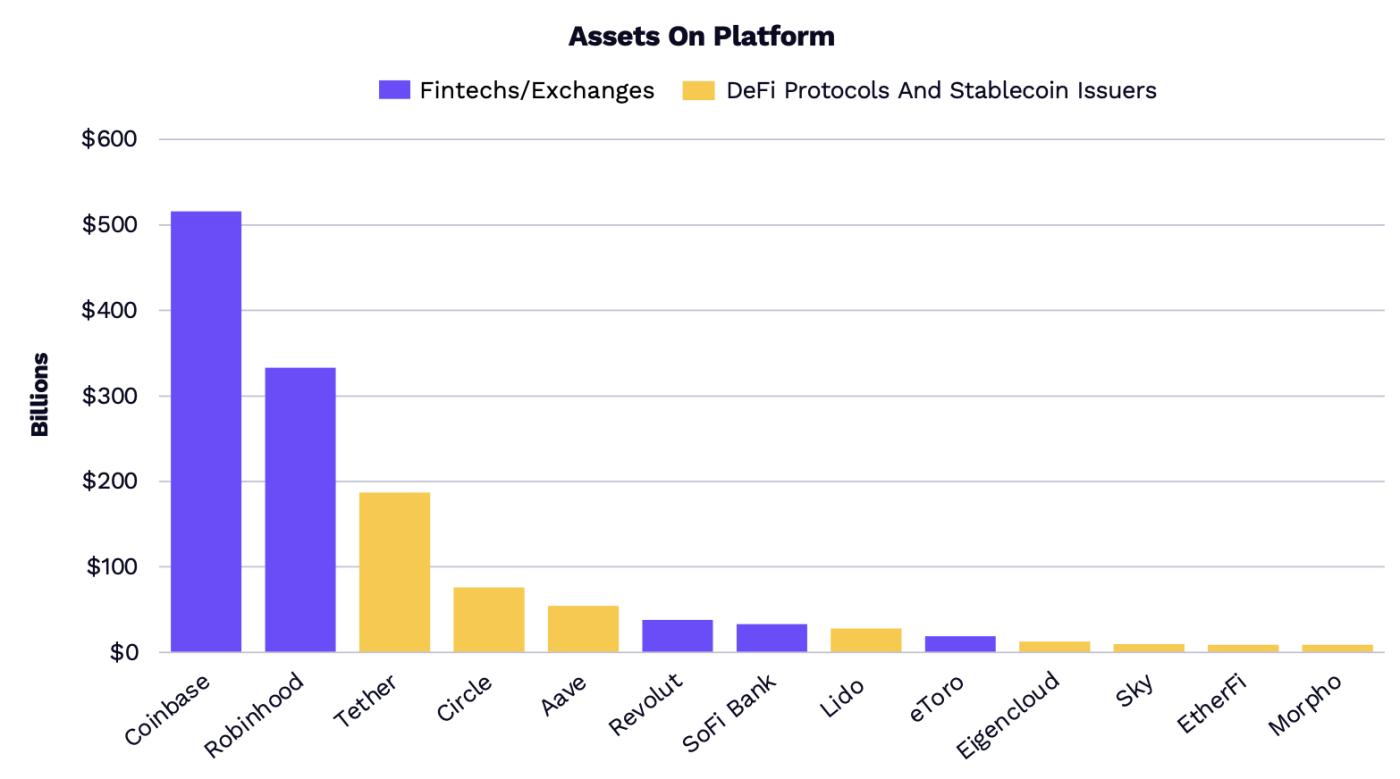
The asset size of DeFi and stablecoin issuers is catching up with that of many fintech companies. The difference in in-platform assets between traditional fintech platforms and native cryptocurrency platforms is narrowing, indicating that traditional infrastructure and on-chain infrastructure are gradually converging. DeFi protocols such as liquidity staking or lending platforms are attracting institutional capital and rapidly scaling.
Among the top 50 DeFi platforms, each platform has a TVL exceeding $1 billion, while among the top 12 platforms, each platform has a TVL exceeding $5 billion. The companies with the highest revenue efficiency globally include Hyperliquid, Tether, and pump.fun.
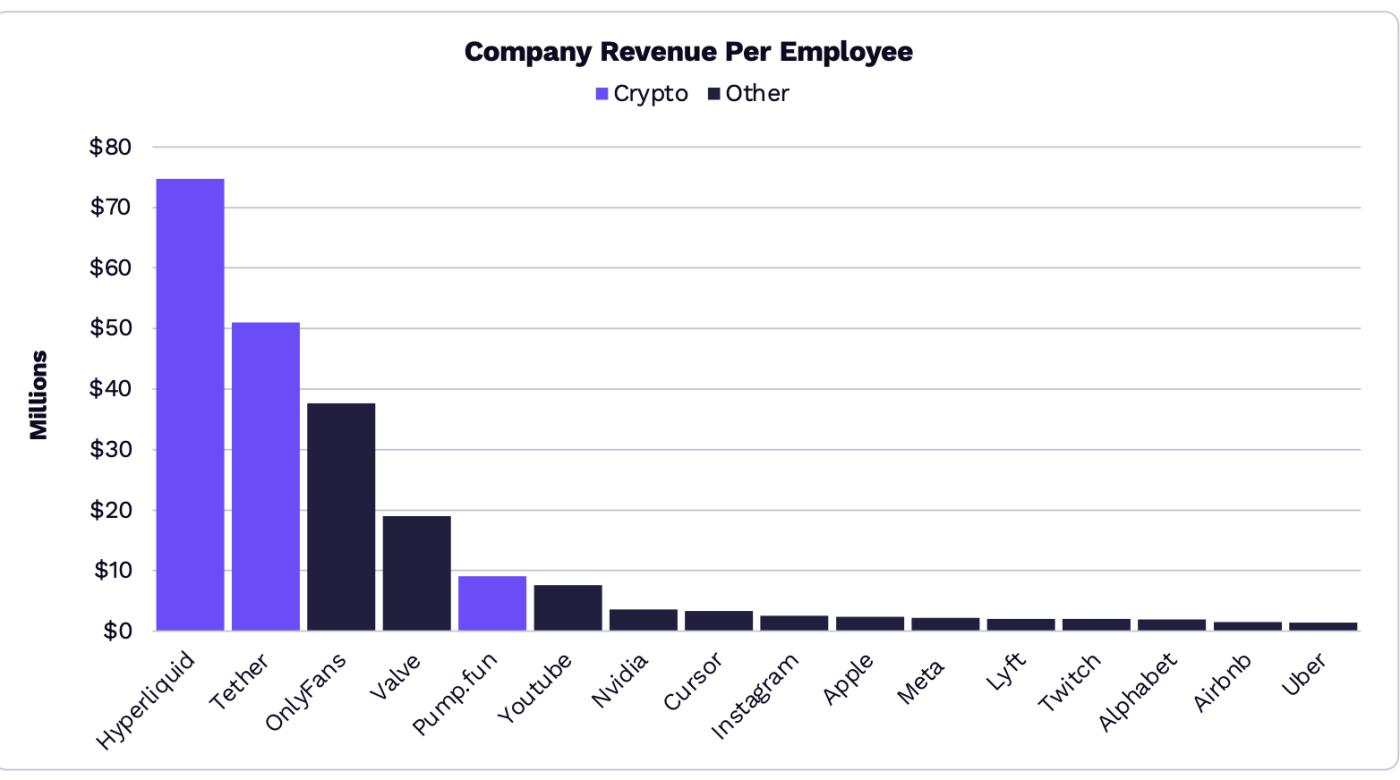
In 2025, Hyperliquid, with fewer than 15 employees, generated over $800 million in annual revenue. Perpetual contracts, stablecoins, and Meme coins, as on-chain verticals, possess clear product-market fit, enabling them to attract a large number of users and capital.
On-chain businesses and protocols are redefining productivity, and double-digit workforces are driving world-class revenue and profitability.
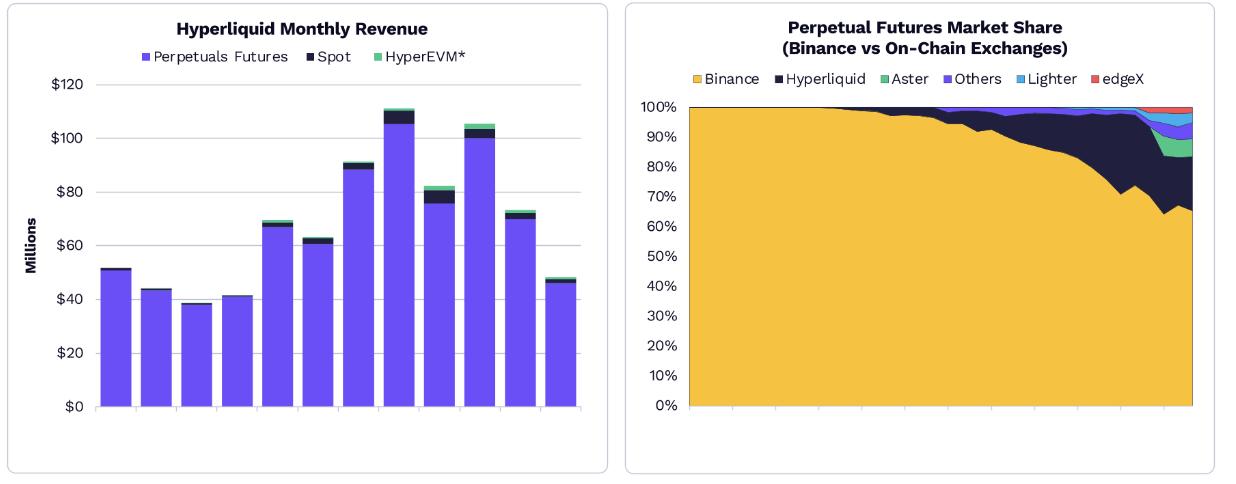
In the perpetual contract market, DeFi derivatives led by Hyperliquid are taking market share from Binance.
Layer 1 is evolving from a revenue-generating network into a monetary asset. Applying a 50x high-growth revenue multiple to its network revenue suggests that over 90% of Ethereum's market capitalization is attributable to its role as a monetary asset.
Solana has generated $1.4 billion in revenue, indicating that 90% of its valuation depends on its network utility.
Only a few crypto assets can retain monetary attributes and serve as a liquid store of value.
Furthermore, the ARK report also mentions artificial intelligence, noting that since the ChatGPT boom, the growth rate of data center systems has increased from 5% to 29% annually. As AI infrastructure models become a new layer in the internet architecture, consumer interaction with applications is decreasing, with more interaction occurring through AI agents. This structural shift is accelerating the digital experience for consumers. Consumers are adopting AI far faster than they did with the internet. By 2030, AI agents are expected to facilitate over $8 trillion in online spending. The share of AI agents in digital transactions is projected to continue increasing—from 2% of online spending in 2025 to approximately 25% in 2030.
By 2030, AI agents are expected to generate approximately $900 billion in commercial and advertising revenue. As AI agents drive the transformation of the digital economy, AI-mediated consumer revenue will grow at an annual rate of approximately 105% over the next five years, increasing from approximately $20 billion currently to approximately $900 billion by 2030. Lead generation and advertising will drive the majority of this growth, far exceeding the contribution from consumer subscription revenue.
The x402 protocol is currently the closest infrastructure in the crypto industry to AI agent consumption, which has also promoted the development of crypto + AI.