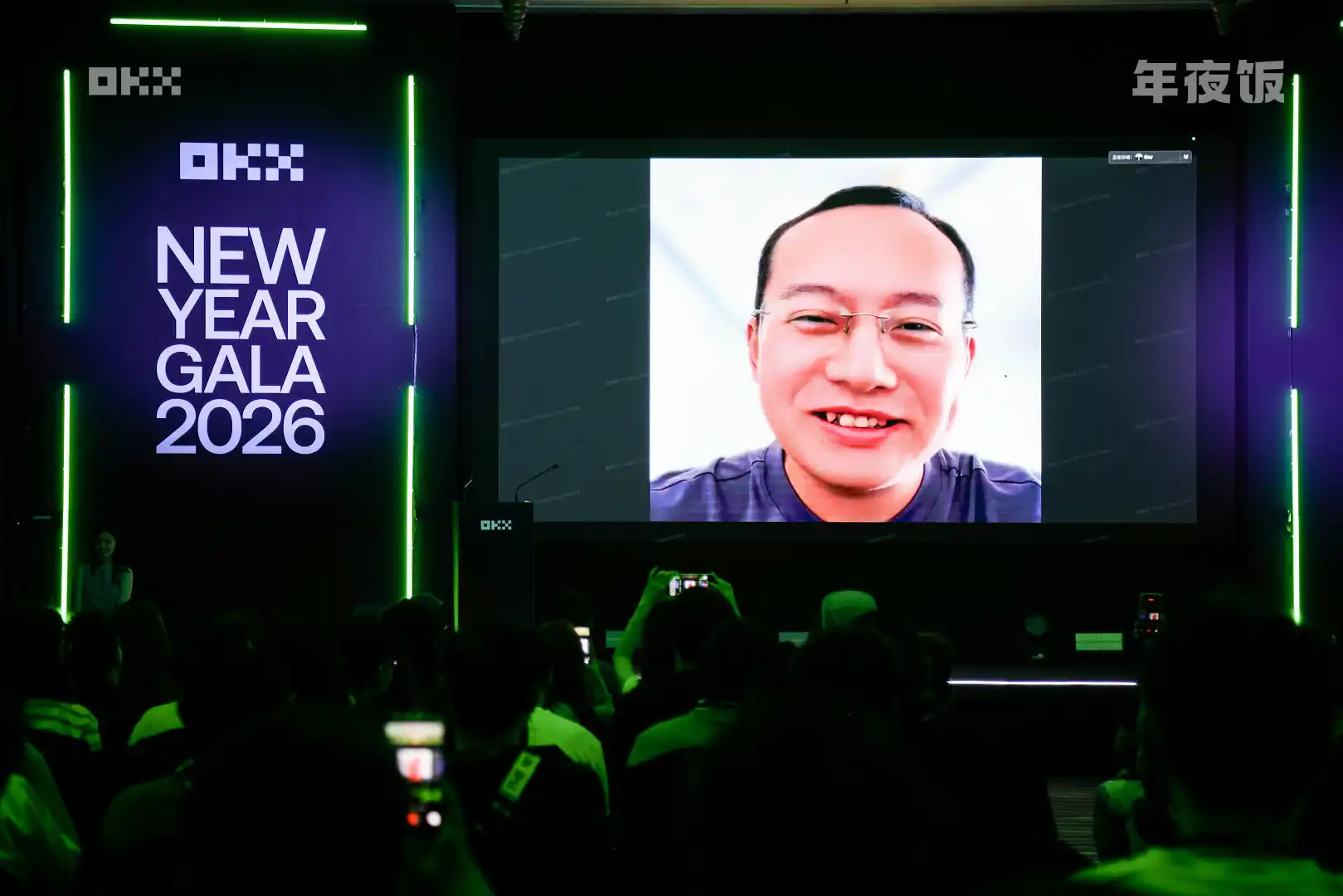
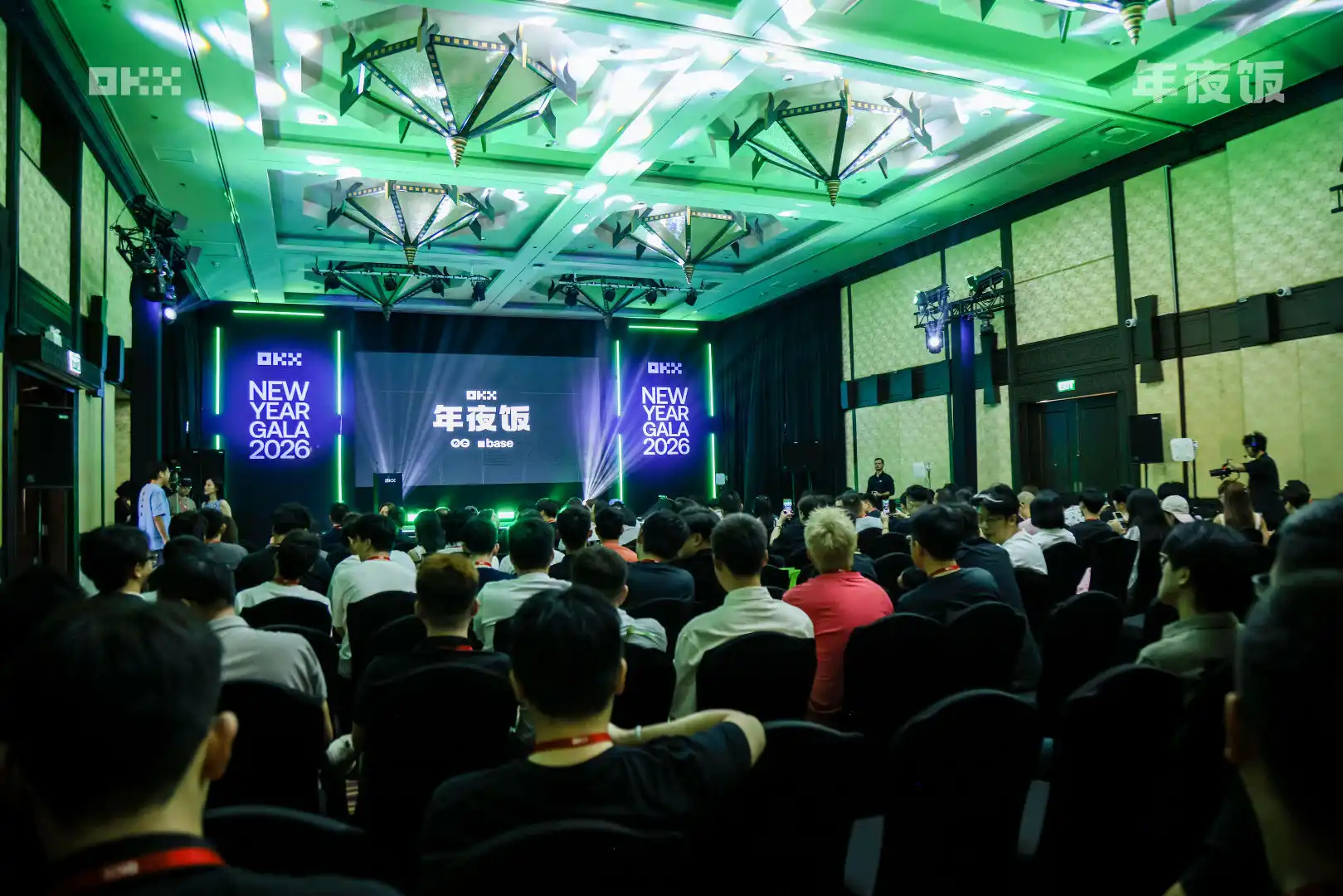
On January 24, 2026 , OKX Founder and CEO Star attended the "New Year's Eve Dinner" event via video link, sharing his latest thoughts on the present with sincere expression. The OKX "New Year's Eve Dinner" is a special event hosted by OKX for industry builders to celebrate the Lunar New Year together.
The following is the full text of Star's speech (edited):
Year after year, we hope to continue this event. We look forward to continuing this journey with all the influencers, KOLs, and partners in the future, growing and achieving together in the next decade of the Crypto and Blockchain industry.
Let me briefly share some of my thoughts from the past year.
See the trends in industry evolution
I've spoken on many occasions about how I view the cryptocurrency and blockchain industry. Since Bitcoin's inception in 2008, this industry has been around for fifteen or sixteen years. Back then, we viewed Bitcoin more like virtual currency or game tokens. We didn't truly understand what blockchain was, nor did we know how the industry would develop, where regulation would lead, or to what extent applications would reach—nobody knew.
As the industry evolved, Bitcoin, based on blockchain, could only do one very simple thing: issue tokens. Later, Ethereum emerged, claiming that blockchain technology could not only issue tokens but also support various applications "like mini-programs," positioning itself as the "operating system of the blockchain."
Over the years, everyone, including OKX, has worked together to play a vital role in the Ethereum ecosystem. Today, Ethereum has indeed become the main platform for DApps, with many financial-grade applications built on it. At the same time, Ethereum is constantly evolving towards higher performance, and many high-performance chains have emerged in the market, such as Solana. OKX is also exploring its own path. Although X Layer is still in its early stages and not yet mature, I believe it will achieve great things in the future.
As the industry develops to a certain stage, it attracts increasing attention from regulatory agencies. Starting as early as 2017, regulatory agencies tended to suppress the industry as a whole, but after several years of development, I have noticed that some core trends are changing.
The first trend is that regulators are gradually recognizing that equating Bitcoin with money laundering tools is unfounded. Any financial system can be abused; the key is that it can be abused, thus requiring governance and regulation. Illegal activities constitute a very small portion of blockchain activity; it's more like a global, open, fair, and transparent financial system.
The second trend is that more and more young people—those born in the 1990s, 1995s, and 2000s—have grown up hearing stories about Bitcoin. My child asked me what Bitcoin was many years ago. Different generations are changing their perceptions of "how to safely store assets." If someone my age asked me where it's safest to put money, I might say large banks, mature financial systems, and products that are more modern and user-friendly. But if you talk to the younger generation, many of them feel that using tools like OKX Wallet or Coinbase Wallet to manage assets is safer and more convenient because it's transparent and verifiable on-chain, and the experience is constantly improving.
When it comes to products like stablecoins, people worry about potential rigging. Taking USDG as an example, if it operates under the regulatory frameworks of the EU, Singapore, and potentially the US in the future, then logically, the possibility of rigging is very small. Further, regarding custody: in a self-custody model, once you back up your private key, you can transfer your assets to any other wallet—you can take your assets at any time; we have no ability to take them. Custody primarily involves the exchange system. OKX has weathered many storms over the years, and whether it's our corporate governance structure, board governance, or our increasing number of compliance licenses globally, I believe we are becoming more and more standardized and taking on more and more responsibility.
Against this backdrop, the industry has experienced tremendous upheaval over the past four or five years. On one hand, some have questioned or even opposed cryptocurrencies; on the other hand, more and more people have begun using Bitcoin or other crypto assets. In this process, Crypto is entering a completely new era.
More importantly, crypto is aligning itself with "future trends." Starting in the United States, the trend of crypto entering the mainstream has spread worldwide: countries and regions such as the United Kingdom, the European Union, Japan, and Singapore have begun to regard crypto as an important direction that they need to address, build upon, and incorporate into their governance frameworks in the long term, and it is even gradually rising to a kind of "national-level" competition and strategic positioning.
Uphold long-termism and protect the reputation of the crypto industry
So what I want to say to everyone is: stick to long-termism.
What did you miss in the past, and what will you do in the future? The first thing to do to answer "what to do in the future" requires you to discard the noise and return to the trend itself, based on your trust in the industry, the company, and the institution. Let's start with the trend I just mentioned:
First, technological development has progressed from initially only being able to create tokens, to being able to create DApps in the Ethereum era, and now to being able to create various more complex, financialized, and large-scale applications such as RWA (Real-World Asset On-Chain).
Secondly, there are changes in population structure and generational attitudes. More and more young people are beginning to believe that crypto is safer, more trustworthy, and has a better future than traditional methods in some aspects.
The third trend is that governments and regulatory agencies around the world are beginning to systematically promote the development of this industry and related sectors.
Based on these three major trends, you must make a clear plan for your next five to ten years. This plan cannot be swayed by market sentiment or various noises every day. What harms you is not opportunity, but noise. Life must have a foundation, and I strongly urge everyone to develop their own long-term strategy. I sincerely believe that if you start thinking seriously and taking action now, you will thank yourself many years from now.
You'll find that everyone comes into this world with their own opportunities. The saying "everyone has their own unique talents" often means that it's not that you're incapable, but rather that you're being distracted by too many irrelevant voices. You should choose your "vehicle" based on the three points I just mentioned. Once you've chosen your strategy, you must learn to "shut down"—block temptations, ignore short-term fluctuations, and even forget about the money for a period of time.
I hope to instill in everyone a kind of faith: faith in the blockchain industry itself as a member of the industry.
The second thing I want to talk about is based on the current stage of development of the entire industry. If you hold Bitcoin, Ethereum, or even larger positions, then you must cherish and protect this industry. Because today's crypto is completely different from the past. Over the years, our industry has been questioned, belittled, and even experienced extreme suppression. Besides the industry's own stage of development, another very important reason is the irresponsible remarks of some so-called "industry leaders" who have long used frivolous and exaggerated language to describe the industry, seriously misleading the public.
When we use terms like "hundredfold return" and "All In" to describe our industry, we need to seriously consider how the government and regulators will view us. Defining your business with "all-or-nothing" and "get-rich-quick fantasies" essentially harms and denigrates the industry, while simultaneously destroying the long-term value of your assets. In essence, you're "smashing your own bucket."
On the other side of the world, however, a completely different picture emerges: stablecoin legislation is progressing, representatives of the cryptocurrency industry are signing bills at the White House, and numerous cryptocurrency companies are listing on the NYSE and Nasdaq. In many countries and regions, cryptocurrencies have already entered the mainstream, and industry practitioners are gradually standing on the same level as cutting-edge industries such as AI and autonomous driving, gaining the respect they deserve.
I want to say that if you're only making money in this industry but not earning respect, then such success is very fragile. Wealth without social recognition and institutional support is easily negated and liquidated. Respect isn't something given by others; it's something you earn yourself, and respect in this industry requires the collective effort of every practitioner.
We are engaged in a technology-driven industry that uses technology to eliminate inequality and enable more people to enjoy higher-quality fintech services. Whether you are a company or a KOL or influencer, you are all essentially participants, builders, and beneficiaries of this industry. As a community, we need to work together to maintain the industry's reputation and earn genuine respect from the outside world.
Jokes are fine occasionally, but if you consistently and repeatedly use extreme and emotional terms on your homepage to describe trading and the industry itself, you need to consider: how will regulators view it? How will users and the world view it? Therefore, leading companies, industry organizations, and KOLs all have their own responsibilities. Leading companies should act with the responsibility of leaders, KOLs should act with the awareness of KOLs, and platforms have their responsibilities. Since we are all participants in the industry's growth, we should work together to maintain the industry's reputation and earn long-term, sustainable respect.
OKX's Three Major Business Directions in 2026
Next, I'd like to discuss OKX's overall plans for 2026. These plans are also based on several core judgments I've repeatedly mentioned earlier: technological development, application development, and the evolution of the regulatory and political environment.
First, at the transaction and service level, we aim to provide more diversified, user-friendly, and convenient exchange services within the global regulatory framework. Whether it's crypto, stocks, or other asset classes, we will continue to expand our service boundaries while adhering to legal and compliant principles, giving users more choices.
Secondly, we are bringing more assets onto the blockchain. We already have xBTC, and in the future, we will have more "X" series products covering cross-chain assets, RWA, and even real-world assets such as stocks. We hope that through OKX's X Layer and Web3 wallets, these will become a unified carrier for multiple assets and a gateway for users to enter the world of on-chain assets.
Thirdly, there's the OKX Pay payment service. Since its launch last year, this product has received mixed reviews, and we acknowledge that it's still somewhat rudimentary, but we will continue to upgrade it. Currently, we have established connections with local banking systems in several countries and regions, including Brazil, Europe, and Singapore. Even in areas where bank card services are temporarily unavailable, we hope to provide a more user-friendly Web3 wallet, allowing ordinary users to easily manage their assets, transfer money to friends or merchants, and fulfill their daily payment needs without complicated operations. Our goal is for OKX to provide ordinary users with an easy-to-use gateway service for managing their digital assets.
Overall, OKX will focus on these three areas in 2026: compliant trading services, multi-asset on-chain infrastructure, and payment and wallet experience.
Beyond that, there's another crucial element: our partners—all of you here today. I've made one clear request of the company: OKX must grow closer to its partners. We will continue to maintain a low profile, but that doesn't mean distancing ourselves. Whether you're a KOL, partner, market maker, or channel partner, we will show you even greater respect and work with you to explore more mutually beneficial avenues.
We will continue to optimize our KOL Program and Affiliate Program, while building a more professional customer service and account manager system to provide one-on-one communication channels. We welcome any suggestions you may have for OKX—including criticisms or areas where we believe our competitors are doing better. For actionable issues, we will respond and improve within clearly defined timeframes through a clearer SLA mechanism; even when it involves long-term principles and core business logic, we will continue to listen and discuss better solutions with everyone.
Finally, I'd like to talk about X Layer and OKB. From a compliance perspective, OKX only operates with licenses in major countries and regions, while we are subject to strict regulation and have many regulatory red lines that we cannot cross. From a long-term business perspective, we also do not agree with the "killing the goose that lays the golden eggs" model. We are not inherently opposed to MEME. MEME is essentially a community-based token, and we welcome cooperation if the community is healthy and transparent. However, we will not participate in projects that are highly centralized, obviously unfair in design, or require the platform to "cooperate in creating a 100x miracle."
However, one thing is clear: the development of X Layer and OKB will not stop. X Layer is one of OKX's core infrastructures. In the past, we haven't invested enough in Web3, but since last year, we've elevated it from the periphery to the core. X Layer is the foundation of our long-term strategy. Currently, its TVL (TVL) may only be a few hundred million US dollars, but our goal is 5 billion, or even 10 billion. In the future, a large number of applications, whether for exchange users, payment users, or wallet users, will be built on X Layer.
OKB, as an ecosystem token and gas token, has a clear and long-term positioning. There is no question of OKX abandoning X Layer or OKB. With the growth and development of OKX itself, and the entire crypto and blockchain industry, I believe that X Layer and OKB will remain core strategic components of OKX in the long term.
We will continue to invest in ecosystem and infrastructure development without ceasing. Regardless of whether we go public in the future, technology and long-term value will always be at our core.