Written by: TechFlow TechFlow
When talking about robots, many people will think of a movie: "I, Robot".
In 2004, "I, Robot," starring Will Smith, was released and became one of the most successful science fiction films.
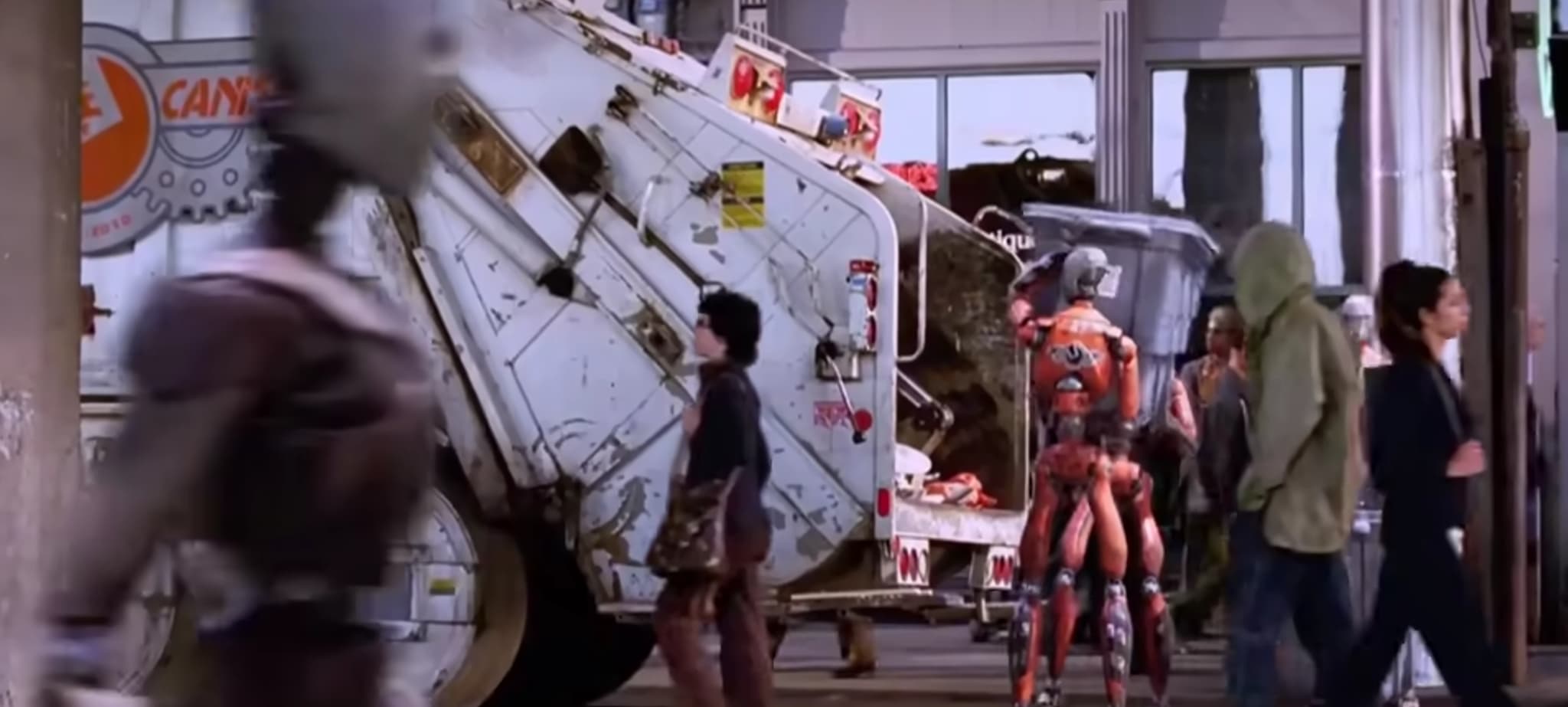
In the 2035 vision depicted in the movie, the NS-5 service robot launched by robot manufacturer USR has been fully integrated into people's daily lives. Standing on the streets of Chicago, you can see NS-5s rushing around, delivering packages, walking dogs, cleaning, carrying heavy objects, etc. According to the plan, there is one robot for every five people.
△ Movie screenshot
Movies carry people's beautiful imagination of the future. Twenty years later, with the development of software and hardware, humanoid robots developed by major companies such as Boston Dynamics, Unitree Robotics, and Tesla are moving from the laboratory to large-scale production lines, pushing scenes that originally only existed in science fiction movies further into reality. However, there is still a long way to go before they can be applied to real consumer scenarios.
Fortunately, we still have ten years to catch up before the 2035 deadline set in the movie. Behind acknowledging this gap, the key to the robot industry's rapid expansion and penetration into the consumer market lies in:
This is exactly what OpenMind, a leading project in the robotics field, is achieving: building a universal operating system and a decentralized collaborative network that enables robots from different manufacturers and of different forms to safely trust each other, share information, and work together globally, thereby better thinking, learning, collaborating, and evolving, and accelerating the robotics industry into the consumer era.
True "consensus" often means crowding, and the robotics industry is a prime example: it has a very strong consensus and is dominated by giants.
According to the "Global Robotics Market Report" released by Precedence Research, the robotics industry will grow from $108.55 billion in 2025 to $375.95 billion in 2034, and the RaaS (Robotics as a Service) model will unlock trillion-dollar opportunities.
Beneath this enormous potential lies a national strategic deployment, with countries including China, Japan, South Korea, the United States, France, and Germany all announcing that they will include the robotics industry as a key focus. On the other hand, tech giants are eager to enter the market, with companies like NVIDIA, Tesla, Figure AI, and Unitree Robotics launching related products. Web3, always quick to seize opportunities, has also reacted: Coinbase Ventures has listed "AI and robotics" as one of its four key investment areas for 2026, while Virtuals announced its entry into the embodied intelligence field as early as October 2025.
In this cutthroat arena where attention and capital are pouring in like crazy, OpenMind is an example that cannot be ignored.
On one hand, OpenMind's attention stems from its stellar team. According to Rootdata, the OpenMind team comprises top experts in robotics, AI, distributed systems, and security.
As the founder and CEO, Jan Liphardt is a professor of bioengineering at Stanford University with extensive experience in AI, biology, and distributed systems. He has received funding from the NIH, NSF, NCI, and the U.S. Department of Energy and is responsible for leading the overall technology development of OpenMind. Boyuan Chen, who serves as CTO, has a background in the MIT Computer Science and Artificial Intelligence Laboratory (MIT CSAIL) and previously worked at Google DeepMind.
In addition, OpenMind's advisory team includes Steve Cousins, head of robotics at Stanford; Bill Roscoe of the Oxford Blockchain Centre; and Alessio Lomuscio, professor of secure AI at Imperial College London.
When such a team configuration is presented to them, many people are more willing to believe that this is not a team that only makes demos, but a regular army that can truly deploy technology on a large scale.
If the team is the fundamental factor, then market performance is the touchstone.
Since its founding in 2024, OpenMind's major achievements, according to official disclosures, include:
More than 180,000 users and thousands of bots participated in the test through the OpenMind App and the OM1 developer portal.
Major hardware companies, including Unitree, DEEP Robotics, Dobot, and UBTECH, all use OpenMind OM1 as their core technology stack.
Partnering with Robostore, Unitree's largest distributor in the US, we launched the world's first comprehensive humanoid robot education program. Robostore already supports more than 100 top institutions, including Harvard University, MIT, and Stanford University.
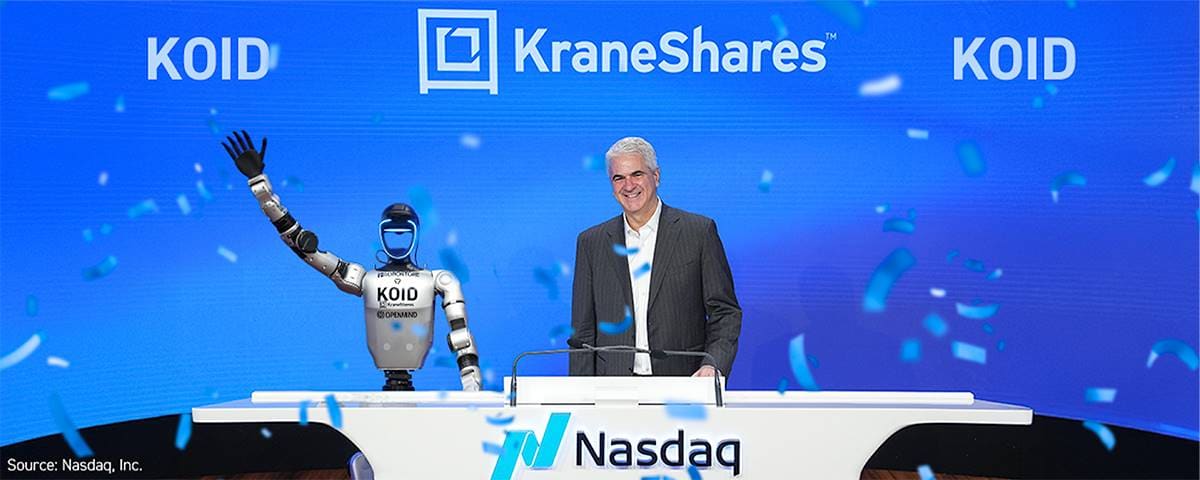
At the listing ceremony of the ETF launched by KraneShares on Nasdaq, a humanoid robot powered by the OM1 operating system from OpenMind made its debut and participated in the listing launch.
This combination of "elite team + strong implementation capabilities" has naturally attracted a frenzy of investment from Smart Money in the Web2 and Web3 fields, both in the East and West.
On August 4, 2025, OpenMind announced the completion of a $20 million funding round, led by Pantera Capital, with participation from Ribbit, Sequoia China, Coinbase Ventures, DCG, Lightspeed Faction, Anagram, Pi Network Ventures, Topology, Primitive Ventures, Amber Group, and many other well-known angel investors.
Amidst the hype, a sober examination of the project is even more necessary:
How has OpenMind managed to simultaneously enable hardware manufacturers to open up their underlying technology, attract capital investment, and retain real users? What exactly has it brought to the robotics industry?
To quote Professor Jan Liphardt, founder of OpenMind:
If AI is the brain and robots are the body, then coordination is the nervous system. Without coordination, there is no intelligence. The system we are building will enable robots to work, act, and evolve collaboratively.
This statement encapsulates OpenMind's core philosophy: isolated superintelligence is of little significance; embodied intelligence capable of collaboration is the future.
Currently, most robots from different manufacturers are like isolated "islands." They possess expensive hardware and complex algorithms, but lack a unified language to understand humans, the environment, and fellow robots. OpenMind's two-layer architecture aims to fill this gap in the "neural network" for robot collaboration:
As the world's first open-source intelligent robot operating system, OM1's ambition is very straightforward: to become the Android of the robot world.
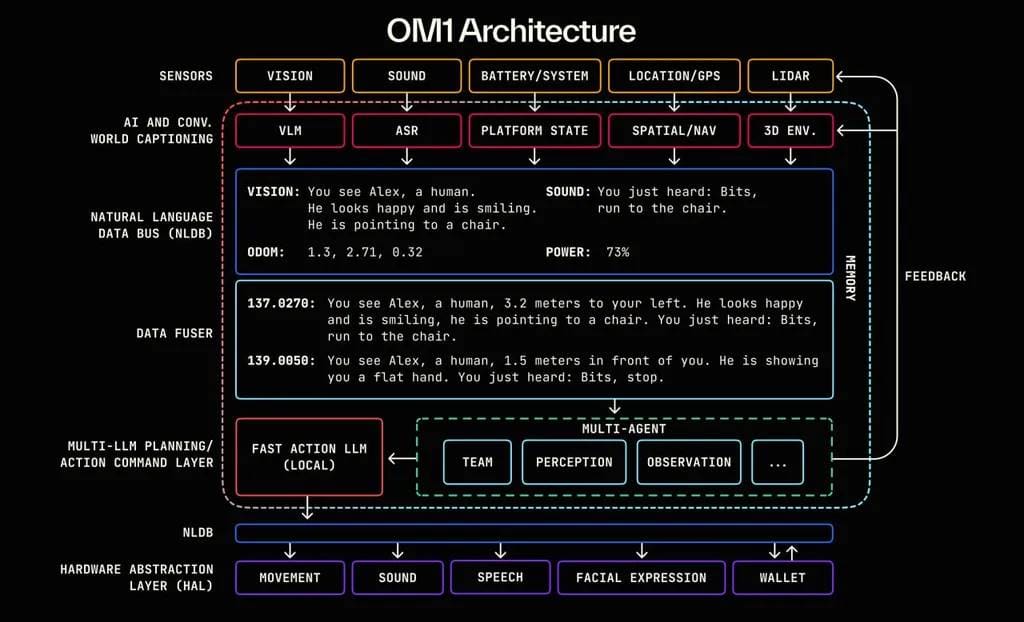
Taking the first step towards the "Android era" for the robotics industry, OM1 is committed to reconstructing the underlying logic of robots using "natural language," enabling robots to understand the world and interact and collaborate like humans.
In the OM1 architecture, the operation of a robot is broken down into four general steps: Perception → Memory → Planning → Action, and the lifeblood running through them is natural language.
Specifically:
Information can be transmitted through a unified natural language, laying the foundation for robot collaboration. The "plug-and-play" and modular design of OM1 further promotes the realization of efficient collaboration.
OM1 is not only open source but also hardware-agnostic: users can efficiently configure an AI agent through OM1's modular design. This agent can run in the cloud or be easily deployed into physical robots. Whether it's Boston Dynamics' robot dog or a home robot vacuum, robots of any hardware, manufacturer, and form can communicate using the same language. This design significantly reduces the time and cost of robot development while also achieving greater scalability and flexibility.
This perfectly embodies OpenMind's core principle: "A Paragraph is All It Takes."
OM1 solved the problems of individual intelligence and group communication, but when thousands of robots leave the laboratory and enter human society, how will they verify each other's identities? Who will assign tasks? Who will ensure their safety?
This requires the other half of the two-tier architecture: FABRIC .
As a decentralized protocol based on blockchain, FABRIC largely answers the question of why "blockchain is a necessary infrastructure for the robotics economy" .
When thousands of robots leave the laboratory, they will face more complex sociological problems:
FABRIC is designed for large-scale robot networks, aiming to provide robots with trusted identities, location verification, and secure communication channels, and to coordinate and settle tasks, thereby mapping the chaotic physical world onto an ordered digital ledger.
At the identity level, OpenMind innovatively proposed the ERC-7777 standard, specifically designed to define and regulate interaction methods in human-robot collaborative societies. FABRIC will assign each robot a verifiable, traceable, and authoritative digital identity based on ERC-7777, solving the "who am I" question.
At the trust layer, robots with identities share data and skills, including robot location, task status, and environment information, through built-in access, usage, and source rules. They also receive status updates from other robots and ensure data reliability through cross-verification by multiple robots. This enables robots to clearly answer the question "Where am I?" in a collaborative and interconnected network.
At the privacy layer, FABRIC employs a distributed architecture, dividing the network into subnets based on tasks or locations and connecting them through a central network server.
In the task allocation and reward settlement layer, firstly, tasks are not assigned in a closed black box, but are published, auctioned, and matched under public rules. All collaborative processes generate encrypted proofs with time and location, which are stored on the blockchain. When multiple robots collaborate to complete a task, FABRIC will verify the task completion, record the proof, and settle the reward. Robots with a long-term, verifiable, and reliable behavioral history will gain higher trust in the network and thus obtain more task opportunities.
In December 2025, OpenMind announced a strategic partnership with Circle to enable robots to perform hundreds or thousands of instant, reliable, cross-chain payments per second while performing physical tasks. In this process, USDC provides the unit of account and value carrier, x402 provides the underlying payment channel, and OpenMind's embodied intelligence system is responsible for deciding when, where, and how to make the payment.
For example:
If robot A is cooking in the kitchen and discovers that there is no salt left, then a task is generated to "deliver a bag of salt".
Robot A shares its location and initiates a task through the FABRIC network. Other compatible robots respond, and FABRIC matches tasks based on factors such as distance, price, and reputation. Ultimately, Robot B in the convenience store sorts out a bag of salt, and Robot C is responsible for transporting the salt to its destination.
Once the task is completed, FABRIC verifies the task and settles the reward.
In this scenario, FABRIC transformed the originally isolated robots into a collaborative fleet, quickly completing the mission. The robots made all the decisions and executed the tasks autonomously, and the entire process was open and verifiable.
In addition, FABRIC will further safeguard the long-term stability of the robotics ecosystem by exploring fair and transparent governance processes.
This is OpenMind's ultimate vision: to drive robots to evolve from "tools" into "economic participants".
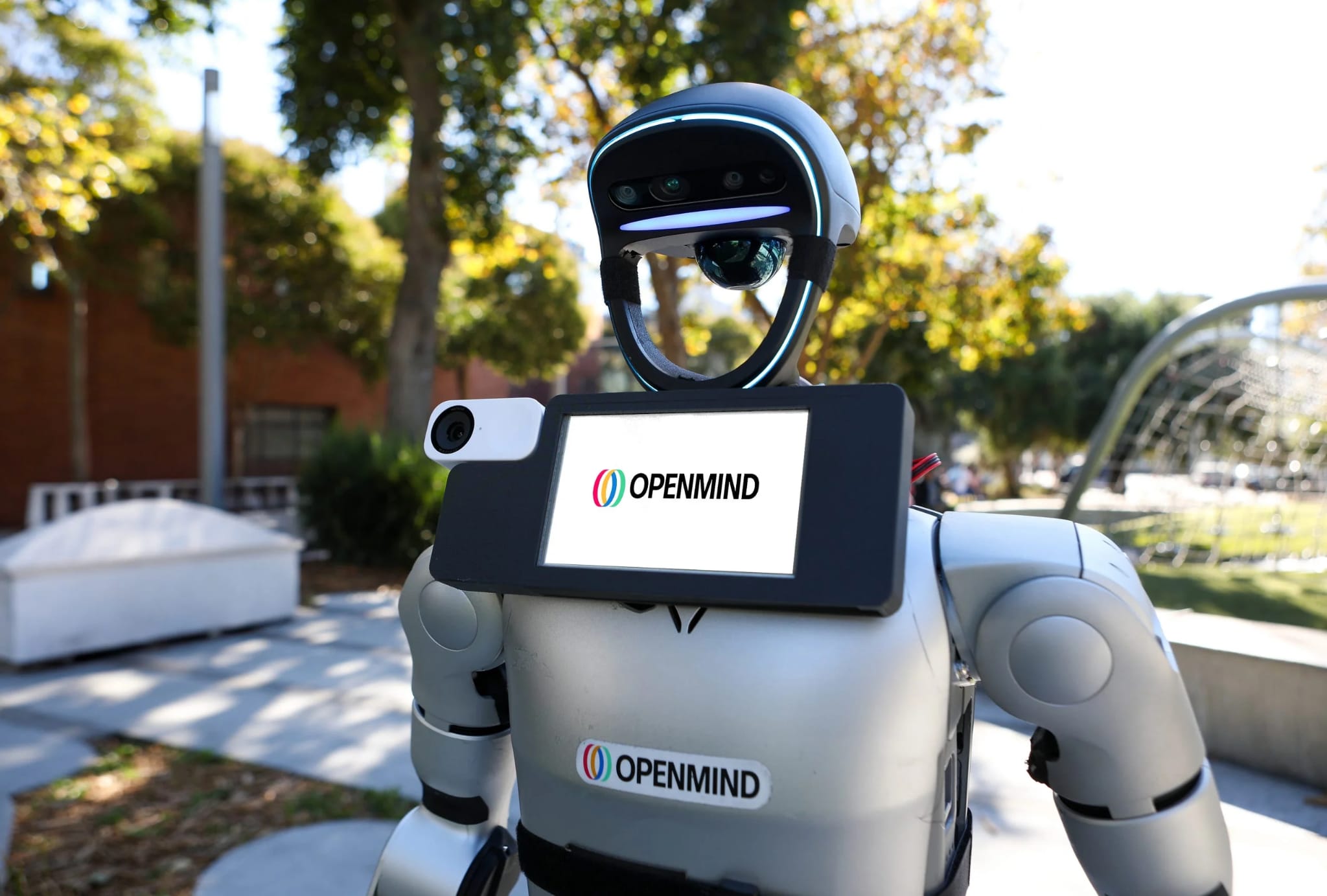
In fact, with the release of BrainPack, an embodied robot product, and its exploration and testing in multiple scenarios, OpenMind is driving the robotics economy from the laboratory to industrial and consumer scenarios.
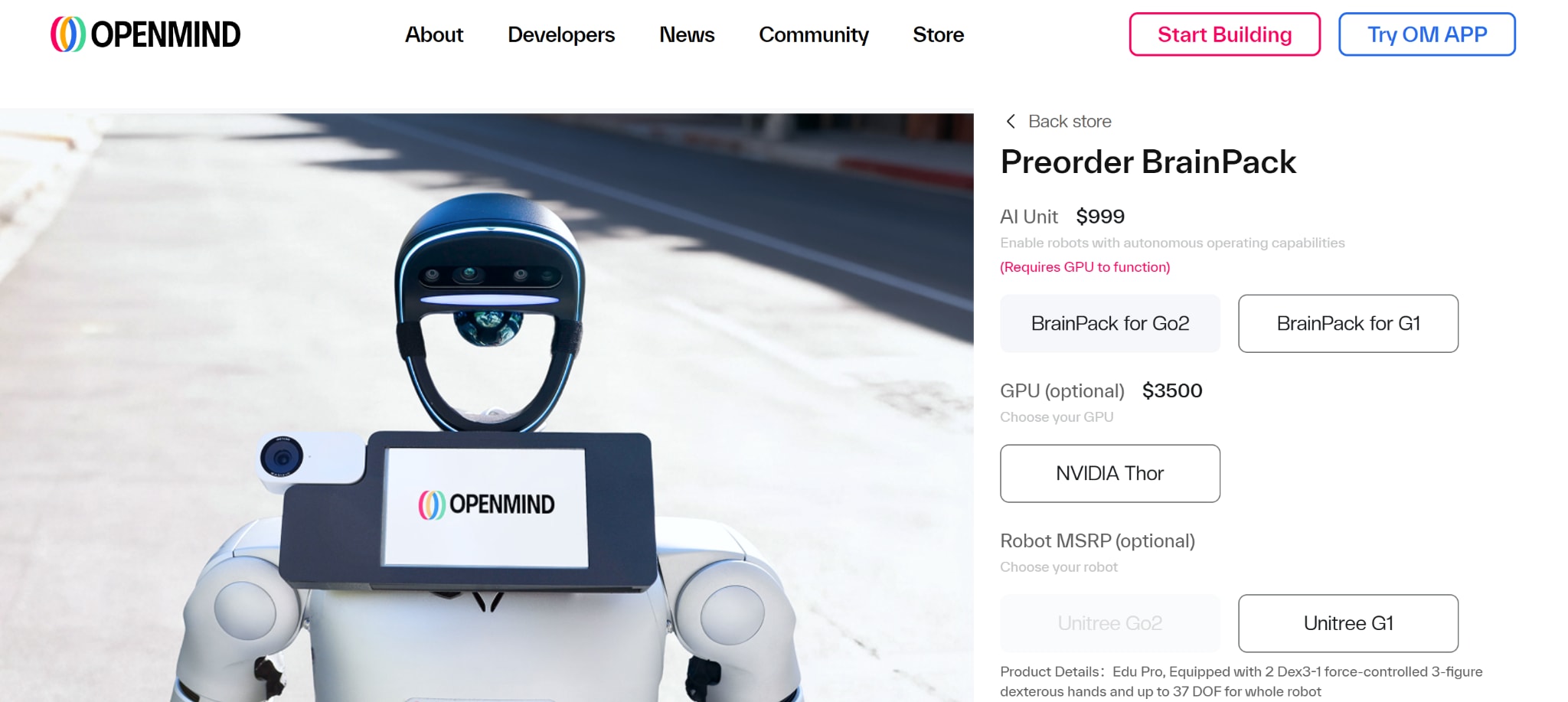
Products that can be seen and touched are the source of confidence. The "BrainPack", which will be available for pre-order in November 2025, is the embodiment of OpenMind's vision of "shared collaborative intelligent network".
As an embodied robot operating on OM1 and employing the FABRIC protocol, BrainPack 's main specifications and functions include:
It's worth noting that although BrainPack is powered by an NVIDIA Jetson Thor GPU, OpenMind positions the device as a plug-and-play solution, allowing for seamless integration with other hardware robots. Previously, OpenMind had explicitly stated its compatibility with Unitree Robotics' platform, particularly the G1 humanoid robot and the Go2 quadruped robot.
With its comprehensive features and powerful adaptability, BrainPack provides a concrete foundation for OpenMind's vision of "robot services":
In logistics warehouses, BrainPack can share real-time maps and task status through FABRIC to achieve dynamic path optimization and load balancing;
In smart city and environmental services, BrainPack enables precise navigation and multi-device collaborative obstacle avoidance in GPS-free environments such as underground parking lots;
In nursing homes, BrainPack can safely conduct nighttime patrols and deliver medication…
According to the official pre-order page, the BrainPack deposit is $999, with the first batch expected to be delivered in the first quarter of 2026. As a significant milestone marking the project's transition from the protocol development phase to the physical product delivery phase, with the first batch of BrainPacks being installed on robots around the world, OpenMind's "shared collaborative intelligent network" will no longer remain just a white paper, but will begin to operate, interact, and create value in the physical world.
As hardware moves towards production-grade delivery, OpenMind is working to create an app store for quadruped and humanoid robots. Users can download applications and skills for their robots with a single click through the OpenMind App Store, just like downloading apps for their phones from the Apple Store or Google Play.
The first application was uploaded to the OpenMind App Store last week. As OpenMind promotes, provides services and education on the market side, it will attract developers from all over the world to join and contribute new applications and skills, driving the rapid growth of quadruped robots and humanoid robots and bringing more intelligent services.
Recently, the most discussed topic surrounding OpenMind is the establishment of the Fabric Foundation on December 30, 2025.
As an independent nonprofit organization, the Fabric Foundation is dedicated to building governance, economic, and coordination infrastructure that enables humans and intelligent machines to work together safely and efficiently. Its specific responsibilities include supporting critical research, building public goods infrastructure, convening global stakeholders, expanding global access and participation, enhancing public understanding, and ensuring long-term governance.
With 2026 already here, the establishment of the foundation is like a starting gun, and according to the official roadmap, OpenMind will see a more concentrated series of milestones implemented:
In the short term, OpenMind is accelerating the development of the OM1 core functional prototype and the FABRIC MVP, and launching on-chain identity and basic collaboration capabilities. In the medium term, OpenMind aims to promote the implementation of OM1 and FABRIC in scenarios such as education, home, and enterprise, connecting early nodes and gathering the developer community. Looking at the long term, OpenMind is committed to making OM1 and FABRIC global standards, allowing any machine to access this open machine collaboration network as easily as accessing the Internet, and forming a sustainable global machine economy.
From the 2035 vision depicted in the movie "I, Robot" to the reality that OpenMind is building, what we are seeing is not only technological progress, but also a shift in paradigms.
In the old model, robots from different manufacturers operated independently, resulting in closed systems and a lack of unified standard communication protocols, making large-scale collaboration difficult. However, the new model built by OpenMind through the OM1 operating system and the FABRIC collaborative network is breaking down these barriers, transforming robots from "islands" into "networks," and from "tools" into "efficiently collaborative economic entities."
More importantly, this new model is being implemented in real-world consumer scenarios through deep collaborations between OpenMind and hardware manufacturers such as Unitree Robotics and DEEP Robotics, rapidly validating the technology's feasibility through physical products like BrainPack. From 180,000 test users to the upcoming delivery of the first batch of hardware products, OpenMind is proving with each milestone that the "Android era" for robots is becoming a reality, and an era of widespread robot adoption characterized by open source, collaboration, decentralization, and efficient settlement is approaching.
Of course, we are still a long way from the consumer-grade era depicted in the movie, where "one robot for every five people" is a reality. OpenMind is also in the early stages, where "the technology is working, but commercialization is yet to come." With the large-scale delivery of BrainPack in 2026, the continued expansion of the FABRIC network, and the addition of more developers and robot manufacturers, a global collaborative network of millions of robots is taking shape.
When thousands of robots are no longer isolated individuals, but are able to perform their respective duties and exchange value in a decentralized network, just like human society, then the era of the trillion-dollar machine economy will truly begin.
TechFlow is a community-driven in-depth content platform dedicated to providing valuable information and insightful thinking.
Community:
WeChat Official Account: TechFlow TechFlow
Subscribe to our channel: https://t.me/TechFlowDaily
Telegram: https://t.me/TechFlowPost
Twitter: @TechFlowPost
Add the assistant's WeChat ID to join the WeChat group: blocktheworld
Donate to TechFlow TechFlow and receive blessings and a permanent record.
ETH: 0x0E58bB9795a9D0F065e3a8Cc2aed2A63D6977d8A
BSC: 0x0E58bB9795a9D0F065e3a8Cc2aed2A63D6977d8A