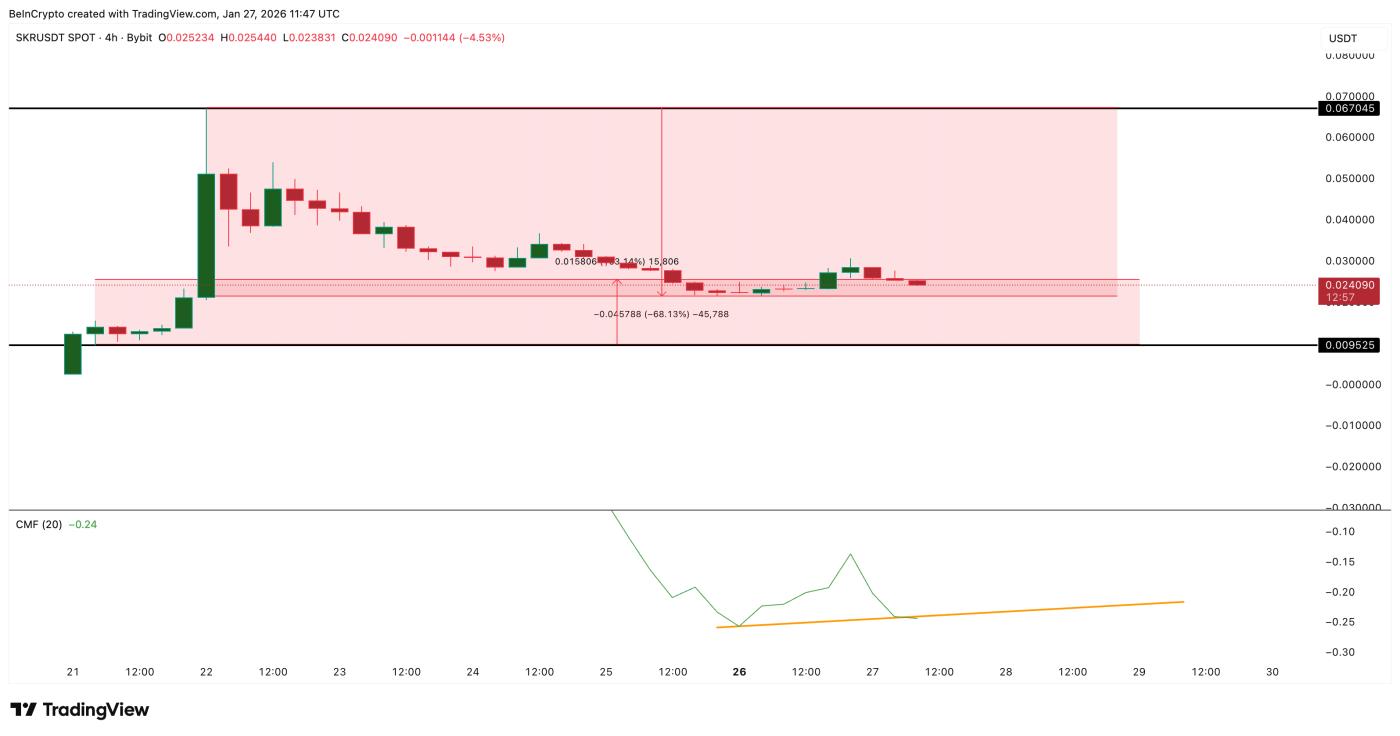
Seeker's strong surge after its launch quickly faded. After peaking at nearly $0.067, the price of Seeker has now dropped almost 70%, trading around $0.024. This decline has wiped out most of the initial enthusiasm. Although the Token is still higher than its launch price, the price movement suggests that buyers are no longer keen and are no longer defending the price levels.
The main issue now is no longer the potential for price increases. The crucial question is whether Seeker can avoid the next price drop. Currently, this outcome no longer depends on the buyers. It depends on the sellers.
Momentum and money flow signals indicate that selling pressure remains dominant.
The first warning sign came from the cash flow.
On the 4-hour chart, Chaikin Money Flow (CMF) has remained below 0 since January 24, 2024. CMF measures the inflow or outflow of Capital based on price and volume. When CMF is negative, it means money is leaving the Token, not flowing in.
Seeker attempted to recover the CMF index on January 26, 2024, but failed. Since then, the CMF has continued to decline, indicating that buyers have not truly returned. Currently, the CMF shows signs of breaking the uptrend line, and if this is confirmed, the Seeker price could face stronger downward pressure.
 Weak cash flow is causing difficulties for Seekers: TradingView
Want to XEM more Token analysis like this article? Sign up for Editor Harsh Notariya's daily Crypto newsletter here .
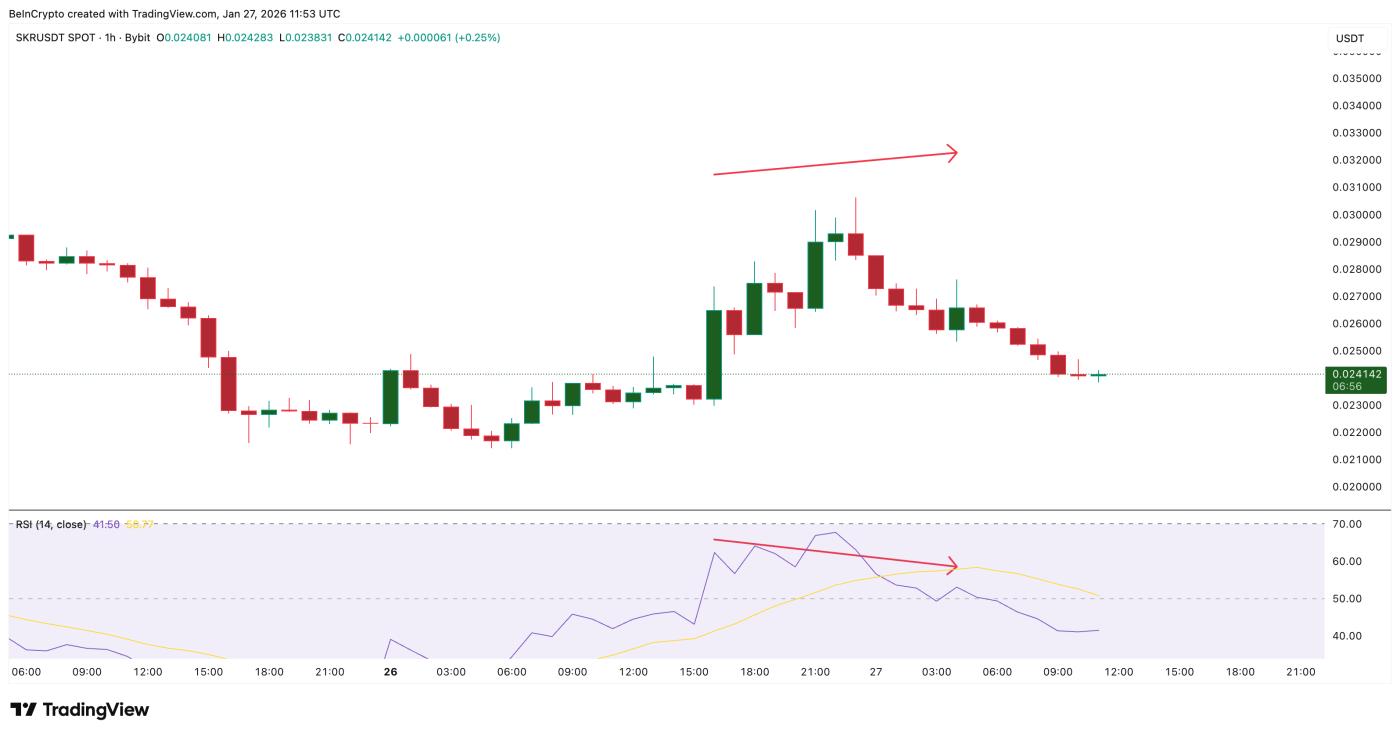
Short-term momentum also confirms this weak trend. On the 1-hour chart, Seeker briefly peaked higher around January 26-27, 2024, but the RSI peaked lower.
The Relative Strength Index (RSI) is an indicator that measures momentum strength. When prices rise while the RSI weakens, it suggests that buying pressure is decreasing and demand is weakening. This bearish divergence is the reason why recent upward movements have failed so quickly.
 RSI weakens: TradingView
The combination of weakening CMF and RSI suggests that downward pressure remains very strong.
Spot data shows no accumulation as prices approach risk levels.
on-chain data also reinforces the negative outlook. Over the past 24 hours, the amount of SKR on exchanges increased by 5.31%, bringing the total number of Token on exchanges to 467.08 million SKR. This is equivalent to approximately 23.6 million SKR being transferred to exchanges.
When Token are listed on exchanges, it's usually a sign that investors are preparing to sell. Meanwhile, smart-money holdings decreased by about 4%, indicating a lack of significant buying interest at the Dip or confidence that prices will rebound.
 No need to buy SKR: Nansen
Simply put, direct buying demand in the spot market is currently very weak. This is noteworthy because Seeker has now fallen nearly 70% from its peak after launch – this is typically the area where Dip -buying pressure from retail or large investors occurs. However, buyers have yet to enter the market.
Why do bears in the current Derivative market decide whether the Seeker price will fall or not?
This is where the story turns around. When spot buyers don't show up, the only remaining force that can save the price is the sellers using leverage.
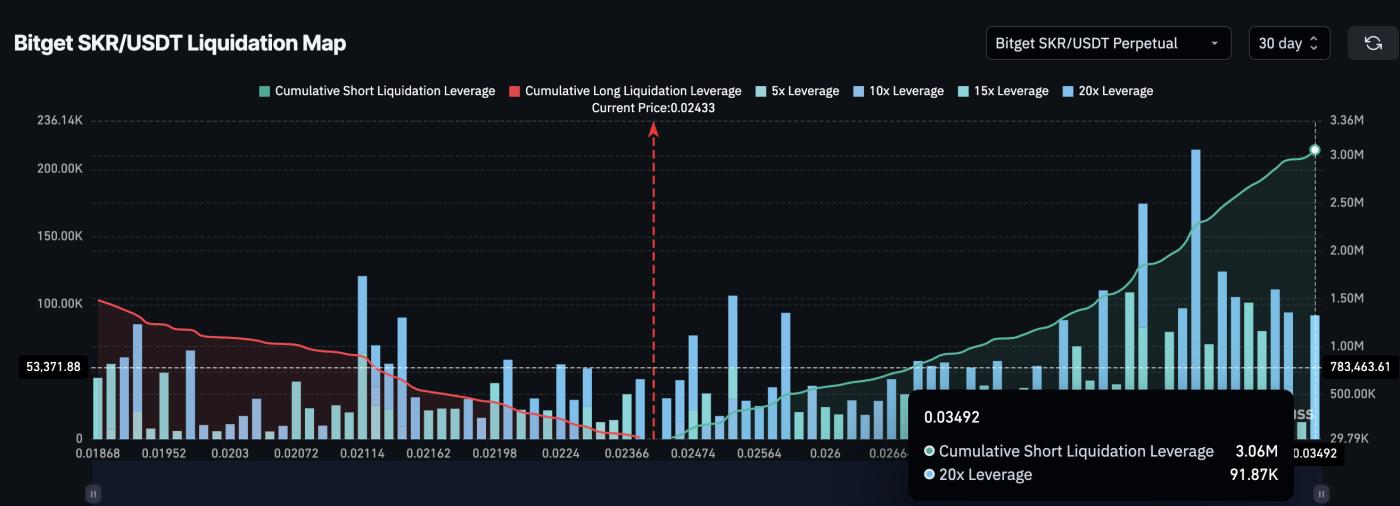
A liquidation map shows the areas where leveraged traders will be forced to close their positions. Liquidated positions can cause unexpected price fluctuations, even without real cash inflows. Leverage means traders borrow additional Capital to increase volume , thereby increasing the risk of liquidation.
On Bitget 's SKR/ USDT perpetual contract market over the past 30 days, the total value of Short positions was approximately $3.06 million, while Longing positions were only about $1.49 million. Thus, sellers are overwhelmingly dominant over buyers, with a ratio of over 100%.
 Liquidation map: Coinglass
If the price of SKR recovers to the $0.030 region, approximately $1.2 million in Short positions will begin to be liquidated. This could trigger a "Short squeeze," forcing sellers to buy back SKR to close their positions and push the price up rapidly.
However, it's important to understand that a Short squeeze isn't driven by the belief that the price will rise, but simply by forced buying pressure resulting from the liquidation of short positions.
 Seeker Price Analysis: TradingView
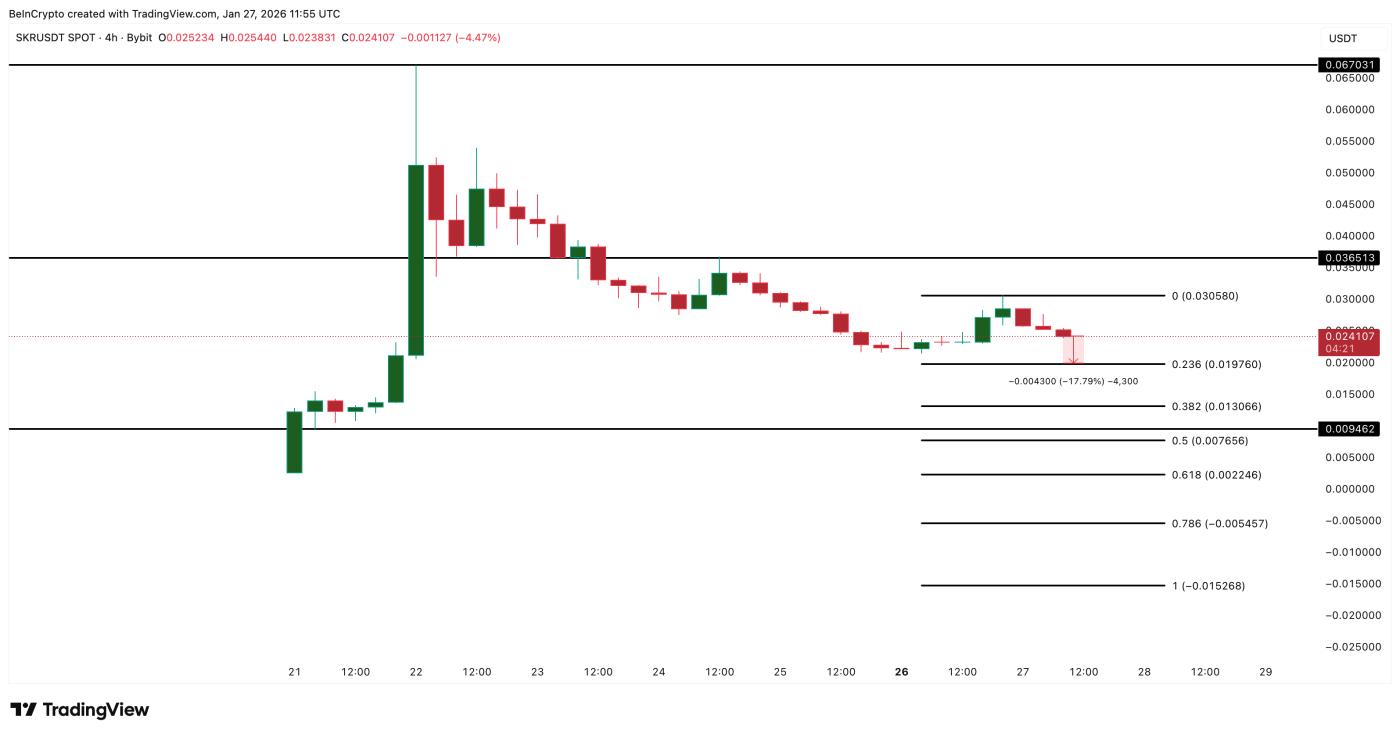
If the bears don't get trapped, Seeker risks falling below $0.019 and creating a new 17% drop. If the bears do get trapped, liquidations could be a temporary factor in holding the price steady. Therefore, Seeker is no longer dependent on the bulls.