Edited by Wu Blockchain Blockchain
Following the dramatic volatility in the crypto market on October 11th, OKX founder and CEO Star recently publicly stated that the event was related to the design of activities surrounding USDe on Binance and the resulting structural leverage. However, Dragonfly partner Haseeb directly refuted this assessment, arguing that the narrative is untenable in terms of timeline and cross-exchange impact. CZ and Ethena founder Guy Young also participated in the discussion. The following are details of the discussions.
Star's tweet on January 31
There was no complexity. There were no surprises.
The 10/10 score is due to irresponsible marketing activities by some companies.
On October 10th, hundreds of billions of dollars were liquidated. As the CEO of OKX, we clearly observed that the microstructure of the crypto market underwent a fundamental change after that day.
Many industry participants believe that the damage caused this time was more severe than the FTX crash. Since then, there has been considerable discussion about why it happened and how to prevent it from happening again. The root cause is not difficult to identify.
What exactly happened?
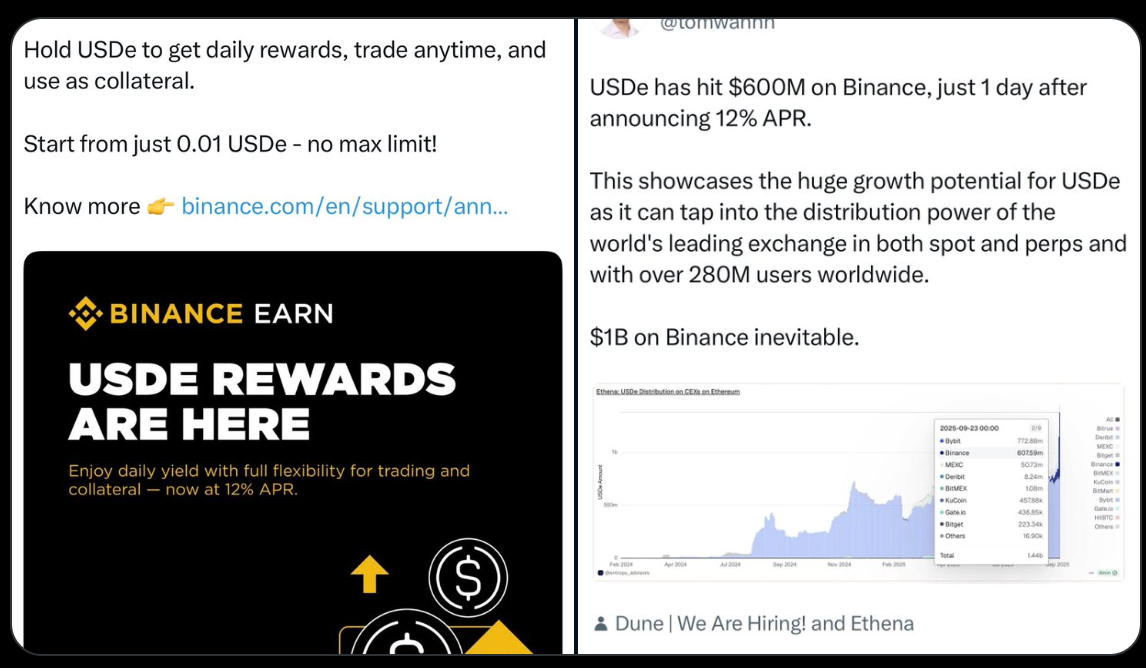
1. Binance launched a temporary user acquisition campaign offering a 12% APY for USDe, while allowing USDe to be used as collateral and enjoying the same treatment as USDT and USDC, without any effective restrictions.
2. USDe is a tokenized hedge fund product.
Ethena raises funds through so-called "stablecoins," invests them in index arbitrage and algorithmic trading strategies, and then tokenizes the resulting funds. These tokens can then be deposited into exchanges to earn returns.
3. USDe is fundamentally different from products such as BlackRock's BUIDL and Franklin Templeton's BENJI, which are low-risk tokenized money market funds.
In contrast, USDe incorporates hedge fund-level risk. This difference is structural, not superficial.
4. Binance users are encouraged to convert USDT and USDC to USDe for higher returns, but the underlying risks are not adequately emphasized. From the user's perspective, trading with USDe is no different from using traditional stablecoins—but the actual level of risk is significantly higher.
5. The risk escalates further as the user performs the following actions:
• Convert USDT/USDC to USDe
• Borrow USDT using USDe as collateral
• Convert the borrowed USDT back into USDe.
• And keep repeating this cycle.
This leveraged cycle generated apparent APYs of 24%, 36%, and even over 70%, which were widely considered "low-risk" because these yields were provided by large platforms. Systemic risk accumulated rapidly in the global crypto market.
6. At that time, even a small market shock was enough to trigger a collapse.
When volatility struck, USDe quickly de-pegged, triggering a chain of liquidations. The collapse was further amplified by risk management deficiencies surrounding assets like WETH and BNSOL. Some tokens saw near-zero trading activity at one point.
The damage to users and companies worldwide (including OKX customers) is severe, and recovery will take time.
Why this is important
I'm discussing the root causes, not blaming or attacking Binance. Speaking publicly about systemic risks can sometimes be uncomfortable, but it's necessary if the industry is to mature responsibly.
I anticipate a significant amount of misinformation and organized FUD targeting OKX in the near future. Even so, it remains the right thing to do to honestly discuss systemic risks—and we will continue to do so.
As the world's largest trading platform, Binance wields disproportionate influence—and consequently bears the responsibility of an industry leader. Long-term trust in the crypto industry cannot be built on short-term profit games, excessive leverage, or marketing tactics that conceal risks.
The industry needs to prioritize market stability, transparency, and leaders who innovate responsibly—rather than a winner-takes-all mentality that views criticism as hostile.
The crypto industry is still in its early stages.
The things we choose to de-normalize today will determine whether this industry earns lasting trust—or repeats the same mistakes.
Dragonfly partner Haseeb responds to tweet
Forgive my bluntness, but the term "Star" is frankly absurd.
Star attempted to claim that the root cause of the 10/10 collapse was Binance's launch of Ethena's yield campaign, which led traders to excessively leverage USDe on Binance through cyclical operations. Ultimately, a small price fluctuation triggered a reverse unwinding, which in turn caused a chain reaction of collapses.
The problem with this narrative is:
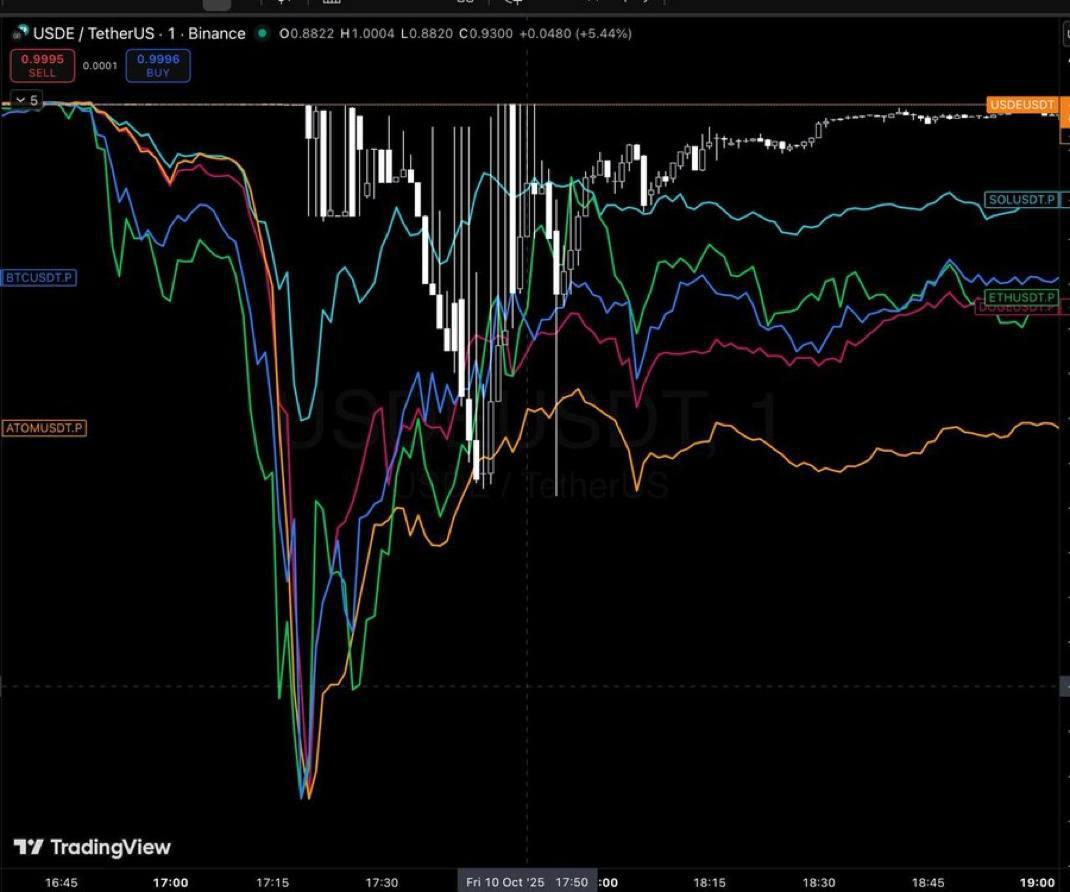
1) The timeline of this narrative doesn't match. The bottom of BTC was affected a full 30 minutes before the price of USDe on Binance was impacted. Therefore, USDe clearly couldn't have "caused" the liquidation cascade. This obviously reverses the cause and effect.
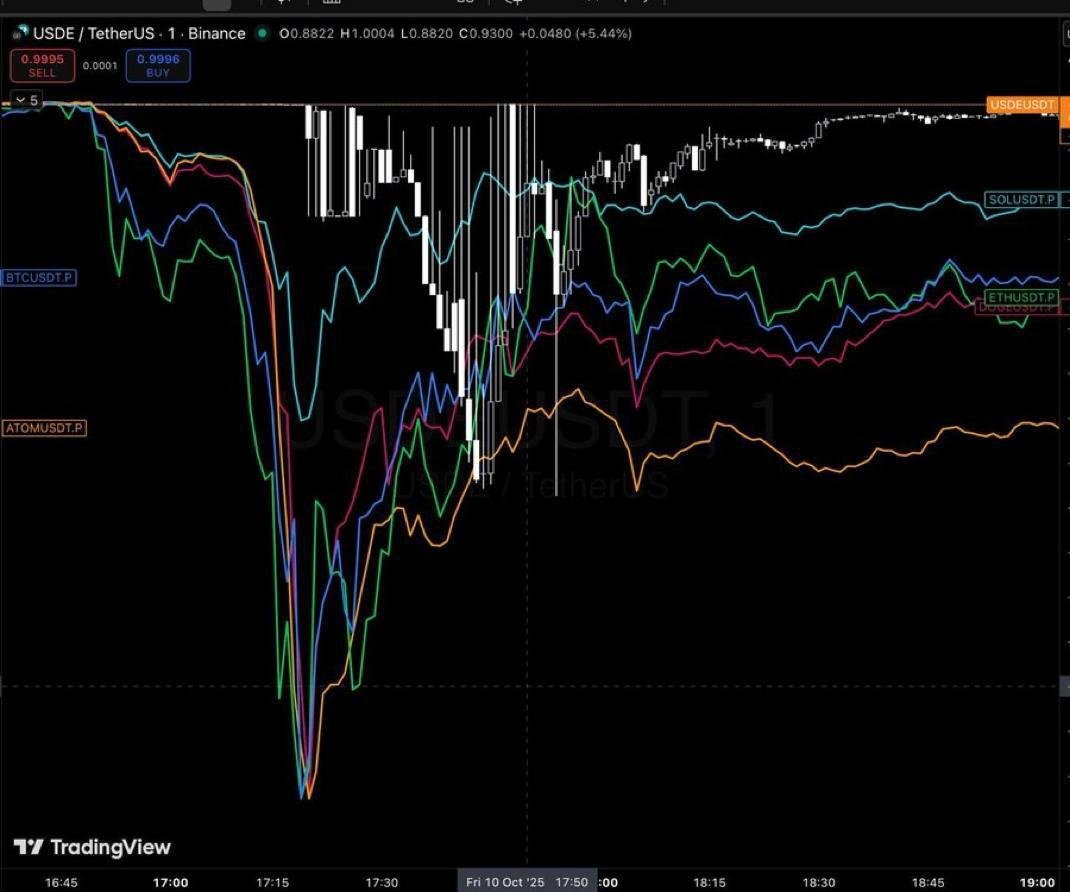
2) The price deviation of USDe only occurred on Binance; it did not occur on other exchanges. However, the liquidation spiral was happening everywhere. Therefore, if USDe's "de-anchoring" did not spread throughout the market, it cannot explain why there were massive liquidations on every exchange . This is very different from Terra, which de-anchored everywhere and caused the same damage on every platform.
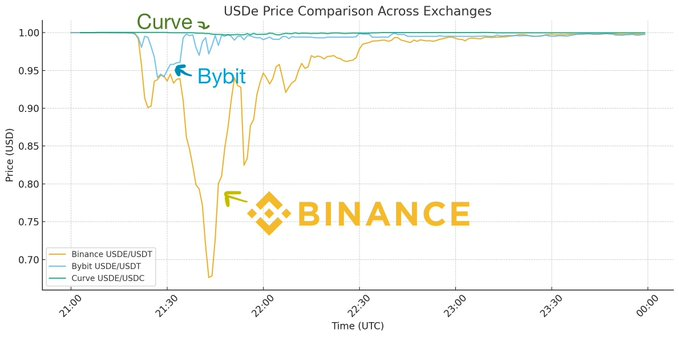
So you might be able to patch Star's point by saying, "Okay, maybe Ethena didn't cause a 10/10, but it amplified it." But even as an amplifier, USDe doesn't stand up to scrutiny because it didn't propagate across exchanges. We know what a good explanation for a crash should look like—Terra, 3AC, FTX all have global balance sheet effects that are felt everywhere. USDe doesn't do that; it's more like an isolated event in Binance's order book.
3) This raises a question: Why is Star only "revealing" this now, and months later? Star hasn't provided any new evidence for this theory that people didn't know before or that hadn't been repeatedly analyzed. All the order book data had been public for over four months, yet he's only saying this now? It seems more like Star is provoking CZ, using this simple story as an excuse to make it seem like CZ was involved, or that his irresponsibility led to the 10/10 score.
To be honest, the reality is: there isn't a single "simple story" that can withstand scrutiny to explain 10/10. Neither can I. If there truly were a simple story that could explain 10/10, then the market would have already reached a broad consensus on the cause, just like the consensus on the reasons for the collapses of 3AC or FTX.
In my opinion, the narrative that best explains 10/10 is:
Trump scared markets on Friday night with his tariff threats;
This led to a sharp sell-off in the market, as crypto was the only thing that could still be traded at the time;
The surge in activity caused Binance's API to crash, resulting in significant price misalignments and preventing market makers from balancing inventory across exchanges. This triggered a large number of unexecuted liquidations, which continued to be triggered regardless of the liquidation engine, and all of this was amplified by the ADL (Advanced Data Execution) systems launched across the board, disrupting hedging and risk control systems.
This resulted in market makers being overwhelmed and unable to clean up the mess—market makers need the API to rebalance inventory, and without them, there's no "buyer of last resort" to absorb the large number of Altcoin. Retailers couldn't possibly rush in to buy the dips on a chaotic Friday night;
• Unlike traditional financial mechanisms, crypto-based liquidation is not self-stabilizing (such as circuit breakers); crypto-based liquidation is purely designed to minimize bankruptcy risk.
• Altcoin prices are extremely path-dependent, and we've embarked on a terrible path.
This is my story. It's not satisfying, but the "Binance + Ethena did it" story is equally unsatisfying. A better root cause explanation would be "API crashed at its worst moment," but that doesn't sound as "conspiracy-driven."
When a simple story doesn't work, unfortunately you have to choose a complex narrative. And I believe this complex narrative best reflects the 10/10 reality. Fortunately, the history of crypto is a series of cycles of "bad things happened, then the market recovered."
In the long run, I'm not worried that 10/10 has permanently damaged the market. It's just that price path dependence, with retail investors and market makers severely impacted by 10/10, will take time to recover.
Haseeb tweet comments
Okay, this matter is much bigger than I expected, so let me disclose a few points first:
Dragonfly was an early investor in Ethena. Binance and OKX were also early investors and partners with Ethena. OKX also invested in Dragonfly, and a Dragonfly partner (not Dragonfly itself) also invested in OKX — we have business dealings with almost every party involved, so there's no simple "X got paid to do Y" story.
This debate isn't about whether Binance is good or OKX is bad. The core issue is: what exactly causes the 10/10 score?
Getting this answer right is crucial because it directly determines what changes we should make in the industry to prevent it from happening again. So if the answer is "Don't do APY projects with Ethena," that's great—if the answer were that simple. But that's almost certainly not the answer, and that's exactly what Star is implying here.
Other comments
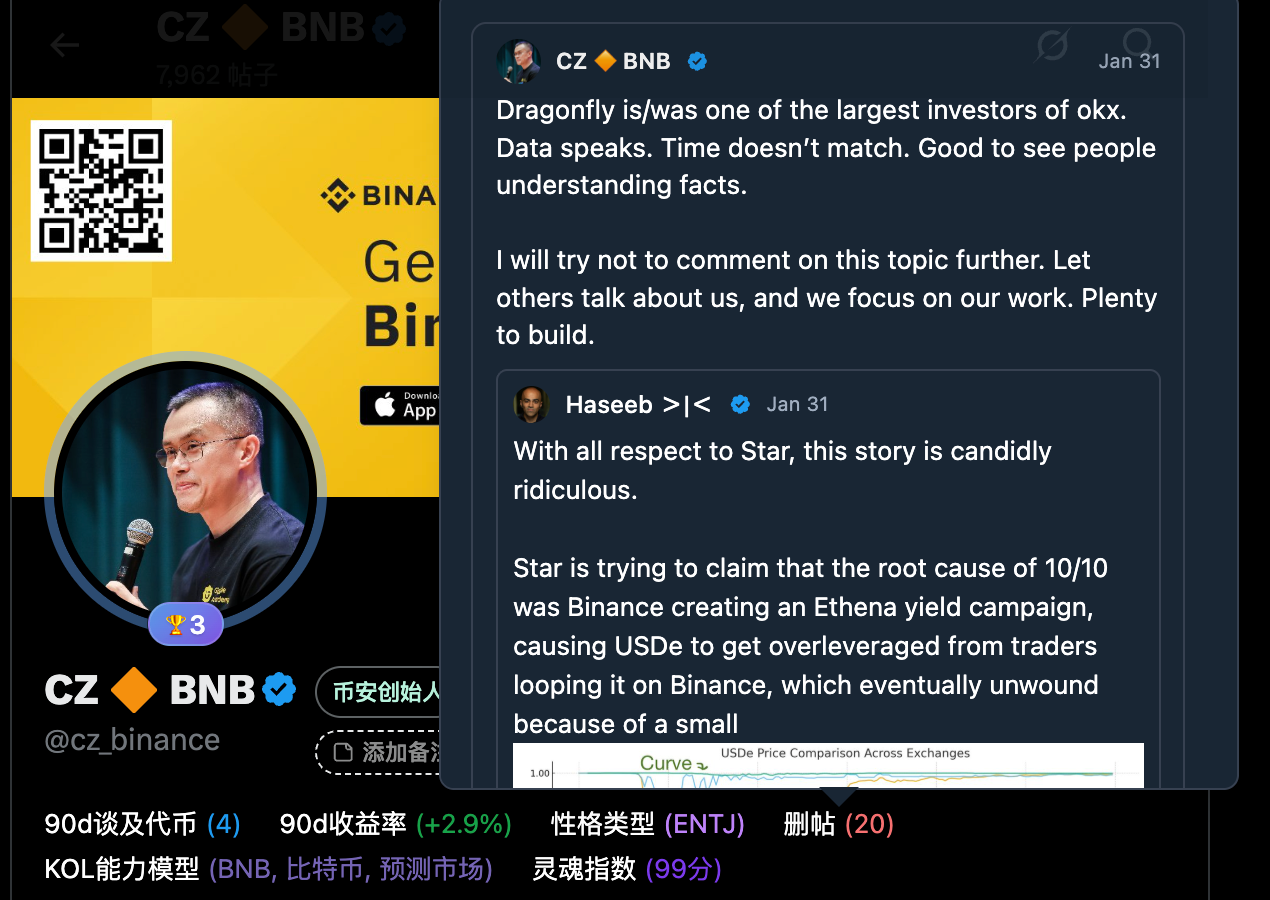
CZ first quoted and retweeted Haseeb's tweet, stating: "Dragonfly was/is one of OKX's largest investors. The data speaks for itself. The timeline doesn't match. I'm glad to see someone starting to understand the facts. I will try not to comment on this topic anymore. Let others talk about us; we're focused on our work. There's still a lot to build."
However, the tweet has since been deleted by CZ.
Star responded to CZ's comment as follows:
However, it is still important to clarify the facts. The following is a record:
1. BTC began to fall approximately 30 minutes before USDe de-pegged.
This supports the earlier view that the initial volatility stemmed from a market shock.
Without the leveraged cycle of USDe, the market would likely have stabilized by then. The cascading liquidation was not inevitable—it was amplified by structural leverage, as previously mentioned.
2. Dragonfly has never invested in OKX—whether it's a small or large investment.
In fact, OKX had invested in Dragonfly before @hosseeb joined the firm.
Additionally, one of the partners' previous funds (not Dragonfly) had invested in OKX. These are independent and easily verifiable facts.
3. I will not spend any more time on this topic.
The facts are clear. I don't intend to engage in a protracted debate.
Ethena founder Guy Young retweeted Haseeb's tweet and said:
We all want simple explanations and scapegoats, but unfortunately, that's not true in fact.
The data below clearly shows that the price discrepancy in USDe on the Binance order book occurred a full 30 minutes after BTC bottomed out from this crash.
Either you're wrong, or this is the first "root cause" — it happened after the event.
You have a large audience who trust your words. Spend 5 minutes looking at the data before you speak. Do better.