Author: Pavel Paramonov
Compiled by: TechFlow TechFlow
TechFlow Dive: Ethereum is facing a profound identity crisis. In this article, veteran crypto researcher Pavel Paramonov raises a thought-provoking question: Why is this former market leader gradually losing public support? From the Rollup roadmap, accused of being a "pie in the sky," to the endless ideological debates within the community, and the loss of core talent and lack of incentives, Ethereum seems to be trapped in a cycle of "being right for the sake of being right."
This article directly addresses the growth dilemma of Ethereum under the guise of technological superiority, and analyzes why even a great leader like Vitalik cannot hide the fatigue of the ecosystem.
In this highly competitive market, will Ethereum rise from the ashes, or will it become, as the author describes, a "rich old lady" that refuses to innovate?
The full text is as follows:
This article was primarily inspired by Vitalik's recent sharing about the current market situation and its changes. Although the entire market is currently declining, it's difficult to blame any one person, and I'm not here to shift the blame.
My identity here is that of someone who has worked with multiple Ethereum teams, represented venture capital funds in investing in multiple protocols built on Ethereum, and is generally a die-hard fan of Ethereum and everything related to the EVM.
Unfortunately, I can no longer say the same thing now, because I feel that Ethereum no longer knows where it is going (many people feel the same way).
I don't want to discuss ETH's price movements, but I can't ignore the fact that the world's second-largest cryptocurrency has been extremely volatile. Regardless of global market trends, ETH behaves more like a stablecoin that is de-anchoring.
This essay is about what has happened to Ethereum over the past few years, and why many people are losing hope, or have become utterly desperate. Ethereum didn't lose to Solana or other competitors; Ethereum is losing to itself.
Rollup-centric roadmap
When Ethereum introduced its "rollup-centric" roadmap, almost everyone was excited. The promise at the time was that Rollups (and Validiums) would solve scalability issues, end-user transactions would take place on Rollups, and Ethereum would act as a validation layer. In other words, it would focus on being the L1 layer for Rollups, rather than directly serving users.
Developing Rollups is much faster and cheaper than developing L1, so the future of "thousands of Rollups" seems very feasible and optimistic.
So, where did things go wrong?
As it turned out, everything went wrong. Endless arguments, prioritizing ideology over practical needs, constant infighting within the community, identity crises, and abandoning the "Rollup-centric" vision too late.
Everything that could possibly go wrong went wrong. The majority of the community had viewed Max Resnick as an utterly incompetent villain, only to find that almost everything he said was correct.
During his time at Consensys, Max made numerous pronouncements about what Ethereum needed to do to progress, but he faced only criticism and received almost no support.
The pinnacle of folly is when the entire industry starts debating whether a certain L2 level is truly "Ethereum," for example:
- Viewpoint A: "Base is an extension of Ethereum, and we have made significant contributions to the Ethereum ecosystem."
- Viewpoint B: "Base is not an extension of Ethereum; it is independent."
What the hell are we even talking about?
How can this kind of dialogue lead to a better future for Ethereum and its ecosystem? Why are people arguing about "what is Ethereum and what isn't Ethereum"? Don't we have more important questions to address?
If we consider Rollups to be extensions of Ethereum because they use ETH for gas fees, then we are on the right track. If we consider Rollups not to be extensions of Ethereum, but rather applications that benefit from Ethereum, then we are also on the right track.
Right? Absolutely not.
This ideological discussion isn't really a discussion; it's a confrontation between two "circlejerks" trying to prove who's right. We don't need internal conflict (PvP); we need external output (PvE). We need to understand that this isn't a confrontation between us, but a shared confrontation about problems and future challenges.
Unfortunately, many people would rather pursue self-indulgence than consider that their views might be wrong.
Beyond the user's required sense of technological superiority
Based rollups, booster rollups, native rollups, GigaGas rollups, and keystore rollups.
- Which is better, what will the future hold, and how will they be connected?
- "This type is the future," "No, that type is the future."
- "There is no reason not to develop rollup-based rollups."
- "Native Rollups will take over the ecosystem because they are aligned with Ethereum."
All these discussions... ultimately resulted in Arbitrum and Base continuing to dominate the market.
Technological advantages can certainly bring many benefits to players, but only if you can't compare apples and pears, or oranges and tangerines. They're too similar, so similar that users simply don't care about the differences. Outside the bubble, nobody cares. Having one more precompile, or one less—you can't win that way.
"Oh, we are actually 'Ethereum consistent,' we have an advantage, we are very close to Ethereum and embody its core values, users will choose us."
I'd like to ask, what are these values? And which users would choose you?
@0xFacet became the first Stage 2 Rollup, and they are practically the definition of "Ethereum Consistency".
But where are they? Where are their users, developers, tech KOLs, and supporters of the Ethereum ecosystem and consistency? Where have all these people gone? How many of you have heard of Facet? How many apps are available on Facet?
I personally have no prejudice against Facet. I've spoken with their founder many times, and I respect him greatly; he's a wonderful person. But where are all those people who used to say we needed more "Stage 2 Rollups"? I don't know, and neither do you.
Economic incentives are far more powerful than technical incentives. I used to be a big fan of Taiko, especially their research on roll-based systems. This model has many advantages: stronger censorship resistance, neutrality, no risk of sequencer downtime, and L1 validators can earn more money.
So, where is the pitfall?
The problem lies in the financial logic behind the model. You can't force people to give up their income for the sake of so-called "consistency".
Arbitrum promised decentralized sorters. Scroll promised decentralized sorters. Linea, zkSync, and Optimism all made similar promises. But what happened? Where are those sorters now?
Every Rollup team includes this statement in their documentation: "We currently have a centralized orderer, but we have a strong desire to decentralize it in the future." Almost no one delivers on this promise. Metis delivered, but fortunately or unfortunately, people didn't care about Metis.
- Do I think they overpromised in an attempt to win over influential "ETH Maxis"? Yes.
- Do I think they really want to decentralize the sorter? Yes, but it doesn't make sense for them.
Coinbase (Base) has a legal obligation to make as much money as possible and create value for the company. Other teams are in the same boat, so why would you want to kill your own revenue stream? It simply doesn't make logical sense.
Only about 5% of Base's revenue goes to Ethereum. Rollup has never been an extension of Ethereum.
Taiko went through a period where the fees it paid to Ethereum for ordering were even more than the fees it collected from user transactions. Clearly, companies like Taiko have many other expenses besides paying Ethereum. The vision of a "rollup based on Ethereum" or any "Ethereum consistency" rollup is only possible if the team is willing to forgo revenue.
I haven't underestimated the importance of decentralization, security, and permissionlessness. But when your sole goal is to pursue "ideological correctness" rather than "user-centricity," all of that becomes meaningless.
Unsurprisingly, this weakness, along with the promise of "Ethereum consistency," attracted a group of swindlers (Grifters) into the space.
Rollup center route results
Eclipse, Movement, Blast, Gasp (Mangata), Mantra: these protocols were never built for the long-term future. It's far too easy to hide behind masks like "Ethereum consistency," making Ethereum better, or introducing SVM into Ethereum.
They all "rugged" in one way or another. All the Rollups realized that their tokens were practically useless and lacked utility because users paid fees with ETH. The scammers realized that you could create a lot of hype around a "Rollup-centric" narrative and then profit by dumping worthless tokens on retail investors.
Ethereum has never acknowledged Polygons as true L2, despite their significant role in locking up ETH value. If you believe Rollups are an extension of Ethereum's "culture," why not acknowledge something so closely tied to Ethereum's security and usability?
Polygon was crucial to Ethereum during the 2021 bull market, making a significant contribution to the growth of ETH as an asset; however, yes, it is not Level 2 and does not deserve the appreciation of the Ethereum community. If Polygon were Level 1, its valuation would be much higher.
@ri5hitripathi tweeted: People in the Ethereum Foundation (EF) ecosystem accused Polygon of being a sidechain because they prioritized scalability over L2 semantic logic and pandering to the Ethereum community. Looking at it 7 years later, we find that "Polygon was right all along."
Even Paradigm —a top crypto venture capital firm that has made the biggest contribution to the Ethereum ecosystem and even developed its own L2 (Ithaca)—has switched to partnering with Stripe to develop L1 (Tempo).
I believe that when even your most steadfast believers are building up your competitors, you must be doing something wrong.
The Ethereum Foundation has no direction.
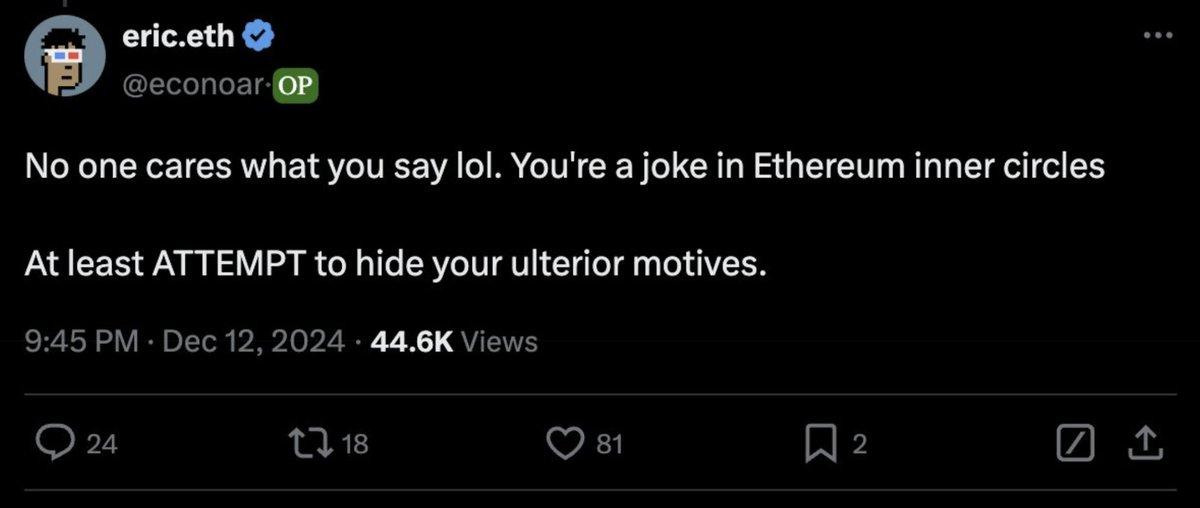
While Ethereum is technically decentralized, it is culturally highly centralized around Vitalik. Ethereum's "inner circle culture" is very real; as people say, if you want to succeed (however you define the term), all you need to do is gain the attention of people close to Vitalik and the favor of a few highly influential venture capital firms within the crypto space.
I'm not saying you have to agree with everything Vitalik says, but his views basically define what's good and what's bad for Ethereum, and you can't argue with that.
Initially, the narrative was that of "Ultrasound Money." Through EIP-1559 and the Merge, ETH's economic model became deflationary, making it a better store of value than Bitcoin. However, by 2024, ETH's annualized inflation rate had turned positive.
So, the vision of "hyperfluid currency" only lasted three years? That makes it impossible to become a store of value. This narrative has collapsed, and it never truly held true, because ETH was not designed for storing value; that's Bitcoin's mission, and you can't compete with it in that respect.
Ethereum then faced a dilemma: whether its tokens were commodities (which is not entirely applicable due to dynamic supply changes and staking mechanisms) or more like tech stocks (which is also not entirely applicable due to insufficient revenue to support valuations like those of tech companies).
Some people are even arguing that ETH isn't a currency at all. What's going on here? We need to choose a direction.
Ethereum cannot have both at the same time—you either have a globally recognized defined direction, or you will fall behind.
Financial Inspiration
I still can't imagine that a lead engineer like Péter Szilágyi , who has made such contributions to Ethereum, only earns around $100,000 a year. This person, who has been here from the very beginning and helped Ethereum's market capitalization grow from almost zero to $450 billion, receives compensation of only 0.000001% of the market capitalization.
As the most influential and successful protocol in cryptocurrency history (after Bitcoin), it surprisingly offers no incentives or equity. The justification, hiding behind the tenets of decentralization, open source, and permissionless principles, is simple: "We're not here to make money, we're here to drive progress."
But you must motivate your most loyal warriors, or they will leave or take on side jobs outside.
- Péter left, Danny Ryan left, and Dankrad Feist went straight to Tempo.
- Justin Drake and Dankrad accepted advisory positions at EigenLayer in 2024 and received token allocations, which led to community hostility towards them.
These poor people at the Ethereum Foundation (EF) who earn meager salaries (compared to FAANG companies or AI labs) were attacked simply because they wanted to earn some money and help an independent protocol that aimed to make Ethereum better.
Are you guys crazy? Sometimes I feel that if you're an honest and hardworking person in Ethereum, you're not allowed to make money, but only expected to work like a slave to gain Ethereum's "recognition".
EF keeps selling ETH to fund various operations, initiatives, and research. But perhaps you should first pay your researchers' salaries?
Zero tolerance for adaptation
"Day One. Ethereum will ultimately win. The most decentralized and longest-running blockchain."
We hear these kinds of things every day, just like we hear Ethereum's excuses every day:
- "Yes, Ethereum is expensive and slow. But we have Rollups, use Rollups, Rollups are Ethereum!"
- "Yes, the price of ETH is lagging behind everything. But Ethereum has the largest developer ecosystem, we have a solid foundation, and the demand will always come."
- "Ethereum is the most decentralized blockchain! Solana is garbage; they lack client diversity."
- "Ethereum is 100% up! Solana is garbage, it crashed several times."
- "Ethereum's network activity is lower than Solana's. Oh, that's because Solana's activity is mostly spam and memecoin gamblers. We are an ethical chain!"
For the past few years, the same excuses, the same answers, the same responses. Everything is garbage except Ethereum and Rollups. If Ethereum underperforms on any metric, we say we're still in "day one," we know what we're doing, and there's nowhere better than Ethereum.
Everyone is tired of hearing the same excuses the community keeps making up.
Ethereum feels like a frail, elderly rich woman who refuses any innovation but distributes her wealth to her parasitic offspring.
Is it too late to mend the fence after the sheep are lost?
Just hours before I finished this post, Vitalik tweeted that the "Rollup-centric" roadmap was a failure and that they needed to find different paths and expand L1.
You know, I'm glad to see people realize their mistakes; it takes courage to speak out. But I think it might be too late. Ethereum has once again found a long-term path, but progress remains slow.
EF has recently undergone some changes: a new leadership team, increased treasury transparency, and a restructuring of its R&D department. EF has also begun recruiting young talent from its developer relations (DevRel) and marketing departments, including Abbas Khan, Binji, and Lou3e.
But change must happen quickly. Ethereum must sprint at full speed to prove everyone wrong.
Let's wait and see. After these reforms and changes to EF, will we see Ethereum once again become an exciting entity, rather than just a synonym for blind delusion and disappointment?