In the blockchain world: Wallet = Account + Identity + Asset Control.
Article author and source: SuperEx
In the crypto world, a wallet is not a tool, but a "dual carrier of identity and finance." In the traditional financial system, identity is confirmed by banks and institutions, assets are centrally managed by the system, and users are more like "users."
In the blockchain world: wallet = account + identity + asset control.
Who you are, what you own, and what you can do are almost entirely determined by your wallet.
However, in the past few years, the issue of wallets has actually been something we've been "making do" with:
- It has powerful features, but it is hosted on a platform.
- Holding your own private key, but the experience is fragmented and the operation is complex.
- Multi-chain support, but the security model is ambiguous.
The result is that while assets are on-chain, risks are not transparent, most iterations are just about piling on features, the ecosystem is becoming increasingly complex, but the core issues remain unresolved.
While most wallets are still focused on piling on features, the SuperEx team's Super Wallet took a cleaner path—
With security and user autonomy at its core, we are reshaping the wallet's architectural logic.
- Click to register SuperEx
- Click to download the SuperEx APP
- Click to enter SuperEx CMC
- Click to enter SuperEx DAO Academy — Space
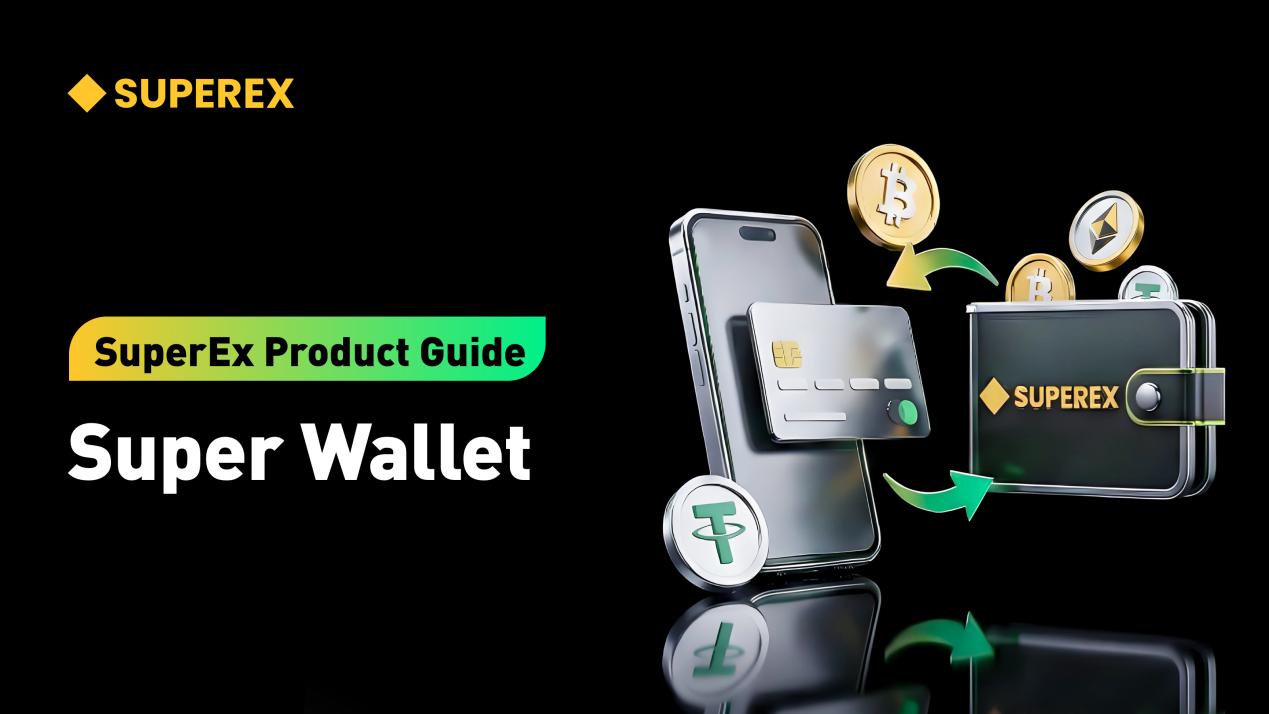
External Licensing: Flexible and Secure "Let Smart Contracts Move Your Money"
Super Wallet's external authorization feature allows users to grant certain operational permissions to other entities or individuals, enabling them to perform specific actions on the user's behalf, such as transferring funds, signing, or managing assets. Users can choose the authorized parties, permission types, and scope to achieve diversified and convenient asset management.
In simple terms, traditional wallets typically require users to authorize their entire wallet address when interacting with DeFi or NFT platforms. This is equivalent to "handing over your entire bank card." Super Wallet's authorization mechanism is more intelligent—you can authorize only a portion of your assets to a smart contract to perform operations. For example, you can allow only a GameFi project to access 10 USDT, instead of the entire wallet. This represents a significant improvement in both security and flexibility.
1. Hierarchical Deterministic Architecture (HD Wallet)
Super Wallet uses the HD (Hierarchical Deterministic) system, which means:
- Users no longer need to set up a separate wallet for each chain;
- If a risk occurs at a certain address or in an on-chain interaction, it will not directly affect the asset management and usage paths of other chains.
- The management experience is simple and does not compromise security.
This is a "minimalist + extremely stable" solution that traditional wallets have almost never achieved.
2. Asset isolation mechanism: partition security
Super Wallet's unique "asset segregation" logic allows users to set up independent storage spaces for different blockchains and different assets.
This is like installing a "firewall" for your digital assets. Even if a contract vulnerability occurs on one chain, it won't affect the overall assets.
Specifically, users can store assets with different purposes and risk levels in different authorized accounts according to their needs, effectively reducing potential risks.
Each partition has its own independent encrypted storage logic, and data access between them is strictly isolated. This design not only reduces the possibility of a single risk point causing overall asset damage from a technical perspective, but also gives users fine-grained control over asset management, allowing them to flexibly configure asset storage methods and independent security guarantees according to their own risk preferences and usage habits.
3. Benefits for users
For users, the introduction of external licensing brings many practical benefits:
- Easy and convenient asset management : External authorization allows users to grant certain permissions to trusted entities. This means users can manage their digital assets very easily and conveniently, freeing them from cumbersome procedures and steps.
- Enhanced security and risk control : External authorization reduces the risk of private key leakage and misuse. Through external authorization, users only need to authorize and sign to complete digital asset management tasks such as top-ups and payments.
- Facilitating Business Partnerships : External authorization plays a crucial role in business partnerships. In future versions, Super Wallet will support granting specific permissions to partners to expedite fund transfers or contract signings. This will help facilitate business collaborations and drive more efficient and convenient business processes.
- Security of Multi-Signature Collaboration : In multi-signature collaboration, multiple authorized signatures can be used to ensure the security and legality of transactions. This is crucial for collaborative decision-making and fund management, guaranteeing the credibility and security of transactions.
Multi-chain and cross-chain support: a truly one-stop experience
Super Wallet natively supports multiple chains such as Ethereum, BNB Chain, and Solana, and allows for free asset migration through its built-in cross-chain protocol. Unlike solutions that rely on third-party bridges, Super Wallet provides a unified abstraction and integration of cross-chain functionality at the architecture layer, significantly reducing transaction friction and gas costs.
Interface and User Experience: Interaction Logic Closer to "Mobile Banking"
Super Wallet's UI logic is significantly different from traditional DeFi wallets:
- One-click transfer, one-click authorization, one-click chain termination;
- Automatically identifies token types and provides risk warnings;
- Users can visualize the distribution of assets.
- The interface is easy to access, supporting one-click switching to the Web3 wallet interface—effortless, fast, and seamless.
Applicable Scenarios
- dApp Interaction: Directly log in to various decentralized applications without additional registration, including logging into SuperEx.
- Asset Management: Manage multi-chain crypto assets to enable cross-chain transfers and transactions.
- Investment Strategy: Utilize external authorization and asset segregation features to participate in DeFi yield strategies and reduce risk.
- NFTs and GameFi: Holding, trading, or licensing NFTs to participate in on-chain games.
Comparison of Super Wallet and Traditional Web3 Wallets
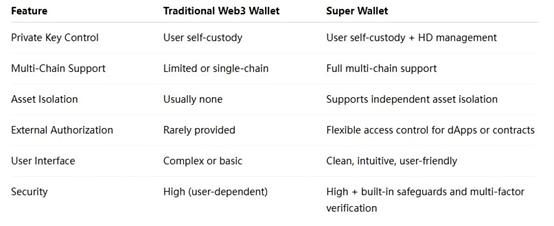
Super Wallet outperforms most traditional Web3 wallets in terms of security, operability, and cross-chain capabilities, making it especially suitable for users who manage large amounts of assets and participate in multi-chain DeFi strategies.
For ordinary users, it's a wallet that "understands human language".
For professional players, it is a strategy platform that combines efficiency and defense.
Super Wallet's biggest advantages lie in its security and user autonomy, especially its asset segregation and external authorization mechanisms, which make it more attractive to institutional users and high-net-worth investors.
Conclusion
The value of Super Wallet lies not in what it “did more,” but in the fact that it deliberately avoided doing anything wrong.
Instead of using a complex structure to mask risks, it uses a clear architecture to break down, isolate, and return risks to the user's control.
In this sense, Super Wallet represents not just a wallet product, but a more mature way of using encryption:
- The assets are truly held by the users themselves.
- The risk boundaries are clearly visible and configurable.
- Multi-chain interoperability, without sacrificing the security model.
- Advanced features are available, but complex operations are not mandatory.
When wallets are no longer just "tools for storing assets," but become a unified entry point for identity, permissions, and assets, Web3 will truly have the foundation to reach a larger user base.