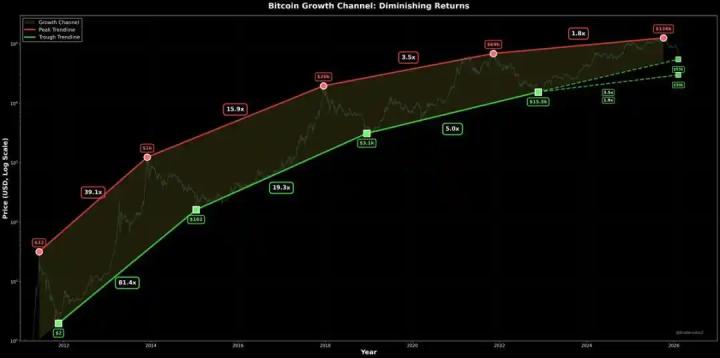
Bitcoin plunges, retreating to $67,000; most of the gains from the 2021 rally have vanished.
The price of Bitcoin (BTC) plummeted to $67,000 (approximately 98.36 million won), breaking even the $69,000 support level that marked its all-time high in 2021. This wiped out most of the gains made during the past two years of recovery, significantly dampening investor sentiment across the market.
The recent selloff was confirmed on Thursday (local time), when the total cryptocurrency market capitalization fell by over 7% in a single day, reaching around $2.3 trillion. Ethereum (ETH) fell below the psychological support level of $2,000 (approximately 29.35 million won), Solana (SOL) fell to $84 (approximately 12.32 million won), and Ripple (XRP) fell to $1.29 (approximately 1,893 won).
The crash stemmed from excessive leverage liquidations. According to data platform Coinglass, approximately $480 million (approximately 70.4 billion won) was forcibly liquidated from the market in the past hour alone, and a whopping $1.4 billion (approximately 205.4 billion won) over the past 24 hours. This is a scale rarely seen since late 2022.
ETF and institutional balances also hit... Strategy estimates a valuation loss of 9 trillion won.
The spot-based Bitcoin ETF market has also been hit by strong selling pressure. According to SoSoValue, Bitcoin ETFs alone have seen net outflows of $800 million (approximately 117.4 billion won) over the past two days, while Ethereum ETFs have also seen outflows of $68 million (approximately 10 billion won) this week.
Strategy, the company with the largest Bitcoin holding, currently holds approximately 713,000 BTC. The recent plunge has resulted in a valuation loss of over $6.7 billion (approximately 9.83 trillion won), and its stock price has plummeted 13% to around $112 (approximately 164,360 won). This is its lowest price since August 2024. Strategy is scheduled to release its earnings today.
BitMine, the largest Ethereum holder, is also reported to be recording valuation losses of approximately $8 billion (approximately KRW 1.174 trillion).
Traditional assets also plummeted, with gold and silver prices also collapsing.
This decline isn't limited to cryptocurrencies. On the same day, the S&P 500 fell 1.2%, and the Nasdaq fell 1.8%. Silver and gold, considered safe haven assets, also plummeted by 15% and 5%, respectively, resulting in an unprecedented "all-class risk-off." This represents the steepest asset correction since late 2022.
Market volatility has intensified again since President Trump's tariff remarks in October, and this is interpreted as reflecting the atmosphere of reduced global liquidity in recent weeks.
Gemini implements restructuring, cutting 25% of workforce and withdrawing overseas operations.
Amidst the crisis, US cryptocurrency exchange Gemini announced a major restructuring. Founders Winklevoss and his brother announced Thursday that they would lay off 25% of their workforce and withdraw from the UK, EU, and Australian markets.
The company plans to restructure its business around the US market, AI-based productivity, and predictive markets. In particular, the company emphasized that its prediction market platform, Gemini Predictions, launched in December of last year, has already generated over $24 million (approximately 35.3 billion won) in trading volume, demonstrating its potential.
The slump in the NFT market is also a factor in the restructuring. Gemini will shut down its NFT marketplace, Nifty Gateway, on February 23rd. Users will have to withdraw their assets before then, and NFT support will be limited to the Gemini wallet.
Meanwhile, Gemini's stock price fell more than 7%, hitting an all-time low, amid the broader cryptocurrency market shock. Since its initial public offering (IPO) in September of last year, the stock has fallen nearly 80% from its reference price.
"Bitcoin OG" Garrett Jinn withdraws $140 million worth of Ethereum.
Even amidst the market plunge, the movements of whale investors attracted attention. Garrett Jin (aka 1011short), a prominent on-chain trader, withdrew 80,000 Ethereum from Binance to his personal wallet. This amount, when converted to cash, amounts to approximately $168 million (approximately 246.4 billion won).
This withdrawal occurred at a time when Bitcoin was plummeting below $71,000 and Ethereum was plummeting below $2,100. Some in the market are interpreting this as a buy signal. Data analytics firm Lookonchain analyzed that Jin had previously deposited large amounts of Ethereum into exchanges late last year, and that this move was likely a "position rebalancing."
Garrett Zinn rose to fame after shorting $735 million worth of Hyperliquid Bitcoin during the cryptocurrency crash triggered by President Trump's tariff remarks in October of last year, netting him approximately $160 million (approximately 234.8 billion KRW). His wallet currently holds over 36,000 BTC, worth approximately $2 billion (approximately 2.935 trillion KRW).
Markets fear a repeat of the "end-of-2022 crisis"; regaining trust will be difficult.
This week's market shock is likely to be the biggest since the FTX crash in 2022. The combination of excessive leverage, institutional selling, and a volatile macro environment has led some to assess that the crypto market has once again entered a deleveraging phase.
A market expert said, "ETF outflows and whales' irregular movements will likely increase volatility for the time being," and added, "If institutions begin to recognize losses in earnest, further declines cannot be ruled out."
💡 "Investors Who Can Survive the Fear of Deleveraging," from TokenPost Academy
The market is once again warning of a "2022-level crisis" in 2024. Bitcoin's plunge, ETF net outflows, and massive losses recognized by institutions... What's needed now is "the structural understanding to recognize crises in advance and respond accordingly."
TokenPost Academy is a practical, hands-on training program designed to cultivate investors with unwavering skills even in times of crisis.
- Step 2: The Analyst course dissects the tokenomics mechanisms that cause crashes, such as leverage liquidations, and develops the ability to identify the "end of the panic" through on-chain indicators.
- Step 5: In The DeFi User, you will learn practical skills to survive the deleveraging phase, including liquidity risk and LTV bankruptcy structures.
- Step 7: The Macro Master reconstructs the recurring macro market cycles from 2022 through data, and develops an eye for reading liquidity flows .
Bad news always comes back, but our responses can vary. With TokenPost Academy, even a bear market can be turned into an opportunity.
Curriculum: 7-step masterclass covering everything from basics to on-chain analysis, leverage risk, futures, options, and macro cycles.
Benefit: First month free event in progress!
Go to: https://www.tokenpost.kr/membership
TP AI Precautions
This article was summarized using a TokenPost.ai-based language model. Key points in the text may be omitted or inaccurate.
Get real-time news... Go to TokenPost Telegram
Copyright © TokenPost. Unauthorized reproduction and redistribution prohibited.