The release of this new regulation marks a historic leap in the attitude of Chinese regulators toward virtual assets, from "complete blocking" to a combination of "guidance and restriction".
Article author and source: Guofeng Law Firm
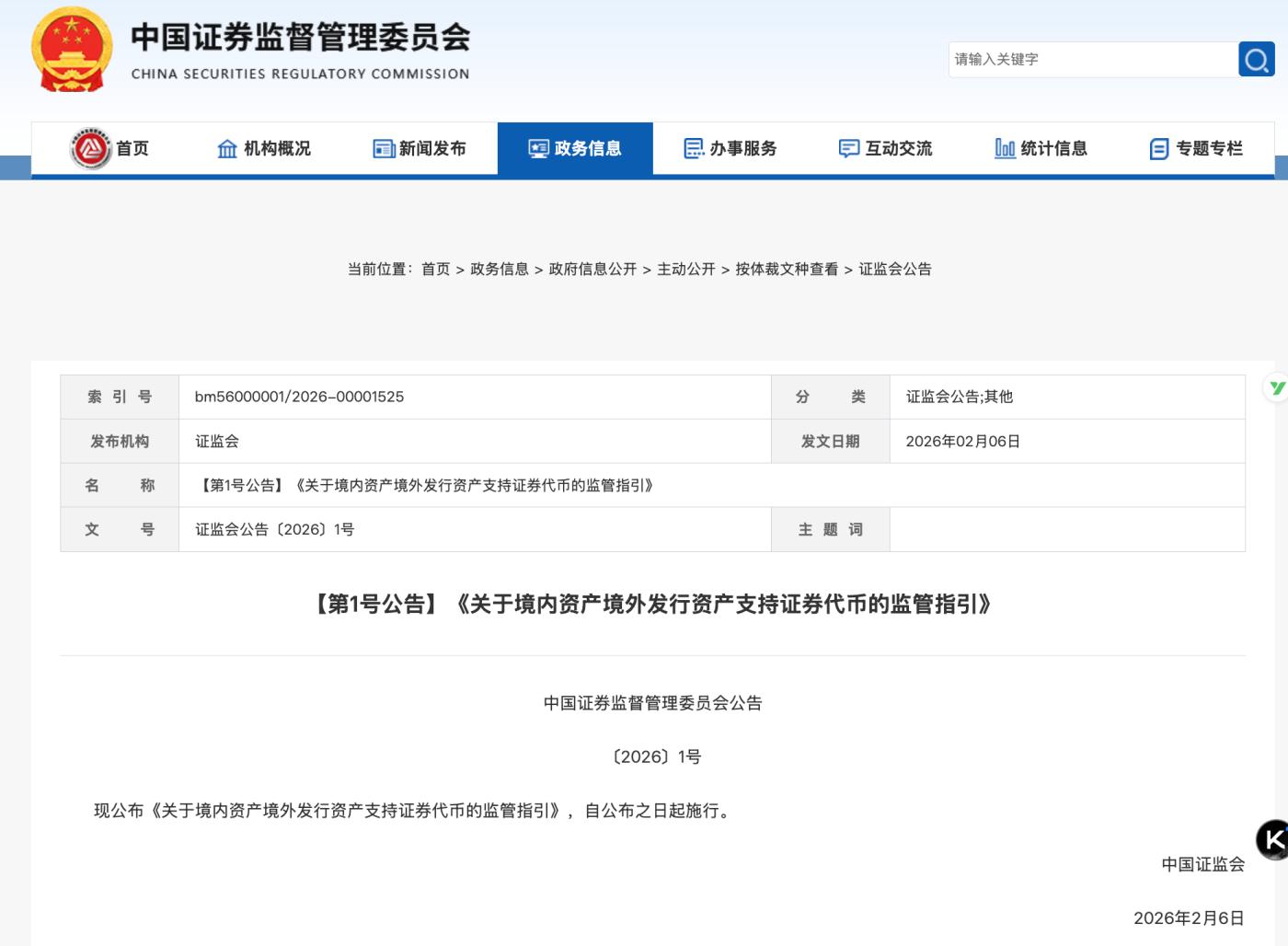
On February 6, 2026, the "Notice on Further Preventing and Handling Risks Related to Virtual Currencies" (Yinfa [2026] No. 42, hereinafter referred to as "Document No. 42"), jointly issued by eight ministries led by the People's Bank of China, and the "Regulatory Guidelines on the Issuance of Asset-Backed Securities Tokens by Domestic Assets Overseas" (hereinafter referred to as "Guidelines") issued by the China Securities Regulatory Commission at the same time, caused a huge shock in the legal and financial circles.
Document No. 42 is not merely a "ban," but rather a "license." While severely cracking down on illegal cryptocurrency issuance within China, it unprecedentedly clarifies the legal definition of "Real-World Asset Tokenization" (RWA) and points to a clear and compliant filing path for high-quality domestic assets to be issued and listed overseas through RWA. Coupled with the "Regulatory Guidelines on the Issuance of Asset-Backed Securities Tokens Overseas by Domestic Assets" simultaneously released by the China Securities Regulatory Commission, the door to "Web3 assets going global" in China has effectively been opened.
If you only glance at the document, you'll only see the word "prohibited," but lawyers read between the lines about "exceptions," where every sentence subtly outlines the boundaries of compliant business practices. Let's analyze the core clauses of this official document clause by clause:
Part 1: Conceptual Reshaping – RWA Finally Gets "Chinese Recognition"
For the first time, regulators have explicitly defined "Real-World Asset Tokenization" (RWA) in an official document, separating it from pure "virtual currency," which is the cornerstone of compliant business operations.
For a long time, RWA (Real World Asset) has been in a gray area. Article 1, Paragraph (2) of Circular 42 clearly defines it as: "Real World Asset Tokenization refers to the activity of using cryptographic technology and distributed ledgers... to convert the ownership, income rights, etc. of assets into tokens..." This definition clarifies the financial attributes of RWA as a "certificate of rights" and brings it back into the financial regulatory framework.
More importantly, the document contains a hidden "exclusion clause": "...suspected illegal issuance of token vouchers...should be prohibited; except for relevant business activities carried out with the consent of the competent business authority in accordance with laws and regulations and relying on specific financial infrastructure."
This is the core principle of the entire document. "Prohibition" is the principle, and "exception" is the exception. This means that RWA (Real Money Management) operations are not inherently illegal, but rather "illegal without a license." This is consistent with the licensing logic of banks and securities firms. As long as it obtains the consent of the "regulatory authorities" such as the China Securities Regulatory Commission (CSRC) and the National Development and Reform Commission (NDRC), and relies on compliant infrastructure, RWA falls under the category of legally protected financial innovation.
Furthermore, Article 6 regarding financial institutions also leaves room for flexibility. While providing services for virtual currencies is strictly prohibited, the ban does not cover RWA (Real Money Exploitation) businesses that are "with consent." This means that once a project completes compliance registration, domestic financial institutions will have the right to provide it with account opening, fund transfer, custody, and clearing and settlement services, thus removing a key obstacle to the entry of financing funds and the exit of profits.
Part Two: Core Breakthrough – The "Compliance Green Light" for Domestic Assets Going Global
Article 14 of Document No. 42 ended the long-standing debate about whether Chinese companies could issue RWAs, established a regulatory closed loop of "domestic assets, overseas issuance, and domestic filing," and established the dual principles of "penetrating supervision" and "filing-based access."
Article 14 of Circular 42 stipulates that: "Domestic entities that directly or indirectly conduct real-world asset tokenization business in the form of foreign debt overseas, or conduct real-world asset tokenization business with the nature of equity based on domestic equity overseas... shall be subject to strict supervision in accordance with laws and regulations."
This seemingly plain statement actually contains three benefits and constraints:
1. Clearly defined permissibility: The phrase "regulated by law" presupposes the feasibility of this business. As long as it remains within a compliant framework, RWA will no longer be directly classified as "illegal financial activity."
2. Business Classification: Regulators have professionally broken down RWA into "foreign debt type" (under the jurisdiction of the National Development and Reform Commission and the State Administration of Foreign Exchange) and "securitization/equity type" (under the jurisdiction of the China Securities Regulatory Commission). This indicates that regulators have a deep understanding of the business models.
3. The principle of transparency: Regardless of whether a VIE structure or an offshore SPV is used, as long as the underlying assets are located in China or the actual controller is a domestic entity, they must be subject to Chinese regulation. This completely ends the era of "regulatory arbitrage," but also provides compliant projects with clear legal expectations. This is the principle of "same business, same risks, same rules."
Part Three: Practical Guide – The "Secrets to Success" for Securities and Futures Commission RWA Filing
The concurrently released "Regulatory Guidelines on the Issuance of Asset-Backed Securities Tokens Overseas by Domestic Assets" (hereinafter referred to as the "Guidelines") is more like a Web3 version of the "New Rules for Overseas Listing Filing." By setting a negative list and procedural requirements, the China Securities Regulatory Commission (CSRC) has brought RWA into a serious financial regulatory framework.
1. Who needs to register? (Entity status)
The guidelines explicitly state that the "domestic entity that actually controls the underlying assets" is obligated to file a record. This means that domestic operating entities cannot evade regulatory responsibilities through offshore shell companies. As long as the cash flow originates domestically, the domestic entity must fulfill its filing obligation with the China Securities Regulatory Commission (CSRC).
2. Which assets cannot be issued? (Negative List)
The guidelines clearly define the red lines: assets prohibited from financing by law (such as illegal constructions), assets with ownership disputes, and assets that endanger national security are all prohibited from conducting business. It is particularly important to note that if the actual controller has a criminal record for embezzlement, bribery, or other criminal offenses within the past three years, the registration will be directly rejected.
3. What is the filing process?
The registration process is not a one-time action, but rather a process subject to full-process supervision.
- Prior to the event: Information on the underlying assets, the token issuance plan, and a complete set of overseas issuance documents must be submitted.
- During the process: Intermediary agencies (lawyers, auditors) need to assume the responsibility of "gatekeepers" and endorse the authenticity of the materials.
- Afterwards: Upon completion of overseas issuance or occurrence of significant risks (such as theft of private keys or default of underlying assets), an immediate reporting obligation must be fulfilled.
Part Four: Red Line Warning – The Untouchable Regulatory Bottom Line
While recognizing the opportunities, we must be keenly aware that the boundaries of regulation are clearer and more stringent than ever before. There remains zero tolerance for issues concerning financial stability.
While Document No. 42 has opened a loophole, it is by no means a signal of "letting loose." The following two types of behavior remain absolutely forbidden:
1. Issuance and trading within the domestic market are strictly prohibited.
The issuance and trading of RWA must be strictly restricted to overseas locations (such as Hong Kong and Singapore). Document No. 42 explicitly states: "Activities involving the tokenization of real-world assets within the territory of China... should be prohibited." Any marketing or trading activities targeting IP addresses and mobile phone numbers within China are suspected of being illegal financial activities.
2. Tokens are strictly prohibited from functioning as currency.
Circular 42 specifically emphasizes: "Stablecoins pegged to the RMB may not be issued overseas without consent." The right to issue currency is the exclusive right of sovereign entities; private institutions must not attempt to tamper with this forbidden area. RWA tokens should be strictly limited to asset certificates and may not be used as payment instruments.
Conclusion
History doesn't repeat itself, but it does rhyme. Chinese regulators have once again demonstrated remarkable political wisdom: striking a delicate balance between preventing financial risks (crypto speculation) and leveraging financial innovation (RWA to empower the real economy).
Document No. 42 and its supporting guidelines are not only regulatory documents, but also a "business prospectus." It declares to global capital: China does not reject technological innovation, but rather bubbles that are unregulated.
For entrepreneurs with high-quality assets, this is the best time to leverage global liquidity. For Web3 practitioners, this is also a ticket to "shift from virtual to real economy".
In 2026, compliance is the key to survival in this market. Assets must be on-chain, regulations must be transparent, and value must flow freely. The golden age of RWA in China has only just begun.
The Guofeng Web3 team has accumulated extensive experience in Web3 project architecture development (both domestic and international), investment and financing, establishment and operation of offshore crypto funds, and domestic and international compliance for Web3 projects. We are one of the earliest teams in China to provide legal services related to blockchain and crypto technology. Since 2017, within the compliance framework, we have continuously provided innovative legal solutions to leading projects, investment institutions and incubators, and blockchain technology application providers across various sectors. We are deeply involved in cutting-edge business practices and supporting legal services in areas such as crypto assets, blockchain underlying technology and infrastructure, and data compliance.

Contact Us:
Simon Mou, Attorney at Law: simon.mou@grandwaylaw.com