


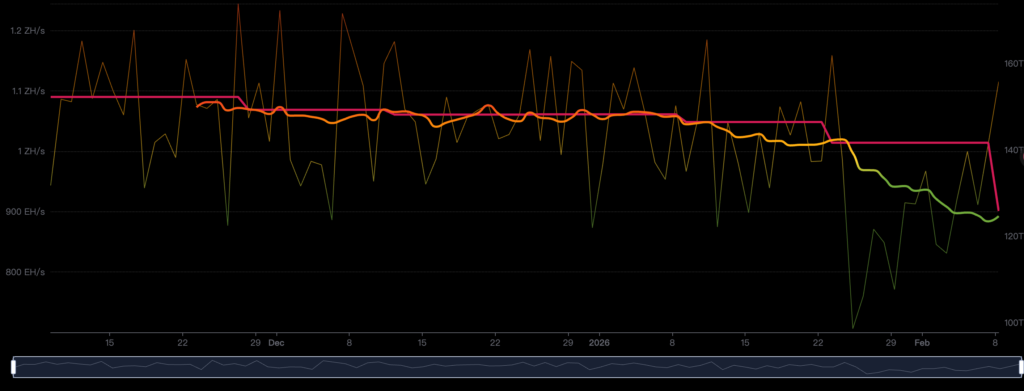
On the evening of February 7th, the Bitcoin network completed its routine difficulty adjustment at block height 935,424, with the mining difficulty plummeting from 141.84 T to 125.86 T, a decrease of 11.16%. This is the largest single drop since China imposed a complete ban on cryptocurrency mining in May 2021.
According to data, the current total network hashrate is approximately 948 EH/s, a decrease of about 14% from the historical high of 1.1 ZH/s reached last October. Analysis indicates that the next difficulty adjustment is expected to further decrease, reflecting that the mining industry is in a significant contraction period.
Reasons for the sharp drop in computing power
Bitcoin's difficulty adjustment mechanism is one of the core elements of its network design. Approximately every two weeks (2,016 blocks), the network automatically adjusts the mining difficulty to ensure that the average block time remains around 10 minutes. When the computing power decreases, the difficulty decreases; and vice versa. This self-regulating mechanism ensures the stable operation of the Bitcoin network.
This sharp drop in computing power was driven by two main factors:
First, there's the price collapse: Bitcoin has fallen more than 45% from its all-time high of around $126,000 last October, and even dipped below $60,000 this week. Some lower-end mining rigs, or mining companies with higher operating costs, are already facing losses.
Secondly, there was the impact of extreme weather: a winter storm swept across the United States, causing Foundry USA, one of the world's largest mining pools, to lose approximately 60% of its computing power, plummeting from nearly 400 EH/s to about 198 EH/s. Extreme weather severely impacted power supply and mining operations.
The mining industry landscape may be reshuffled again.
Historically, similar sharp drops in difficulty have often foreshadowed major reshuffling in the mining industry. Following the Chinese ban in 2021, Bitcoin difficulty dropped by more than 50% within weeks, but new mining farms in North America and Central Asia gradually filled the gap.
However, the current situation is different: this time the pressure comes mainly from economic factors rather than policy factors, which means that unless prices recover significantly, the loss of production capacity may be more persistent.
However, Wintermute CEO Evgeny Gaevoy points out in his analysis that the current market structure is more orderly compared to the previous cycle. Leverage is mainly concentrated in the transparent perpetual contract market, rather than in opaque unsecured lending platforms such as Genesis and Celsius. This means that miners face a relatively lower risk of systemic cascading liquidations.
Market Impact and Outlook
For mining companies, the short-term survival pressure is immense: inefficient mining machines will be forced to shut down, and some mining companies with excessive financial leverage may face bankruptcy. If prices remain low, the market may witness the largest wave of mining consolidation since 2022.
However, as the difficulty decreases, the profitability of surviving miners will gradually improve, which may help reduce the pressure on mining companies to sell Bitcoin. However, many listed mining companies are currently accelerating their transformation towards AI, and the future industrial structure of mining companies will be more diversified, making the impact on Bitcoin selling pressure more complex.






