Author: Jeff Park
Compiled by: TechFlow TechFlow
TechFlow Dive: In this lengthy article, Jeff Park, advisor at Bitwise and chief investment officer at ProCap, analyzes the true reasons behind Bitcoin's 13.2% plunge on February 5th. He argues that this wasn't a fundamentally driven sell-off, but rather a technical chain reaction of collapses triggered by deleveraging in traditional financial multi-strategy funds and amplified by short-selling gamma in the options market. Crucially, while IBIT's trading volume broke records with over $10 billion that day, ETFs saw net inflows. This analysis is invaluable for understanding the deep integration of Bitcoin with traditional capital markets.
At the end of the article, the author also said in the comments section that if you accept this opportunity, an excellent opportunity is right in front of you.

What exactly happened on February 5th?
As more data comes out, one thing becomes clearer: the sharp sell-off was related to Bitcoin ETFs, and it happened on one of the worst days in the capital markets.
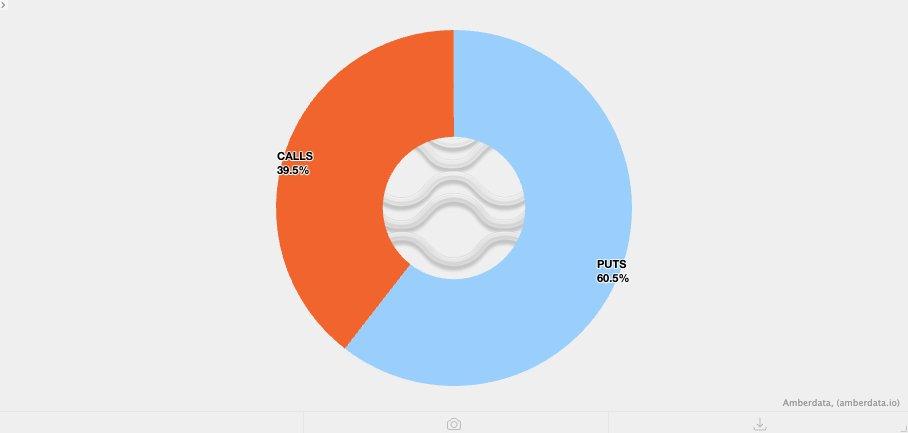
How do we know this? Because IBIT set a new record for trading volume (exceeding $10 billion, twice the previous record), and options trading volume also reached the highest number of contracts since the ETF's inception. Slightly different from previous events, this options activity was dominated by put options, with trading volume clearly skewed towards sellers. We'll discuss this further later.

Caption: IBIT historical trading volume data, 2/5 recorded a record high.
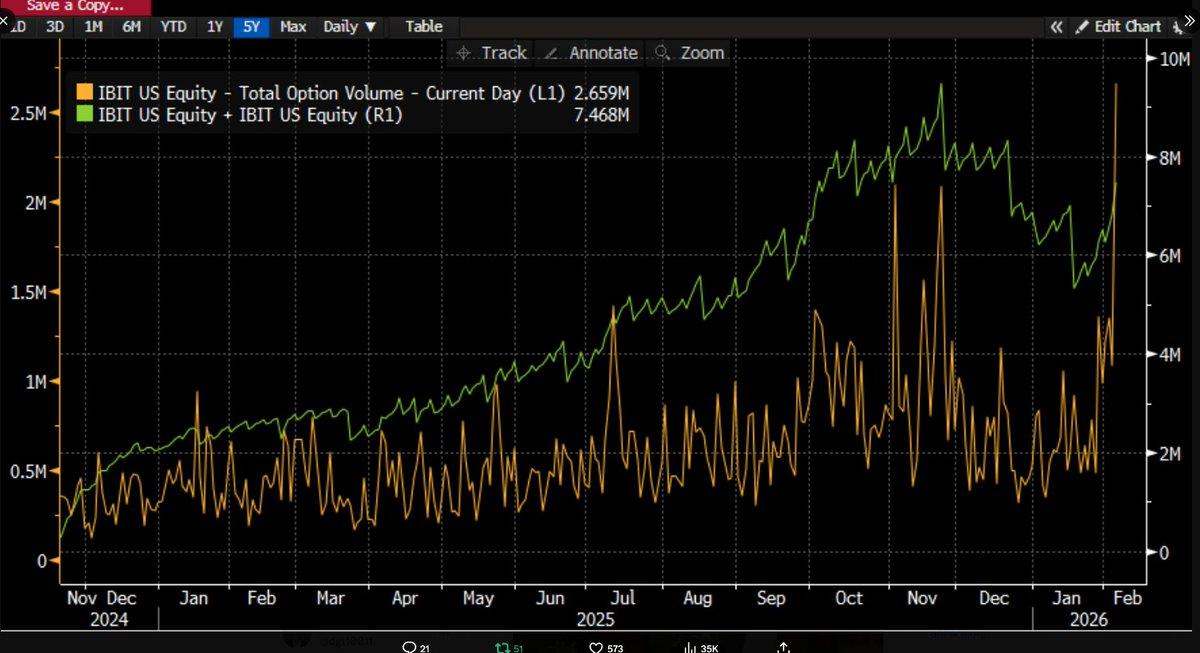
Caption: Total IBIT options trading volume; the number of contracts traded that day reached the highest level since the ETF's listing.
Meanwhile, IBIT's price movement has shown a very strong correlation with software stocks and other risky assets over the past few weeks. Goldman Sachs' PB (Prime Brokerage) data also shows that February 4th was one of the worst-performing days ever for multi-strategy funds, with a z-score of 3.5. What does this mean? This is a 0.05% probability event, 10 times rarer than a 3 standard deviation event. It's catastrophic.
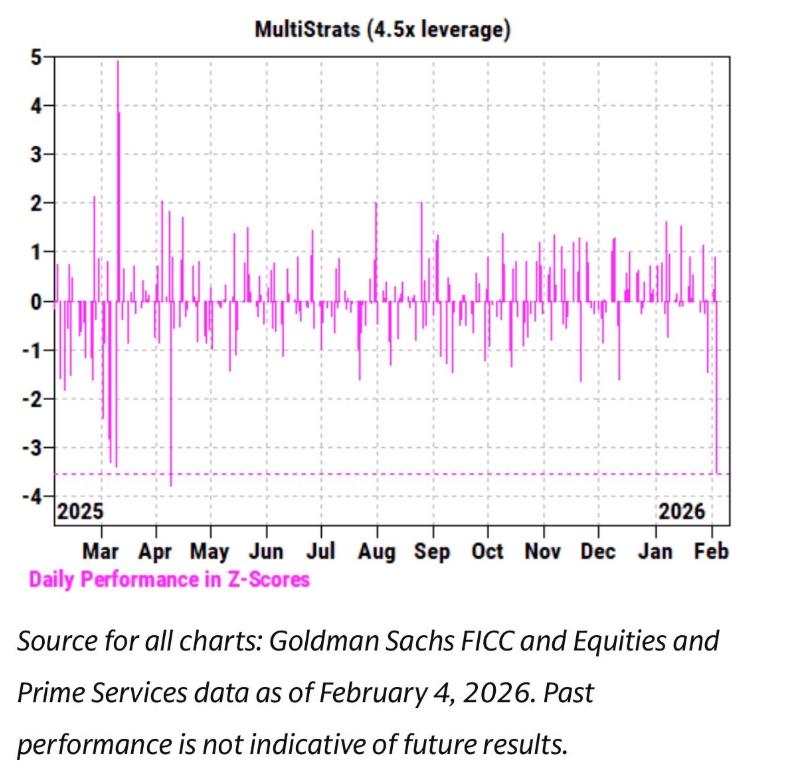
Caption: Source: Goldman Sachs FICC and Equities and Prime Services. Data as of February 4, 2026. Past performance is not indicative of future results.
After every event of this magnitude, the risk manager of Pod Shop (the various trading groups under the multi-strategy fund) would step in and demand that everyone immediately reduce their positions without any explanation. This explains why February 5th was also a bloodbath.
Anomalies in IBIT's cash flow
Given the record activity and price action that day (down 13.2%), we would have expected to see net redemptions. Historical data: On January 30th, IBIT fell 5.8% the previous day, recording a record-breaking -$530 million in redemptions; on February 4th, it saw -$370 million in redemptions during a continuous decline. Following this logic, an outflow of $500 million to $1 billion seems reasonable.
But the reality is quite the opposite; we are seeing widespread net inflows: IBIT added approximately 6 million units, and AUM increased by over $230 million. Other ETFs also recorded inflows, totaling over $300 million and still growing.
This is perplexing. You could勉强 explain it by saying the strong rebound on February 6 reduced some outflows, but turning that into net subscriptions is a completely different matter. This suggests that multiple factors are at work simultaneously, but they don't point to a single narrative.
Based on the information currently available, several hypotheses can be made:
- The Bitcoin sell-off triggered a multi-asset portfolio or strategy that is not purely crypto-native (it could be the aforementioned multi-strategy hedge fund, or a model portfolio like BlackRock's that allocates between IBIT and IGV, which triggered automatic rebalancing after the sharp fluctuations).
- The accelerated sell-off in Bitcoin is related to the options market , especially the downside.
- The sell-off did not result in a final outflow of Bitcoin assets, meaning that most of the activity was "paper money" trading driven by market makers and dealers, and these positions were generally hedged.
My assumption
Based on these facts, my hypothesis is as follows:
- The catalyst was widespread deleveraging of multi-asset funds/portfolios, as the downside correlation of risky assets reached statistically anomalous levels.
- This led to a dramatic deleveraging of Bitcoin, but much of the Bitcoin risk was actually hedged by "delta-neutral" positions. These included basis trading and relative value trading (pegged to crypto stocks), where market makers typically hedged off the residual delta.
- Deleveraging triggered a short-selling gamma effect, creating a compound acceleration in the downside. Market makers needed to sell IBIT, but because the sell-off was so intense, they had to short Bitcoin without any inventory. This actually created new inventory, thus reducing the expected large outflow.
- Then on February 6, a positive IBIT inflow occurred, with buyers (the specific type of buyers is still uncertain) buying on dips, further offsetting the small net outflow that might have occurred originally.
Starting with the correlation of software stocks
I tend to believe the catalyst came from the sell-off in software stocks, as the correlation even extends to gold. See the two charts below:
[Image: Correlation chart between GLD and IBIT (Bloomberg screenshot)]
Chart caption: Price trend comparison between GLD (Gold ETF) and IBIT
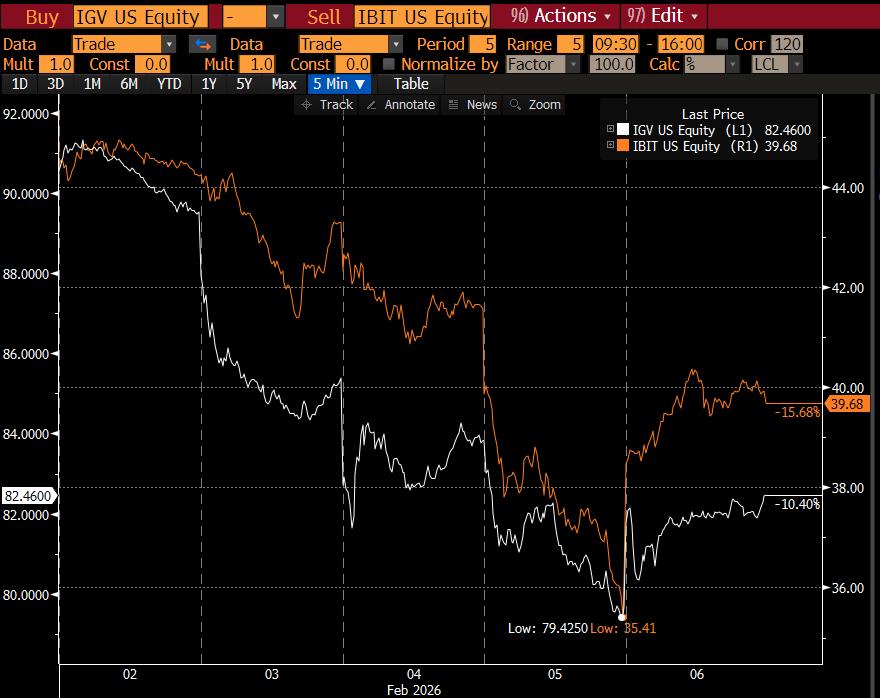
[Image: Correlation chart between IGV and IBIT (Bloomberg screenshot)]
Chart caption: Price trend comparison between IGV (Software ETF) and IBIT
This makes sense to me. Gold is not typically an asset used by multi-strategy funds for leveraged trading, but it could be part of an RIA (Registered Investment Advisor) model portfolio. Therefore, this confirms that the core of the event is more likely a multi-strategy fund.
The Collapse of CME Basis Trading
This leads to the second point: drastic deleveraging includes hedged Bitcoin risk. Take, for example, CME basis trading, a favorite among Pod Shops:
[Image: CME BTC basis data table (30/60/90/120 days)] Caption: CME BTC basis data from January 26 to February 6, thanks to @dlawant for providing it.

Looking at the full dataset reveals the truth—the near-month basis surged from 3.3% for 2/5 to 9% for 2/6. This is one of the largest jumps we've observed since the ETF's inception, essentially confirming what happened: basis trades were forcibly liquidated under orders.
Consider giants like Millennium and Citadel, who were forced to liquidate their basis trading positions (selling spot and buying futures). Given their size within the Bitcoin ETF ecosystem, you can understand why they're being hyped so much.
Structured products: the "fuel" for a downturn.
This brings us to the third leg. Now that we understand the mechanism by which IBIT was sold off during the widespread deleveraging, what is accelerating the decline? One possible contributing factor is structured products.
While I don’t believe the structured products market is large enough to single out this sell-off, it could very well be the trigger that sets off a chain of liquidations when all the factors align in a way that no VaR model could predict.
This immediately reminded me of my time working at Morgan Stanley—knock-in put barrier options can, under certain circumstances, allow delta to exceed 1, a situation that the Black-Scholes model simply doesn't consider for ordinary options.
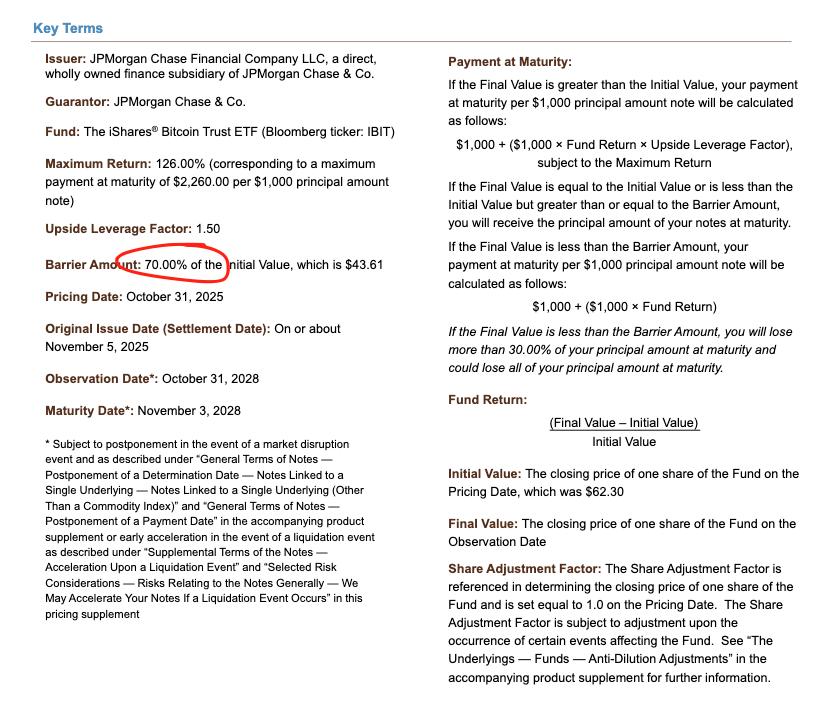
[Image: JPM's structured note document priced last November]
Chart caption: JPM structured notes, the barrier price is around 43.6.
Looking at the notes priced by JPM last November, the barrier price was around 43.6. If Bitcoin drops another 10% in December, many barriers will fall into the 38-39 range—right at the heart of this storm.
When these barriers are overcome, if market makers use a combination of short put options to hedge knock-in risk, the gamma changes extremely rapidly, especially under negative vanna (volatility sensitivity) dynamics, forcing market makers to aggressively sell the underlying asset during a downtrend.
This is what we're seeing: implied volatility (IV) has plummeted to historical extremes, nearly reaching 90%, indicating a catastrophic squeeze. In this scenario, market makers may have been forced to short IBIT significantly, ultimately creating a net increase in share volume. This part requires some imagination and is difficult to confirm without more spread data. However, given the record trading volume, authorized participants (APs) involvement is entirely possible.
Superposition of crypto-native short gamma
Adding another factor: due to persistently low volatility in recent weeks, clients in the crypto-native community have been buying put options. This means that crypto market makers are naturally in a short gamma state, essentially selling options at excessively low prices. When unexpectedly large volatility occurs, the downside is further amplified.
[Image: Market maker gamma position distribution chart]
Caption: Market makers primarily hold short gamma positions in put options within the 64k-71k range.
The rebound on February 6
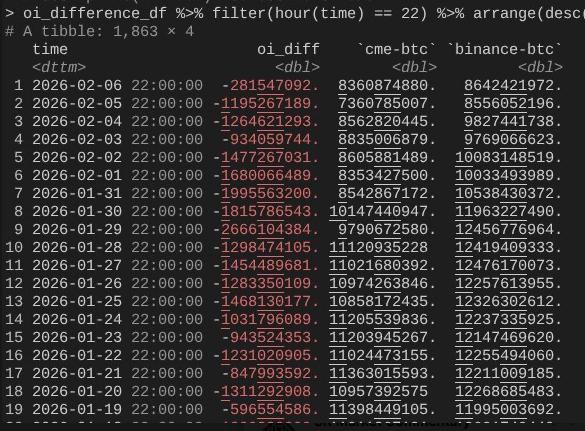
By February 6th, Bitcoin had completed a heroic rebound of over 10%. An interesting phenomenon is that CME's open interest (OI) is expanding much faster than Binance's.
[Image: Comparison of CME vs Binance OI changes]
Caption: Thanks to @dlawant for providing the hourly snapshot data, aligned to 4 PM Eastern Time.
We can see that OI dropped sharply from February 4th to February 5th (which again confirms that CME basis trading was closed out on February 5th), but it came back on February 6th, possibly to take advantage of the higher basis level and neutralize the outflow effect.
This puts the whole picture together: IBIT subscriptions/redemptions were roughly balanced because CME basis trading recovered net; but prices were lower because Binance's open interest (OI) collapsed, meaning a lot of deleveraging came from crypto-native short gamma and liquidations.
Conclusion: Not a fundamental event.
So this is my best theory about what happened in 2/5 and 2/6. It has some assumptions and isn't entirely satisfactory—because there isn't a "culprit" like FTX to blame.
The core conclusion, however, is that the catalyst came from non-crypto traditional financial de-risking operations, which just happened to push Bitcoin to a level where short gamma accelerated the decline through hedging activities (rather than directional trading), leading to a need for more inventory – which quickly reversed the market-neutral position in traditional finance on 2/6 (but unfortunately, crypto directional positions did not recover in tandem).
While this answer isn't entirely satisfying, it at least confirms that yesterday's sell-off had nothing to do with 10/10.
Refuting the "Hong Kong Fund Yen Arbitrage" Theory
I don't believe last week's events were a continuation of the 10/10 deleveraging. Some have suggested a non-US Hong Kong fund might have been involved in a yen carry trade that resulted in a margin call. This theory has two major flaws:
First, I don't believe any non-crypto prime broker could offer such complex multi-asset trading services while also providing a 90-day margin buffer; they would have run into problems long ago, even before risk controls tightened.
Second, if arbitrage is used to buy IBIT options to "recover losses," then a drop in Bitcoin won't lead to an accelerated decline—the options will simply become out-of-the-money (OTM) and the Greeks will go to zero. This means the trade definitely involves downside risk. If you 'short IBIT put options while simultaneously long on USD/JPY arbitrage—that prime broker deserves to go bankrupt.
The next few days are crucial.
The next few days are crucial because we'll see more data to determine whether investors are using this pullback to create new demand, which would be a very bullish signal.
The outlook for ETF inflows is currently very encouraging. I firmly believe that true RIA-style ETF buyers (not relative value hedge funds) are diamond hands. We're seeing a lot of institutional push in this area, including what the industry and our colleagues at Bitwise are doing. To verify this, I'm watching for net inflows that aren't accompanied by an expansion of basis trading.
The fragility of traditional finance is the antifragility of Bitcoin.
Finally, this also tells you that Bitcoin is now integrated into financial capital markets in a very complex way. This means that when we are positioned to experience a squeeze in the opposite direction, the upward movement will be more vertical than ever before.
The fragility of traditional financial margin rules is Bitcoin's antifragility. Once a reverse price surge occurs—which I believe is inevitable, especially now that Nasdaq has increased the open interest limit for options—it will be spectacular.