At two shops on the fourth floor of Terminal 3 (International) at Tokyo Haneda Airport, "Edo Koji" and "Edo Restaurant" have begun accepting a new payment method: travelers open their MetaMask wallets, generate a QR code, and the staff scans it to complete the transaction in USDC within seconds. The test is expected to continue until February 28.
The driving force behind this is NetStars, a Japanese payment infrastructure company founded in 2009 whose "StarPay" payment gateway service covers more than 1.6 million POS terminals and supports over 50 payment methods. WEA JAPAN, a technology provider specializing in blockchain services, is collaborating on the development of the QR payment application.
Why Solana? Why an airport?
NetStars ultimately chose USDC on the Solana blockchain, rather than Ethereum or other mainstream public chains. The reasoning is pragmatic: airport retail scenarios demand extremely low latency, and Solana's high-speed processing capabilities and shorter address format are well-suited for environments with high passenger traffic and frequent transactions. The system features a 30-second transaction timeout mechanism; failed transactions are automatically canceled, and error notifications are sent to international passengers in English.
Choosing Haneda Airport also has its logic. As one of Japan's most important international air hubs, Terminal 3 primarily serves foreign passengers, and the initial target audience for stablecoin payments is precisely those inbound travelers who have USDC in their wallets but may not hold Japanese yen. MetaMask's multilingual interface, in-store multilingual signage, and automatically displayed yen/dollar exchange rate all point to the same design intent: to reduce payment friction for foreign travelers.
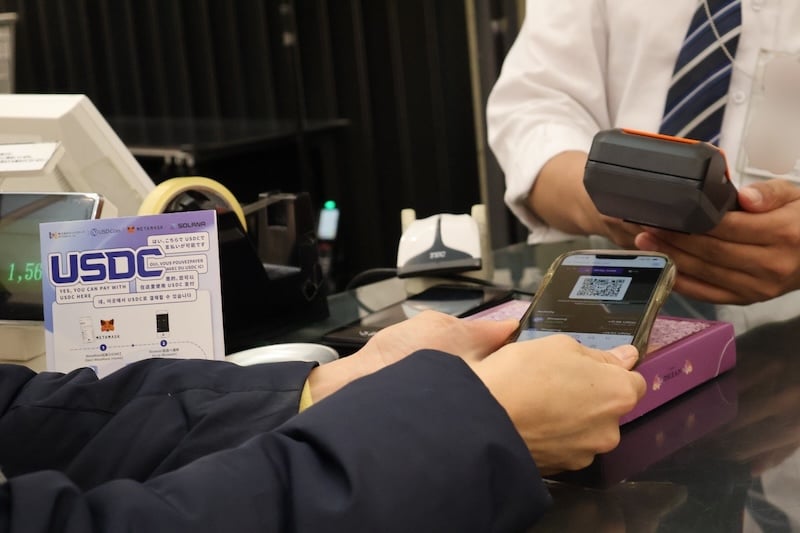
The key is for merchants to avoid handling cryptocurrency.
For any retail payment solution, the merchant experience determines its scalability. Haneda's design is quite pragmatic in this regard: merchants receive transaction information through the StarPay gateway and settle in Japanese Yen, without having to handle digital asset exchange or any Web3 operations.
This means that for merchants, there is no fundamental difference between accepting USDC and accepting Apple Pay: both involve scanning a code, confirming, and depositing the payment. The technical complexity of cryptocurrency is encapsulated in the back end of the payment gateway.
This architecture aligns with current trends: it allows stablecoin payments to eliminate the need for merchants to "believe in crypto," requiring only that they trust the payment service providers they already use.
Japan's stablecoin regulations are clear.
The successful implementation of the Haneda Airport case study is inseparable from Japan's prior planning in regulating stablecoins. In June 2023, Japan revised its Payment Services Act, defining fiat-pegged stablecoins as "electronic payment instruments" (EPIs) and restricting their issuance to only banks, money transfer service providers, and trust companies. This framework is among the most stringent globally, but it also provides the clearest compliance path.
In June 2025, the Japanese Diet passed an amendment to the Payment Services Act, further relaxing reserve requirements. Issuers can allocate up to 50% of their reserves to low-risk assets (such as Japanese or US Treasury bonds with maturities of three months or less), instead of keeping the entire amount in bank demand deposits. This amendment is expected to take effect before June 2026, providing stablecoin issuers with more flexible options for fund allocation.
Meanwhile, Japan's domestic stablecoin ecosystem is rapidly taking shape. In October 2025, after obtaining registration with the Financial Services Agency, JPYC officially launched JPYC, Japan's first legal and compliant yen stablecoin, with bank deposits and Japanese government bonds as its full reserves. SBI Holdings and Startale Group have also signed a memorandum of understanding to launch another yen stablecoin in the second quarter of 2026.
It's also worth noting NetStars' own strategic moves: the company has formed an alliance with NetX, JPYC, and Progmat to jointly build Japan's first regulated yen stablecoin payment infrastructure. If this system is successfully launched, over 600,000 NetStars payment terminals will be able to directly connect to the stablecoin settlement network, enabling 24/7 programmable payments.
Not the finish line, but the baseline.
Of course, the two duty-free shops at Haneda Airport are currently quite small. But as a proof of concept, it is testing whether stablecoins can operate within a compliant framework, in real retail scenarios, and without merchants handling the coins at all.
The answer is yes. At least technically, this has been proven.
The real test is yet to come. From two stores to 600,000 terminals, from USDC to the Japanese yen stablecoin, from airport duty-free shops to convenience stores and restaurants, every step forward will involve regulatory approval, merchant education, optimization of user experience, and most fundamentally: are consumers really willing to use stablecoins to buy things?
Japan is proceeding with this in its usual way: first legislation, then pilot programs, and finally scaling up. This path may not be "decentralized" enough, but if the ultimate goal is to bring cryptocurrency into everyday life, then starting with duty-free shops at Haneda Airport may be more practical than starting with any white paper.