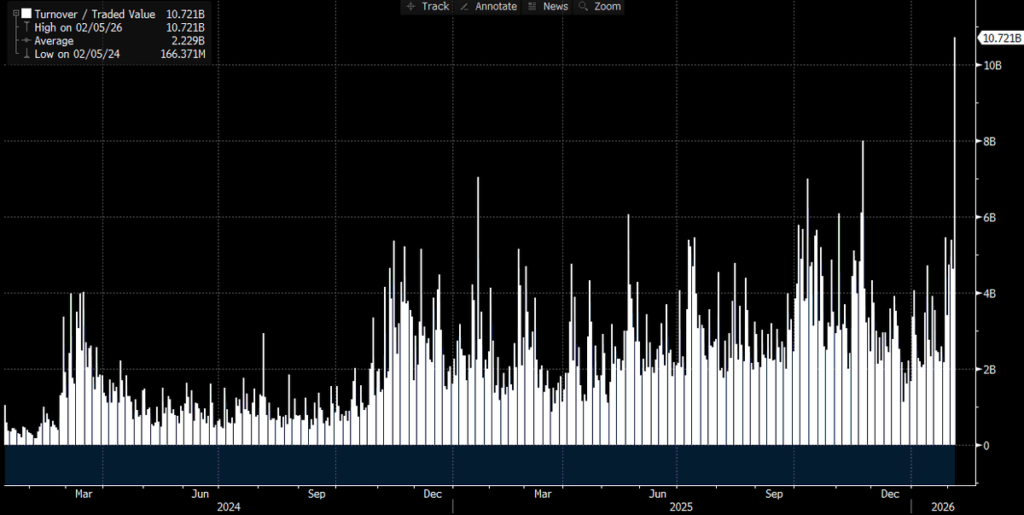
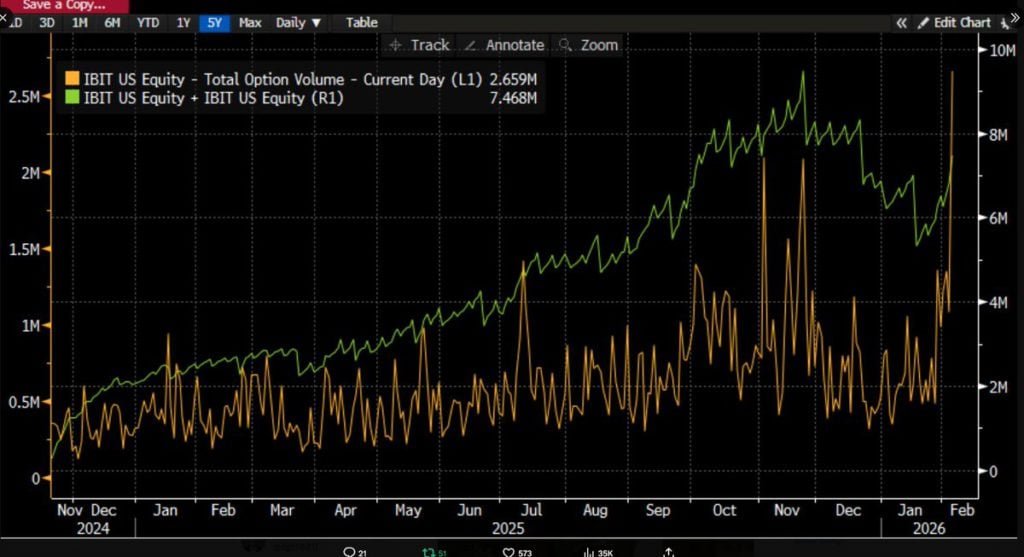
As more data surfaced over time, things became increasingly clear: this massive sell-off was linked to the Bitcoin ETF, and it all happened on one of the most devastating trading days in the capital markets. We are certain of this because IBIT set a record trading volume (over $10 billion, double the previous record – a staggering figure), while options trading volume also reached historic levels (see the chart below, the highest number of contracts since the ETF's inception).
One aspect is slightly unusual compared to past trading activity: the imbalance in trading volume indicates that this options activity was dominated by put options (rather than call options). (This will be discussed further later.)
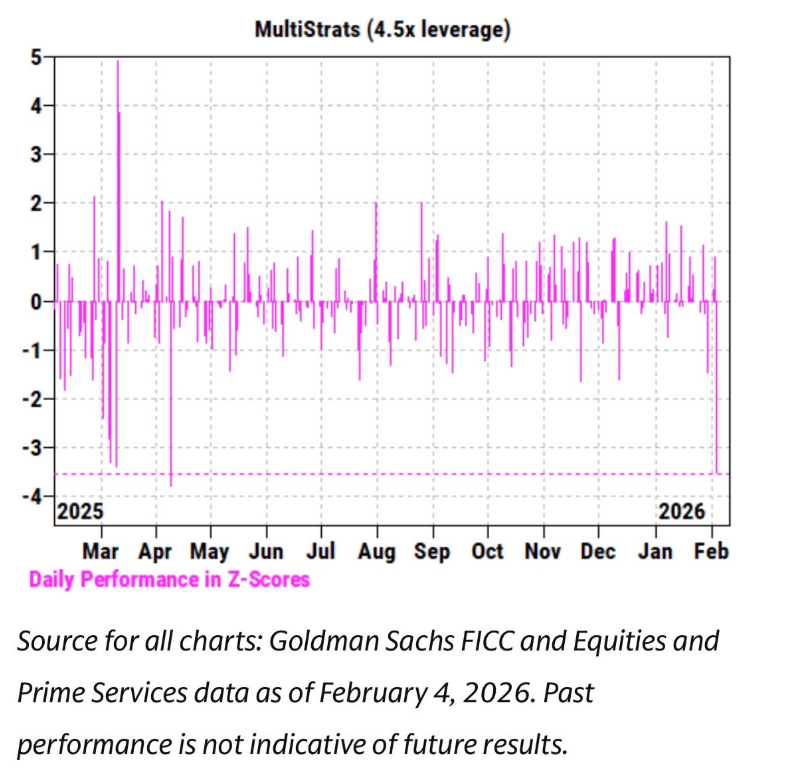
Meanwhile, we observed that IBIT's price movement over the past few weeks has shown a very close correlation with software stocks and other risky assets. Goldman Sachs' Prime Brokerage division also released a report noting that February 4th was one of the worst single-day performances ever for multi-strategy funds, with a Z-score as high as 3.5.
This is an event with a probability of only 0.05%, ten times rarer than a three-standard-deviation event. It's a catastrophic event. Whenever such an event occurs, the risk managers at Pod Shop (the independent trading team within a multi-strategy hedge fund) intervene, demanding everyone indiscriminately and urgently reduce leverage. This explains why February 5th was also a bloodbath.
Given all this record-breaking trading activity and the direction of the price movement (down 13.2%), we would have been most likely to expect net redemptions. Referring to historical data, such as the record $530 million in redemptions on January 30th after a 5.8% drop the previous day, or the $370 million in redemptions on February 4th after consecutive losses, an outflow of at least $500 million to $1 billion seems reasonable.
But in fact, the result was quite the opposite: we saw widespread net subscriptions: IBIT saw approximately 6 million new shares subscribed, boosting assets under management by over $230 million. The rest of the ETF portfolio also recorded inflows, totaling over $300 million and still increasing. This is quite perplexing. One might tentatively imagine that the strong price rebound on February 6th reduced outflows, but to translate that into a positive net subscription result is a completely different matter.
This means that multiple factors are likely interacting, but they do not point to a single narrative. Based on the information we currently have, we can make the following assumptions, and on this basis, propose my hypothesis:
- The Bitcoin sell-off likely impacted a multi-asset portfolio/strategy that is not purely cryptocurrency-native (it could be a multi-strategy hedge fund as described above, or a model portfolio business like BlackRock's that allocates between IBIT and IGV and requires automatic rebalancing due to high volatility).
- The accelerated sell-off in Bitcoin is likely related to the options market, especially in the downtrend.
- This sell-off did not result in a net outflow of Bitcoin assets, meaning it was primarily driven by "paper money complex" activity dominated by traders and market makers who typically run roughly hedged positions.
Based on these facts, my current hypothesis is as follows:
The catalyst for the sell-off was widespread deleveraging in multi-asset funds/portfolios, driven by statistically anomalous levels of downside correlation in risky assets. This triggered a dramatic deleveraging that included risks associated with Bitcoin, but much of this risk was actually "Delta-neutral" hedging positions, such as basis trading or relative value trading against cryptocurrency-related stocks, or other types of trading that typically tend to lock in residual Delta within the trading community.
This deleveraging subsequently led to some short-term Gamma effects, creating a compounding effect on the downside and forcing traders to sell IBIT. However, due to the extreme volatility of the sell-off, market makers were forced to short short Bitcoin without considering inventory levels. This created new inventory, thus mitigating the previously anticipated large outflow of funds.
Subsequently, on February 6, we saw a positive inflow of funds into IBIT—buyers of IBIT (the question is, what kind of buyers?) took advantage of the low prices to buy, which provided an additional hedge against what would otherwise have been a small net outflow.
First, I tend to believe the catalyst was driven by a sell-off in software stocks, as evidenced by their close correlation with gold. Please see the following two charts:
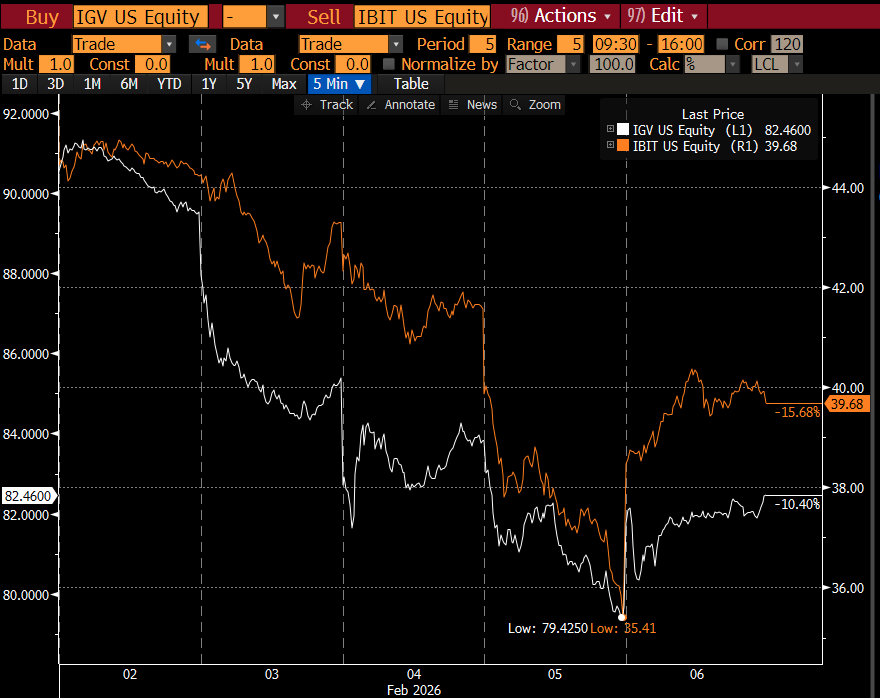
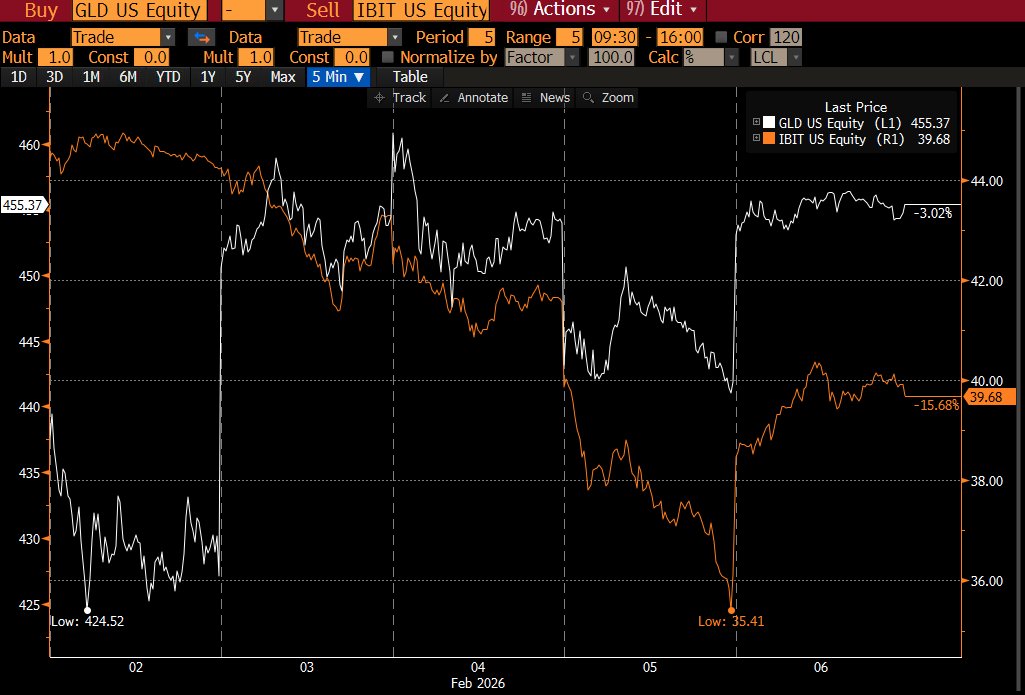
This makes sense to me because gold is generally not an asset held by multi-strategy funds as part of a leveraged trade, although it may be part of an RIA (Registered Investment Advisor) model portfolio. Therefore, this further confirms, in my view, that the core of the event is more likely multi-strategy funds. Then, the second point makes even more sense—the dramatic deleveraging involves hedged Bitcoin risk.
For example, basis trading on the Chicago Mercantile Exchange (CME) has always been a favorite of Bitcoin trading platforms:

Please see the complete dataset, containing CME Bitcoin basis data for 30/60/90/120 days from January 26th to yesterday (thanks to industry-leading research expert @dlawant). It can be observed that near-month basis trading jumped from 3.3% on February 5th to a staggering 9% on February 6th. This is one of the largest increases we've personally observed in the market since the launch of ETFs, illustrating the most likely scenario: deleveraging of basis trading under orders.
Consider giants like Millennium and Citadel, who were forced to liquidate basis trades (selling spot and buying futures). Given their massive size within the Bitcoin ETF complex, you can see how they can cause such dramatic volatility. I've outlined my hypothesis here.
This leads to the third point. Now that we understand the mechanism by which IBIT was sold off during widespread deleveraging, what accelerated the decline? One potential "fuel" that fueled this fire is structured products. While I don't believe the structured products market is large enough to be solely responsible for this sell-off, I think it's entirely possible that when everything aligns in a bizarre and perfect way that no VaR model could predict, it can become an acute event triggering a chain reaction of liquidation.
This immediately reminded me of my time at Morgan Stanley, where knock-in put barriers could lead to disastrous situations—option Delta increases greater than 1, something the Black-Scholes model would never consider in a vanilla payoff structure.
Please look at a note priced by JPMorgan Chase last November. You can see the barrier is at 43.6. If the note had continued to be priced when Bitcoin dropped another 10% in December, you would have found significant barriers in the 38-39 range, which is precisely where the storm is brewing.
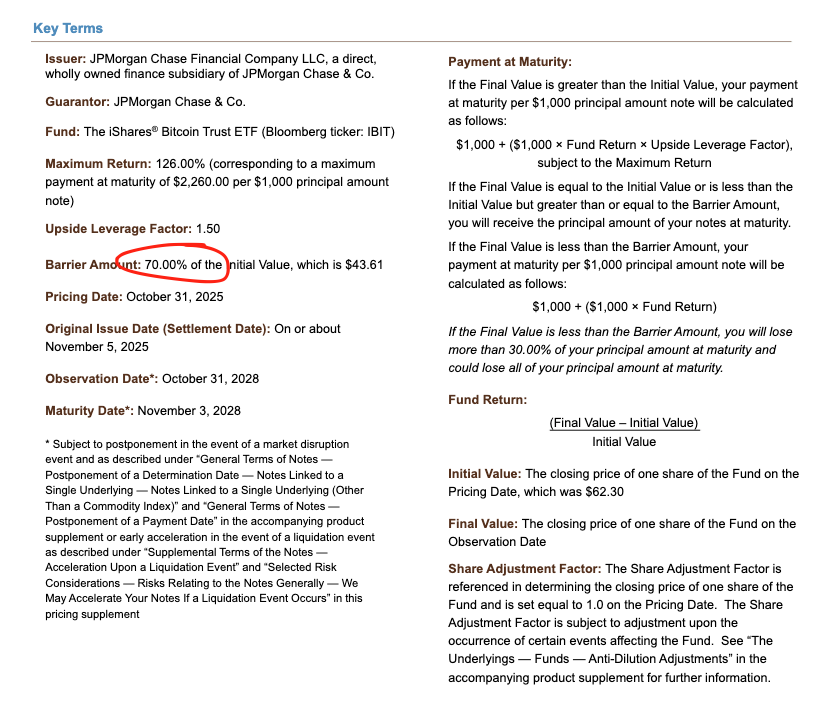
If these barriers are overcome, and traders use a combination of short put options to hedge knock-in risk, Gamma will fluctuate extremely rapidly due to negative Vanna dynamics. As a trader, you will have to actively sell the underlying asset when the market is weak. And this is exactly what we are seeing—implicit volatility has plummeted to record levels, almost reaching 90%, which will be interpreted as a catastrophic squeeze, to the point that traders may have to short IBIT to the point of ultimately creating net new units.
This part requires further imagination and is difficult to determine without more spread data. However, given the record trading volume, it is entirely possible that authorized participants (APs) were involved in this process.
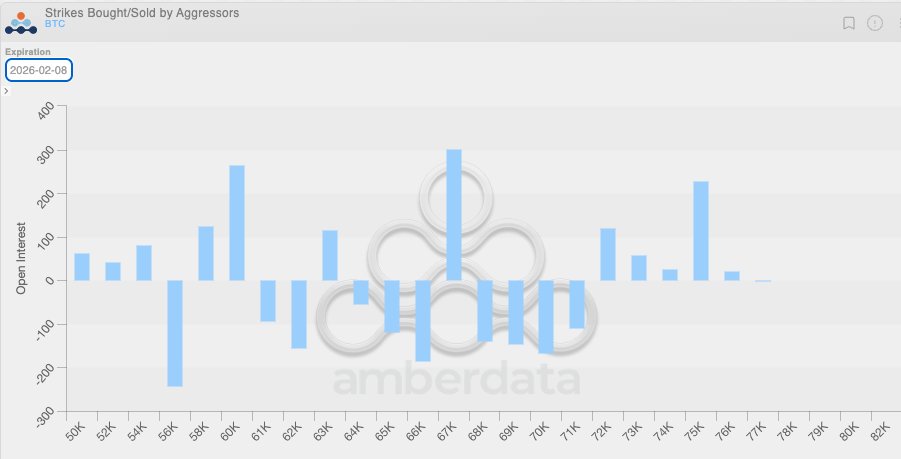
Now combine this negative Vanna dynamic with the fact that, due to persistently low volatility, we've seen widespread buying and selling activity from clients in the cryptocurrency-native space over the past few weeks. This means that cryptocurrency traders are naturally in a short Gamma state, essentially selling options at prices that are too cheap relative to the ultimately realized massive volatility, thus exacerbating the decline. You can also see this position imbalance below, with traders mostly in a short Gamma state selling options in the $64,000 to $71,000 range.
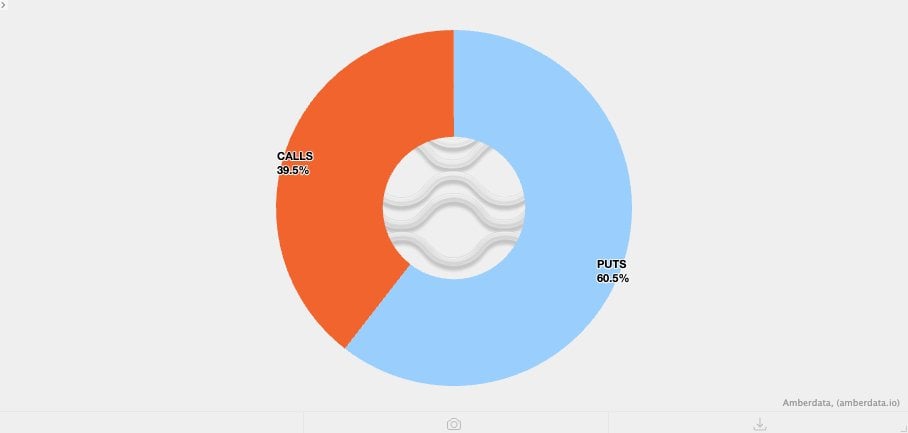
This brings us to February 6th, when Bitcoin staged a heroic rebound of over 10%. Here, we can point out an interesting phenomenon: CME's open interest (OI) is expanding much faster than Binance's (thanks again to @dlawant, who looked at the hourly snapshots and aligned the data to 4 PM Eastern Time).
You can see the decline from February 4th to February 5th, with open interest collapsing (which reaffirms that CME basis trading was liquidated on February 5th), but it may have rebounded yesterday to take advantage of higher levels, thus neutralizing the effect of the outflow.
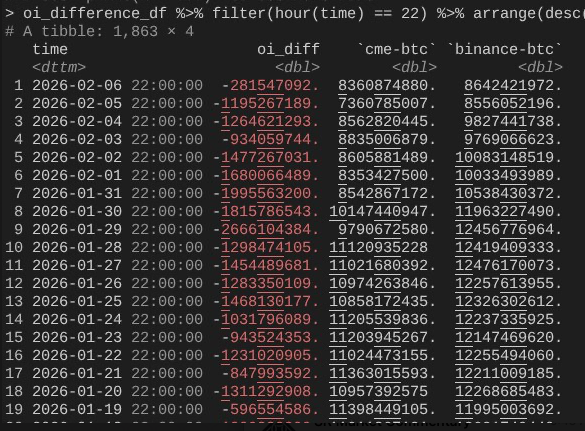
This now puts everything together nicely: you can imagine that IBIT's subscription/redemption was roughly flat because the CME basis recovered, but the price was lower because Binance's open interest had collapsed, which means that a lot of deleveraging likely came from the cryptocurrency's native short Gamma and forced liquidation.
So this is my best theory of what happened on February 5th and subsequently February 6th. It makes some assumptions, and less than satisfyingly, there isn't a single culprit to blame (like FTX). But the key conclusion is: the catalyst came from traditional financial de-risking operations outside of cryptocurrencies, which happened to push Bitcoin down to a level where short-term Gamma accelerated the decline due to hedging (rather than directional) activity, leading to demand for more holdings: this was then quickly reversed on February 6th by market-neutral strategies in traditional finance (but unfortunately, this wasn't the case for directional positions in cryptocurrencies).
While this may be less than satisfactory, it's at least somewhat reassuring to know that yesterday's sell-off was unrelated to the 10/10. Yes, I don't believe what happened last week was a continuation of the 10/10 deleveraging. I read an article suggesting the disaster might involve a non-US, Hong Kong-based fund involved in a problematic yen carry trade. This theory has two major flaws.
First, I simply do not believe that a non-cryptocurrency prime broker would offer services for such complex multi-asset trading while providing a 90-day buffer to cover margin shortfalls, without already being caught in a risk management framework tightening.
Second, if arbitrage is used to buy IBIT options to "get out of trouble," then a drop in Bitcoin doesn't necessarily lead to an accelerated decline—the options simply become out of the money, and their Greeks go to zero. This means the trade must involve downside risk, and if you're short IBIT put options while simultaneously long on USD/JPY arbitrage, then that prime broker deserves to go bankrupt.
The next few days will be crucial as we'll see more data to determine if investors are buying on dips and creating new demand: this would be a very bullish signal. Currently, I'm quite excited about the potential ETF inflows, because I still believe that true RIA-style ETF buyers (rather than relative value hedge funds) are diamond hands (steadfast holders), and there's so much progress happening at the institutional level, driven by the entire industry and my friends at Bitwise. To observe this, I'm monitoring net inflows not accompanied by an expansion in basis trading.
Finally, this also shows that Bitcoin has now been integrated into the financial capital markets in a very sophisticated way, which means that when we finally prepare for a squeeze in another direction, it will be more vertical than ever before.
The fragility of traditional financial margin rules is precisely the antifragility of Bitcoin. Whenever a surge occurs in the opposite direction—which, in my view, is inevitable given Nasdaq's increased cap on open interest in options—it will be absolutely spectacular.