The precious metals market experienced an epic rollercoaster ride at the start of 2026.
Against the backdrop of central bank buying, a weakening dollar, and international geopolitical turmoil, gold and silver prices initially hit record highs, with gold reaching $5,400 per ounce and silver even surpassing $118 per ounce. Within a month, gold rose by approximately 25% and silver by approximately 65%. This was followed by a precipitous pullback, with gold retreating by about 15%-18% from its peak and silver plummeting by 30%-39%. This extreme volatility has transformed gold from a dull safe-haven asset into a product whose profit potential and volatility are comparable to mainstream cryptocurrencies.
In such volatile market conditions, the optimal choice for most traders is not physical holding and delivery, but rather betting on a direction and magnitude of price fluctuations to maximize profits. Therefore, gold and silver perpetual contracts, with their advantages of two-way trading and capital efficiency, have become the preferred option for many.
Amidst fierce competition among numerous exchanges launching gold and silver contracts, which platform is truly the best choice? A truly excellent platform must simultaneously meet the following three criteria:
Deep liquidity: It can handle large inflows and outflows of funds and avoid price distortion and extreme price spikes.
Low transaction costs: Reduce fee friction for high-frequency and large-value transactions.
High leverage: fully unleash the profit potential of trending markets.
Based on this, we conducted a systematic comparison of the perpetual gold and silver contracts on six major platforms: MEXC , Binance, Bybit, Bitget, Gate, and OKX, in terms of liquidity, transaction costs, and leverage.
Which of the six major CEXs offers the best gold/silver contract trading experience?
Liquidity Comparison
In terms of liquidity, we conducted depth and slippage tests on XAUTUSDT ( the main gold underlying asset) and XAGUSDT (the silver underlying asset ). These metrics directly affect order execution efficiency and costs. The following data is from actual tests conducted on major exchange platforms (as of January 27, 2026).
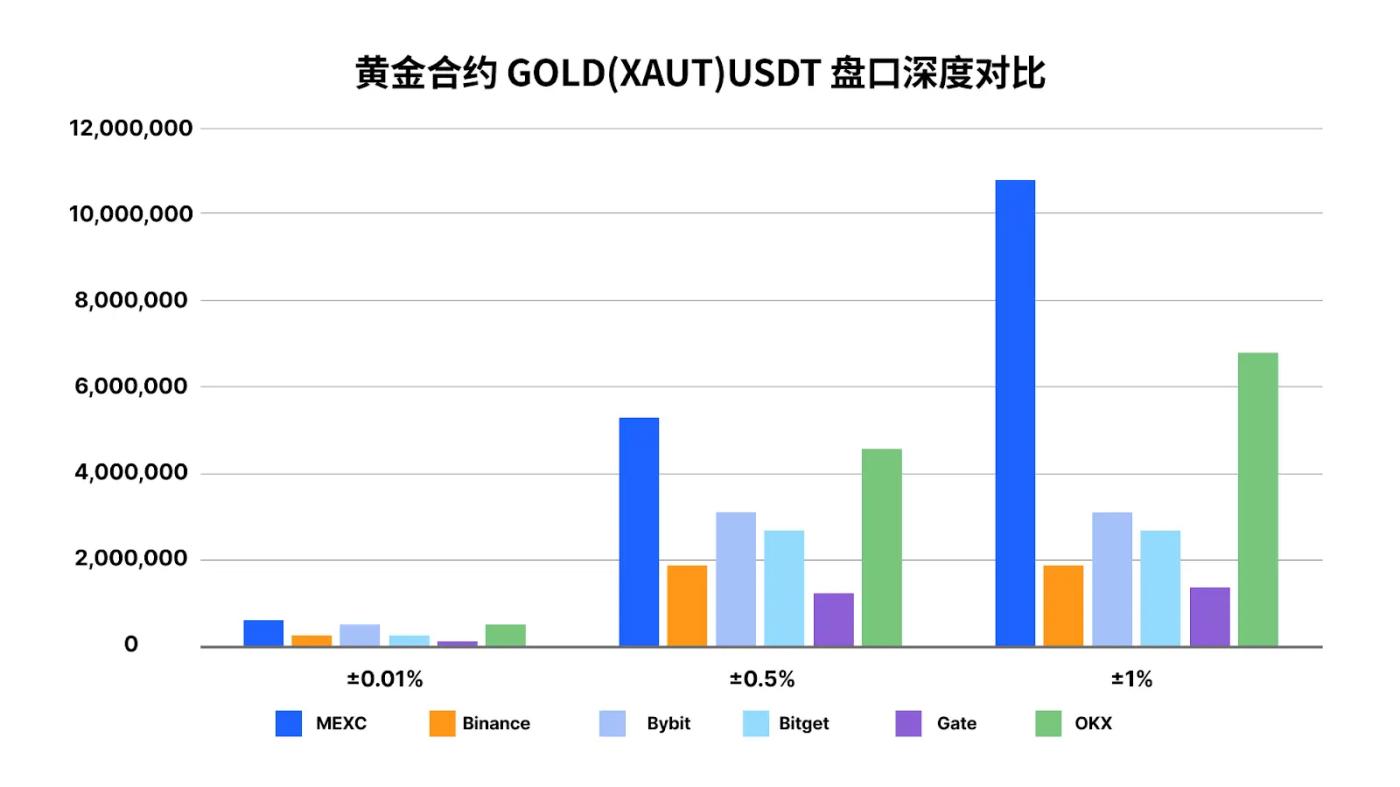
Gold contract XAUTUSDT
Within ±0.01% of the order book closest to the price, MEXC's order volume approaches 400,000, more than double that of other exchanges. This means that during minor market fluctuations, MEXC can absorb more orders instantly, resulting in smaller price deviations. This is extremely advantageous for quantitative bots or short-term high-frequency strategies, as order taking becomes very easy and stable.
When we widen the price range to 1%, MEXC provides a deep support level of over 10 million, compared to OKX's 6.8 million. In volatile markets, this level of support makes it less likely for exaggerated spikes in price action, and large buy/sell orders have a smaller impact on the price.
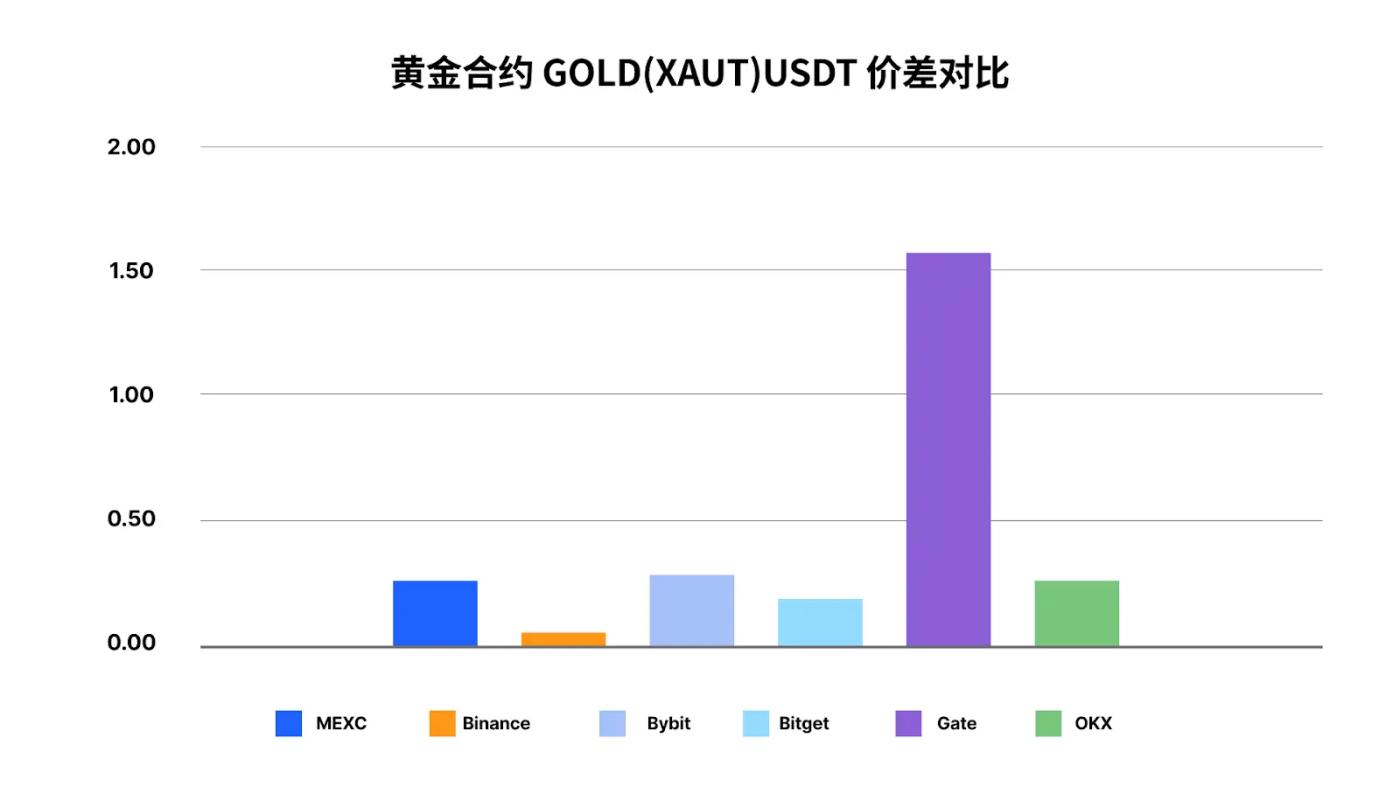
In terms of spreads, Binance has achieved the best, with a closer order book and a more advantageous real-time cost for frequent short-term trades. Apart from Gate.io, while other exchanges have slightly wider spreads, they are still generally within a relatively controllable range.
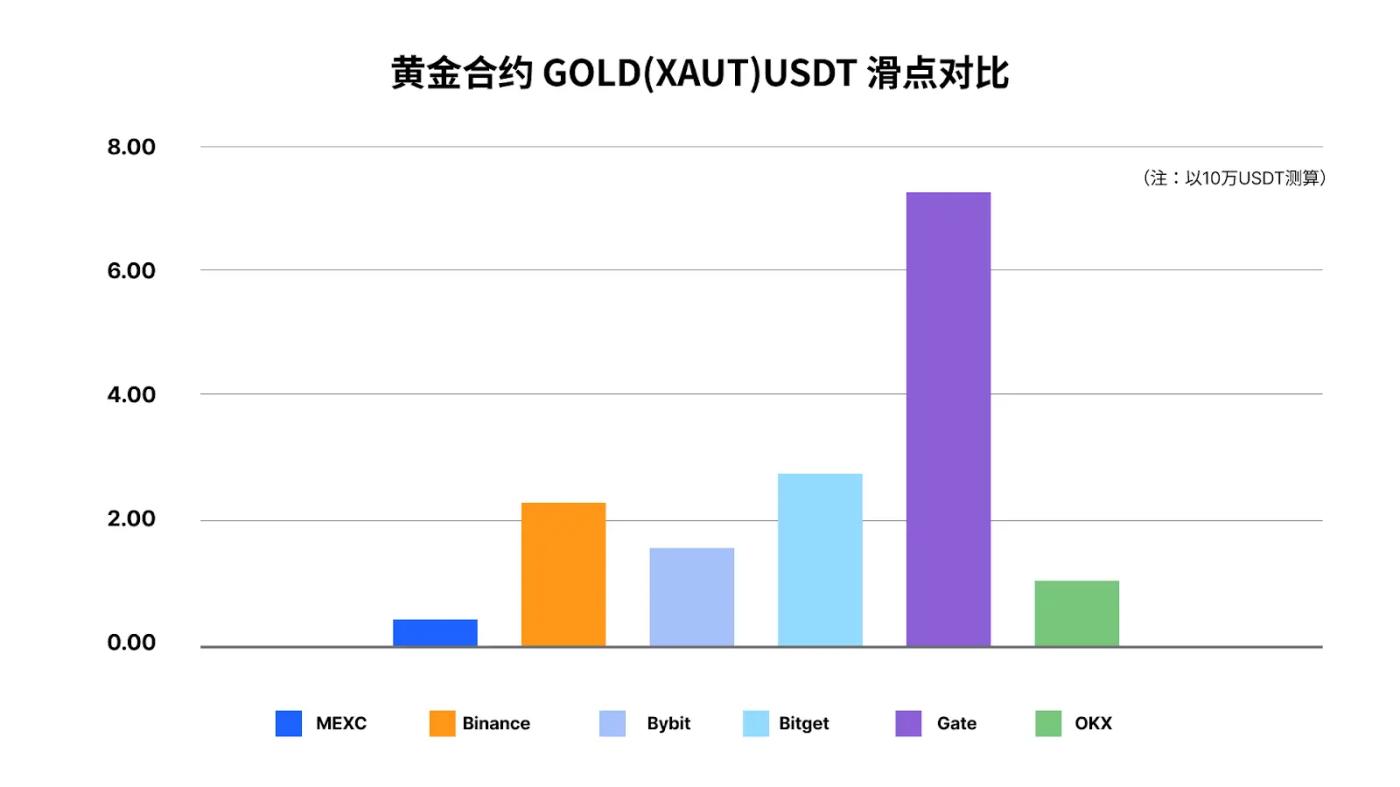
Let's look at another important friction cost—slippage. Based on a 100,000 USDT order, MEXC's slippage loss is only 0.44 USDT, significantly lower than other platforms, such as Binance at 2.39 USDT, Bitget at 2.85 USDT, and Gate at a whopping 7.31 USDT.
In summary, although Binance has the narrowest spreads and is more advantageous for small-volume, high-frequency trading, MEXC is better able to keep the transaction price close to expectations and reduce impact costs when executing larger trades and splitting orders, in terms of depth and order slippage.
(
Silver futures contract XAGUSDT
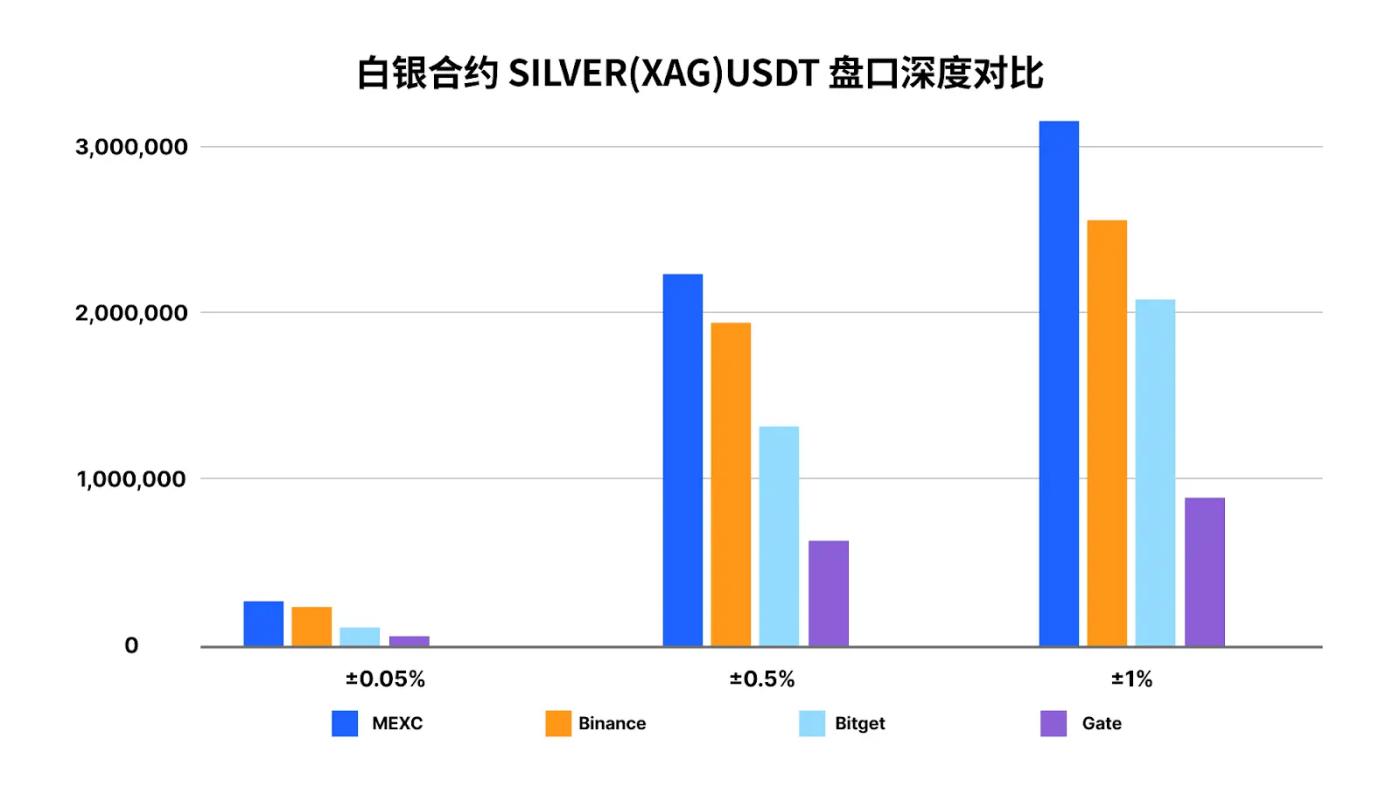
Compared to gold, silver typically exhibits higher volatility and is more prone to thinning of the order book and increased slippage during volatile market conditions. In the ±0.05% depth test, which is the most critical indicator of order book density, MEXC ranks first, with its order book volume exceeding not only Binance but also Bitget and Gate. For scalping and high-frequency trading, orders on MEXC are more likely to be matched closer to the execution price, thus reducing impact costs.
As the price deviation range widens, MEXC's order book advantage becomes even more apparent. Within a depth range of ±0.5%, the order book volume is approximately 2.3 million USDT; within ±1%, the depth is approximately 3.4 million USDT, significantly higher than other platforms. Greater depth means the market has stronger absorption capacity, large orders have less impact on prices, and there is a lower likelihood of spikes or wicks during extreme volatility.
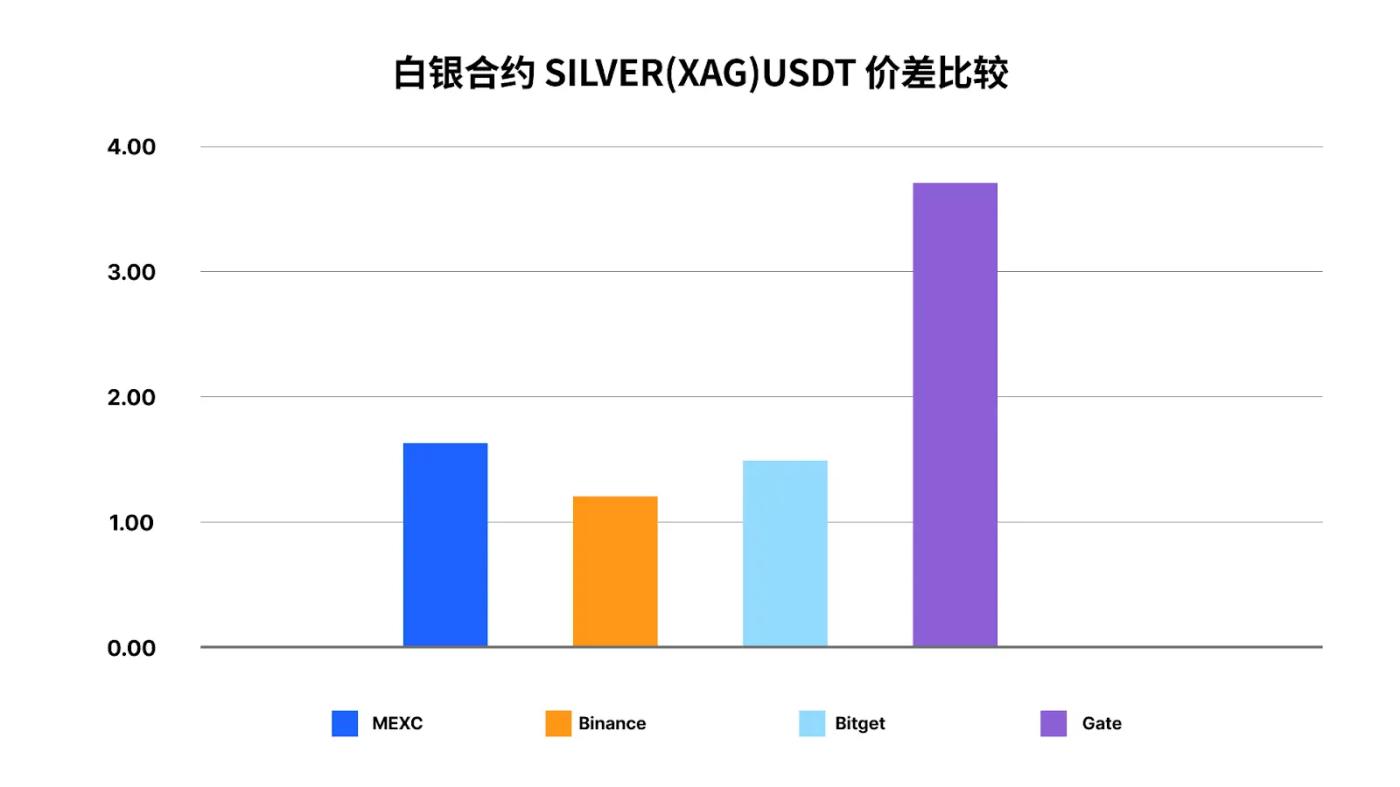
In terms of spreads, Binance has the narrowest range, making it more suitable for controlling the cost of frequent, small-amount transactions. MEXC and Bitget are similar, but slightly wider than Binance.
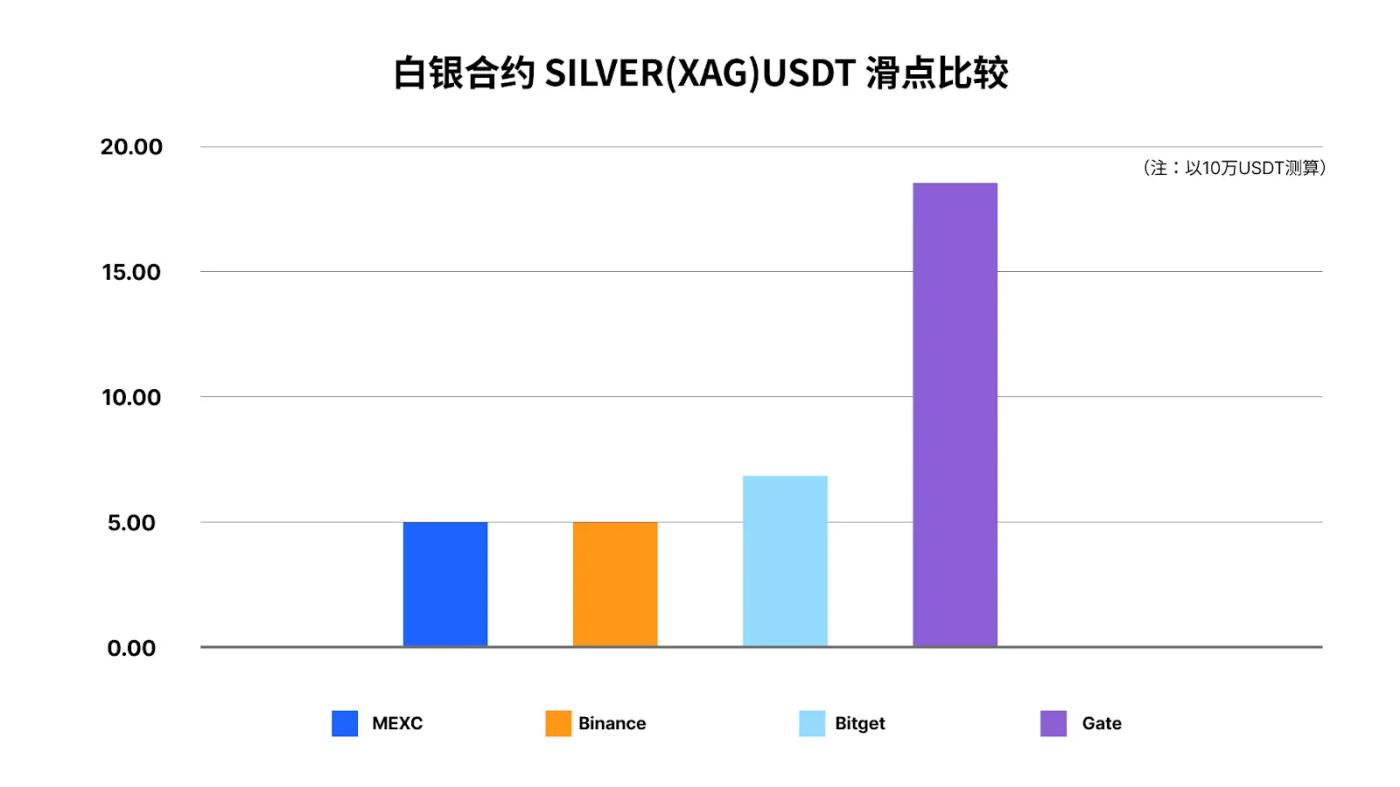
In slippage testing, taking a 100,000 USDT order size as an example, MEXC and Binance had the lowest slippage losses, approximately 5 USDT; Bitget had approximately 7 USDT, and Gate had approximately 18 USDT. This indicates that on higher volatility instruments like silver, MEXC offers more stable execution quality and lower implicit transaction costs.
Overall, in higher-volatility instruments like silver, when order sizes increase or prices fluctuate sharply, thicker pending orders and lower slippage are more effective in determining whether execution closely matches expectations. During periods of market volatility, a thicker order book on MEXC provides a greater margin of safety and execution certainty.
Fee Comparison
Transaction fees are another key factor affecting trading returns. For large-capital and high-frequency traders, even a difference of just a few basis points in fees can lead to significant net worth losses over the long term.
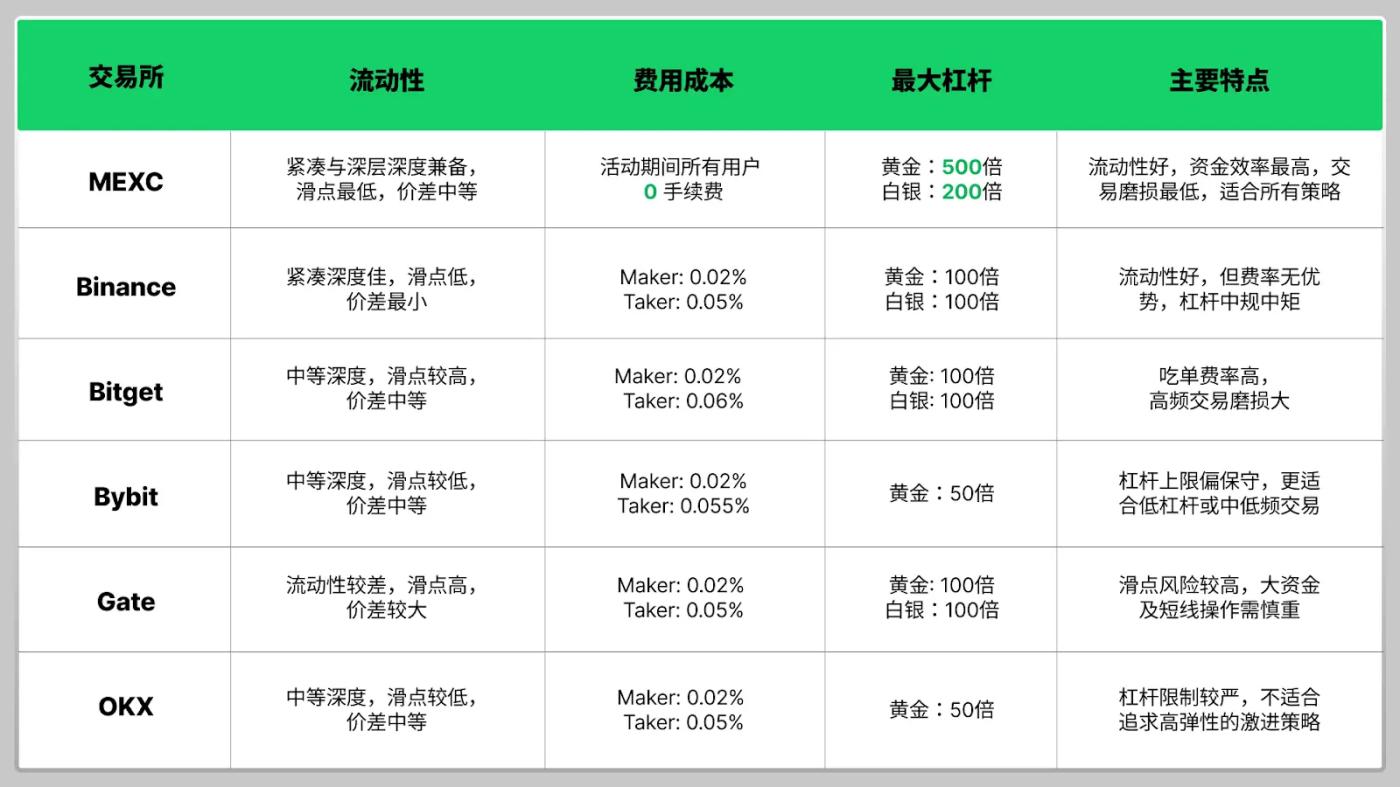
Comparing contract fees across six major exchanges, the default range is typically around 0.05% for takers and around 0.02% for makers. For example, a 1 million USDT order would cost approximately 200 USDT to open or close, while a taker would cost 500 USDT. If a complete trade (opening and closing) is considered, the cost could double. Unlocking lower fees often requires holding a large amount of platform tokens or reaching a high monthly trading volume threshold in exchange for VIP discounts. This creates a significant barrier to entry for ordinary users.
However, MEXC's current limited-time zero-fee promotion directly eliminates this friction cost. Regardless of account size, all users will not have to pay platform fees when trading gold or silver contracts, thus retaining more profits in their net asset value and avoiding long-term erosion by fees.
3. Leverage Comparison
In precious metals trending markets, leverage can effectively improve capital efficiency and position management flexibility. Under the same trading opportunity, higher leverage allows traders to leverage larger notional capital with less margin, facilitating phased position building, short-term hedging, and high-turnover execution.
Looking at the maximum leverage limits for gold and silver perpetual contracts , MEXC's leverage is significantly higher than most mainstream platforms. MEXC offers up to 500x leverage for gold contracts and up to 200x for silver contracts. In contrast, Binance, Bitget, and Gate generally limit their gold and silver contracts to 100x, while Bybit and OKX's gold contracts are only 50x. This means that, with the same principal and the same price volatility, MEXC users can theoretically leverage positions five times larger than those on Binance and Bitget. Of course, while high leverage amplifies returns, it also amplifies risks. When prices move in the opposite direction, high leverage is more likely to trigger liquidation, requiring strict risk management.
Furthermore, MEXC's high leverage advantage is not isolated; it combines with zero transaction fees and abundant liquidity to create a synergistic effect greater than the sum of its parts (1+1+1>3). Zero transaction fees significantly reduce the friction costs of high-frequency, grid, or large-volume trading, ensuring that every penny of profit remains within the user's net worth as much as possible. Greater liquidity reduces price shocks and slippage during large entries and exits, ensuring more stable opening and closing positions closer to the expected price. The combination of these two factors further amplifies the potential for leverage to achieve significant gains with a small investment.
The advantages of "zero fees + world-leading liquidity" empower diverse traders.
MEXC's limited-time 0% fee policy for gold and silver contracts, coupled with the platform's excellent liquidity, will bring tangible benefits to different types of traders.
Novice traders: Lower costs, all-day practice opportunities
For novice traders with limited experience, MEXC's precious metals perpetual contracts significantly lower the barrier to entry. Firstly, the " zero fee " allows beginners to confidently practice small, frequent trades. Secondly, MEXC supports 24/7 trading, allowing beginners to participate in the market during their spare time, without being restricted by weekday trading hours. Furthermore, beginners can flexibly use leverage according to their risk tolerance to capitalize on market opportunities with small amounts of capital—something almost unimaginable in the past, as traditional gold futures contracts and margin requirements were unfriendly to traders with limited funds. Of course, beginners must also carefully manage their positions and pay attention to risk management to avoid unnecessary losses due to excessive leverage.
Advanced traders: Favorable for diversified strategies
For experienced advanced traders, MEXC's gold and silver contracts offer a wealth of strategic options. Firstly, it enables one-stop trading of multiple assets, allowing traders who typically focus on both the crypto market and macro safe-haven assets. MEXC allows for flexible position allocation on a single platform; for example, when macro risk aversion is anticipated to rise, some crypto positions can be transferred to long gold or silver contracts, achieving cross-market hedging. This convenience is difficult to achieve in traditional environments, usually requiring separate operation of stock/futures accounts and crypto accounts. Furthermore, many advanced traders frequently engage in short-term or swing trading. MEXC's temporary waiver of gold and silver contract fees makes the cost of switching positions virtually zero, allowing traders to adjust positions more aggressively without worry, which is especially important in volatile markets.
High-frequency traders: Extreme cost efficiency
For high-frequency traders and even professional traders with huge intraday trading volumes, a "zero-fee" strategy is tailor-made. These traders capture tiny price differences in seconds, potentially executing hundreds or even thousands of trades a day. Even with traditional exchanges charging only a few per trade a fraction of a percent, the accumulated costs can be substantial. With a zero-fee option, this equates to a direct increase in profit margin compared to the same strategy. Secondly, MEXC emphasizes the high liquidity of its gold and silver contracts. For high-frequency and quantitative trading, liquidity is the lifeline, enabling frequent execution at near-optimal prices without slippage spiraling out of control. Overall, MEXC's precious metals contracts not only attract professional trading teams but also help improve the platform's overall liquidity, creating a virtuous cycle.
More importantly, "zero fees + world-leading liquidity" is also part of MEXC's long-term strategy. Even after the limited-time promotion ends, MEXC will maintain its highly competitive fees, continuing to create value for traders. Whether you're a novice user or a professional institution, trading gold and silver contracts on MEXC will offer unprecedented benefits and convenience.
Conclusion: The ambition to expand the multi-asset trading ecosystem
MEXC's launch of gold and silver contracts with a limited-time 0% fee may seem like an expansion of its contract product offerings, but it actually reflects the further implementation of its "one-stop, multi-asset trading platform" strategy. As tokenized assets, real-world assets, and crypto assets gradually merge at the trading layer, traders are increasingly inclined to gain exposure to multiple assets such as Bitcoin, stocks, gold, and silver within a single platform. MEXC is responding to this trend by breaking down the boundaries between traditional finance and the on-chain world through a unified trading experience.
Looking ahead, with the introduction of more commodities and stocks, MEXC is building a "super trading portal" spanning both crypto-native assets and traditional assets. It's not about being tied to a particular sector for the sake of a concept, but rather about providing users with truly efficient, low-cost, and 24/7 multi-asset trading capabilities . The launch of gold and silver contracts is a landmark milestone in this process, but far from the end. In the future, whoever can continuously optimize fee structures, improve liquidity, and meet the diverse asset allocation needs of users will be more likely to become the main force in the "on-chain multi-asset era."