Compiled & translated by: CoolFish
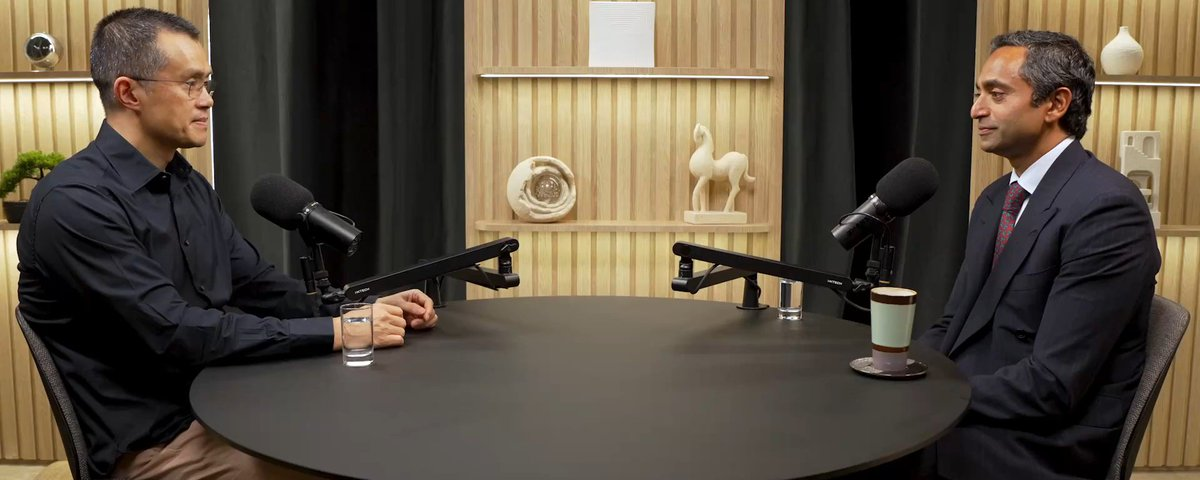
Guest: CZ (CZ@cz_binance )
Host: Chamath Palihapitiya ( @chamath )
Podcast: All In Podcast ( @theallinpod )
Original title: CZ's Untold Story: The Rise, Fall, and Redemption of Binance's Founder
Broadcast date: February 10, 2026
Key points summary
In this episode of the All In Podcast, Binance founder CZ delves into his personal growth journey, from working part-time at McDonald's to founding the world's largest cryptocurrency exchange, and the valuable lessons he learned in facing challenges. He also shares his vision for the future of cryptocurrency and his profound insights into success, wealth, and the meaning of life.
Summary of key viewpoints
Early life and education: CZ spent his teenage years in Canada, worked part-time at McDonald's, studied computer science at McGill University, and worked in financial trading system development in Tokyo and New York.
All-in on cryptocurrency: After getting involved with Bitcoin in 2013, CZ firmly believed in its potential, sold his Shanghai apartment, and devoted himself to the crypto industry, holding on firmly even during the bear market.
Entrepreneurship and Challenges: The experience of founding Binance was full of challenges, and he emphasized the importance of resilience, adaptability, the ability to cope with uncertainty, and adherence to principles.
The definition of success: Success is not just about money, but also includes health, family, time freedom, values, contributions, and a positive impact on the world. Money is only one dimension of happiness; after a certain point, more money does not necessarily bring more joy.
Life advice: You don't need to be too stupid, but you don't need to be exceptionally smart either. Many other factors are equally important, such as principles, values, and emotional intelligence. The only thing you can do is change yourself. Just push yourself a little harder each day, keeping yourself in a state of 120%, 110%, or 130%. If you can persist for thirty years and have some luck, you are very likely to achieve considerable success.
...
1. From China to Canada
Chamath: CZ, welcome to the All In podcast. I want to rewind to the beginning because I feel many people don't know your background as much as they should. One thing I'm particularly interested in is how similar your early life in Canada is to mine. You worked at McDonald's, and I worked at Burger King. But before that, your parents immigrated from China around 1989. How did that happen?
CZ: My father actually went to study in Canada back in 1984. He can come back to see us about twice a year, but he spends most of his time in Canada.
He was a professor at the time, first going to the University of Toronto as an exchange student, and then transferring to the University of British Columbia (UBC) in Vancouver a few years later. We were applying for immigration at the time. In those days, getting a passport was very difficult, usually taking three to four years. We started applying around 1985, and it took us about two or three years to get our passports.
Chamath: Does it refer to a Chinese passport?
CZ: Yes, Chinese passport. After getting the passport, it still took several years to get a visa. That was how long the process was back then. After 1989, getting a visa became easier. But the hardest part was always the passport; after that, the government rarely issued new passports. But we were very lucky because we had already gotten our passports. So after that, with the relaxation of visa policies, we actually got our visas smoothly. I remember very clearly my mother taking me to the US consulate to queue up—at that time, the US consulate handled Canadian affairs, or they worked together.
It was August 6, 1989. We had been queuing outside the U.S. consulate for three whole days. We even camped out there to wait in line, taking turns every three hours. My mother, my sister, and I took turns. It was the kind of line that seemed to stretch on forever.
Chamath: You were only 12 years old at the time. Did those events and discussions shape your worldview in any way?
CZ: To be honest, on a conscious level, I probably wasn't there at that moment. But I was living on a university campus (University of Science and Technology of China), which is one of the top four universities in China. I was surrounded by university students, who were seven, eight, or nine years older than me, and I often heard them discussing all sorts of things. Although I was only 12 years old and didn't participate deeply, those voices definitely left some imprint on my subconscious.
Chamath: How was it after you moved to Vancouver? Did you speak English at the time?
CZ: Vancouver is fantastic, a completely different world to me. A whole new country, with green lawns everywhere, incredibly spacious, a high standard of living, and even the fruit looks plumper. I studied English for two years in high school, but I wasn't fluent at all and could barely speak it.

Chamath: What were your parents' jobs like at the time? Were they having a hard time?
CZ: My father was pursuing his doctorate at the time, and he received a stipend of about 1,000 Canadian dollars per month. We lived in a staff housing unit provided by UBC specifically for students with families. It was a very small apartment with only two bedrooms. My mother was originally a math and history teacher in China, but because of the language barrier, she went to work as a seamstress in a garment factory on her third day in Canada. She worked there for a long time, about seven to ten years, always on minimum wage.
Chamath: That sounds exactly like my family's situation back then. I got my first job when I was 14, did you?
CZ: Yes, I started working at McDonald's when I was 14 or 15. I remember it very clearly; the minimum wage in Vancouver was $6, but McDonald's had a special exemption for hiring teenagers, paying only $4.50. I applied on my 14th birthday, and a week later I was working in the kitchen flipping burgers. That was the first time I ever earned money.
2. CZ's early career: Surprisingly ordinary
Chamath: You're not the kind of precocious tech genius who spends all his time programming and studying computer science, are you? Or are you?
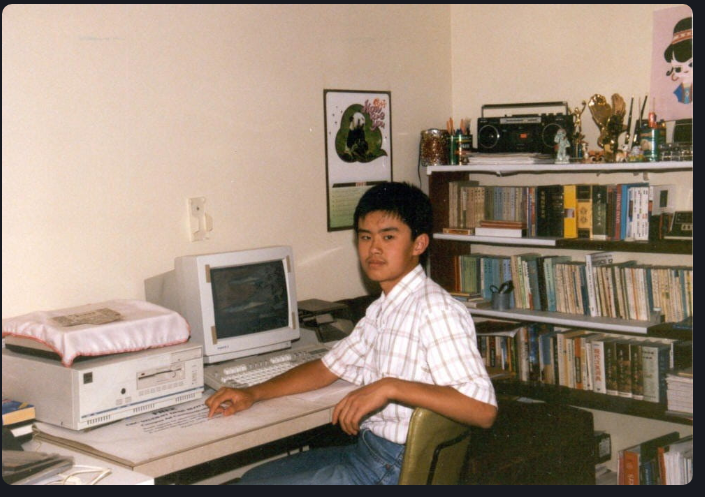
CZ: No, I wouldn't describe myself like that. I consider myself a tech guy; I studied computer science. I was interested in programming in high school, but I'm not a programming prodigy, not a true genius programmer. I think I'm a pretty good programmer; I've written some decent code throughout my career. Around 28 to 30 years old, I moved away from pure coding work and started doing more business development, sales, and so on. That took up about eight years of my career.
Chamath: So you're just an ordinary immigrant kid trying to adapt to Canada. Do you have many friends?
CZ: Yes, I have many friends.
Chamath: Are there only Asian friends?
CZ: Yes, I have both Asian and non-Asian friends. Actually, at my school, most Asians only hang out with other Asians, but I'm an exception. I also have white friends, and I have all sorts of friends. My teenage years in Canada were fantastic; they were the best years of my life, and I think those years really shaped me and made me a happy person. I'm generally a very happy person.
Chamath: How did you feel when you didn't get into the University of Waterloo and had to "settle" for McGill University? Did it make you feel stupid?
CZ: Actually, my sister went to Waterloo. I was torn between Waterloo, McGill, and U of T, but I knew I didn't want to stay in Vancouver for UBC; I wanted to go to a different city. UBC actually accepted me, but I just knew I didn't want to go there. At the time, the mother of a friend I greatly respected suggested I might want to become a doctor because doctors have a good life and high social status. I took her advice and studied biology, even though Waterloo isn't a school known for its biology programs.
So I went to McGill. But after one semester I decided: no, biology isn't for me. I'm switching to computer science.
Chamath: Is your college life typical? Will you be looking for a great job during the summer, or just an average college student? By the way, how do you pay for your tuition?
CZ: I worked every summer. I worked summer jobs and also did part-time work during the semester. So I had no debt, and I insisted on not graduating with debt. The first year I got about 6,000 Canadian dollars from my dad, and the second year I was still a little short, so my sister gave me 3,000. Since then, I haven't taken any money from home, I've been completely self-sufficient, and I graduated without student loans. I was very lucky, but I really did work every summer.
Chamath: You graduated from McGill's Computer Science department?
CZ: Actually, I didn't graduate from McGill. I studied there for four years. I got an internship in my junior year, another in my senior year, and then the internships kept getting extended. I didn't go back to McGill. Later, I found out that applying for a work visa in Japan required a bachelor's degree, which was in 2000, right at the peak of the dot-com bubble. So I enrolled in an online education program called the "American Computer Science Academy" and got my degree there. So technically, I'm a graduate of that school.
Chamath: Which internship led you to start working there long-term?
CZ: My internship was in Tokyo. I've been doing programming work since my freshman year; I wrote simulation software for a company called OriginalSim. In my junior year, I joined a company in Tokyo called Fusion Systems Japan. They were developing order execution systems for brokers on the Tokyo Stock Exchange.
Chamath: Is that a Japanese company with an office in Canada?
CZ: No, I went to Tokyo. It was actually a company run by a group of Americans in Tokyo.
Chamath: You were thinking, "This is an adventure. I'm going to spend the summer in Tokyo."
CZ: Yes, I was a college student at the time, and living in Tokyo felt like a dream. It was so interesting, and Tokyo felt like it was from the future.
Chamath: What kind of software do you write?
CZ: Primarily order execution software. That is, the software that processes orders and drives transactions. It's basically the same style as the software that drives Binance today. In fact, none of the software development I've participated in has involved decision-making.
Chamath: So when you first encountered this field, was it not the "Wow, this is so cool, this is so interesting" feeling? Or was it more like "Okay, the company asked me to write this code, I understand the principle, so I'll do it"? Were you attracted to this field, or was it purely because of work requirements?
CZ: Initially, it was purely for work purposes. I was too young then and didn't understand the differences between industries at all. After joining the company, the project I was assigned was to develop a digital image storage system—not like the iPhone photo album, but Nikon's medical imaging system. But I soon discovered that the company's core product was actually an order fulfillment system.
I participated in this project, and it later became the main focus of my career. I love this field because it requires a deep technical foundation. Everything revolves around efficiency—the pursuit of ultimate speed and the achievement of minimal latency. This pursuit deeply attracts me; efficiency-driven behavior is an intrinsic motivation in my mind.
Chamath: In high-frequency trading, how is this pursuit of low latency reflected in the code?
CZ: There are several levels. The first level is to make the software itself efficient and fast, removing all database queries and completing everything in memory. It also involves reducing any form of extra computation and simplifying risk checks. More advanced systems use network chip cards like FPGAs, which eliminate the need for a processor, reducing round-trip latency from 100 microseconds to 20 microseconds.
Chamath: Was the company you worked for in Japan successful?
CZ: It was a success. That company was acquired by a NASDAQ-listed company before 2000. The amount was approximately $52 million, which was quite a sum.
Chamath: So, at that point, did you realize—wait, there's an opportunity here? Or did something else happen?
CZ: No, I was too young back then, only in my early twenties, what we'd call a "salaryman" in Japan. After the company was acquired, there was a serious cultural clash between the parent and original companies. That was the first time I realized that mergers and acquisitions don't always go as planned. The management teams of the two companies were constantly at odds. Later, these partners started their own company, Building 2. But this time I didn't get a penny, while the other partners made a lot. They rented a luxury office, but the company only lasted a year before going bankrupt. This shows that past success doesn't guarantee future success. In fact, they spent a fortune building a luxury office but had no source of income. The company finally went bankrupt in 2001.
3. The first company in Shanghai
CZ: In early 2001, I was looking for a new job. Bloomberg was hiring at the time, before 9/11. I had actually received an offer before 9/11; I was in Tokyo then, while Bloomberg was in New York. After 9/11, I called and asked: Is the position still available? Do you still want me to come? They said: Do you still want to come? I said: Yes. So I went to New York in November 2001. I worked there for four years, doing the same thing.
I joined as a senior developer and was assigned to a team called Tradebook Futures. This team was newly formed, and they had developed a system that allowed users to trade futures on the Bloomberg terminal. Previously, these functions were scattered across different systems, but they were later integrated into this team.
Chamath: What were you looking for at the time? Stability? Why did you choose Bloomberg? Because of New York or something else?
CZ: I was just a young man back then, probably 24 or 25. I wanted to experience different fields and explore my life's direction. I knew I lacked experience and couldn't start my own business. At the time, I was working for a small company in Tokyo with only about 200 people. Bloomberg, on the other hand, had 3,000 people. To me, that was a large company. The company had luxurious offices, fish tanks, free meals, and all sorts of benefits. I joined as a senior developer, met several excellent superiors, and was promoted three times within two years. Initially, I led a team of 60 people, which later expanded to about 80, at which point I began taking on management roles. I stopped writing code and started managing.
Chamath: And then you resigned and went to China? How did that happen?
CZ: In early 2005, some friends I met in Japan wanted to start a new fintech company. They were in Asia at the time and discussed Tokyo, Shanghai, or Hong Kong. They said Shanghai was likely to be the most dynamic place for fintech in the future. We should have chosen Hong Kong, and it turned out to be more vibrant. Six of us went to Shanghai: four white people, one Japanese person, and me. I was the only one who could speak Chinese.
Chamath: What are your thoughts?
CZ: Our idea is to bring Wall Street trading technology to China and serve Chinese brokers and exchanges.
Chamath: So when you started your company—your first venture—were you just going to do it with a "let's do it" attitude?
CZ: That's basically it.
Chamath: Did you consider equity allocation at the time? For example, issues like equity structure tables? Or did you simply think, "Great, let's act immediately"? What was the actual situation?
CZ: Actually, it wasn't one-sixth. At the time, the core members held about 39% or 40% of the shares, and the remaining five were divided equally. So I only had 11% of the shares and didn't understand anything about the difference between common stock and preferred stock. But I went anyway; I was a junior partner in the team. After arriving in China, I started contacting potential clients—after all, I could speak Chinese—so I started negotiating with them. I went to talk to brokers and later discovered that we were registered as a wholly foreign-owned enterprise (WFOE), and at that time, Chinese financial institutions were not allowed to cooperate with WFOEs.
We discovered this situation after we founded the company in Shanghai, so we transformed the company to provide any IT system to any company—we did everything. Initially, we had many clients in the automotive industry: Shanghai GM, Shanghai Volkswagen, and SAIC Motor were among them. About three or four years later, we set up an office in Hong Kong and began serving financial institutions such as Morgan Stanley, Deutsche Bank, and Credit Suisse. That's how the company expanded. It grew to 200 people, and it was still very stable when I left. I worked there for eight years, until I left in 2013.
Chamath: As junior partners, do you receive direct profit sharing?
CZ: Yes. But the actual dividends weren't much. I reinvested most of my savings back into the company, and didn't cash out a single penny. But a few years later, after the company stabilized, the partners' salaries were enough to send our children to international schools, and we all received six-figure annual salaries.
4. Discovering Bitcoin
Chamath: So far, these experiences don't seem to suggest you'd go on to found Binance.
CZ: Not at all. I didn't even know it myself at the time.
Chamath: So how old were you in 2013 and 2014?
CZ: I was 36 years old in 2013.
Chamath: So you were still a salaried employee, a junior partner on that project, everything was going well, and your kids were attending private school. So what happened next?
CZ: Later I came across Bitcoin. A friend of mine told me, "CZ, you have to look into this thing called Bitcoin." I started researching it and it took me about six months to fully understand it. That started around July 2013.
Chamath: Is it because you read the white paper and then thought, "I have to read it again and again," or is it something else?
CZ: That's about right. And there was also a Bitcoin forum (Bitcoin Talk) back then. Basically, it was through these platforms.
Chamath: Was the friend who showed you Bitcoin a colleague, or a friend you met randomly in Shanghai?
CZ: He's a friend. We don't do business together. His name is Ron Cao. I guess he now runs Sky9 Capital; back then he was the Managing Director for China at Lightspeed Ventures.

Ron Cao
We have a private poker game, not a big one, a group of aspiring entrepreneurs versus venture capitalists. The VCs have money and time. It's a very interesting game. In one game, Ron Cao said, "CZ, you should check out this thing called Bitcoin." I said, "OK, Bitcoin." So we chatted for a while.
Bobby Lee was also present at the time. He was working at Walmart and was about to resign to join BTC China as CEO. As part of the deal, Lee invited Ron Cao to invest on behalf of Lightspeed Venture Partners. That was in July 2013. I thought to myself, these two seem very serious about Bitcoin.
CZ: The next day, I had lunch with Li Qiyuan, and he said, "Invest 10% of your net worth in Bitcoin. Although there's a small chance it will go to zero, then you'll only lose 10%; but the more likely probability is that it will increase tenfold, doubling your net worth." I thought, "That sounds pretty plausible." So I started seriously studying the white paper, spending a full six months on it. It wasn't until the end of 2013 that I truly made up my mind to enter the market. But just then, the price of Bitcoin skyrocketed from $70 in mid-2013 to $1,000 by the end of 2013. It had increased more than 15 times.
Chamath: How did you feel at that time?
CZ: I feel like I'm too late. I thought to myself, "I wish I had gotten in sooner." But the truth is, no matter when you enter the Bitcoin space, you'll always feel like you're too late. Because everyone in the industry you talk to bought in earlier than you.
Chamath: When you were learning it, did you communicate with the Shanghai community?
CZ: There was a very small circle in Shanghai at the time. Basically, I was willing to talk to anyone in the world who was interested in Bitcoin. I had a few friends in Taiwan who were working at TSMC at the time, and later quit to try to make Bitcoin mining chips. Although that startup project didn't succeed, they were a group of people I was talking to back then.
There's another group, mainly miners. There's a man called "Shenyu" (Divine Fish), who's very famous in China; he's a big-time miner. He still runs F2Pool (Fishpond) to this day. They live in Hangzhou and often come to Shanghai to exchange ideas with me.
CZ: The most important thing was the Bitcoin conference in Las Vegas around December 2013. I flew there and met everyone. The industry elites were there, about 200 people. Vitalik (Ethereum founder) was there, as were Matt Roszak and Charlie Lee (Litecoin founder). It's the same group of people today.
At the time, Ross Ulbricht, the founder of Silk Road, had been arrested. The media was widely reporting that Bitcoin was merely a tool used by drug lords. But when you went to that conference, you saw a group of young people, a group of geeks. They were all very nice people; for example, you could talk to Vitalik, who was very approachable.
Chamath: When you were doing all this, were you still working part-time at your original company?
CZ: Yes, that was in the final stage.
Chamath: You can tell your partner, “Hey guys, I’m going to Las Vegas for a few days, I’ll be right back.”
CZ: Basically, that's it. When I got back, I told my partners, "We should build a Bitcoin payment system." At the time, BitPay was a big player in the industry; they had just raised $4 million in 2013.
Chamath: So you wanted to create a Chinese version of BitPay. Your partners must have been thinking, "What nonsense are you talking about?" And by then, you still hadn't bought any Bitcoin?
CZ: I didn't buy it. At that time, I only had about one Bitcoin. It was worth about $1,000 at the time.
Chapter 5: A desperate gamble in cryptocurrency
Chamath: So, what happened next?
CZ: So I told my partner, I felt this was the most significant opportunity I'd ever encountered in my life. I realized then that I'd come across two fundamental technologies in my lifetime: the first was the internet, which I was too young to fully participate in then; the second was Bitcoin. I was 35 or 36 at the time, and I didn't want to miss it. I felt that this kind of opportunity might not come again for another 15 years, which is now AI. So for me, the goal was very clear: I had to do something in this industry.
I told my partner I was going to quit my job and work in the Bitcoin industry. I also needed to buy Bitcoin, but I didn't have much cash. So I said, "I plan to sell my apartment in Shanghai and buy Bitcoin with all the proceeds." Selling the apartment took several months.
Chamath: So after you sold your house, did you rent a place to live?
CZ: At that time, I sold the house, and my family moved back to Tokyo. We rented an apartment in Tokyo, while I frequently traveled to Shanghai for work, which was when I started living apart from my family. The house sold for about $900,000, close to $1 million. The payment was received in installments, and I used each installment to buy a new property. The first purchase price was $800, and then the price of Bitcoin kept falling, dropping to $600, then $400, so my average purchase cost was about $600.
Chamath: Unbelievable. So you're holding a Bitcoin position now, but still no job.
CZ: Actually, I was also looking for a job at the time, and my goal was very clear: only to find a job in the Bitcoin industry. From the time I resigned to the time I finally settled on a job, it only took about two or three weeks.
Chamath: Who hired you?
CZ: I first spoke with Bobby Lee, who wanted to hire me. But then Blockchain.info came along, and Roger Ver introduced me to them. I was the third member of the Blockchain.info team. The first two members were founder Ben Reeves and Nicholas Carey, who had just been hired as CEO. Since Ben wanted to keep his CTO title, my position was VP of Engineering. I joined them and flew to York, three hours north of London, to spend some time figuring out what to do.
Chamath: Is it going well?
CZ: It wasn't very smooth. We expanded the team to 18 people. Then Peter Smith joined as CFO to try and raise funds. At the time, Coinbase had just completed a $30 million funding round, which was big news. Peter Smith eventually managed to become CEO and promoted Nicholas Carey to product manager. The company culture changed, so I resigned, and many of the developers I had hired left with me. Ben Reeves sold most of his shares and left a few months later. I was only there for six or seven months, and although the results weren't ideal, I learned a lot.
CZ: For example, Ben Reeves said we didn't need a company, no office, everyone worked remotely, and all salaries were paid in Bitcoin. I later applied these experiences extensively at Binance. I also learned about guerrilla marketing. At the time, Blockchain.info was the industry's largest user platform, with 2 million wallets, more than Coinbase at the time. And their entire marketing strategy consisted of a single post on the BitcoinTalk.org forum, where Ben Reeves would reply to users. This made me realize that guerrilla marketing could also achieve tremendous success.
CZ: After leaving, He Yi recruited me to OKCoin. He Yi said to me at the time, "Why are you working for a wallet company? Your experience should be in order execution and exchange management." So I joined OKCoin as CTO.
Chamath: Was there competition back then?
CZ: During my onboarding process, BTC China contacted me again. At the time, OKCoin offered me 5% equity, while Li Qiyuan offered 10%. OKCoin matched that offer within three hours. I ultimately decided to go to Beijing to join OKCoin. He Yi only had 1% equity at the time; she recruited me as a higher-level partner. I only stayed at OKCoin for about eight months, which didn't last very long.
Chamath: Why?
CZ: It's still a cultural difference; there are some practices I can't agree with. For example, a simple promotional method: they advertise fee discounts, but users have to actively apply to enjoy them. This kind of promotion doesn't work for everyone, despite their advertising. Small issues like these.
6. Found Binance
Chamath: So how did we get to Binance from there?
CZ: In 2015, some former colleagues wanted to start a Bitcoin exchange in Tokyo because it was a year after Mt. Gox went bankrupt, leaving a vacuum in the Japanese market. On the very day I decided to leave OKCoin, two developers came to me and said they had also resigned. So the three of us decided to do something.
CZ: I served as CEO, taking the majority of the shares, and was responsible for fundraising. I used my own savings to pay their salaries, taking nothing for myself. We quickly created a demo, downloaded an open-source exchange system, and made slight modifications to the UI.
Chamath: You guys directly fork open-source projects? Is this Binance?
CZ: No, we didn't say this was Binance; this happened before Binance. I maintained complete transparency and clearly stated that this demo version was rushed out in two days and was only a proof-of-concept, not the final product. That's it. At the time, we had a script that scraped market data from Bitfinex. Bitfinex was considered a large exchange at the time. We directly copied their order book, which displayed real-time trading activity, making the demonstration very vivid.
Investors were amazed when they saw it: "Wow, this technology is amazing!" But it wasn't just a demonstration. When they asked questions, I could provide in-depth answers. For example, if they asked me "how to build a high-speed exchange architecture," I could explain in detail all the technical principles I'd learned, such as memory matching and database identification. So I could analyze their questions thoroughly. My expertise was there. Right? They said at the time, "This technology is cool, but you won't succeed operating a Bitcoin exchange in Japan because you don't speak Japanese." They suggested I sell the technology to existing exchanges because many exchanges in Japan had terrible technology.
Two weeks later, we signed a contract with an exchange, and they prepaid $180,000 (total price $360,000). This finally freed me from having to pay salaries out of my own pocket. So we transitioned into a software service provider, or "Exchange as a Service" (SaaS).
Chamath: Many people believe that great companies are born from a moment of inspiration, but your story is more like a process of continuous refinement, learning, and experimentation. This kind of non-explicit iteration is what ultimately led to the result.
CZ: Exactly. I think most people idealize the entrepreneurial process. They loathe the hardships but yearn for the results, like the stories of Facebook or Microsoft—dropping out of college to write code in a garage and suddenly succeeding. But in reality, the growth paths of Binance or Tesla were also fraught with difficulties. You have to try countless different paths, and success doesn't begin in the obvious direction. So I think those three are exceptions; they had a smooth ride from the very beginning.
Chamath: So let's go back to the startup phase, when you were licensing software.
CZ: Our software outsourcing business was doing very well, signing contracts with about 30 exchange clients within two years. It was a very stable SaaS model. But in March 2017, the Chinese government shut down most of our clients. By May, we realized we had to transform.
CZ: At the end of May, three of my team members wanted to create a cryptocurrency trading platform. I saw a guy named Yang Linke, who was a partner at BTCChina. He launched an ICO and raised $15 million in 10 days, and all he had at the time was a document and a website; he didn't even have a product. I thought, if he could do it, so could I.
CZ: Originally, we planned to go the venture capital route, but after seeing the ICO craze, I decided in mid-June: we should also do an ICO. In mid-June 2017, I attended a conference where everyone was talking about ICOs. Everyone told CZ: You must do an ICO, you absolutely must do an ICO. So in mid-June, specifically June 14th, I gathered the team to launch the ICO and began writing the white paper.
Chamath: Were you already somewhat well-known in the Crypto or cryptocurrency community at that time—whether in China, Japan, or other regions?
CZ: I do have some name recognition. I worked at a blockchain news website back then, and many people knew me. That platform was incredibly popular at the time. During my time at OKCoin, I served as CTO, was very active on social media, and was also responsible for managing international business in non-English/non-Chinese markets—after all, no one on the team spoke English better than me. So I do have some reputation in the industry.
Chamath: Back then, you really needed some fame or background to do an ICO.
CZ: Exactly. But that's precisely the advantage of early entrants—attend a few conferences with 200 people, and by the second time you're there, people will recognize you. By the third time, they'll say, "Oh, you're an expert," "You're a veteran in the industry."
Chamath: Who bought Binance's ICO?
CZ: To be honest, I still don't know who the specific buyers are. Looking at the user distribution, 80% to 90% of ICO buyers are probably Chinese. There were also some international buyers involved. Data shows that approximately 20,000 people participated in the ICO.
Chamath: So even though Chinese exchanges were banned, ICOs were still allowed at the time?
CZ: No, ICOs weren't banned at the time. Let me clarify: our exchange clients were primarily stamp trading platforms, not cryptocurrency exchanges. Cryptocurrency exchanges weren't banned in March; they were only shut down after we launched.
Chamath: You guys are walking a tightrope with incredible precision. How many shares of the company did you sell?
CZ: We simply launched the BNB token and did not participate in any equity distribution. There was absolutely no equity involved. We sold 60% of the tokens, raising approximately $15 million.
Chamath: What was the original token economic model you designed for the BNB token?
CZ: We've proposed many solutions, but the most crucial and quickly implementable one is: BNB holders will enjoy a 50% discount on transaction fees when trading on the Binance platform. However, we also promise that BNB will eventually have its own independent blockchain and decentralized ecosystem, and we've planned three or four additional features.
Chamath: You guys must have been ecstatic, right? Thinking: Wow, we've raised $15 million. Now we're launching an exchange. But then in September, everything changed. What did you do?
CZ: Yes, on September 4th, seven different departments of the Chinese government jointly issued a notice, the first point of which was that China would no longer allow cryptocurrency exchanges, ICOs, or mining. We immediately decided that we had to relocate. At that time, although Chinese users accounted for about 30%, users from other parts of the world still accounted for 70%. After assessment, we determined that even if we lost those 30% of users, we could still survive. In fact, we survived quite well. Ultimately, we returned to Tokyo.
I know Japan, I know Tokyo. It wasn't a foreign country to me. So I suggested we move to Tokyo. There were about 30 of us at the time, and everyone moved.
Chamath: Did Binance become an instant hit when it first launched? Or did it require considerable effort to find a product-market fit, relying on word-of-mouth from its initial enthusiastic users? How did the viral spread begin? How exactly was liquidity established?
CZ: Binance's product itself was developing quite well, but the token price fell by 30-40% from the ICO price and took three weeks to recover. At that time, the cryptocurrency market was still hot, and product-market fit existed—this was not a new concept, just a cryptocurrency trading platform.
Chamath: So the ICO is crucial, right? Because holders will think: since I hold tokens, I can enjoy fee discounts. That's why Binance was chosen. But is the platform architecture superior? Is its speed and stability significantly better?
CZ: When it was launched, you could clearly see that the order speed on Binance was much faster than the competing platforms, and the performance of the exchange system was obvious.
Chamath: Who were your main competitors back in 2017?
CZ: At the time, the largest were Polonex and Bittrex. There were also several Chinese platforms, including Huobi, OKEx, and OKCoin. Coinbase was from the Western market, and Gemini hadn't been established yet; it appeared later. Bitstamp and Bitfenix were also there, but they've shrunk considerably since then.
Chamath: You're in your 40s now. Binance is experiencing explosive growth. How do you internalize this success? Do you ask yourself things like, "What's going on? What happened?"
CZ: Yes, there are definitely some really surreal moments where you think, "Is this for real?" For example, once I asked her how much we earned, and she gave me a number. I said, "That's insane, we couldn't possibly earn that much. Are you sure?" She said, "I'm sure." I said, "That number is definitely wrong, we're definitely off by an order of magnitude." Then we checked it two or three times, and it turned out to be correct. That was crazy.
There was another period, during the three weeks when the price of BNB was recovering. At that time, the initial offering price of BNB was about 10 cents, and it once dropped to 6 cents. Then we announced that He Yi had joined. For the next two or three weeks, every time I woke up, the token had risen by 20%; after I came out of a meeting, the token had risen by another 20%; even after I went to the bathroom and came back, it had risen by another 20%.
Chamath: That feeling must be so fast it makes you dizzy: Wait, I suddenly have money?
CZ: Actually, this came a little later. In early 2018, when Binance had been operating for about seven or eight months, Forbes put me on the cover.
Chamath: How did they find you back then? How did they put you on the cover?
CZ: Actually, I don't know either. But at the time, Forbes was doing a cryptocurrency special, and they had already used photos of Vitalik striking a cool pose. So they invited us and contacted the PR department—which was actually He Yi's team at the time, a team of four or five girls. He Yi said Forbes wanted to do a feature article and take photos, and she thought I should go. I was very resistant at the time, but they said we were a new brand. Forbes could also help us increase brand awareness. So I said okay, I'll go, and I went to take photos. That was my first ever photoshoot, and of course, someone did my makeup—it was my first time wearing makeup.
Chamath: So CZ, what is money? Does it matter? What does money mean when you're making a lot of money in your 40s?
CZ: I think I was old enough back then, and I'd been through a few things. First, I was old. I was in my forties. Unlike a young person in their early twenties, constantly driving Lamborghinis and partying. I was too old for that. Second, my personality was quite stable; I wouldn't get overly excited by external things. And one more thing (not to brag), I went from barely being financially independent to making it onto the cover of Forbes.
Then it dawned on me: Wait, how rich am I really? I don't even know myself. Opening my wallet, nothing seemed to have changed. A Forbes cover? Nothing had changed for me. Yet people said, "Look, you're probably a billionaire now." I thought, "Am I really a billionaire? It doesn't feel like it." Even a month ago, maybe less than a month ago, when we left China for Japan, I booked economy class. He said, "No, we should upgrade to business class so we can lie down and sleep." I thought, "Hmm, that makes sense." That's how it is.
So, I have this habit. When you're consistently making money, say from 1 million to 10 million, you might want to buy a luxury car; at 100 million, you might want to buy a yacht or something. But at 1 billion—I didn't experience that gradual process. I just went from being relatively okay to suddenly appearing on the cover of Forbes. Things like yachts. At 1 billion—I didn't experience that step-by-step process. I went directly from a relatively ordinary life to appearing on the cover of Forbes. So I didn't develop many of those consumption habits.
Chamath: What does this mean now? Are you a billionaire or a multi-billionaire? What does all this mean?
CZ: I think money serves two purposes: First, to take care of yourself, to have food and shelter, which actually only requires a small amount of money. Really, you don't need much to satisfy these needs. People are often confused by all sorts of complicated concepts, but life doesn't have to be luxurious. So I do have these things, and I live a life that, while not luxurious, is quite comfortable.
Chamath: Excuse me, what do you mean by that?
CZ: Look at my house, the living room leaks almost every month because the house is so old. But for now, the house is the perfect size for me. When it leaks, I just fix it. It's still happening; it leaked last month. People always think I live in a mansion, some even more outrageous. My house is the right size, big enough for all my family members. I bought it as a secondhand house, an old house that's changed hands three or four times, but the location is excellent, the size is perfect, it's fully functional, and it doesn't matter if something breaks occasionally.
Chamath: Do you think this is because of pragmatism, or simply because you're not attracted to appearances?
CZ: I only care about functionality. As long as it functions properly, that's fine. I don't care about fancy features or style. Color doesn't matter, and neither does shiny gold jewelry. As long as it's practical, that's all that matters.
Chamath: Do you ever suddenly feel uneasy?
CZ: No. I know my weaknesses and have learned to deal with them. I hope I'm not an arrogant person. I'm usually very calm and have very little emotional fluctuation. This mindset allows me to handle many problems.
Chamath: Do you think you ever became addicted to growth at some point?
CZ: I wouldn't say I'm addicted to growth, but I'm definitely fascinated by the job. The job itself is incredibly fulfilling and rewarding. I attend about 20 meetings a day, including scheduled conference calls and in-person meetings, plus various unexpected events, and I also have to respond to user questions on Twitter. But the job is incredibly valuable—that indescribable sense of accomplishment doesn't come from money or growth.
Chamath: So, what exactly are they? Some people always focus on lagging indicators. For example, revenue is a lagging indicator, right? Revenue and profit are just results; they reflect the situation six months or even a year ago. What are your leading indicators? Those North Star indicators that truly reflect the health of the system?
CZ: I believe the core metric is daily active users. Not transaction volume, not revenue. Continuously serving more users creates value. I firmly believe that product value lies in user needs—as long as someone is willing to use it, even zero revenue has value. For any widely used product, the larger the user base, the higher the value; this has always been my core philosophy. While you can optimize short-term revenue and pursue short-term profits, you might lose long-term growth potential. I firmly believe that in the long run, true value is formed when a large number of users use your platform—not just creating value for yourself, but also creating value for users. People choose to use your product because it contains value, right? This is the North Star I always follow. More importantly, when hundreds of millions of users choose us, we truly help them. Therefore, I believe that if users are willing to pay, it must be because we create higher value.
Chamath: This rapid growth also has its costs, such as the presence of bad actors. When did you realize this would be a serious problem?
CZ: I remember it was New Year's Day 2018. We had only been established for five months, but we had already jumped to the top of the exchange rankings. A U.S. Department of Homeland Security contacted me, emailing me saying they needed our assistance in tracking down hackers—criminals who might have transferred the stolen funds from EtherDelta. EtherDelta was a decentralized exchange that started operating in 2017 and later went bankrupt after being hacked. When this U.S. government employee contacted us, I didn't know how to respond—after all, no one was familiar with the procedures for dealing with law enforcement. So I gathered a few people to discuss how to provide information. Afterwards, I asked him if he could recommend someone who could handle future interactions with law enforcement. He recommended someone, but that person was based in the United States. At the time, we didn't have a U.S. entity and couldn't hire people in the U.S. So we had to give up on that candidate. But that's the key point. It was like on New Year's Day that I realized these kinds of things would inevitably happen more often, and we needed to hire people with experience working with law enforcement.
Chamath: This pressure gradually escalated. Fast forward to later, the Biden administration accused you of focusing on the fact that groups like Hamas were using the Binance platform and that you were failing to properly regulate it.
CZ: Yes. I may be legally restricted from going into details like plea agreements on this point. While I'm not a lawyer, I always avoid legal issues. However, overall, the Biden administration was quite hostile towards cryptocurrencies—they openly declared war on them. So seeing the new administration's 180-degree turn is truly welcome. This is good for the US, and good for the world. I don't blame the previous administration, but they certainly lacked awareness.
Chamath: Why do you think they are so hostile to cryptocurrency?
CZ: Ultimately, it's a fear of the unknown. I suspect there's some deep-seated concern: not to shake the existing financial system, the vested interests of banks, and other stakeholders. The lobbying pressure from these industries must be immense.
7. The story of FTX: its feud and collapse with SBF
Chamath: From 2018 to 2020, you gradually established yourself. Then, in 2019, you set up an entity in the United States. Why was that necessary at that time?
CZ: In 2019, news reports surfaced that the US government—in layman's terms—was investigating BitMEX. Both BitMEX and Bitfinex were in the news at the time. I remember the US government froze approximately $600 million to $800 million in their assets—a significant amount considering their market capitalization was only $4 billion at the time. Later, the US government sued them for insufficient reserves. After seeing these news reports, we realized the US government was paying attention to the industry and we needed to complete the registration process as soon as possible. I consulted several friends with legal backgrounds, and the general consensus was that we should operate as a registered entity in the US.
So we registered Binance US. This is an independent entity with independent deployment, an independent matching engine, and independent liquidity pools. Binance US has been regulated since its inception. Operations went smoothly overall in 2019, 2020, and 2021.
Chamath: By 2019 and 2020, some other players started to emerge. SBF and FTX began to rise. How did you come to know him? Did you once own a significant portion of his company?
CZ: We once owned 20% of their shares, but exited after a year; we didn't hold them long-term. I remember first meeting them at the Binance Singapore conference in January 2019. At that time, FTX hadn't been established yet, and SBF was operating Alameda. They held a celebration party at the Singapore Aquarium, with divers holding signs in the tanks. They were a major client and top trader for Binance at the time. A few months later, they suggested a collaboration to create a futures platform, proposing a 60/40 revenue split, with us taking the lion's share. I considered alternatives—after all, we had the entire user base, while they had nothing. I thought about proposing a 95/50 split, but felt that would be impolite. After all, they were still a trader, still a VIP client. So we rejected the proposal.
They were a large brokerage firm, but Binance was a new platform at the time, not a well-established exchange with many years of experience. They had only been operating for about six months to a year, I can't remember the exact time. Later, they came back with more favorable terms—probably around summer—but we still refused.
They returned in November with extremely attractive terms, and FTX subsequently launched. Once trading volume reached a certain level, they stated: "We can basically give you 20% of the share at this price." A token swap then took place—exchanging BNB for FTT tokens. We received our first batch of FTT tokens.
But shortly after the deal was completed, I kept hearing from friends that SBF was badmouthing us in Washington, D.C. I thought to myself: Come on. They did other annoying things too. They offered account managers with access to our VIP database five times their usual salary. The day after that girl switched jobs, our VIP clients received calls saying they could get better rates with FTX. I immediately contacted Sam: Can you please stop this? We're your shareholders. But at the same time, he suggested, "CZ, could you arrange one-on-one interviews at cryptocurrency events?" Okay, we're investors, willing to help promote. I actually hoped that multiple exchanges in the industry would succeed so we wouldn't always be targeted. But someone always said no. I kept hearing all sorts of negative comments, things like that. So a year later, around early 2021, we found out they announced a $32 billion valuation for a funding round. We thought: Why not exit?
In fact, our investment terms included a veto power over subsequent financing. Understand? So we could have completely prevented them from raising funds. But I didn't want to exercise that right. So I proposed: why don't we exit and then compete? So we discussed exit strategies. The deal was finalized and the equity transfer completed in July 2021. This was a full year and a half before their problems arose. We were unaware of it at the time.
Chamath: There are rumors that many of their problems only surfaced after you sold your shares, suggesting a connection. You've definitely heard these rumors.
CZ: This claim is completely untrue. Furthermore, due to the competitive nature of the industry, even as a shareholder, I have never requested financial statements from them. I am a very passive investor and never interfere in their business when making investments. We have a futures platform, and they have one too. So I try to maintain a distance and let them operate independently.
Chamath: Regarding the FTX incident, two main points have been discussed: firstly, the compensation plan was not ideal for some FTX holders (especially those holding cash); secondly, the issue of how these investments were valued after the incident. What are your thoughts on the subsequent impact of this event? Does it reflect a common problem in the entire industry or in the cryptocurrency world?
CZ: I don't quite understand whether the entire bankruptcy process was fair. There's a lot of information online. Also, frankly, the state government is in court with us, trying to recover some of the funds we received a year and a half ago. So my commentary may be limited. However, to reiterate, I'm not an expert in this field. But I have heard some complaints, such as some Chinese users not being eligible. However, as far as I know, due to the appreciation of cryptocurrency, they are now well-funded in dollar terms. Even those who held cryptocurrency initially may now have gained more.
8. Negotiating with the Department of Justice in the face of hostility from the Biden administration.
Chamath: At Binance, when did things start to get complicated? I mean, with the relationship with the US government.
CZ: They started demanding information from us, and we were cooperating by providing it. That was around 2021 or 2022. By the end of 2022, the atmosphere had become more hostile. In early 2023, the situation became clear: we either reached some kind of agreement, or they would sue us. Things turned into negotiations.
Chamath: As a client, how do you deal with this pressure? How do you feel when your lawyer tells you that you may face a lawsuit?
CZ: I don't have a legal background, so I have to rely on a lot of people's advice. The hardest part for me was the lack of experience. Nobody's been through this before, and once you've been through it, you never want to do it again. If you hire a bunch of expensive lawyers, they each have their own specialties and differing opinions, and everyone wants to show that they're the smart one making the decision. And they're used to spending a lot of time analyzing, since they're charged by the hour.
I'm not saying they were unethical; they genuinely wanted to do a good job. But the result was that they got tangled up in various subplots, dragging you in different directions. That was the most troublesome for me. If someone could clearly point out these three things that must be focused on, that would be our strategy. At the time, our legal team was weak, young, and lacked experience in handling these kinds of issues, which was always a thorny problem.
Chamath: Where was the whole team at that stage?
CZ: We're scattered all over the place. In 2023, I spent most of my time in the UAE, traveling between Abu Dhabi and Dubai. The pressure was immense. My way of dealing with the pressure was to look at the best and worst scenarios. The best-case scenario was paying the fine and reaching a deferred prosecution agreement (DPA), and the matter was over. The worst-case scenario was that they tried to put you in jail.
Chamath: But you could have stayed in the UAE, which is a non-extradition country, right?
CZ: Yes, this is another worst-case scenario: if you can't reach an agreement, you choose to fight and stay in the UAE. Then your travel will be restricted, and even if you go to another non-extradition country, you might face secret deals between states. I don't want to be the kind of person who lives in constant fear, and I don't want to cause trouble for the UAE government that gave me citizenship. The worst-case scenario is that you don't go there, they prosecute you, and then put you on the Interpol Red Notice list.
Chamath: How was the final agreement reached?
CZ: The negotiations lasted for more than a year, and I met with 12 to 20 lawyers almost every day. The most common thing I heard from the lawyers was: "We have never seen them (the Department of Justice) show such hostility towards this kind of case."
Chamath: Will you become numb to it eventually? Or will you continue to hold onto it? Will you think, "Why me of all people?" Will you feel no resentment, or will you focus more on how to cope?
CZ: This requires a gradual approach, and there are several particularly difficult stages. For example, you might encounter certain key points in the negotiation where you have to say, "We have no choice but to refuse." Like—we simply cannot accept this proposal. The other party is unwilling to compromise, and I genuinely cannot agree, so I have no choice but to say no.
Then came weeks of uncertainty, a living hell. They could file a lawsuit at any moment, depending on their choice, and you'd clearly refused. There were several such phases. During those weeks, you thought: Okay, I can't go anywhere. I might have to get used to living in one country, constantly on guard. Maybe some border crossing would intercept an unpublished, sealed indictment. Interestingly, two weeks later they suddenly returned, saying: We can renegotiate. At that point, you couldn't help but wonder: What are they up to? Actually—in retrospect—it was all a negotiation tactic.
For me, or anyone in a similar situation, silence is key.
For the person experiencing all this, it's a once-in-a-lifetime event. You have no experience; it's a matter of life and death. They might issue you a sealed red notice. And this will be the life you'll face forever. They won't—these kinds of warrants can hang in the balance for decades. For them, it's routine. But I think they're smart enough to know that two weeks is the optimal timeframe. Because beyond that, you get used to it. When they come back to negotiate, you'll definitely refuse. It's like saying: See, I'm used to it. Keeping someone in this state for a long time... (interesting), so it's clear they're quite adept at psychological warfare.
Chamath: This was extremely psychologically challenging. How did you convince yourself to accept the final terms?
CZ: After several rounds of negotiations, I confirmed a charge of violating bank secrecy regulations, namely improper registration, which is a federal felony. It is serious in nature. But no one has ever been imprisoned for this.
Chamath: I'm sorry, this accusation is more technical. How does it relate to the perception presented by the media (at least in the US)? Media reports emphasize money laundering, aiding and abetting crime, failure to fulfill KYC obligations, and lack of anti-money laundering measures, while the actual accusations are quite different? Are these two related and comparable in nature? Or is there a disconnect between public perception and the actual accusations?
CZ: I am not a lawyer, and this is merely a layperson's opinion, which may contain inaccuracies. My understanding is:
The first level is a violation of the Bank Secrecy Act, which means failure to fulfill registration obligations. In short, you provide services to U.S. users without registering as a financial services company in the U.S. You failed to declare to the relevant regulatory agencies that you "would accept U.S. customers," which is the first level of violation.
Furthermore, you have deficiencies in your KYC (Know Your Customer) and AML (Anti-Money Laundering) processes. All operational procedures are flawed. This constitutes another layer of problem—KYC and AML processes must be established even without registration. People often assume this is a black-and-white standard, but it is not.
The key lies in the quality of execution: What system is used? How is the risk assessment conducted? How many personnel are allocated? What are the standard operating procedures? The details are actually very complex. Even more crucial—as I understand it—is whether one was aware of and assisted in malicious transactions. For example, the anti-money laundering program has loopholes and fails to intercept all illicit funds, but you were unaware of this. Right? This isn't intentional aiding and abetting crime, but rather the system being insufficiently robust and relatively loose. Yes. But this situation does exist.
Another situation is: knowingly supporting a problematic transaction. For example, Charlie Schramm once handled transactions for Ross on the Silk Road, right?
I personally handled absolutely no transactions. This is simply not my area of expertise. So they say: Binance's KYC and AML checks are lax. We can agree with these accusations. The Department of Justice also wanted to add two more serious charges (charges 3 and 4), claiming that I personally assisted in illegal transactions. But they couldn't produce any evidence. Therefore, these two aggravating charges were directly dismissed by the court. But before going to the US, we decided to agree to debate this in court. I don't want to discuss the confidential conversations, but what I knew before leaving was that no one went to jail. The most severely punished BitMax founder, Arthur Hayes, only received six months of house arrest. In contrast, he had much more direct interaction with customers, while my involvement was far less. Basically, I don't directly contact customers at Binance. I interact with users through Twitter, but I'm not involved in Binance's back-end operations. Therefore, I'm quite confident that we should be in a very favorable position.
9. Court Trials and Judgments
Chamath: You fly to America, walk into a courtroom. What happened?
CZ: That morning I went to the courthouse in downtown Seattle. The judge asked me, "Do you understand this passage?" All I had to do was answer, "Yes, yes, yes."
CZ: The real battle was over the bail conditions. My lawyer argued for my return to the UAE to await sentencing three months later, and the local judge initially granted it. However, the government appealed the bail conditions. Two weeks later, the court ruled that I had to remain in the US and could not go home. My lawyer said that in his forty-year career, he had never seen bail conditions appealed. Two weeks later, the court ruled in favor of the government, and I was detained in the US. Thus, I was away from home for three months.
I gained the freedom to travel within the United States. Thinking that since I was stuck in the US, I might as well travel around. My sister had a place to stay in the US, so I stayed with her for a while. After that, I started wandering around, purely to calm myself down. Three months later, the government requested another three months' extension. So I had to stay in the US for another three months to wait.
Chamath: At least your children could come to see you back then?
CZ: No, I didn't let them come.
Chamath: So you haven't seen them for a whole six months?
CZ: Yes. Actually, it had been a year since we last met. On April 30, 2024, the day of sentencing, the government actually requested a 36-month prison sentence, which was more than double the maximum recommended sentence by all legal guidelines. Even five days before sentencing, Senator Elizabeth Warren publicly declared "war" on cryptocurrency on television and wrote an open letter to the Department of Justice. In court, the judge initially said many good things about me. But then he said a "but," and at that moment I knew things were going badly. Ultimately, the two serious additional charges were dismissed by the court because I did not actually have any involvement in the specific transactions, but the judge still sentenced me to four months in prison.
Chamath: What do you think when you hear you're going to jail?
CZ: At first, it was hard to accept. My biggest concern was my safety. The media was reporting that I was the richest person in American prison history. A prison advisor told me that due to the high profile, I might become a prime target for extortion. Ensuring my safety became my only concern at the time.
CZ: You'll meet a lot of prison consultants—they're usually former guards or wardens. There's another type who actually served time, but worked in the prison. They weren't prisoners. Then there are those who did go to prison, but served time as inmates. Talking to these people gives you a sense of what prison is like. Should you make friend