Phyrex's Web3 experience includes the luck brought by a high starting point, the victory of gradually mastering the "rules" through learning and becoming confident, and the restraint of gradually converging after being repeatedly corrected by the market.
Article author and source: BitMart
If you've been following the Chinese Web3 community for a long time, you're probably familiar with Phyrex Ni, whose name consistently ranks among the top three KOLs.
Many people know him through his macroeconomic analysis: a verified account, a real profile picture, consistent output, and logically sound reasoning. His content is often repeatedly shared as learning material. But in this podcast episode, you'll find that Phyrex himself isn't fixated on the identity of a "macroeconomic analyst," and even emphasizes multiple times that he's just a "laborer," and that sharing is more like a form of self-learning and self-monitoring.
If he had to label himself, he hopes his content will be helpful to others, but he doesn't want anyone to buy or sell based on his judgment. In his view, neither on-chain data nor macro research is sufficient to provide a precise buy or sell point, nor should it be regarded as a timing tool. They are more like a "background judgment"—helping you make fewer obviously wrong decisions over a larger period.
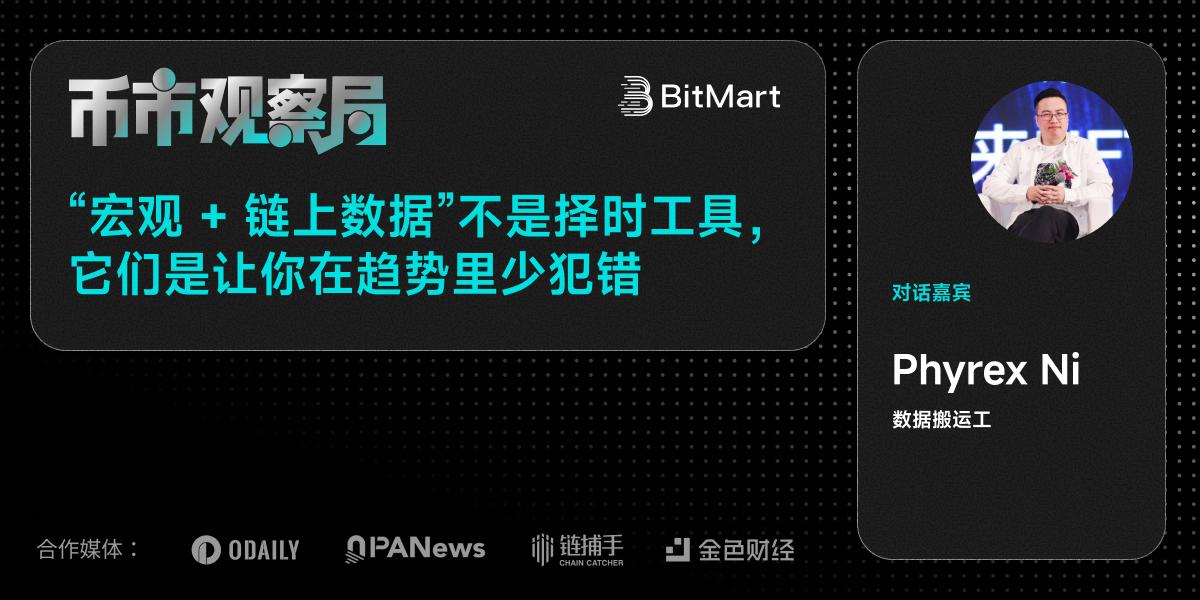
This episode of "Crypto Market Observation Bureau" features a conversation with Phyrex, a data transporter.
Host: Yuanyuan, VP of Marketing at BitMart
They started their careers at a high level and were also quite lucky.
Phyrex entered the gaming industry in 2003. From Tianjin to Shanghai, he participated in the production of game-related television programs, then joined a game company, worked on game project operations, and later gradually shifted to game-related mergers and acquisitions and investments.
His real involvement with the crypto industry began in 2017-2018. At that time, he was already involved in game investment and acquisitions, and his limited partners (LPs) allowed him to use funds from his fund to explore new asset classes, one of which was cryptocurrency. Because of this background, during the ICO boom, while many were still participating in the secondary market by "buying coins," he was already at the forefront of projects, directly involved in the projects themselves: communicating with the team, making early-stage investments, and participating in project incubation. This higher perspective allowed him to access and participate in a number of projects earlier, and it was during that period that he earned his first fortune in the crypto industry.
Phyrex recalls that during that period he was frequently invited to participate in various industry sharing and exchange activities, traveling to places like Shanghai, Hangzhou, and Hong Kong. This starting point allowed him to see another side of the crypto industry earlier than most people.
But in his view, all of this was simply due to good luck.
On-chain data was something we were forced to learn at a critical stage.
Phyrex began systematically learning on-chain data after March 12, 2020.
Although Phyrex had experienced a complete market uptrend before, he saw many people giving completely different opinions in the face of this decline: some were bullish, some were bearish, and some advised doing nothing.
Since the funds were his own, he had to be responsible for every judgment he made. The idea of simply borrowing from others was clearly not feasible here. Adhering to the principle that it is better to rely on oneself than on others, he began to learn mainstream technical analysis methods, including the analysis of candlesticks, indicators, and patterns in trading. Although he had friends who taught him step by step, he still couldn't grasp the essentials.
Until one day, he saw Glassnode's on-chain data in an analysis. Unlike technical patterns, this data was not a prediction of price trends, but rather the on-chain behavior that had already occurred. It was as if God had closed the door to trading indicators for him, but opened the window to on-chain data. Phyrex suddenly understood and immediately purchased Glassnode's highest-level membership, spending several months on his self-study journey.
After completing his studies, he didn't rush to use this data to draw conclusions about the market. For him, the more important thing was to first confirm one thing—whether he could understand what the data was saying.
I was introduced to macroeconomics by a friend.
By 2021, Phyrex, which continued to conduct on-chain data analysis and sharing, had already gained attention from a segment of people on Twitter.
As the market recovered at the end of 2021, he found that some of his on-chain judgments were highly similar to the conclusions of PlanB, a very popular analyst at the time.
PlanB's assessment at the time was that Bitcoin had a chance to reach $100,000 and Ethereum could reach $10,000 by the end of 2021.
This convergence of judgments led to a significant surge in his confidence. In retrospect, however, he believes that he and PlanB made the same mistake: they both overlooked a crucial premise—the crypto market is not an independent system, but is deeply influenced by the financial environment, which in turn is highly dependent on US political and monetary policies.
After Christmas 2021, the market began to decline. However, according to on-chain data, this decline was only a short-term correction. The pullback caused by blindly opening long positions, coupled with misjudgments, plunged Phyrex into another period of uncertainty.
He began frequently asking his friends: Why was he wrong? It was during this period that a friend in a group, Frank, reminded him: The market has entered a monetary policy cycle, and liquidity is changing.
Therefore, starting in 2022, Phyrex began to systematically study the Federal Reserve, monetary policy, and interest rate hike mechanisms for the first time.
The learning process was also full of ups and downs. When he had just learned a little bit, he predicted that the market would continue to decline in the second half of 2022, but the market proved him wrong again, and he fell into self-doubt once more.
This experience became a point he repeatedly mentioned later: on-chain data can only show what has already happened, while macroeconomic data is more likely to influence the long-term direction.
I do not recommend lists or methods; I prefer to maintain transparency and self-discipline.
When asked which accounts he usually follows and where he gets his macroeconomic information, Phyrex is not keen to give an "answer".
Aside from accounts related to Jinshi Finance and Bank of America, he is not very willing to share a fixed list. In his view, the process of finding information sources is itself part of the learning process.
The content that suits a person's tastes varies at different stages of life. What you find useful today might not be relevant after a while, and constantly updating your watchlist reflects a evolving understanding. He believes more in dynamic filtering than in a replicable list.
He doesn't believe he possesses a writing method that can be copied or taught, nor does he feel qualified to teach others. Initially, his motivation for writing stemmed from seeing something and feeling the need to record it, so he wrote it down. Now, he has set a framework for his output: organizing and recording Bitcoin and Ethereum spot ETF data daily, and writing a summary article.
He hopes to use writing as a way to prevent himself from becoming lazy, rather than as a means of expressing opinions. He also tries to avoid giving direct conclusions and hopes that everyone will analyze and judge for themselves.
He also said that he probably set a record on Twitter X, having written 250,000 tweets and replies so far. In the early days, before AI replies were available, he basically replied to every single one of them, and was even banned from posting because he was judged to be a "machine" due to the excessive number of replies he made in a day.
Accompanying this writing habit is his strong insistence on "transparency." From the very beginning, he chose to use a real-name account and a real profile picture. In an industry where information, stances, and interests are highly ambiguous, this approach is neither smart nor safe. But for him, transparency is to increase the difficulty of "doing evil," and it is also a brake he actively puts on himself, constantly reminding himself to guard against arrogance and impetuosity.
End
Phyrex's Web3 experience includes the luck brought by a high starting point, the victory of gradually mastering the "rules" through learning and becoming confident, and the restraint of gradually converging after being repeatedly corrected by the market.
Rather than textbook-like methodologies, he hopes that everyone can gain a certain understanding of the underlying principles of finance, and push themselves to learn and move forward step by step when they feel confused or driven crazy, so as to develop their own financial and Web3 knowledge system and logical thinking.
—------
Recording date for this episode: February 2, 2026
The full content can be found on Xiaoyuzhou , Apple Podcasts, and Spotify by searching and following "Crypto Market Observer".

You are also welcome to follow BitMart's Twitter account for more industry insights, market trends, and platform updates.
Risk Warning
The opinions or views expressed in this column represent only the personal views of the guests and do not represent the views of BitMart or its affiliates, nor should they be considered as professional financial investment advice.
Cryptocurrency investment is highly speculative and carries a significant risk of loss. Past performance, hypothetical scenarios, or simulation results are not indicative of future results. The value of cryptocurrencies may fluctuate, and buying, selling, holding, or trading cryptocurrencies may involve significant risks. Before engaging in trading or holding cryptocurrencies, please carefully assess their suitability based on your investment objectives, financial situation, and risk tolerance. BitMart does not provide any investment, legal, or tax advice.