The U.S. Supreme Court announced at 11 p.m. Taiwan time tonight (20th) that it ruled 6 to 3 that Trump's tariffs imposed on countries around the world under the International Emergency Economic Powers Act (IEEPA) were illegal!
Chief Justice Roberts' core ruling consisted of only one sentence: "IEEPA did not authorize the president to impose tariffs." He further pointed out that in the half-century that IEEPA existed, "no president has ever invoked this law to impose any tariffs, let alone tariffs of this scale and scope."
The court held that the power of "regulation" and the power of "taxation" have long been considered distinct concepts in law.
Justice Kavanaugh, who disagreed with the ruling, warned in his dissenting opinion that the decision would create "chaos," and specifically pointed out:
"The court today made no mention of whether or how the government should return the billions of dollars it has already levied on importers."
The overturned tariff list: From fentanyl to "Liberation Day"
This ruling will affect two main categories of tariffs:
The first category is the "fentanyl tariff" that will take effect on February 4, 2025 : a 25% tariff on Canada and Mexico and a 20% tariff on China, on the grounds that fentanyl smuggling poses a national security threat.
The second category is the reciprocal tariffs announced on April 2, 2025, "Liberation Day" : a base tariff rate of 10% will be imposed on almost all countries, with some countries having a higher rate. At that time, China was subject to a 34% tariff, Taiwan 32%, Vietnam 46%, and the EU 20%.
According to Penn-Wharton's budget model, the cumulative amount levied since the IEEPA tariffs were implemented is estimated to be between $175 billion and $179 billion. More than 301,000 importers and over 34 million import declarations have been affected.
However, it should be emphasized that this ruling does not affect tariffs imposed under other legal authorizations, including steel and aluminum tariffs and automobile tariffs under Section 232 of the Trade Expansion Act, and tariffs on China under Section 301 of the First Term Trade Act.
The $175 billion refund issue
The legal logic is clear: if tariffs are illegal from the outset, the amount already collected should, in principle, be refunded. A coalition of over 800 small businesses immediately demanded a refund after the ruling. Many law firms had also advised importers as early as January to file protective refund applications with the Court of International Trade to preserve their rights.
But actual implementation is another matter. 34 million customs declarations, 300,000 importers, and goods scattered across different clearance statuses: this is an administrative and judicial nightmare.
As Kavanaugh stated in his objection, the court made "no mention" of the specific mechanism for the refunds. Complicating matters further, the Trump administration has already included IEEPA tariff revenue in the budget for the tax cuts passed in the summer of 2025. The $175 billion fiscal shortfall is not a mathematical problem, but a political one.
Trump's contingency plan is not just empty talk, but it's not a panacea either.
Before the ruling, Trump stated, "If we don't win, we'll find a solution." National Economic Council Director Kevin Hassett then announced that the government had a "Game Two" plan ready and was "confident that the president's policies could be reimplemented almost immediately with alternative authorization."
Alternative tools include: Section 232 of the Trade Expansion Act (national security reasons, requiring item-by-item investigation by the Department of Commerce), Section 301 of the Trade Act (unfair trade practices, requiring USTR investigation), Section 122 (balance of payments, capped at 15%, maximum 150 days), and Section 338 of the Tariff Act (retaliation against discriminatory trade practices). Trump himself even mentioned repackaging tariffs as "license fees" under IEEPA.
However, no alternative mandate can replicate the breadth of tariffs granted by IEEPA. IEEPA allows the president to impose tariffs on virtually all countries, all goods, at arbitrary rates, and indefinitely. Alternative tools are either narrow in scope (Section 232 requires item-by-item review), have low tariff rates (Section 122 has a 15% cap), or are time-consuming (Section 301 requires a formal investigation process). Analyses by the Atlantic Council and the Tax Policy Center agree: Trump still has tariff tools, but he cannot rebuild the tariff wall of IEEPA.
In other words, "Game Two" is not just empty talk, but it's not an equal replacement either. It's more like a downgrade from nuclear weapons to conventional weapons.
Why is the market reaction so muted?
According to the script, the Supreme Court overturning massive tariffs should be a major boon for risk assets. Tariffs increase import costs → increase inflation → limit room for interest rate cuts → suppress risk assets. Removing tariffs should reverse this logic.
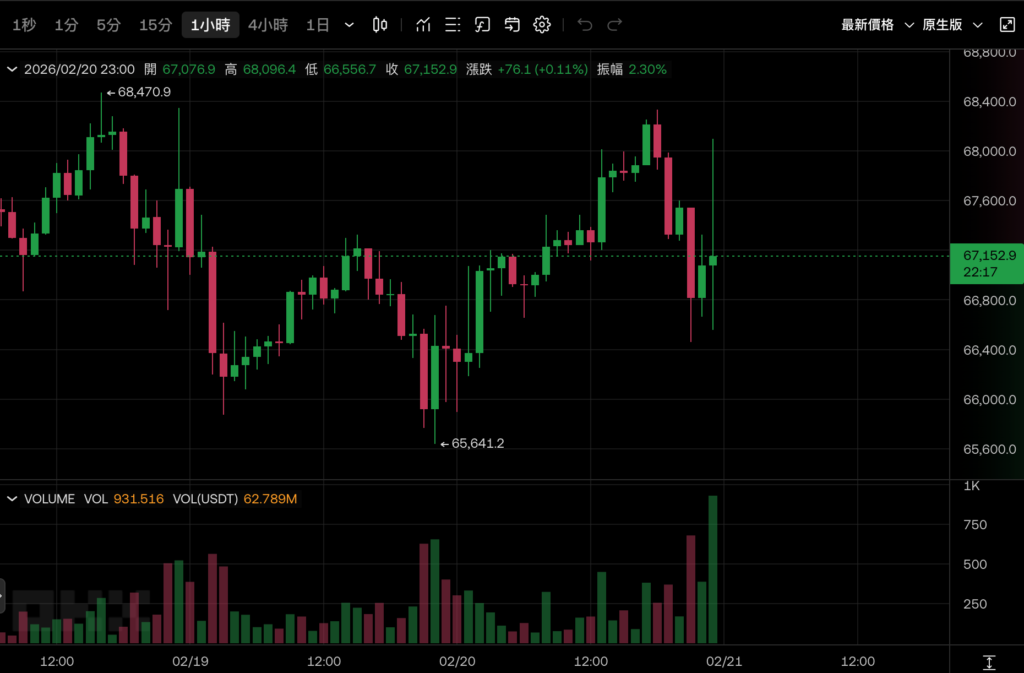
However, the actual market reaction was as follows: the Dow Jones rose 207 points (+0.42%), the S&P 500 rose 0.52%, and the Nasdaq rose 0.68%. Bitcoin briefly broke through $68,000 before quickly falling back to $67,000, with the gains being absorbed within half an hour.
There are three potential reasons. First, the fourth-quarter GDP growth of only 1.4% (expected 2.5%) and core PCE inflation of 3.0% (expected 2.9%), released on the same day, had a more direct impact on sentiment than the tariff ruling.
Second, the existence of "Game Two" means that tariffs will not really disappear, but will just take a different form.
Third, the market has become numb to the continuous shocks of the past four months. With a 47% drop from the October high, continuous outflows from ETFs, and the Fed's hawkish stance, a potentially useful but uncertain positive factor is not enough to reverse sentiment in this environment.
Bitcoin's volatile price action reflects the current market sentiment: uncertainty about how long this good news can last.