The most discussed topic in the Ethereum community recently is undoubtedly Vitalik Buterin's public reflection on the scaling roadmap.
Vitalik's attitude can be described as "sharp," stating bluntly that with the improvement of Ethereum's mainnet (L1) scaling capabilities, the roadmap established five years ago that regarded L2 as the main scaling method has become obsolete.
These remarks were initially interpreted negatively by the market as a "pessimistic" or even "negative" view of L2. However, a careful analysis of Vitalik's core viewpoints, combined with Ethereum's mainnet scaling progress, decentralization evaluation framework, and recent technical discussions surrounding Native/Based Rollups, reveals that Vitalik did not completely deny the value of L2, but rather leaned towards a "correction of past mistakes."
Ethereum is not abandoning L2, but rather redefining the division of labor— L1 will return to its role as the safest settlement layer, while L2 will pursue differentiation and specialization, thus allowing the strategic focus to return to the mainnet itself.

I. Has L2 completed its historical mission?
Objectively speaking, in the previous cycle, L2 was indeed once regarded as Ethereum's lifeline.
In the initial Rollup-Centric roadmap, the division of labor was very clear: L1 was responsible for security and data availability, while L2 was responsible for extreme scalability and low gas consumption. In an era when gas cost tens of dollars, this was almost the only feasible answer.
However, the actual development was far more complex than expected.
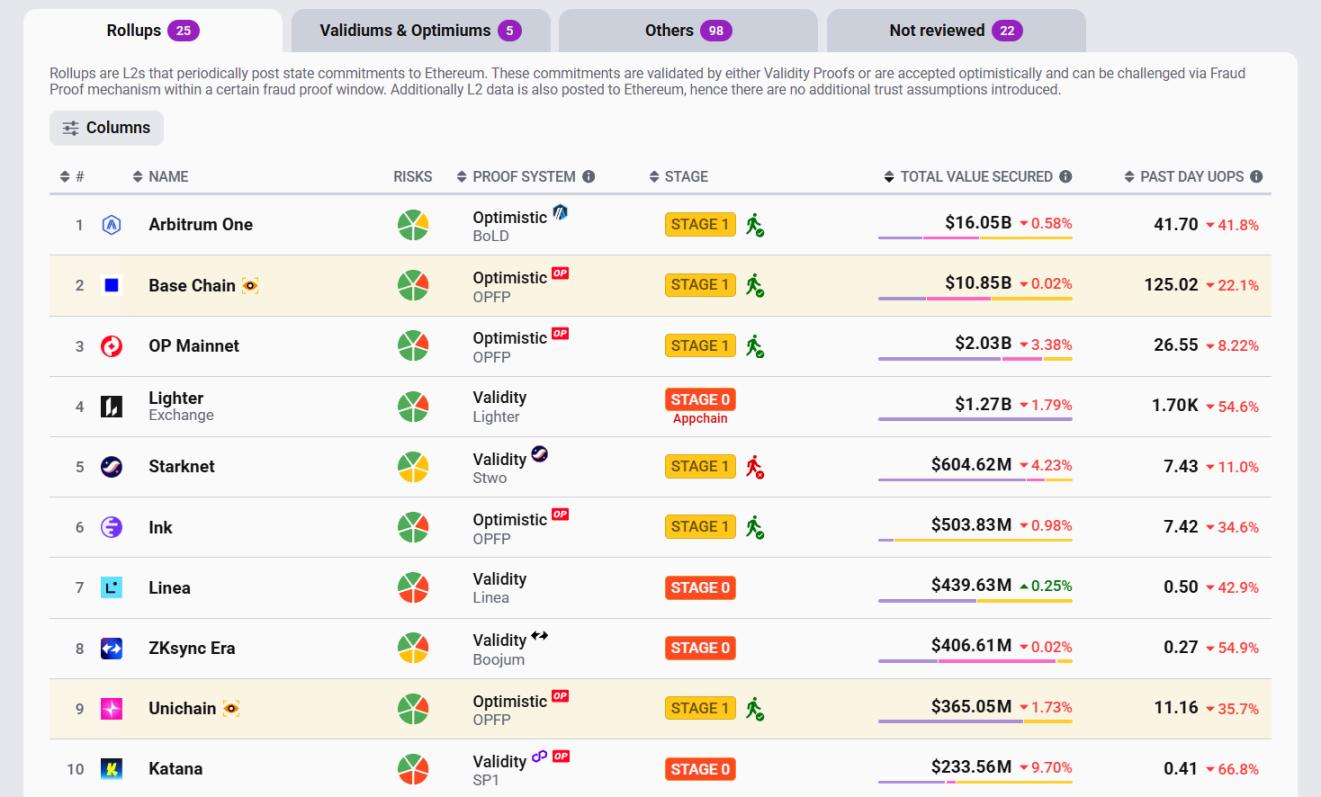
According to the latest statistics from L2BEAT, there are now over a hundred L2 servers in a broad sense. However, the expansion in number does not equate to structural maturity, and the vast majority are making slow progress in the decentralization process.
Here, we need to add some basic information. Back in 2022, Vitalik criticized the training wheel architecture of most rollups in his blog, stating that it relied on centralized operation and maintenance and manual intervention to ensure security. Users who frequently use L2Beat should be very familiar with this, as its official website displays a related key metric—Stage.
This is an evaluation framework that divides Rollup into three decentralized stages, namely "Stage 0" which is completely dependent on centralized control, "Stage 1" which has limited dependence, and "Stage 2" which is completely decentralized. This also reflects the degree to which Rollup depends on the human intervention of auxiliary wheels.
In his recent reflections, Vitalik pointed out that some L2s may remain in "Stage 1" forever due to regulatory or commercial needs, relying on the Security Council to control upgradeability. This means that such an L2 is essentially still a "secondary L1" with cross-chain bridging attributes, rather than the "branded sharding" originally envisioned.
Or to put it bluntly, if the power to rank, upgrade, and make the final decision are concentrated in the hands of a few entities, it not only runs counter to the original intention of Ethereum's decentralization, but L2 itself is nothing more than a parasite that leeches off the Ethereum mainnet.
At the same time, the expansion of L2 liquidity has also brought about another structural problem that everyone has felt deeply over the past few years: liquidity fragmentation.
This has led to the gradual fragmentation of traffic that was originally concentrated on Ethereum, creating isolated value islands. As the number of public chains and L2 blockchains increases, the fragmentation of liquidity will intensify further, which is not the original intention of scaling.
From this perspective, it becomes clear why Vitalik emphasized that the next step for L2 is not more chains, but deeper integration. Ultimately, this is a timely correction—strengthening L1's position as the most trusted global settlement layer through institutionalized scaling and protocol-inherent security mechanisms.
Against this backdrop, scaling is no longer the only goal. Security, neutrality, and predictability have once again become Ethereum's core assets. The future of L2 lies not in quantity, but in deeper integration with the mainnet and more specialized innovation in niche scenarios.
For example, it can provide unique additional features, such as privacy-dedicated virtual machines, extreme scalability, or dedicated environments designed for non-financial applications such as AI agents.
Hsiao-Wei Wang, co-executive director of the Ethereum Foundation, echoed this view at Consensus 2026, namely that L1 should serve as the most secure settlement layer, carrying the most critical activities; while L2 should pursue differentiation and specialization, carrying activities that pursue the ultimate user experience.
II. Native Rollup: Based Rollup + Pre-confirmed Future?
It is precisely in this wave of reflection on L2 narratives that the concept of Based Rollup is expected to have its moment in the spotlight in 2026.
If the keyword for the past five years has been "Rollup-Centric," then the core of the current discussion is shifting to a more specific question: Can Rollups "grow within Ethereum" rather than "be attached to outside Ethereum"?
Therefore, the "Native Rollup" currently being hotly debated in the Ethereum community can be understood to some extent as...
An extension of the concept of Based Rollup—if native Rollup is the ultimate ideal, then Based Rollup is currently the most practical path to that ideal.
As is well known, the biggest difference between Based Rollup and traditional L2 such as Arbitrum and Optimism is that it completely abandons the independent, or even centralized, sequencer layer. Instead, the ordering is directly handled by Ethereum L1 nodes. In other words, the Ethereum protocol itself integrates Rollup-like verification logic at the L1 level, which unifies the extreme performance optimization and protocol-level security that were originally separate between L2 and the Ethereum mainnet.
The most intuitive feeling this design gives to users is that Rollup seems to be embedded in Ethereum. It not only inherits the censorship resistance and activity of L1, but more importantly, it solves the most troublesome problem of L2 - synchronous composability. In a Based Rollup block, you can directly call the liquidity of L1 to achieve atomicity of cross-layer transactions.
However, Based Rollups face a real challenge: if they completely follow the pace of L1 (12 seconds per slot), the user experience will feel cumbersome. After all, under the current Ethereum architecture, even after a transaction is packaged into a block, the system still needs to wait about 13 minutes (2 epochs) to achieve finality, which is too slow for financial scenarios.
Interestingly, in the same tweet where Vitalik reflected on L2, he recommended a community proposal from January, "Combining preconfirmations with based rollups for synchronous composability." The core of this proposal is not simply promoting Based Rollups, but rather proposing a hybrid structure:
By preserving low-latency sequenced blocks, generating based blocks at the end of a slot, submitting the based blocks to L1, and finally combining this with a pre-acknowledgment mechanism, synchronous composability is achieved.
In Based Rollup, preconfirmation is a commitment by a specific role (such as an L1 proposer) to include a transaction before it is formally submitted to L1. This is what Ethereum's Project #4: Fast L1 Confirmation Rule, explicitly proposed in the Interop roadmap, aims to do.
Its core objective is very straightforward: to enable applications and cross-chain systems to obtain a "strong and verifiable" L1 confirmation signal within 15–30 seconds, without having to wait the 13 minutes required for full finality.
From a mechanistic perspective, the fast confirmation rule does not introduce a new consensus process, but rather reuses the attester voting that occurs in every slot of the Ethereum PoS system. When a block has accumulated enough validator votes in an early slot, it can be considered "extremely unlikely to be rolled back under a reasonable attack model" even if it has not yet entered the final confirmation stage.
In short, this level of confirmation does not replace finality, but rather provides a strong confirmation that is explicitly acknowledged by the protocol before finality. This is especially crucial for Interop: cross-chain systems, Intent Solvers, and wallets no longer need to wait blindly for finality, but can safely advance the next step of logic within 15–30 seconds based on protocol-level confirmation signals.
Through this layered confirmation logic, Ethereum has finely differentiated different levels of trust between "security" and "perceptual speed," which is expected to create an extremely smooth interoperability experience (further reading: " Ethereum's 'second-level' evolution: From fast confirmation to settlement compression, how does Interop eliminate waiting time? ").
III. What is the future of Ethereum?
Looking back from the 2026 mark, Ethereum's main theme is quietly shifting, gradually moving from pursuing ultimate "scalability" to pursuing "unification, layering, and inherent security."
Last month, several executives of Ethereum L2 solutions expressed their willingness to explore and embrace the Native Rollup path to improve the consistency and synergy of the entire network. This attitude itself is an important signal: the Ethereum ecosystem is undergoing a painful but necessary de-bubbling process, returning from pursuing the "number of chains" to pursuing the "unity of protocols".
However, as Ethereum's underlying roadmap is recalibrated and advanced, especially with the continuous enhancement of L1 and the gradual implementation of Based Rollup and pre-acknowledgment, when underlying performance is no longer the only bottleneck, a more realistic problem begins to emerge—the biggest bottleneck is no longer the chain, but the wallet and the entry barrier.
This confirms the insight that imToken repeatedly emphasized in 2025: when infrastructure becomes invisible, what truly determines the limits of scalability will be the entry-level interactive experience.
Overall, aside from underlying scaling, the future expansion and large-scale development of the Ethereum ecosystem will not only focus on TPS or Blob count, but will revolve around three more structurally significant directions:
- Account abstraction and the dissolution of barriers to entry: Ethereum is pushing for native account abstraction (Native AA), and future smart contract wallets will become the default choice, completely replacing obscure seed phrase and EOA addresses. For users of wallets such as imToken, this means that entering the crypto world will be as simple as registering a social media account (further reading: " From EOA to Account Abstraction: Will the Next Leap of Web3 Happen in the 'Account System'? ").
- Privacy and ZK-EVM: Privacy features are no longer a peripheral need. With the maturity of ZK-EVM technology, Ethereum will provide necessary on-chain privacy protection for commercial applications while maintaining transparency. This will be its core competitive advantage in the competition among public chains (further reading: " The Dawn of the ZK Roadmap: Is Ethereum's Endgame Roadmap Accelerating? ").
- On-chain sovereignty of AI agents: In 2026, the initiator of transactions may no longer be a human, but an AI agent. The challenge lies in establishing trustless interaction standards: how to ensure that AI agents are executing the user's will, rather than being manipulated by a third party? Ethereum's decentralized settlement layer will become the most reliable rule-maker in the AI economy (further reading: " A New Ticket to the AI Agent Era: What is Ethereum Betting on by Pushing ERC-8004? ").
Returning to the original question, did Vitalik really "deny" L2?
A more accurate understanding is that he is rejecting a fragmented narrative that is overly inflated, detached from the mainnet, and operates independently. This is not the end, but a completely new beginning. Moving from the grand dream of "brand sharding" back to the meticulous refinement of Based Rollup and pre-confirmation will essentially help strengthen Ethereum L1's absolute position as the foundation of global trust.
However, this also means that in this return to technological pragmatism, only those innovations that are truly rooted in the underlying principles of Ethereum's new phase and share the fate of the mainnet will survive and thrive in the next great age of exploration.