This battle over AI payment standards appears on the surface to be a tactical struggle between two commercial camps. But what it reflects is a deeper question: when AI begins to participate independently in economic activities, is the financial system we designed for humanity still sufficient?
Article by: Lin Wanwan
Article source: Beating
The money is already living in the code.
Six months ago, AI payment was just a PowerPoint presentation at a press conference. Now, AI is becoming the "cashier counter."
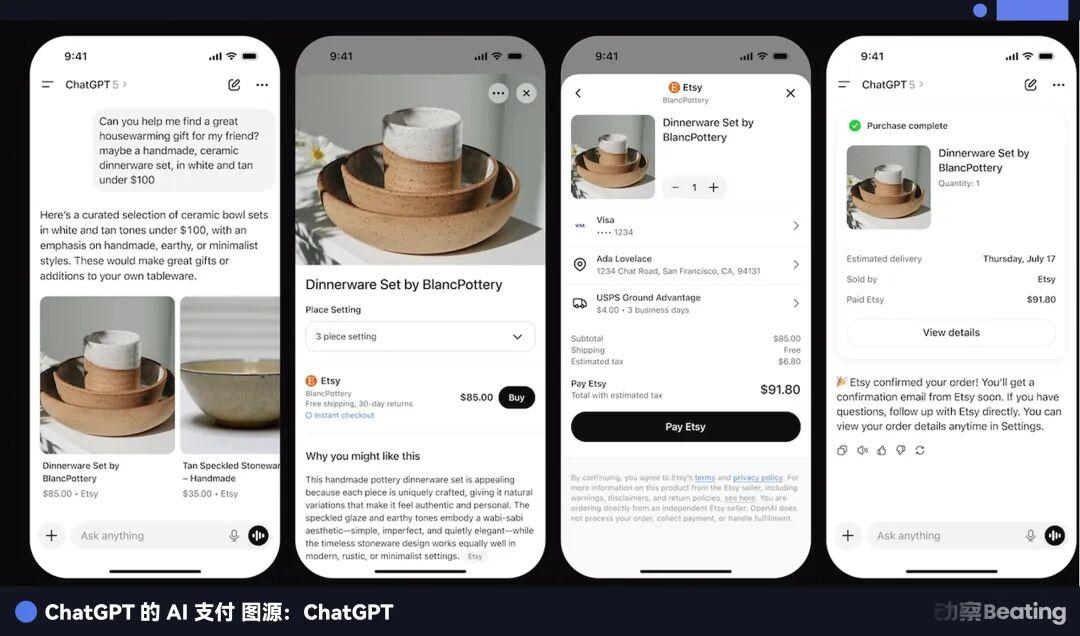
Now open ChatGPT and search for any item. You'll see a blue "Buy" button. Fill in your address, pay, and it will ship. The entire process is seamless, without redirecting you or opening any other webpages.
Last week, Google followed suit, integrating Etsy and Wayfair products into its search and Gemini apps, allowing users to checkout directly within the chat. Microsoft's Copilot also launched its shopping checkout feature. Meanwhile, Meta's Zuckerberg just announced a full-scale shift towards AI-powered commerce.
But an even more insidious business battle is quietly unfolding. The toll-free war in AI payments begins in the fall of 2025 with the emergence of two major AI payment camps.
On September 16, Google brought together more than 60 companies to release an "AI Agent Payment Protocol".
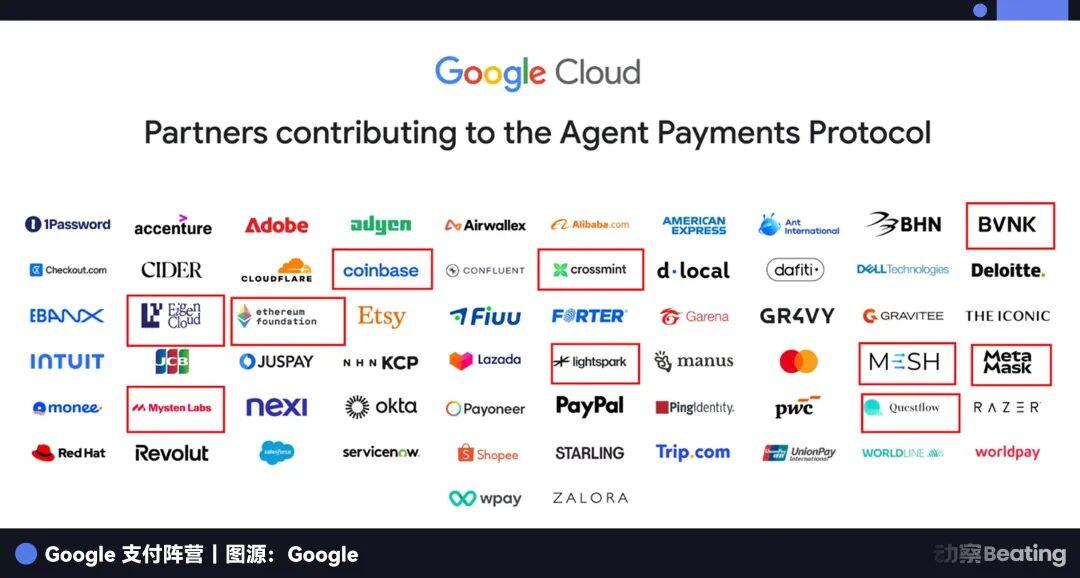
The list is full of familiar faces from traditional finance: Mastercard, PayPal, American Express, plus a few allies from the tech world.
On the 29th of the same month, Stripe, in collaboration with OpenAI, released another protocol, the Agentic Commerce Protocol, or ACP for short. Stripe also announced that it is testing ACP-based agent commerce solutions with AI companies such as Microsoft Copilot, Anthropic, and Perplexity—all native AI players.
The two lists have very little overlap. Coinbase is also part of Google's AP2 ecosystem and a long-term partner of Stripe.
The two camps are arguing over a seemingly mundane but trillion-dollar question: When AI spends money on behalf of humans, from whose pipe does the money flow?
You might think this is far removed from your life. But think about it: you can now have ChatGPT book your flight, an AI assistant compare prices for you, and an agent automatically purchase office supplies—these scenarios are becoming a reality. Every transaction requires a conduit to transfer money from your pocket to the merchant.
Whoever repairs this pipe can collect a toll for every transaction.
This is the essence of this war.
A roundtable discussion changed 12 months
The story begins with a dinner party.
In the summer of 2024, Stripe hosted a fintech roundtable at its San Francisco headquarters with then-U.S. Under Secretary of the Treasury Wally Adeyemo.
A group of payment company owners sat together chatting, including two people they had never met before: Stripe CEO Patrick Collison and a young man named Zach Abrams.
Abrams is no ordinary person. He and his partner Sean Yu are serial entrepreneurs. In 2013, they sold their first company, Evenly (a peer-to-peer lending platform, similar to the American version of Venmo), to Square (now called Block).
Abrams later became Head of Consumer Products at Coinbase and also served as Chief Product Officer at Brex; Yu worked as an engineer at DoorDash and Airbnb. In 2022, the two reunited to found Bridge, helping businesses integrate stablecoin payments. Clients include Coinbase and SpaceX.
The roundtable discussion that day was originally very broad, but Abrams later recalled that he was shocked: more than 90% of the time was spent talking about stablecoins, even though he was the only stablecoin company present.
Before that, Bridge had been pursuing Stripe as a client, wanting to integrate its technology into Stripe's payment system. But after that roundtable, things changed. Collison started frequently meeting with Abrams, not to discuss cooperation, but to discuss acquisition.
In October 2024, Stripe announced its acquisition of Bridge for $1.1 billion. Bridge had just completed a $40 million Series A (first round of institutional funding) in March 2024, valuing the company at $200 million.
The acquisition price was 5.5 times the valuation, and could exceed 100 times based on revenue multiples. In its post-investment statement, Sequoia Capital said they believe Bridge will join Instagram, YouTube, PayPal, and WhatsApp as "the kind of company that realizes its full potential after being acquired."
In February 2025, the transaction was officially completed. Bridge's 60-person team moved into Stripe's San Francisco headquarters and participated in Stripe's bi-weekly new employee training camp.
This is just the first step.
What followed happened quickly. In May 2025, Stripe launched stablecoin financial accounts, allowing businesses in 101 countries to directly hold stablecoin balances and use stablecoins for payments globally.
In the same month, ChatGPT launched a shopping recommendation feature, allowing users to search for products, compare options, and then be redirected to the merchant's website to place an order.
In June, it acquired the wallet company Privy.
Privy did something simple: it enabled any app to have a built-in digital wallet, allowing users to complete on-chain payments without needing to download any additional cryptocurrency wallet software. At the time, it already had over 75 million accounts using it.
Patrick Collison tweeted something very straightforward: "Money has to live somewhere, and Privy has built the world's best programmable vault."
In September, it partnered with crypto investment giant Paradigm to incubate the Tempo Chain, a brand-new blockchain designed specifically for payments. Paradigm co-founder Matt Huang (who is also a board member of Stripe) personally led the team.
The list of companies joining Tempo's design team reads like an all-star game in the payments industry: OpenAI, Anthropic, Deutsche Bank, Visa, Shopify, Standard Chartered Bank, Nubank (Brazil's largest digital bank), DoorDash, Revolut, and South Korean e-commerce giant Coupang.
Stripe CEO Patrick Collison stated that Tempo can process tens of thousands of transactions per second with sub-second confirmation, and each transaction incurs a fee of less than 0.1 cents. Furthermore, transaction fees are denominated in a USD stablecoin, eliminating the need to hold highly volatile native tokens.
In the same month, Stripe and OpenAI officially released the ACP protocol and simultaneously launched ChatGPT's Instant Checkout feature—users can directly place an order and make payment with one click after seeing recommended products in the dialog box, without being redirected or swiping their cards.
The first to receive support were Etsy merchants, with Shopify's millions of merchants following suit.
In October, Tempo completed a $500 million Series A funding round, led by Greenoaks and Thrive Capital, with participation from Sequoia, Ribbit Capital, and SV Angel, valuing the company at $5 billion. A blockchain project less than two months old has reached a $5 billion valuation. Stripe and Paradigm themselves did not participate in this round.
In December, Tempo launched its public beta. UBS, Mastercard, and Klarna, the European pre-purchase payment giant, joined the list of partners.
Bridge's Zach Abrams also announced that Bridge has applied for a national bank trust charter in the United States to comply with the requirements of the GENIUS Act, a stablecoin regulatory law that will be signed into law in July 2025.
Connecting these events: spending 1.1 billion to acquire the ability to issue tokens, establishing stablecoin financial accounts, acquiring wallet companies, incubating a proprietary blockchain, and applying for a banking license.
From issuing tokens to building blockchains to creating wallets, defining protocols, and obtaining licenses, Stripe handled every layer of the process itself.
In contrast, Google has over 60 alliances, an open protocol, and a code repository. Google has everything, except its own blockchain, its own stablecoin, and its own wallet.
Alliances are the product of a group of people sitting down for a meeting. Stripe, on the other hand, creates a system that can be launched with a single decision.
Tempo was already being tested the same month Google released AP2.
Regardless of who wins, Circle is guaranteed to win.
There's a character in this war who's even smarter than Stripe.
It doesn't take sides, doesn't fight, and hardly ever speaks. But no matter who wins, it always wins.
This character is called Circle.
Circle has issued a stablecoin called USDC, which is currently the most compliant digital dollar in the world.
Another company, Tether, issues USDT, which is larger in scale, but regulators have been debating for years whether its reserves are sufficient and whether its audits are reliable without reaching a conclusion.
Retail investors may not care about these things, but in the world of AI, there may be hundreds of thousands of automated transactions every day, and each one needs to withstand auditing. No reputable company would dare to build its AI trading platform on a stablecoin with questionable compliance.
What about Circle? It's a NYSE-listed company. The SEC has seen its books, and it discloses its financial statements every quarter. The whole world can see how much U.S. Treasury bonds and cash it holds in reserves.
So you see an interesting situation: Stripe's stablecoin financial accounts support USDC. OpenAI uses USDC through Stripe. Coinbase, within the Google camp, also accepts USDC.
The two camps are locked in a fierce battle, vying for control of the "entry point"—the interface and protocol through which AI spends money. But regardless of who controls the entry point, the money ultimately needs to be converted into stablecoins to circulate on the blockchain. And in the compliant stablecoin market, USDC has virtually no rivals.
Two camps are vying for access, while Circle gets the settlement volume.
Let's look at some data. In 2024, the total global stablecoin transaction volume reached $15.6 trillion. What does this figure mean? It's roughly equivalent to Visa's total annual transaction volume.
Something that was born less than ten years ago has already caught up with the network that Visa built over sixty years.
AI-driven transactions are just beginning. Consulting firm Edgar Dunn & Co. predicts that by 2030, AI-driven transactions will reach $1.7 trillion. Almost every single one of these $1.7 trillion transactions will likely pass through the stablecoin channel.
U.S. Treasury Secretary Scott Bessent publicly stated at a Senate hearing in June 2025 that a stablecoin market capitalization of $2 trillion is a "very reasonable expectation."
Patrick Collison himself said that the average interest rate on bank deposits in the United States is only 0.40%, and the $4 trillion in bank deposits have even zero interest rates.
He believes this consumer-unfriendly approach is a "loser's strategy," and that young people will eventually exchange their money for higher-yielding stablecoins.
He was talking about trends. And Circle is right in the middle of those trends.
end
Finally, let's zoom out a bit.
This battle over AI payment standards appears on the surface to be a tactical struggle between two commercial camps. But what it reflects is a deeper question: when AI begins to participate independently in economic activities, is the financial system we designed for humanity still sufficient?
Patrick Collison envisions a future where AI agents are the primary participants in economic activity. They compare prices, make purchases, pay, and settle accounts—the entire process requiring no human intervention. This represents the pinnacle of efficiency, but also the boundary of risk.
The alliance between Google and traditional finance envisions another future: AI should be integrated into existing human financial infrastructure, subject to existing regulatory rules, and operate within existing trust frameworks.
Two futures, two sets of logic, two camps.
But no matter which future comes, one thing is certain: AI requires money, money needs to run on the blockchain, and on-chain settlement requires stablecoins.
So Circle continues to win. Stripe and Google continue their battle. Regulators continue to chase. Merchants continue to accept. Consumers continue to have no idea where their money is going.
Until one day, something goes wrong with the item the AI bought for you, and you realize that neither the AI nor anyone else knows who to contact for a refund.
On that day, everyone will suddenly remember those questions that no one answered today.
But by that day, the pipes had been repaired, and tolls had already been collected.
History always goes like this: get on the train first, buy the ticket later.
This time, however, the car was going too fast.