The crypto market did not get a respite this past weekend. After continuing its narrow range trading on Saturday and Sunday, Bitcoin came under renewed pressure during today's European and American trading sessions, briefly falling below the $64,000 mark to reach $63,924.44, a new low since February 6. As of press time, the price has rebounded slightly to around $64,800, a 24-hour drop of nearly 4%.
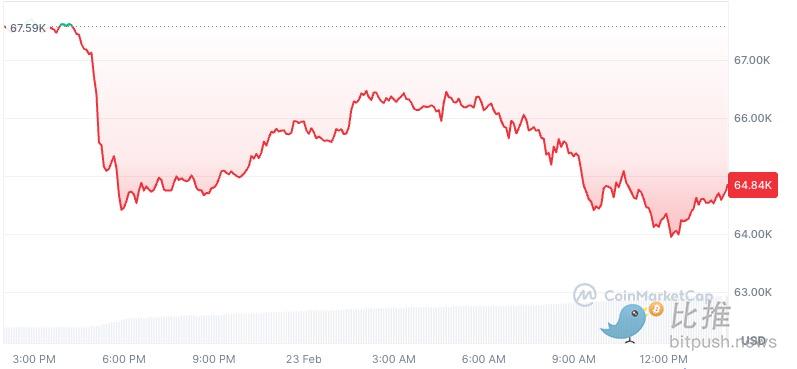
This is a liquidity crunch that has lasted for several days. Since February 20, Bitcoin has been in a downward trend for four consecutive trading days, with a cumulative drop of over 7%. Compared to its all-time high of nearly $127,000 last October, the current price has almost halved.
Market sentiment has plummeted to rock bottom amid continued volatility. The Crypto Fear & Greed Index fell to single digits of 5 yesterday, marking its third consecutive day in the extreme "fear" zone: the lowest figure since the market panic in January of this year.
Macro: Tariff Controversy and the Shaking of the AI Narrative
Although last week's US CPI data showed some easing of inflationary pressures, the market's focus has quickly shifted to new variables in the global trade situation.
Last Friday, the US Supreme Court rejected President Trump's application of emergency powers to impose tariffs. Subsequently, Trump's administration indicated it would pursue a new legal path to implement temporary global tariffs, potentially raising rates from 10% to 15%. The EU responded immediately, demanding the US adhere to existing trade agreements. This back-and-forth has led markets to re-indulge in the possibility of escalating global trade tensions. Furthermore, geopolitical uncertainty in the Middle East has intensified, with a new round of negotiations between the US and Iran scheduled for June 26 in Geneva, Switzerland.
Risk assets are extremely sensitive to this. US technology stocks retreated in unison, with software and AI-related companies under pressure.
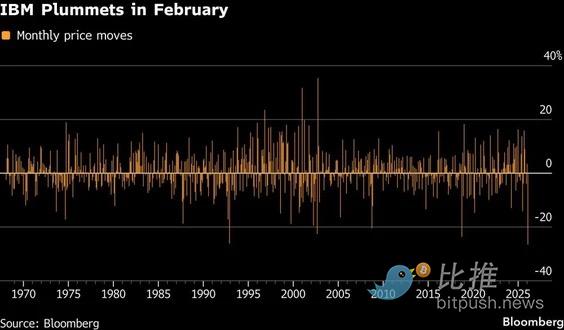
To make matters worse, during Monday's US trading session, leading AI stock IBM plummeted over 11% due to Anthropic's release of AI tools that could automate the COBOL language, dragging down the overall tech sector. Market analysis firm Ecoinometrics pointed out that Bitcoin is currently extremely sensitive to downside risks in the US stock market. When US tech stocks confirm a structural downtrend, Bitcoin often follows closely and experiences a larger drop. The low volatility structure that previously supported Bitcoin's independent price movements has been broken due to deep institutional participation, resulting in a higher correlation with tech stocks.
Institutions: Funds shift from "basis trading" to comprehensive hedging
The more crucial variable lies in institutional funding.
According to SoSoValue data, in the week ending February 20, the US spot Bitcoin ETF recorded a net outflow of approximately $316 million, while the Ethereum ETF saw a net outflow of approximately $123 million. This marks the second consecutive week of net capital withdrawal.
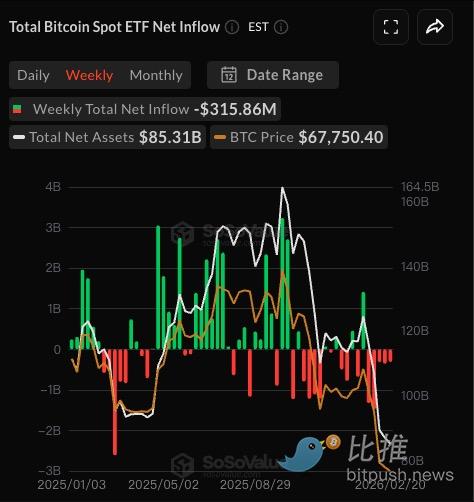
ETF funds were the most significant marginal increase in the last bull market . Net outflows imply two things:
First, institutions do not view the current price as "significantly undervalued" in the short term;
Second, prices lack passive long-term capital support.
Previously popular "basis trading" (buying spot or ETFs while short futures to lock in the price difference) has become unprofitable as prices have fallen. Without sustained ETF inflows, market movements are increasingly driven by derivatives funds. If the macroeconomy weakens, leveraged positions could easily trigger a sell-off.
On-chain: Slowing down of long-term holders' selling, miners selling off
Amid the continued decline in prices, on-chain data is also revealing some subtle signals.
Glassnode points out that the recent 7-day average net realized profit/loss of investors (short-term holders) has narrowed from -$1.24 billion/day on February 6 to -$480 million/day, indicating that loss-making selling is weakening, but has not yet ended.
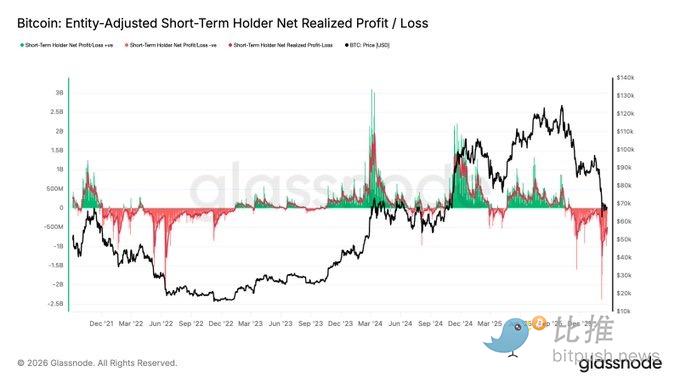
This means that we are currently in a typical "bottoming-out period": selling pressure still exists, but the intensity of panic has decreased.
If we segment the market:
Long-term holders did not show any obvious panic;
Short-term funds are still exiting the market at a loss;
In terms of sentiment indicators, the Crypto Fear & Greed Index has slipped into the "extreme fear" zone.
This combination usually corresponds to a bottoming out process rather than a trend reversal.
At the same time, subtle changes have also occurred on the supply side.
Bitdeer disclosed that it had sold all 943 of its held Bitcoins as of February 20, reducing its BTC balance to zero. The company stated that this move was to secure liquidity for land and data center expansion. Given the declining prices and shrinking mining profits, miners selling their reserve cryptocurrencies can exacerbate short-term selling pressure. While this is not a common practice in the industry, it is often amplified and interpreted by the market during periods of heightened market sentiment.
Outlook: NVIDIA's earnings report may mark a short-term turning point.
The market is searching for its next directional direction amid panic. Bitcoin is currently struggling with a key technical support level – the 200-week exponential moving average (EMA) around $68,350, which has now been breached.
Analyst Tom McClellan warned that while "smart money" in CME futures is rapidly reducing its short positions, this merely reflects market conditions, not a clear signal of a rebound. If key support levels are breached, Bitcoin still faces the risk of further declines to the $40,000 to $50,000 range. Strategists at Ned Davis Research have even offered a more pessimistic scenario, suggesting that if this bear market develops into a "winter," Bitcoin could fall to $31,000.
Against this backdrop, Google searches for "Bitcoin is dead" have quietly increased in recent months.
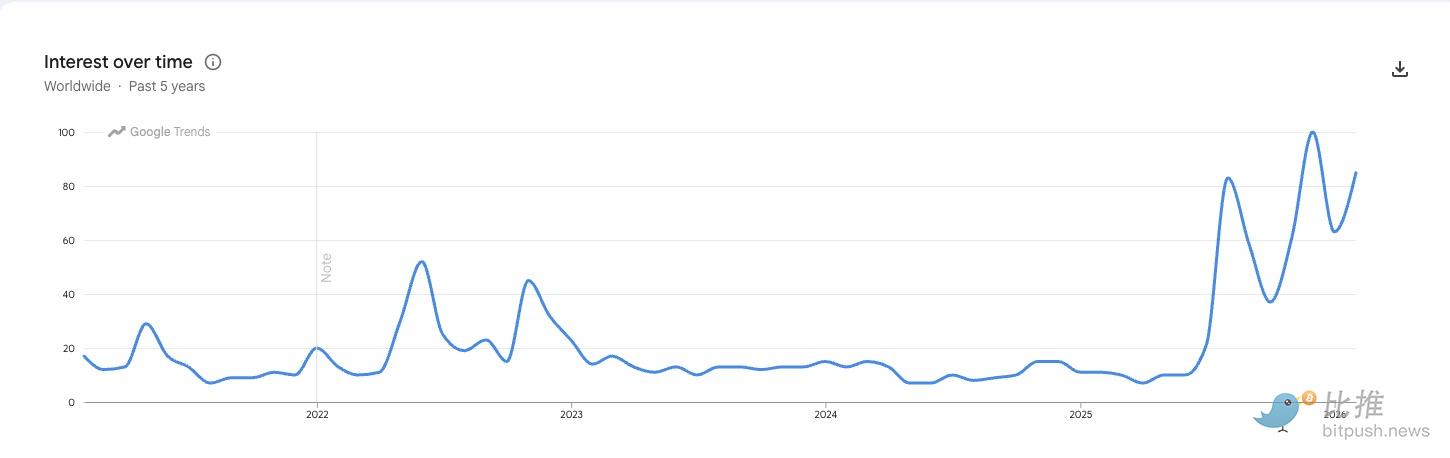
However, bulls like Arthur Hayes, Tom Lee, and Michael Saylor continue to assert through various channels that it's only a matter of time before Bitcoin returns to or even surpasses its all-time high.
In the short term, the potential variable lies in this week's macroeconomic events. Digital asset firm Keyrock points out that NVIDIA's earnings report, to be released on February 25th, could be the next major catalyst for the market. Given the current market's extreme sensitivity to the AI narrative and the high correlation between Bitcoin and tech stocks, NVIDIA's performance guidance will directly impact risk appetite in the tech sector and even the overall market, which will then be transmitted to the crypto market.
In short, amidst heightened macroeconomic uncertainty and a liquidity crunch, Bitcoin is currently in a phase of liquidity scarcity and fragile confidence. Market self-correction may require either a complete end to the selling by long-term holders or the emergence of new macroeconomic policy signals (such as a clear easing stance from the Federal Reserve). Until then, any rebound is likely to face heavy selling pressure.
Author: Bootly
Twitter: https://twitter.com/BitpushNewsCN
BitPush Telegram Community Group: https://t.me/BitPushCommunity
Subscribe to Bitpush Telegram: https://t.me/bitpush