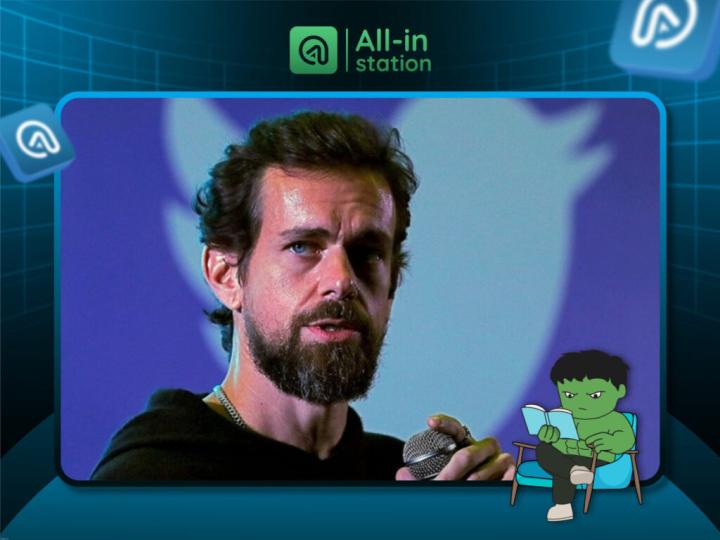
While the industry is still debating whether Web3 has truly taken off, new concepts have already emerged. Recently, Justin Sun publicly stated that he will be "all in on Web 4.0," reigniting market discussion. Naturally, there are many skeptics, but beyond the controversy, a more important question is emerging—is the future that Web 4.0 points to rapidly taking shape?
What is Web 4.0?
Looking back at the evolution of the internet, from Web 1's information browsing to Web 2's social interaction, and then to Web 3's emphasis on "information ownership," each upgrade has essentially changed "who has power on the internet." The vision of Web 4.0 is even more radical: the main participants in the future internet may no longer be humans, but AI agents.
This concept has recently gained renewed attention due to an article by developer Sigil Wen. He argues that as model capabilities rapidly evolve and computing costs continue to decline, the cost of running autonomous AI agents is approaching zero. When millions or even billions of agents are running online simultaneously, an internet economy system "centered on AI" will gradually take shape.
It's worth noting that he believes the problem isn't whether AI is smart enough, but whether it has the authority to act. Current AI can think and generate content, but it can't act truly independently—it can't have a wallet, can't make payments, and can't complete economic transactions on the blockchain. Blockchain, however, offers a possibility: on-chain identity, permissionless payment systems, stablecoin settlement networks, and automated financial infrastructure. These capabilities combined make it theoretically possible for AI agents to become "economic agents."
If this vision comes true, the role of cryptocurrency will change. It will no longer be merely a tool for transferring value between humans, but could become the settlement layer of a machine economy. When agents can autonomously pay for computing power costs, transaction services, and even collaborate to earn money, on-chain financial infrastructure will become their operating environment.
However, the controversy is equally intense. Vitalik Buterin publicly expressed his concerns, arguing that with the exponential growth of AI inevitable, what truly matters is controlling the direction, not accelerating expansion. He pointed out that so-called "autonomy" still relies on centralized model companies, and if underlying capabilities remain controlled by a few enterprises, the decentralized foundation of Web 4.0 is questionable. Meanwhile, recent security incidents caused by AI-generated code also serve as a reminder that the industry must remain vigilant while embracing the new narrative.
Whether Web 4.0 will become a reality remains to be seen, but it has already triggered a new round of thinking in the crypto industry: if the future internet is involved in or even dominated by AI, is blockchain ready to support such an economic system?
KAI's perspective
At KAI, we focus not just on short-term trends, but on long-term structural changes. Whether Web 4.0 has truly arrived remains to be seen, but one thing is certain: the future digital economy will no longer be just "transactions between humans," but may be a "settlement network between agents."
As AI becomes a major economic driver, is the crypto infrastructure ready?
This is an issue affecting the entire industry.
KAI will continue to focus on the evolution of Web 4.0, AI Agents, and the on-chain economy, bringing users more forward-looking market observations and analyses.
#Web4 #AI #Crypto #Web3 #Blockchain