Author: Jae, PANews
The Bitcoin network is experiencing an ideological debate that rivals the "block size war" of 2017.
The catalyst was a technical proposal called BIP-110. It attempted to draw a line on the amount of data that could be included in a Bitcoin block through a soft fork. In short, it aimed to limit the ability of protocols like Ordinals and Runes to "write" images, videos, and even code onto the blockchain.
The emergence of BIP-110 signifies that the "minimalist" camp, led by developer Dathon Ohm, is preparing to launch a counterattack against the "liberal" camp.
Supporters call it "correcting past mistakes," while opponents criticize it as "extreme conservatism." This debate has spread from the tech community to miners, institutions, major node users, and has even caught the attention of community leaders like Adam Back.
This is not just a battle over bytes, but a battle over the definition of Bitcoin's value proposition.
BIP-110 points the finger at the inscription protocol.
BIP-110 is not a spur-of-the-moment idea; its prototype can be traced back to BIP-444, proposed by Dathon Ohm in October 2025, which aimed to observe the network's operation under low load by temporarily limiting the size of non-monetary data.
At the time, the intention was simply to "observe for a year," but as Bitcoin Core v30 removed the byte limit on OP_RETURN, fundamentalists became restless, believing it to be a betrayal of Bitcoin's "monetary function" and tantamount to giving the green light to "blockchain spam."
Therefore, Dathon Ohm introduced an even more stringent BIP-110 last December, with more stringent constraints than before.
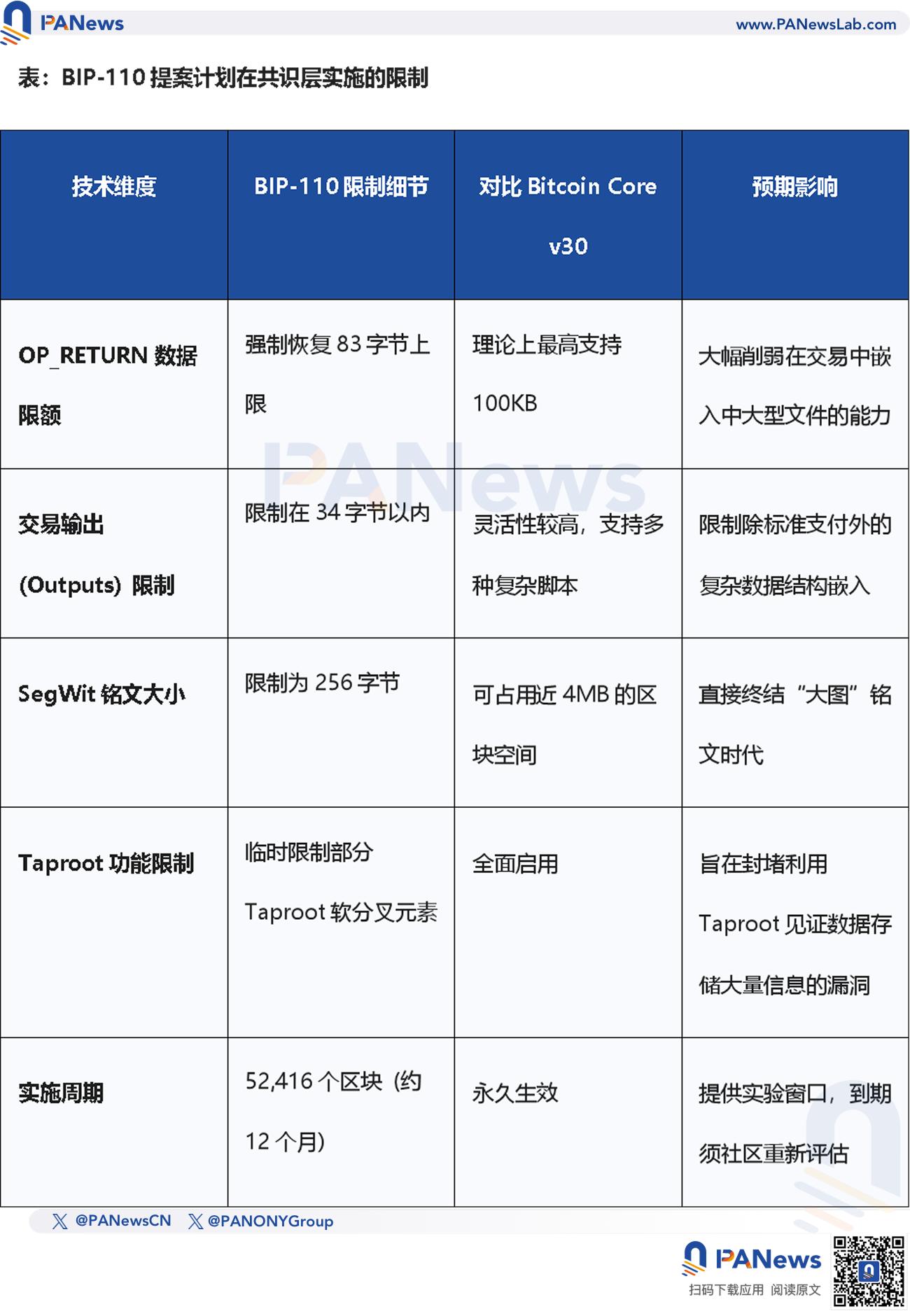
Supporters of BIP-110 argue that these restrictions are not intended to stifle innovation, but rather to restore the technological prudence that Bitcoin maintained in its early days. These rules do not affect normal "payment" and "store of value" use cases; their aim is to target non-financial records that are considered "data abuse."
The 55% activation threshold has sparked controversy: mob attacks or decentralization of power?
What truly caused an uproar in the community was the activation threshold set by BIP-110: as long as 55% of the computing power is supported, it can be approved.
In Bitcoin's governance tradition, major consensus changes typically require support from 95% of miners' hash fees to ensure network stability and prevent chain splits. Previously, the activation of major upgrades such as SegWit and Taproot followed this unwritten rule.
The setting of this threshold has triggered a huge governance crisis within the community.
Supporters argue that the 95% threshold effectively gives a minority a veto power. The problem of unresolved data persists because a minority of stakeholders are stubbornly resisting. The 55% threshold is primarily a "defensive activation" designed to break the deadlock in protocol upgrades.
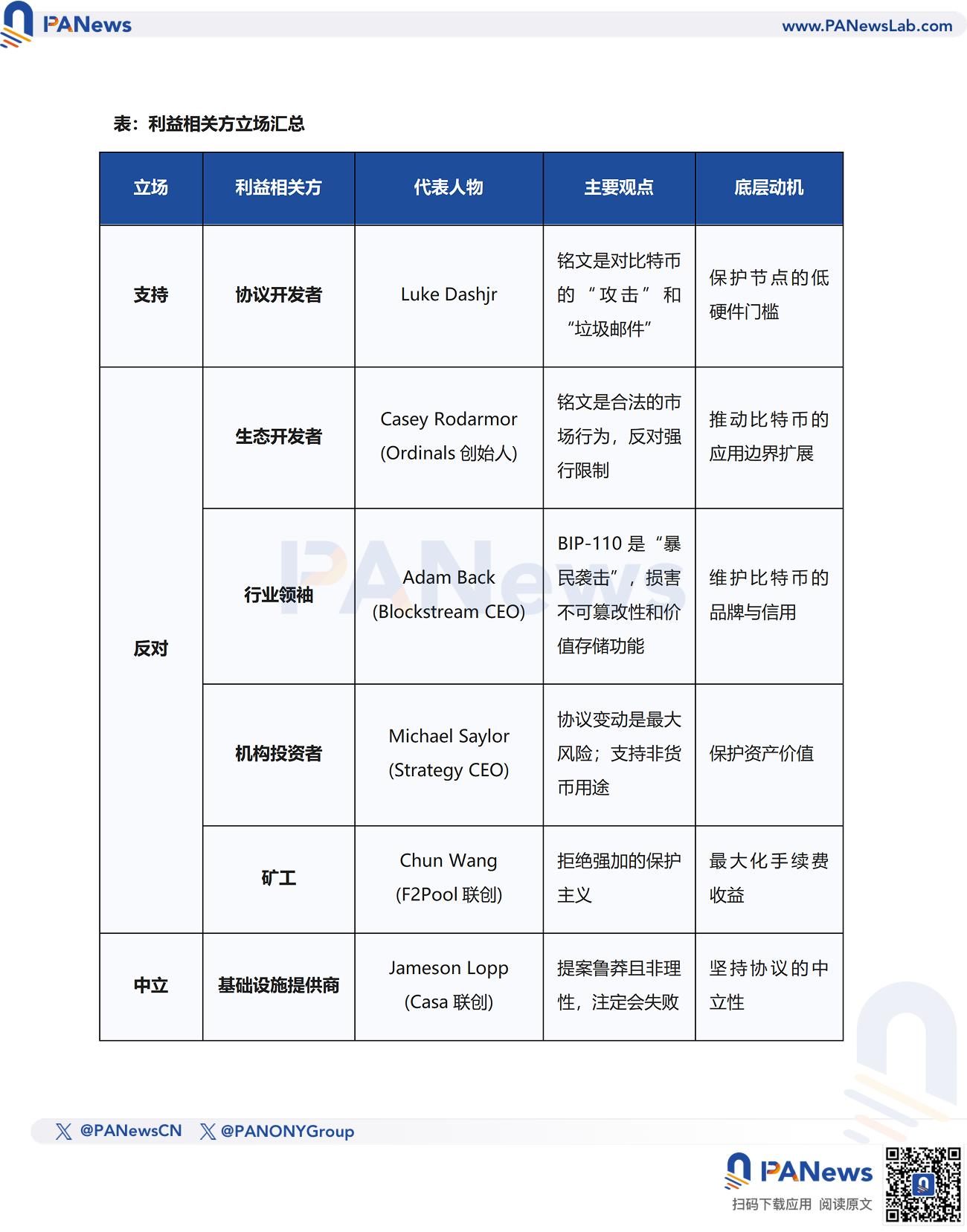
Opposition leader Adam Back accused the move of being "a mob attack on Bitcoin's reputation" and an attempt to force rule changes without broad consensus.
A 55% threshold means that if a simple majority of miners reach a consensus, the remaining 45% of miners and users are forced to accept it. This is using a low barrier to entry to hold the entire network hostage, which can easily lead to a chain split, resulting in two or even more Bitcoin assets.
What's even more chilling is that once this precedent is set, if data can be restricted today, can addresses be frozen tomorrow? Bitcoin's "immutability" will become meaningless.
Factional clashes: Minimalism or cutting off miners' livelihoods?
The underlying driving force behind BIP-110 is the developer community led by Luke Dashjr and loyal users of the full-node client Bitcoin Knots. Their logic is rooted in concerns about the underlying hardware requirements of Bitcoin.
Bitcoin advocate Matthew Kratter likened the inscription protocol to ivy, arguing that while it grows attached to the Bitcoin (tree), it will eventually crush the tree's structure, causing both to die.
If the block space is filled with images, the size of the blockchain will grow exponentially. This means that ordinary users will be unable to run full nodes using regular consumer-grade hard drives, leading to the concentration of verification power in the hands of large nodes and undermining the decentralized foundation of Bitcoin.
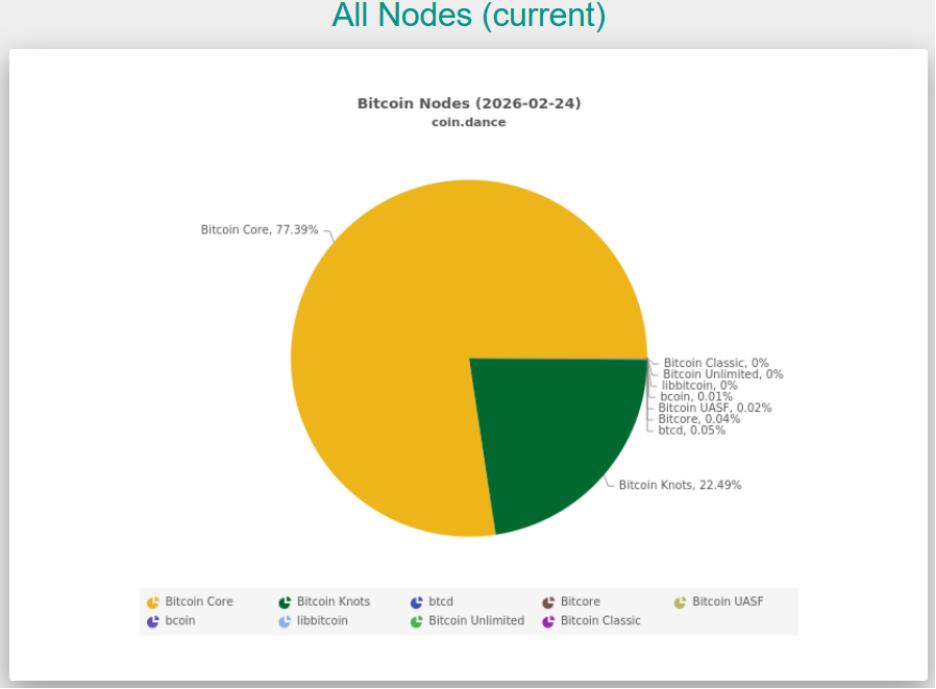
As the controversy intensifies, Bitcoin Knots' market share has surged to 22.49%, while the share of the full node client Bitcoin Core has plummeted to 77.39%. This trend indicates that a significant number of nodes are expressing their support for data restrictions by switching clients.
The opposition is comprised of highly influential opinion leaders and miners, including Adam Back, making for an even more impressive lineup.
Strategy CEO Michael Saylor warned that frequent changes to the protocol are the biggest threat to Bitcoin .
Blockstream CEO Adam Back also pointed out that Bitcoin's greatest value lies in its immutability . If the rules can be easily changed because of the preferences of a few, then Bitcoin's credibility as "digital gold" will be completely destroyed.
From an economic perspective, the controversy surrounding BIP-110 reflects the community's anxiety about Bitcoin's "long-term security budget." As the halving cycle progresses, the security of the Bitcoin network will increasingly rely on transaction fees rather than block rewards.
The fees contributed to the Bitcoin network by non-monetized transactions have exhibited significant volatility. Dune data shows that, as of now, the daily fees for the Inscription protocol have fallen below $10,000, but in December 2023, they contributed nearly $10 million in fees in a single day. With block rewards continuing to halve, miners don't want to close off any avenues of revenue.
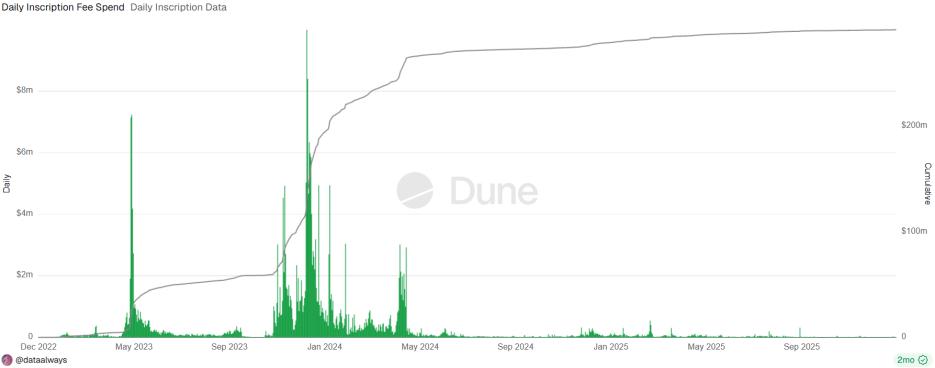
Miners generally believe that cyclical market fluctuations should not be a reason to modify the underlying protocol, and that such non-monetary transactions will remain an important source of income once the market recovers.
The market competition for fees is unfair, and there are both legal risks and challenges in addressing the landslide.
However, the decline in inscription fees has given supporters ammunition to criticize. Since the economic benefits of inscriptions are now negligible, the network optimizations resulting from cleaning them up (such as reducing UTXO set size and lowering node pressure) seem more cost-effective.
The deeper economic logic supporting BIP-110 lies in the fact that the current SegWit discount mechanism is essentially subsidizing non-monetary transactions . Under the current billing rules, storing 1MB of image data is significantly cheaper than sending the same amount of monetary data.
BIP-110 aims to end this "unfair competition" by setting a data cap at the consensus layer, forcing this "low-value" data to compete for more expensive, undiscounted space, or simply leave the mainnet.
Proponents argue that only in this way can the fee market return to its true value, ensuring that currency transactions that are genuinely willing to pay a premium for "global consensus" are prioritized for packaging.
However, if a proposal like BIP-110, labeled as "temporary and with low barriers to entry," is passed, it will erode institutional trust in the Bitcoin network. For institutional investors, Bitcoin's most attractive feature is the immutability of its rules.
Once this precedent is set, will there be future asset freezes targeting specific addresses? Or mandatory adjustments to specific rates?
This "governance slippage" is the risk that Adam Back and Michael Saylor are most concerned about. For Bitcoin, even a protocol containing garbage data is better than a "high-quality protocol" that can be modified at any time. This is because the latter is unpredictable, while institutions seek certainty.
Furthermore, BIP-110 may render some existing UTXOs "dead money," effectively temporarily depriving some users of their property rights. Legally, this could lead to charges of "interference with private property" against miners.
The emergence of BIP-110 is an inevitable product of Bitcoin's growing pains, and its activation remains questionable, especially given that the 55% threshold has traditionally posed a significant challenge to the community.
The most significant aspect of this debate is that BIP-110 brought the issue of "data misuse" to the forefront, forcing the community to consider "what the Bitcoin mainnet should actually support?"
Bitcoin's greatest value lies not in its unchanging nature, but in the fact that every change it undergoes rigorous testing. The future of Bitcoin may become more pure because of this debate, or it may usher in a new chapter of diversification because of this split.
In this battle to defend the value of digital gold, every user running a node is casting a precious vote for the future with their hard drive and bandwidth.