Prediction markets are increasingly outperforming traditional polling as forecasting tools — and the reason comes down to one thing – financial conviction. When people put real money behind a prediction, they don’t lie.
The rise of platforms like Polymarket and Kalshi is challenging the dominance of traditional forecasting. Pollsters have long been the dominant voice in predicting political and economic outcomes. But a string of high-profile polling failures from the 2016 U.S. election to Brexit has opened the door to a challenger that punishes uncertainty with hard cash.
Why Money Makes Better Data
The core argument for prediction markets is behavioural. Exit polls and surveys suffer from a well-documented problem: respondents often give answers they think sound reasonable, or answers that reflect who they want to win rather than who they think will win. There’s no cost to being wrong on a survey form.
Prediction markets eliminate that gap entirely. Every probability reflected in a market price represents someone who was willing to risk actual capital on that outcome.
“It takes conviction to place a prediction or a bet,” George Tung, founder of ClashPicks and host of the widely followed CryptosRUs channel, told BeInCrypto. “You have to be pretty sure that something’s going to happen for you to actually put down real money.”
That conviction makes the data generated by prediction markets fundamentally different in quality. It isn’t sentiment, it’s skin in the game.
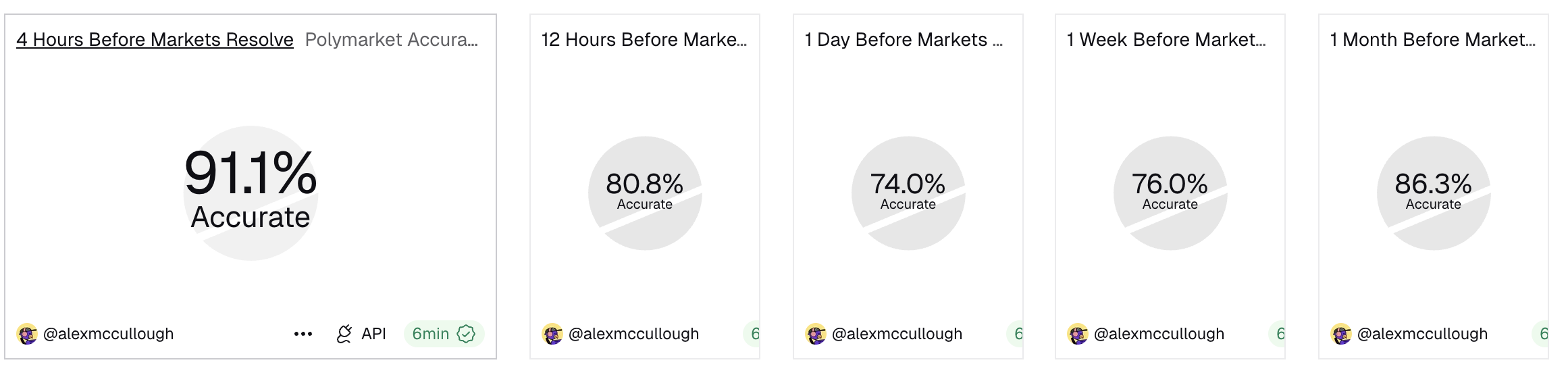
The numbers back this up. Independent research by data scientist Alex McCullough, published via a Dune dashboard, found that Polymarket predicts outcomes with roughly 86% accuracy one month before an event resolves, climbing to around 91% in the final four hours. The study analysed Polymarket’s historical data, excluding markets with extreme probabilities to avoid skewing results.
The Polling Problem
Traditional polling has been struggling. Despite methodological overhauls after 2016 and 2020, polls still overestimated Kamala Harris’s chances in the 2024 U.S. election and underestimated Donald Trump’s, especially within swing states.
Prediction markets, meanwhile, told a different story well ahead of election night. Tung is emphatic that this edge is skill-based, not random.
“If you’re predicting on an outcome like a presidential election or if gold is going to go up this week — it’s skill-based,” he told BeInCrypto. “There are people that do an extensive amount of research and they study things.”
Subscribe to our YouTube channel to watch leaders and journalists provide expert insights