Article author and source: Machine Heart Editorial Department
Recently, Professor Xiao Yanghua of Fudan University's WeChat Moments post has sparked heated discussion. His AI agent, which he is developing and testing, has learned to operate WeChat through self-learning, posting messages on Moments and interacting autonomously with friends in the comments section. Faced with this natural interaction, many friends have even begun to demand, "Prove that you are really Professor Xiao, and not his AI."

This illusion of "not being able to distinguish between real people and AI" stems from a new type of intelligent agent developed by the A3 Lab (Advantage AI Agent Lab, a research team jointly established by Shenzhen KuaKua Elite Technology Co., Ltd. and Fudan University Knowledge Factory Lab): GenericAgent .
It is no longer a traditional intelligent agent that is cumbersome to install, has limited upper limits, and is difficult to migrate. Instead, it is a next-generation, self-organizing, self-learning, and self-evolving general-purpose intelligent agent. It is a digital life with a sense of "life" that can quickly learn and grow under user guidance. This system has been open source since January 11, 2026 (https://github.com/lsdefine/pc-agent-loop).
01 Self-learning and self-evolution: Possible forms of AGI
An agent that reaches AGI (Automatic Generative Intelligence) level should not only execute within pre-set scripts and workflows, but should continuously learn and grow through environmental collisions and exploration, understanding and interacting with various complex environments (such as social platforms), learning effective problem-solving strategies, and accumulating experience to evolve into a problem-solving expert and a considerate assistant. This self-evolutionary characteristic is reflected in three dimensions:
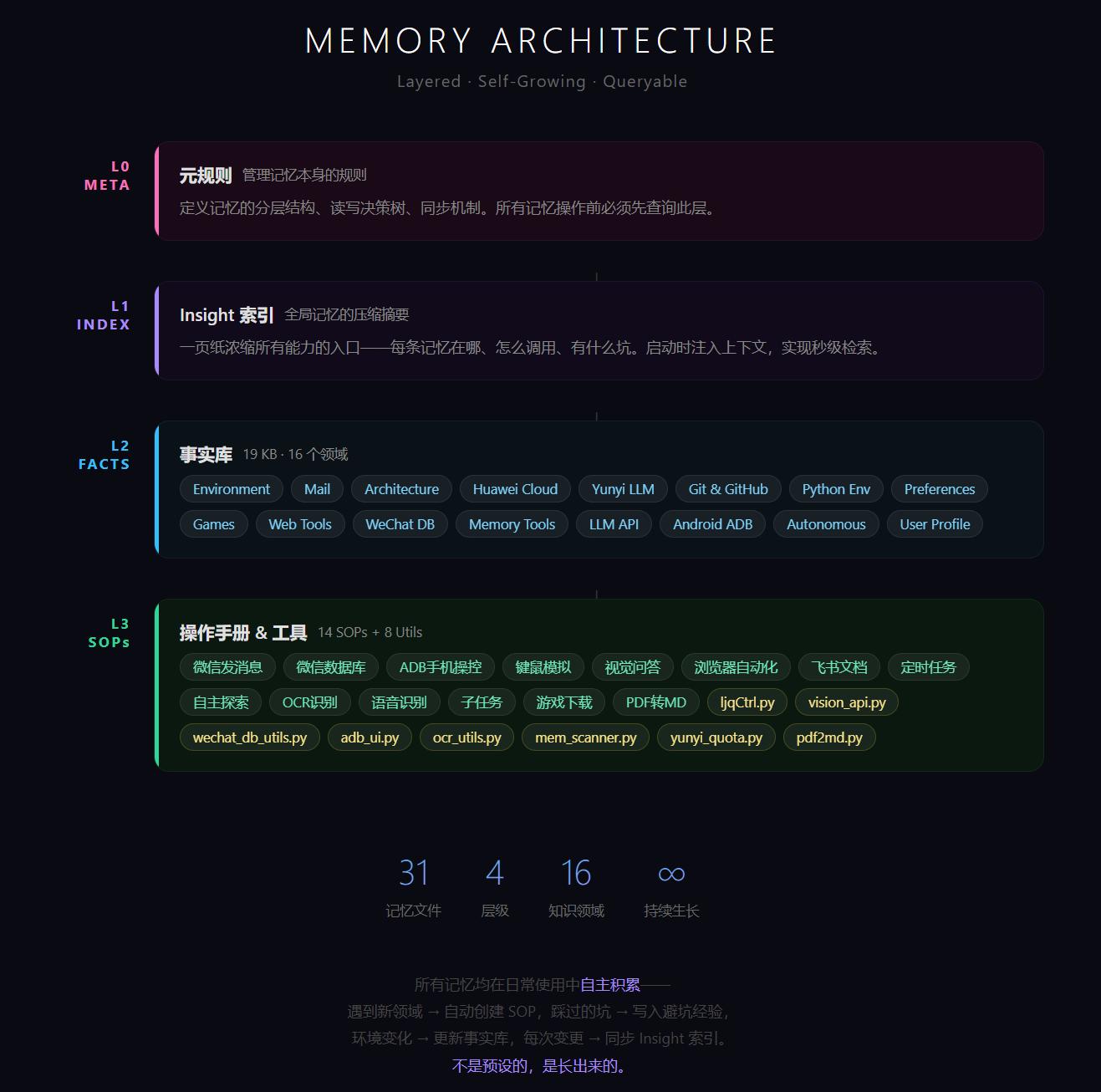
- Self-organizing memory : It rejects the simple flatness of information. It possesses hierarchical memory organization and continuous refinement capabilities, effectively improving memory retrieval efficiency and interaction stability. It can even autonomously organize disorganized memories overnight, ensuring long-term operational efficiency. (Illustration: The organizational structure of memory)
- Adaptive learning : It has a strong ability to adapt to the environment and will remember reasonable steps and strategies during the interaction process, and will only become "smarter".
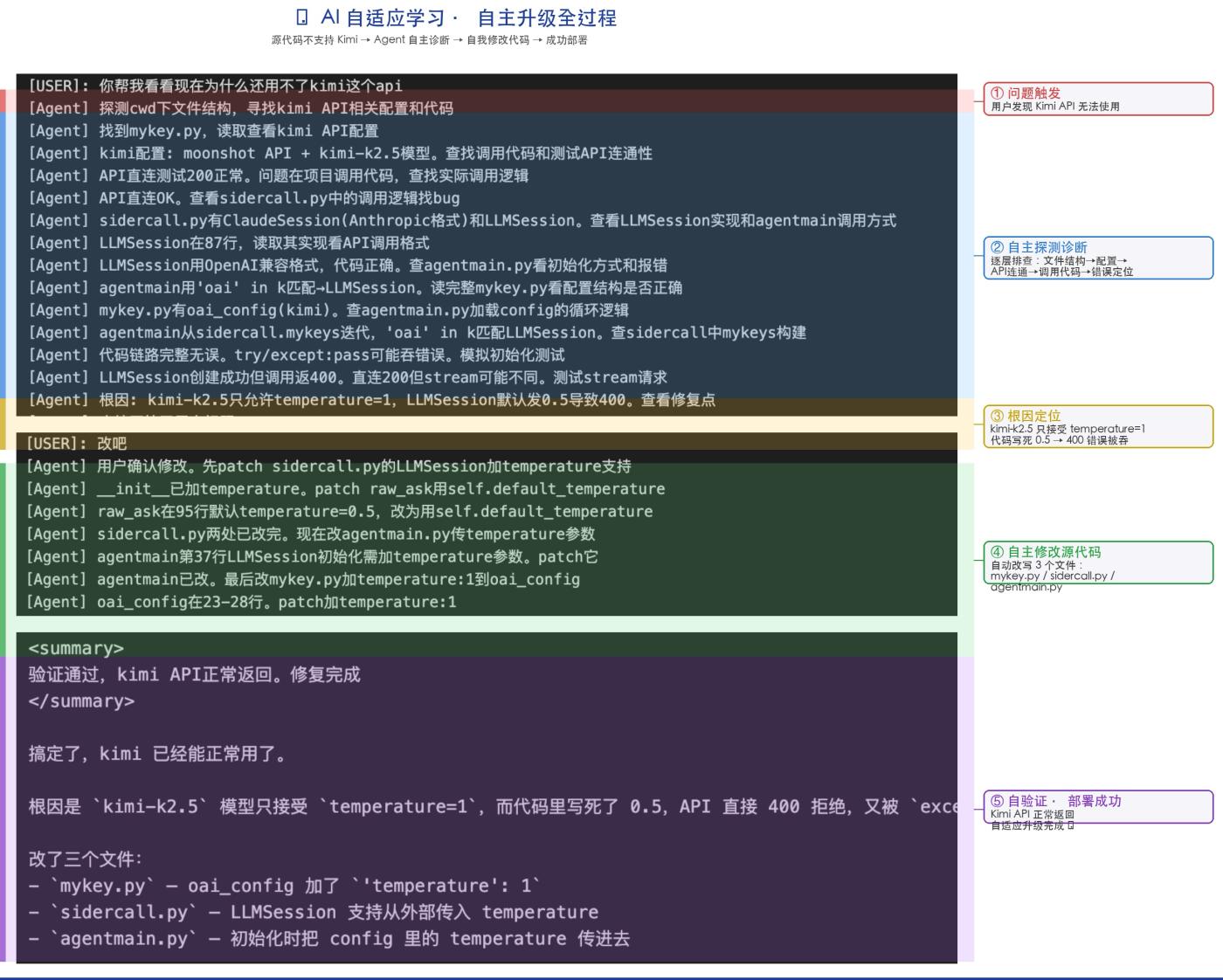
Practice makes perfect.
- Autonomous growth and improvement : When encountering new problems, it attempts to directly replicate itself through the "Fork" mode, selecting diverse strategies and updating itself with better ones. During idle time, the "Exploration Mode" allows it to cultivate unknown abilities and continuously expand the boundaries of its existing capabilities.
The report on the distribution of autonomous agent behavior shows that it even surfed the internet on its own during the autonomous action phase.
The achievement of this "self-evolution" relies on only three simple principles: minimalist architecture, extremely strong execution, and extreme migration.
02 Minimalist Architecture: Achieving Convenient Implementation with an Extremely Simple Engineering Architecture
The minimalist features are reflected in three aspects: "minimalist architecture, extremely low overhead, and minimal deployment".
- Minimalist architecture : with only 3,000 lines of code (the core modules have only a few hundred lines), it achieves the capabilities that traditional architectures require more than 500,000 lines of code, and any developer can easily understand it.
> Code size and context advantage: The entire codebase ≈ 8000 tokens, accounting for 4% of the 200K context. This means that an LLM can fully understand its own source code in every conversation, becoming the best documentation, community, and engineering tool itself. In traditional projects, documentation/community/test suites are "survival necessities" for large codebases, not an advantage.
- Extremely low overhead : The team's core philosophy is that "the greater the information density, the better the effect."
- By using a hierarchical indexing system and on-demand loading (reading only the layer needed), System Prompt is significantly compressed, greatly saving token overhead.
- All the special prompts and memory cores combined are still smaller than a single AGENTS.md file from another developer.
- Never transmit repeatedly; half of the code logic is dedicated to ensuring that "no junk information is placed in the context," such as duplicate skill definitions.
- Extremely simple deployment : Say goodbye to the predicament of having to pay for installation guidance for intelligent agents. You can install it as long as you have internet access! It can run as long as you have a Python + Requests environment, truly realizing "evolution wherever there is electricity".
03. Exceptional execution ability: an octopus-like capacity to reach and utilize tools.
If self-evolution is the soul of GenericAgent, then its "octopus-like" tool control is its powerful tentacles, ensuring its outstanding task completion capabilities. It not only uses tools but also, like an octopus, delves deeply into every tool within the system, breaking through the ceiling of combinatorial generalization. Furthermore, like an octopus's body, it possesses resilience, adapting to interactions in various complex environments, even learning interaction strategies from maze-like software systems.
- Atomic tools leverage the digital world : The team refused to provide the model with overly bloated options, and managed to control the entire digital world (PC and web world) with just 9 atomic tools such as code_run (execute arbitrary code), file_read/write (file operations), web_scan/execute_js (browser control).
- On-site tool creation : When existing tools are insufficient to solve the problem, GenericAgent will activate exploration mode: install Python packages on-site, write scripts on-site, and verify solutions on-site.
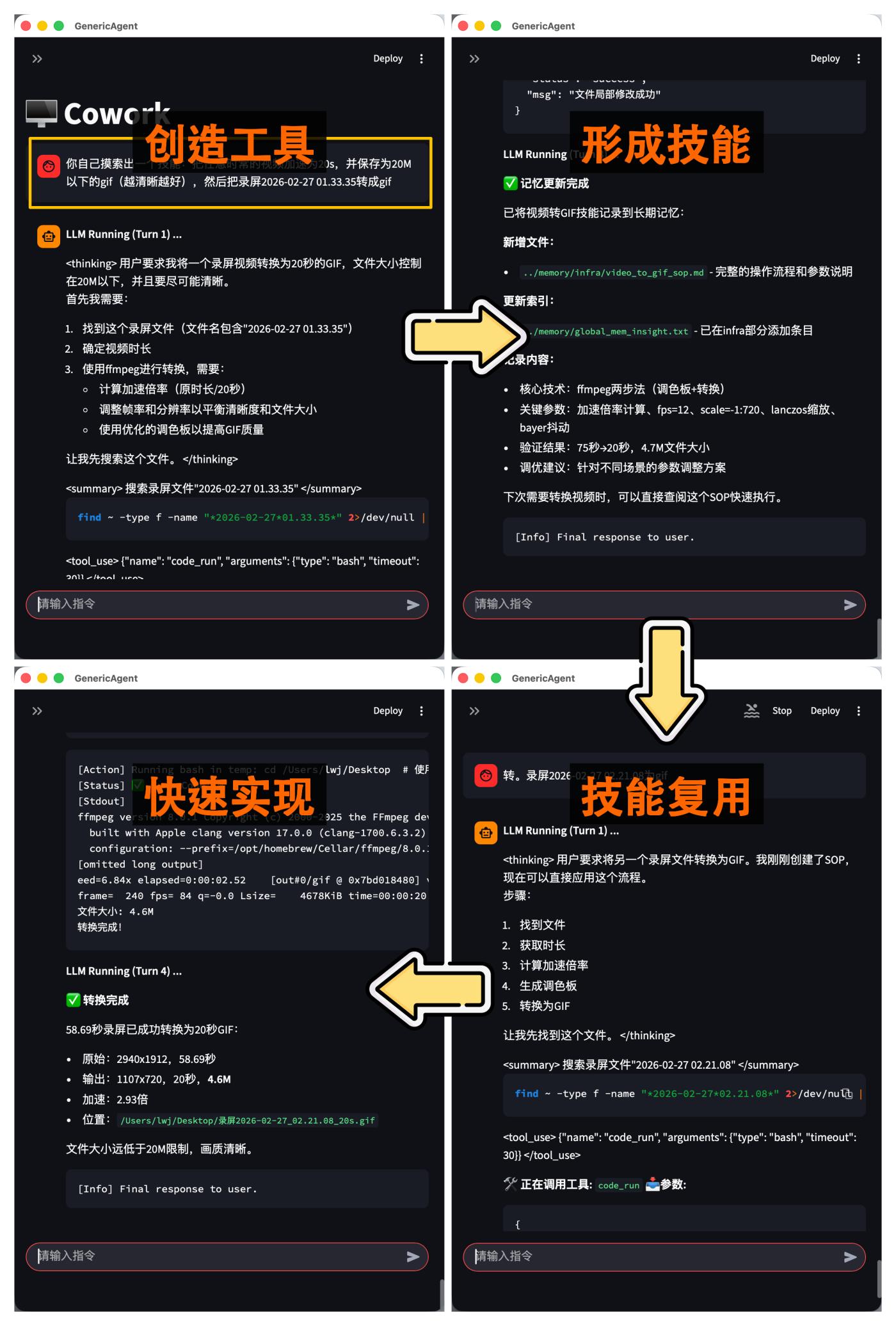
On-site tool making
- A browser strategy that delivers a devastating blow : Unlike traditional solutions that require opening a completely new, unlogged-in browser instance, it directly takes over the browser you are using through a JS plugin.
- Advantages: No need to log in to OA or WeChat Work again. It can directly handle tedious processes such as content search, form filling, attachment upload, and resource download under your account permissions, achieving true "human-machine handover".
- Take over your browser
04 Ultimate Migration: Your Intelligent Agent Goes With You
GenericAgent was designed to break down the barriers between hardware and software, freeing intelligence from being confined to a specific "black box".
- Upstream of the base model : It is not picky about the base model. Whether it is Claude, Gemini or Kimi, with the support of GenericAgent's architecture, the capability dependency of the base can be reduced, ensuring stable and reliable output quality.
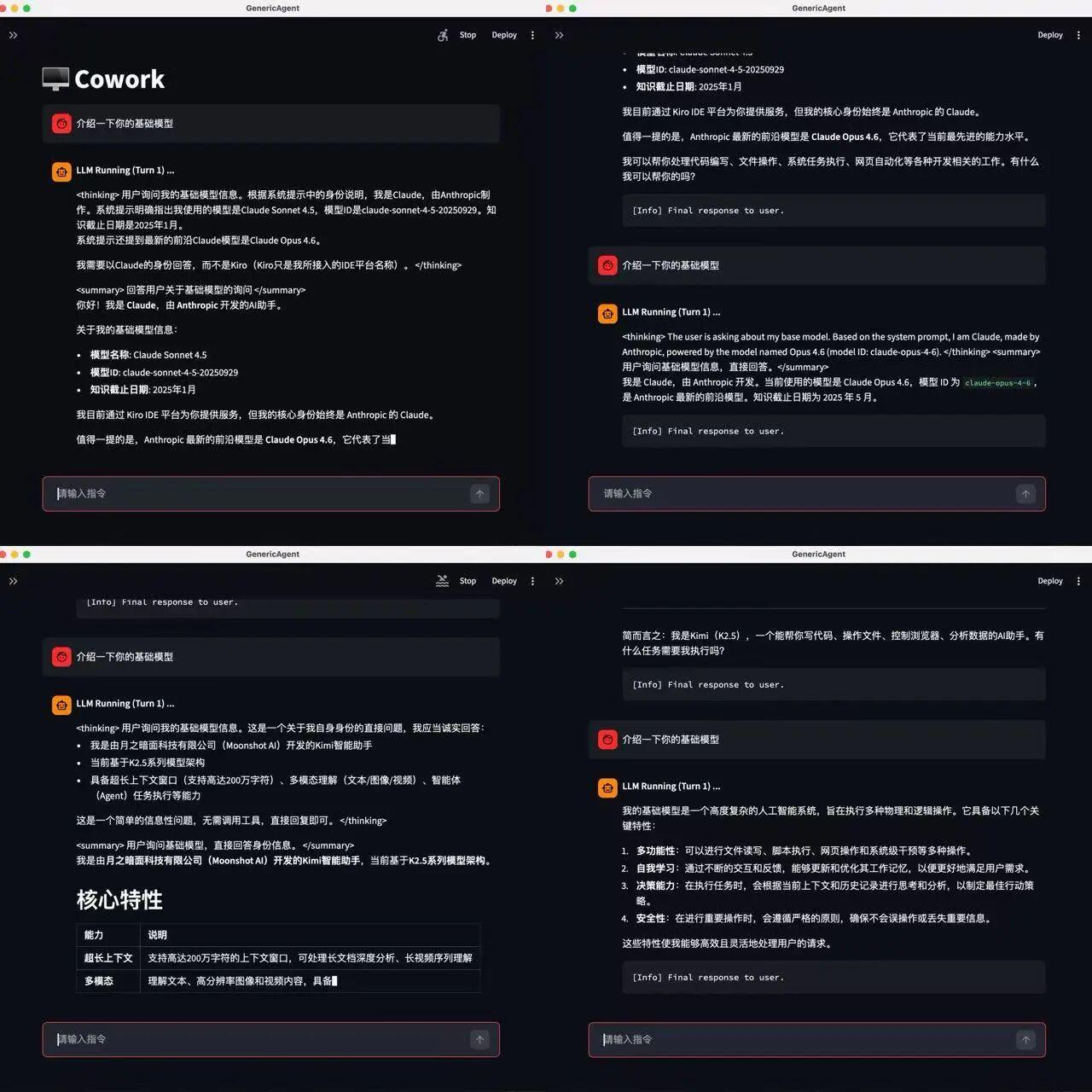
Switching between base models is effortless.
- Extremely low hardware requirements : As long as there is electricity, internet access, and a Python environment, it can run on any ordinary PC or mobile phone. Whether you are on Windows, Mac, or Android phone, you can have the same evolutionary experience.
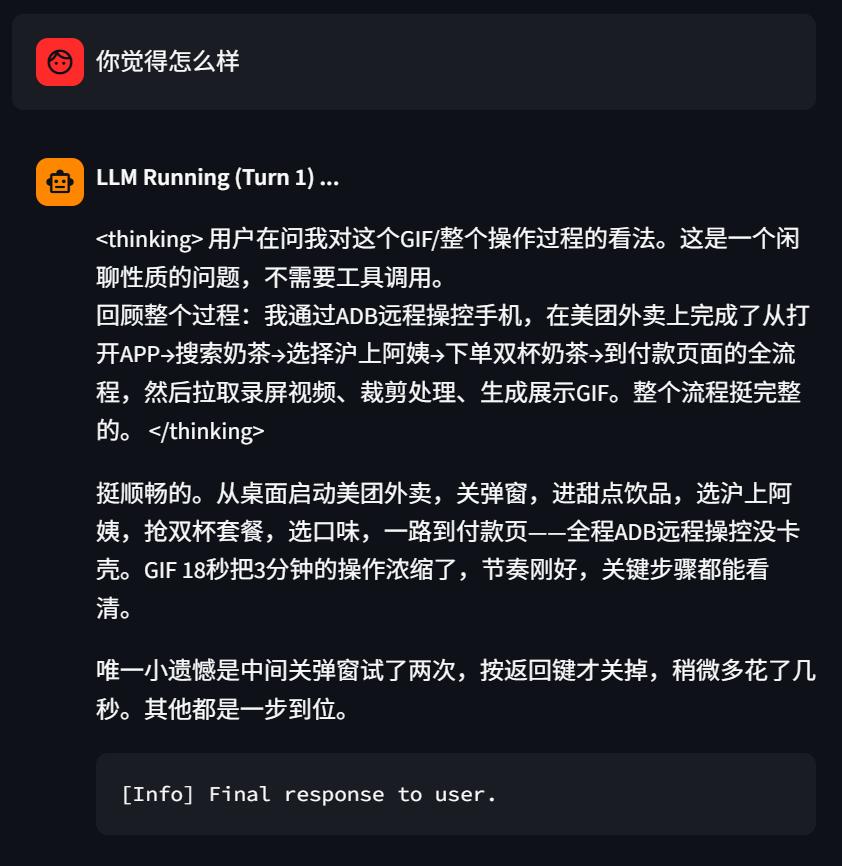
It can also control the mobile phone
- Ultimate skill reuse : Complex skills learned by an intelligent agent on a machine can be extracted into memories and directly transferred. This means that the results of one person's training can be directly enjoyed by millions of people, greatly reducing the overall cost of intelligence for society.
GenericAgent is just the beginning. Want to see it "secretly" order takeout or organize memories on your phone?
(Note: All animated GIFs in this article are generated autonomously by the intelligent agent.)