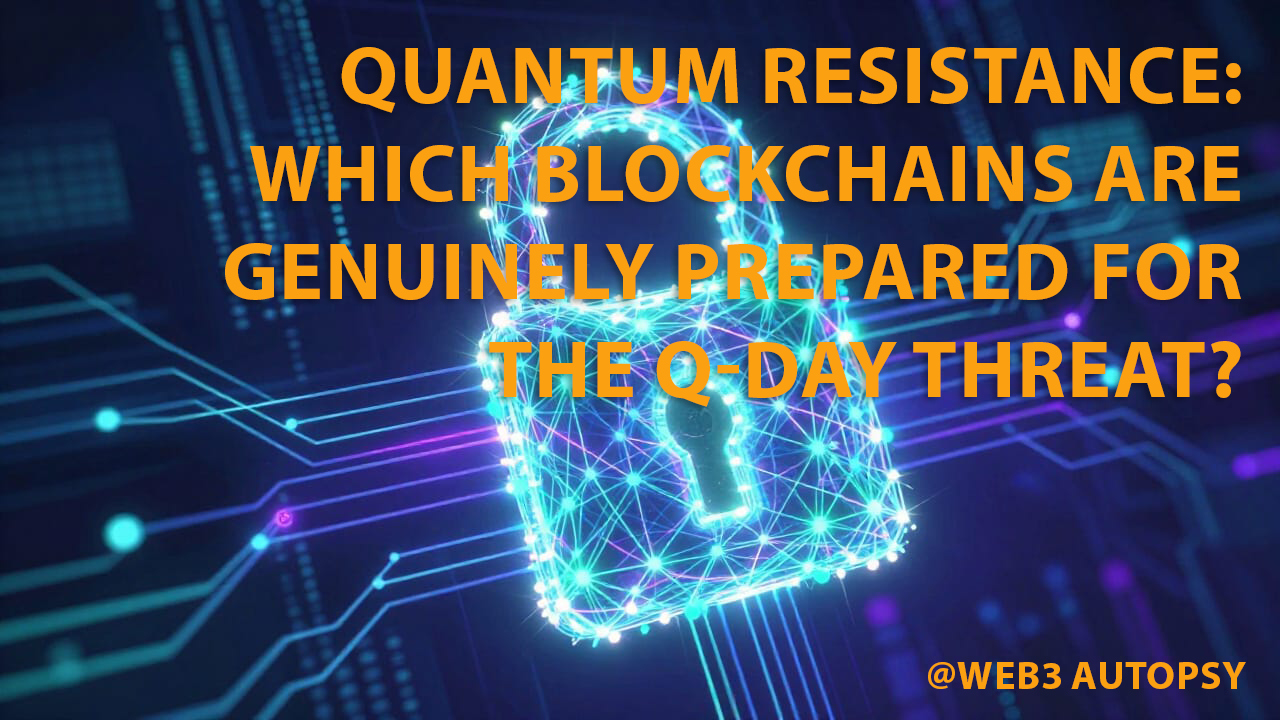
For years, the "Quantum Apocalypse" or Q-Day—the hypothetical moment when quantum computers become powerful enough to crack modern encryption—was a boogeyman for the distant future. But as we move through 2026, the timeline has compressed. With IBM and Google hitting new qubit milestones and fault-tolerant quantum computing becoming a reality, the blockchain industry is no longer asking ifit will happen, but who is ready.
Most of today’s digital world, including Bitcoin and Ethereum, relies on Elliptic Curve Cryptography (ECC). To a quantum computer running Shor’s Algorithm, ECC is less like a vault and more like a paper curtain. Here is a deep dive into the state of quantum preparedness across the blockchain landscape in 2026.
The Leaders: Blockchains Built for the StormWhile most networks are retrofitting their security, a few were born with quantum-resistant DNA or have already completed the transition.
1. The Quantum Resistant Ledger (QRL)QRL remains the gold standard for pure-play quantum security. Unlike other chains that use ECC by default, QRL has used the eXtended Merkle Signature Scheme (XMSS) since its genesis in 2018.
- The Tech: XMSS is a hash-based signature scheme that is NIST-approved and considered "future-proof" because its security doesn't rely on the difficulty of factoring large numbers.
- 2026 Update: QRL is currently rolling out Project Zond, an upgrade that introduces an Ethereum-compatible virtual machine (EVM) with SPHINCS+ signatures, allowing quantum-safe smart contracts.
2. AlgorandAlgorand has moved faster than almost any other "Top 20" chain to secure its history.
- The Tech: In late 2025, Algorand successfully executed the first post-quantum (PQ) transaction on a major mainnet using Falcon signatures.
- State Proofs: They utilize "State Proofs"—cryptographic snapshots of the chain's history—signed with quantum-resistant algorithms. This ensures that even if a quantum attacker eventually breaks the network's active consensus, they cannot rewrite the past.
The Giants: Ethereum’s 2026 "Quantum Leap"Ethereum is currently in the middle of a massive cryptographic overhaul. Vitalik Buterin’s updated roadmap for 2026-2030 highlights four major vulnerabilities: BLS signatures(consensus), KZG commitments (data availability), ECDSA (user wallets), and ZK-proofs.
Vulnerable ComponentProposed Quantum-Safe ReplacementUser Signatures (ECDSA) Hash-based signatures & STARKsValidator Signatures (BLS) Aggregated STARK-based signaturesData Availability (KZG) STARK-based commitmentsZK-SNARKs STARK-based Zero-Knowledge proofs
The Challenge: Quantum-resistant signatures are "bulkier." An ECDSA signature is tiny; a quantum-safe one can be 10x to 100x larger. Ethereum is testing EIP-8141, which aims to aggregate these signatures so gas fees don't skyrocket when the switch is flipped.
The "Wait and See" Group: Bitcoin and Cardano
BitcoinBitcoin’s preparation is more conservative. Approximately 25% to 33% of all BTC is currently stored in "p2pkh" addresses (older legacy addresses) where the public key is visible on the blockchain. These are "low-hanging fruit" for a quantum computer.
The Plan: There is no official hard fork scheduled. The consensus among Core developers is that Bitcoin can migrate via a Soft Fork to introduce "Quantum-Safe Taproot" addresses once NIST standards are finalized. However, "lost" coins in legacy addresses will likely be unrecoverable if Q-Day arrives before they are moved.
CardanoCardano’s approach is academic and deliberate. Their "Cardano Vision 2026" reports indicate heavy research into Ouroboros Leios, a consensus model designed to handle the massive data overhead required by post-quantum signatures without sacrificing the 10,000+ TPS goals.
The "Harvest Now, Decrypt Later" ProblemA critical point often missed is that Q-Day doesn't have to happen today to be a threat. State actors and hackers are currently engaging in "Harvest Now, Decrypt Later"attacks. They are intercepting and storing encrypted blockchain data today, waiting for the 2030s when they can use a quantum computer to "unlock" private keys from a decade ago.
For high-value "whale" wallets or institutional custody, being "quantum-ready" in 2028 might already be too late if your public keys are already exposed.
Summary: Who Is Truly Ready?
- For Absolute Security: QRL is the only production-grade chain that has been quantum-safe from Day 1.
- For Enterprise Speed: Algorand is leading the pack by integrating Falcon signatures into a high-throughput environment.
- For Smart Contracts: Ethereum is the most proactive "major" chain, with a clear 2026 roadmap to replace its entire cryptographic stack.