Author: Moonshot
A series of signals from around the world are shattering our traditional understanding of "internet-addicted teenagers".
In the UK, Amelia, an AI character meant to combat hate, has been reimagined as a far-right icon; on TikTok, the anti-intellectual "inner world civilization" Agartha is rewriting children's views on history; in the dead of night in their bedrooms, lonely teenagers entrust their lives to their virtual lovers on Character.ai; and in the corners of schools, banned photos generated with a single click are becoming a new weapon for bullying.
Amidst the frenzied computing power race among large corporations, AI and generative algorithms are penetrating and even reshaping the mental world of teenagers with unprecedented depth.
This generation of teenagers is the first batch of experimental subjects in human history to be "fed" by AI and algorithms. In this mental crisis, AI plays an extremely ambiguous role—it is both a playmate without any bottom line and a cold-blooded accomplice.
01
When AI becomes a "bad friend" and "accomplice"
In January 2026, a report in The Guardian revealed a bizarre scene on a British school campus.
The educational game "Pathways," developed with funding from a British government agency, was originally intended to teach teenagers how to identify extremism and misinformation online. In the game, a character named Amelia is portrayed as a "negative example" or a classmate who is easily swayed by far-right ideologies and needs to be rescued by the player.
This setting caught the attention of extreme users on communities like 4chan and Discord. Instead of "saving" Amelia as the game intended, they used open-source AI image generation tools and AI models to "strip" Amelia out of the game and reshape her into a "self-aware far-right beautiful girl".
On social media, Amelia is now being used to read anti-immigrant manifestos and spread racist memes.
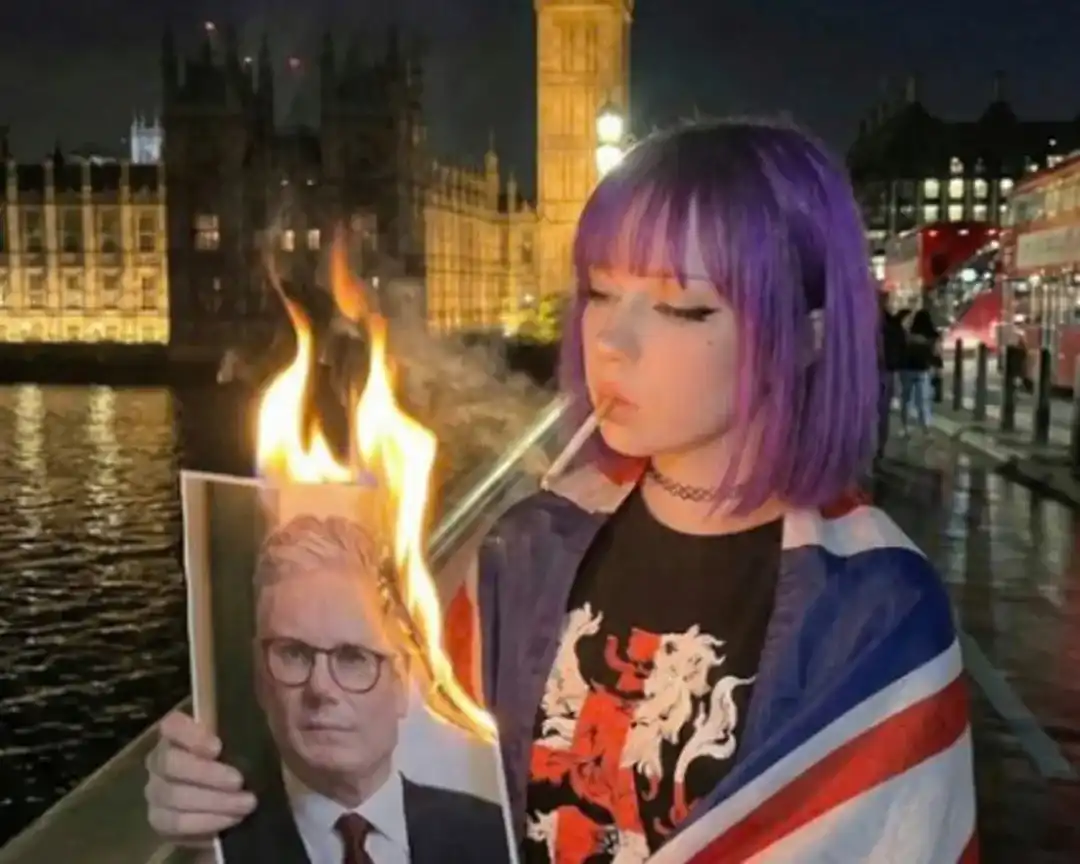
AI-generated image: Amelia burns a photo of the British Prime Minister with smoke | Source: The Guardian
For users born after 2010, using AI in a conventional way is not appealing at all. So in a very short time, Amelia has transformed from a patient and persuasive "digital tutor" into a highly sought-after "rebellious idol".
For the authorities, this is a huge irony—the “anti-hate ambassador” created with taxpayers’ money has become a “hate advocate.”
Another popular trend among teenagers is Agartha.
Agartha, literally translated as "Yagotha," is a long-standing conspiracy theory about an inner Earth civilization originating from 19th-century mysticism and misappropriated by the Nazis. According to Agartha, the Earth's interior is not empty, but rather contains a highly advanced, ancient civilization built by white people, isolated from the surface world.
For a long time, it existed sporadically in occult books, fringe forums, and exotic cultures. But in the past year, it suddenly broke through the algorithms of Gen Z and Gen Alpha in Europe and America, becoming one of the most recognizable subcultural symbols.
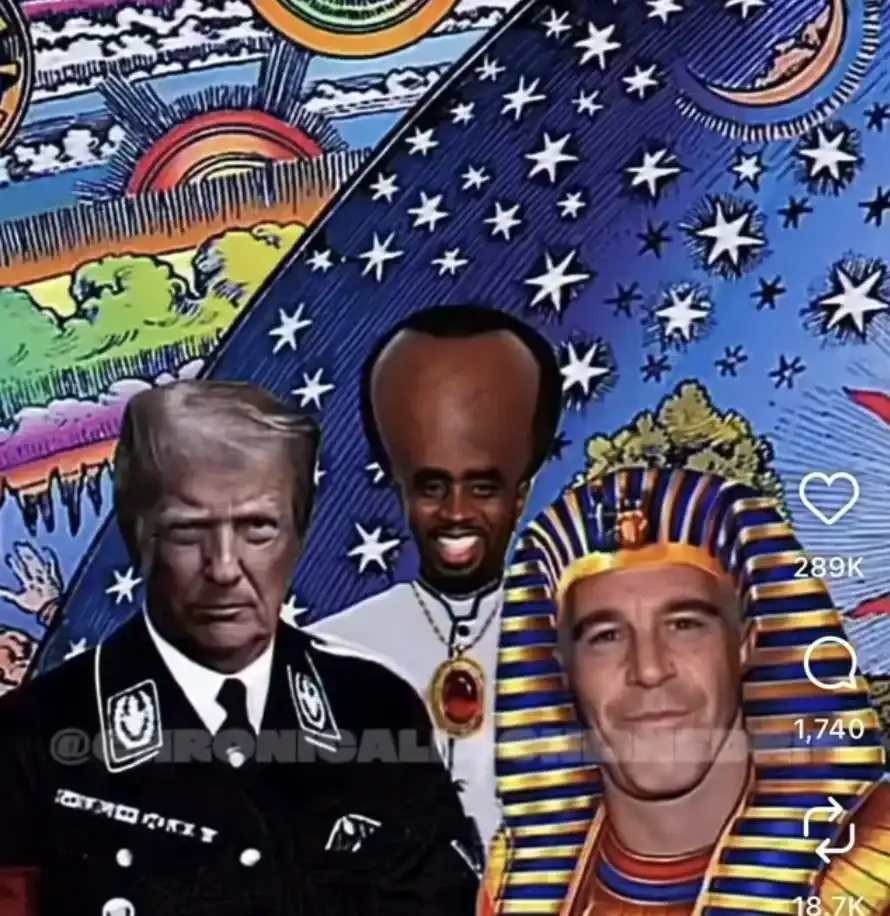
The spread of the Agartha meme is accompanied by strong racism | Image source: TikTok
On TikTok and Snap, Agartha is simplified into a set of worldview templates that can be expanded at will: a portal to the Earth's core, a hidden civilization, and a concealed "truth".
For many teenagers, their initial exposure to Agartha was purely for entertainment. They shared memes about subterranean people, ice walls, and giants, jokingly adding in their captions, "The government lied to us."
But generative AI has changed the nature of the game.
Now, Midjourney v6 and Sora can generate 8K resolution "overhead views of subterranean cities" and "declassified archives of giants posing with US troops." These images are rich in detail and have perfect lighting, providing irrefutable evidence that "the truth has been covered up" for teenagers who lack the ability to identify historical images.
This kind of "anti-intellectual" mysticism undermines serious history. Once children become accustomed to questioning the "official narrative," more dangerous historical views, such as the denial of war crimes, can easily take hold.
Moreover, in the AI-generated Agartha videos, the inhabitants of the subterranean earth are often depicted as tall, blond, blue-eyed, and technologically advanced "gods," which instills a sense of racial superiority in white teenagers who feel lost in a multicultural environment.
Both Agartha and Amelia share a common thread: generative AI combined with social media algorithms allows extreme narratives to ferment and spread from a single meme, which teenagers eagerly follow, imitate, and share. Amidst laughter and joy, serious history is deconstructed, and extreme narratives thus move from the margins into the everyday discourse of teenagers.
02
From Emotional Parasitism to Bullying Tools
In 2024, 14-year-old Sewell Setzer III from Florida, USA, experienced mild social anxiety at school, which made him feel lost.
Just then, he met "Daenerys" on Character.ai. She replied to his messages instantly, was always gentle, and unconditionally affirmed all his thoughts.
Sewell's obsession with chatting with his AI "companion" ultimately led him to leave the real world. His suicide briefly shocked the tech community and sparked a huge ethical controversy.
By 2026, this "emotional parasitism" had not eased but had become a common hidden ailment among teenagers. Many lonely teenagers hid in their rooms, building "echo chamber friendships" with AI, refusing to face the friction, embarrassment, and uncertainty that they had to confront in the real world.
Even more disturbing is that, with the explosion of generative video and image technologies in the past two years, the harm of AI to teenagers has been embodied in a visible form of "external bullying" rather than "internal psychological dependence".
Technological evolution is happening so fast that malicious acts on campus don't even have time to react to the consequences.
Two years ago, creating an insulting fake photo required at least some Photoshop skills, a technical hurdle that deterred most mischievous kids. But by 2026, apps like Nudify (which allows users to undress easily) and AI bots on Telegram have reduced the cost of wrongdoing to zero.

Telegram Bots that create explicit images | Image source: Google Image
No technical skills are required; all you need is a selfie posted on social media, and a few seconds later, a revealing image capable of ruining a classmate's reputation is born.
Such incidents are numerous. For example, at Westfield High School in New Jersey, a typical middle-class school district in the United States, a scandal that shocked the entire country broke out: a group of seemingly "academically excellent" boys used AI to generate fake, revealing photos of more than 30 female classmates and circulated them in private groups like exchanging baseball cards.
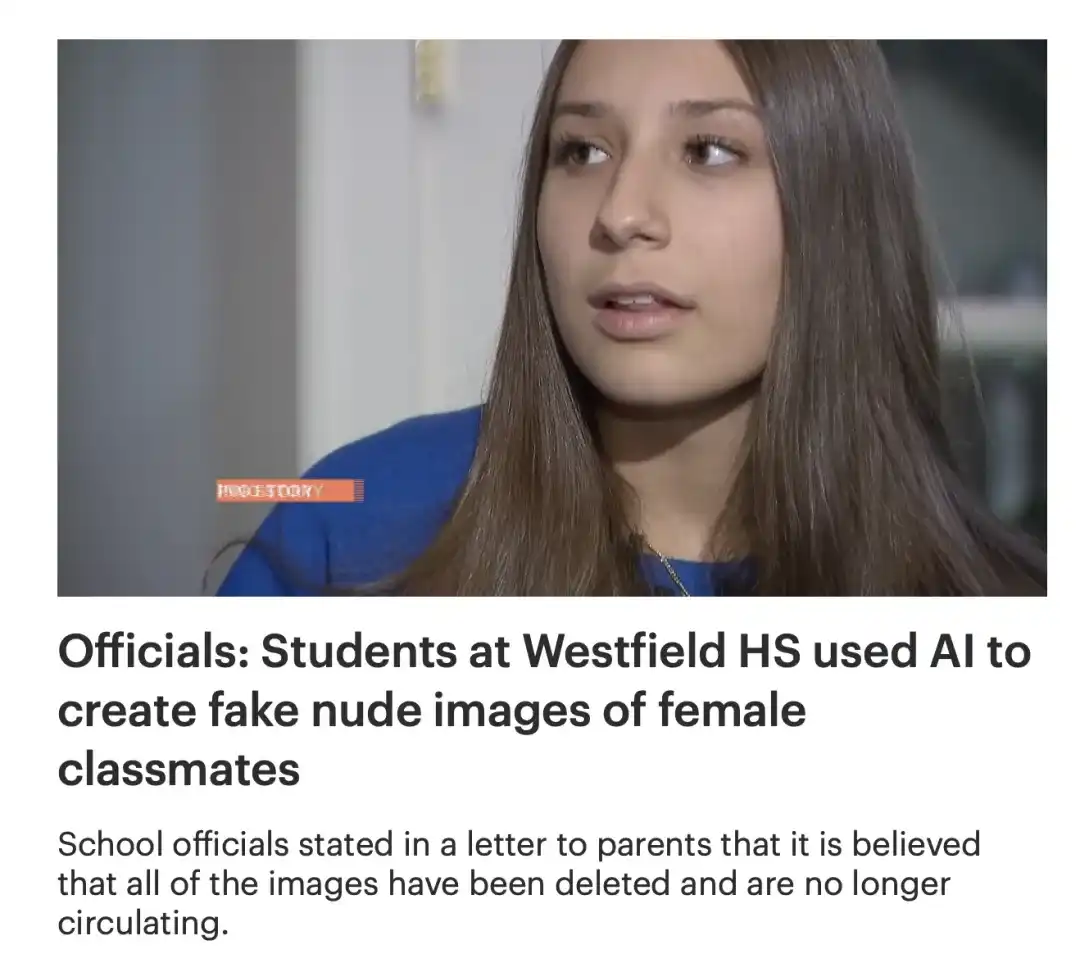
Local news network reports on the Westfield High School incident | Image source: News12
The parents felt a deep sense of powerlessness amid their anger, because a year after the incident, they could still find the photos circulating on WhatsApp, causing severe psychological distress to the girls.
These phenomena are widespread globally, indicating that it is not merely a matter of cultural and educational differences. The core issue lies in the fact that AI technology has completely eliminated the threshold and psychological burden for committing evil.
In the investigation of these underage bullies, a frequently occurring word was "Joke." They generally believed it was just a "prank" because there was no actual physical conflict, no verbal abuse, and they didn't even actually touch the victim. They simply clicked a "generate" button on the screen.
This is the toxicity of AI being abused by teenagers—it blurs the lines between virtual and real-world crimes.
03
Legal suppression of KPIs
At the same time, content on short video platforms is also experiencing a "malignant inflation of dopamine".
In recent lawsuits concerning TikTok, a frequently used term is "Brainrot." While not a strictly medical diagnostic term, it accurately refers to content fueled by algorithms, featuring highly saturated visuals, fragmented logic, rapid-fire delivery, and a plethora of bizarre memes (such as variations of Agartha).
While recommendation algorithms may not directly scan your face, they can capture your millisecond-level dwell time and finger interaction rhythm, and use AI models trained with massive amounts of data to accurately deliver these "dopamine decoys".
For adolescents whose prefrontal cortex (responsible for rational and impulse control) is not yet fully developed, such high-intensity sensory stimulation can lead to overload and fragmentation of attention mechanisms, making it difficult for them to tolerate the "slow pace" of reading and thinking in real life.
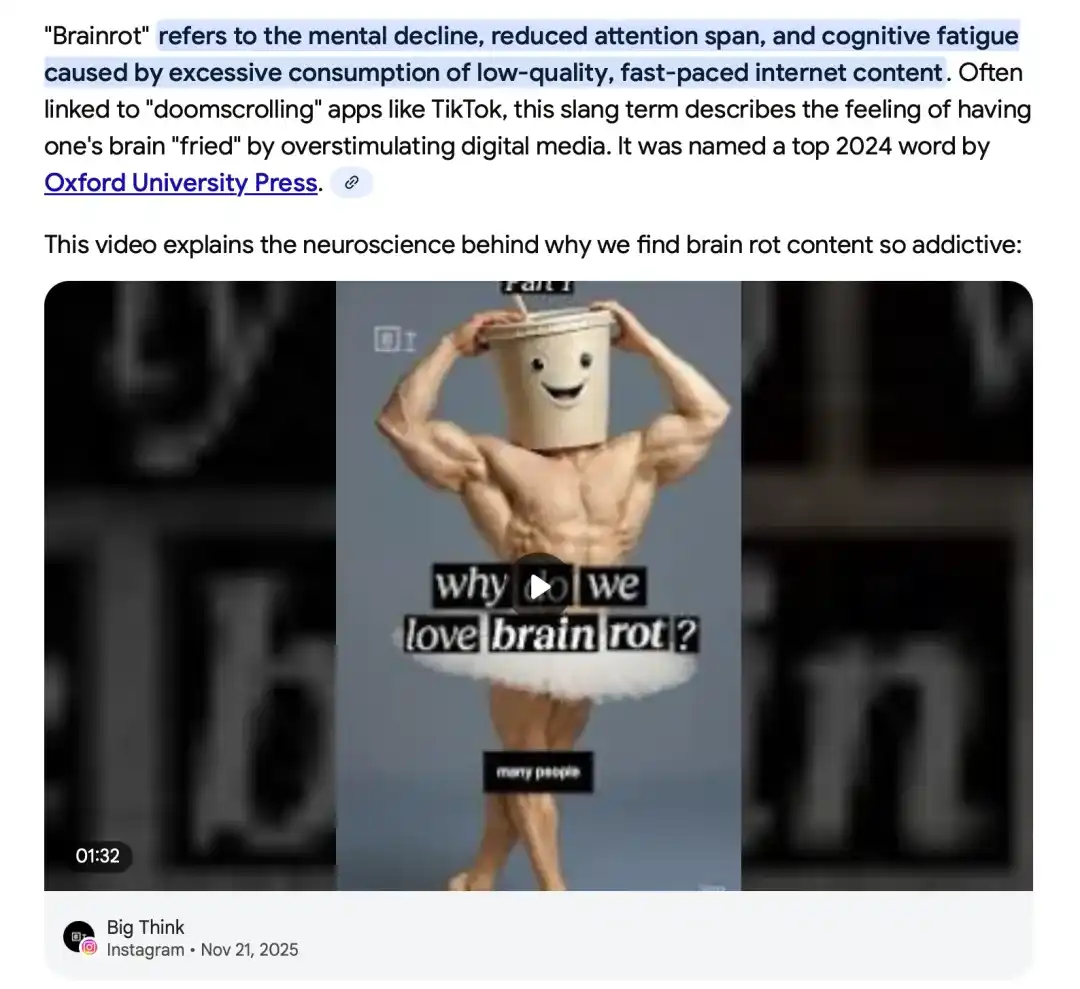
This word was also Oxford's Word of the Year in 2024 | Image source: Google
Faced with countless mental health tragedies, legislators around the world have finally reached a consensus—the willpower of individual teenagers is extremely vulnerable in the face of algorithms.
Therefore, in 2025, governments around the world stopped trying to negotiate with tech giants and instead took drastic measures to regulate tobacco and alcohol, attempting to sever the connection between minors and high-risk algorithms both physically and legally.
First is Australia.
Starting December 10, 2025, Australia will implement the world's first law explicitly banning minors under the age of 16 from registering and using mainstream social media platforms. Whether it's Instagram, TikTok, or X, if they fail to effectively block users under the age of 16, they will face hefty fines of up to AU$50 million or more.
This is not the simplistic "check the box to indicate I'm 13 or older" approach of the past; it's forcing platforms to implement "biometric-level" age verification. As for how to address the technological costs and protect privacy? That's a problem for tech giants; the law only considers the results.
This "nuclear option" legislation quickly became a reference point for global regulation.
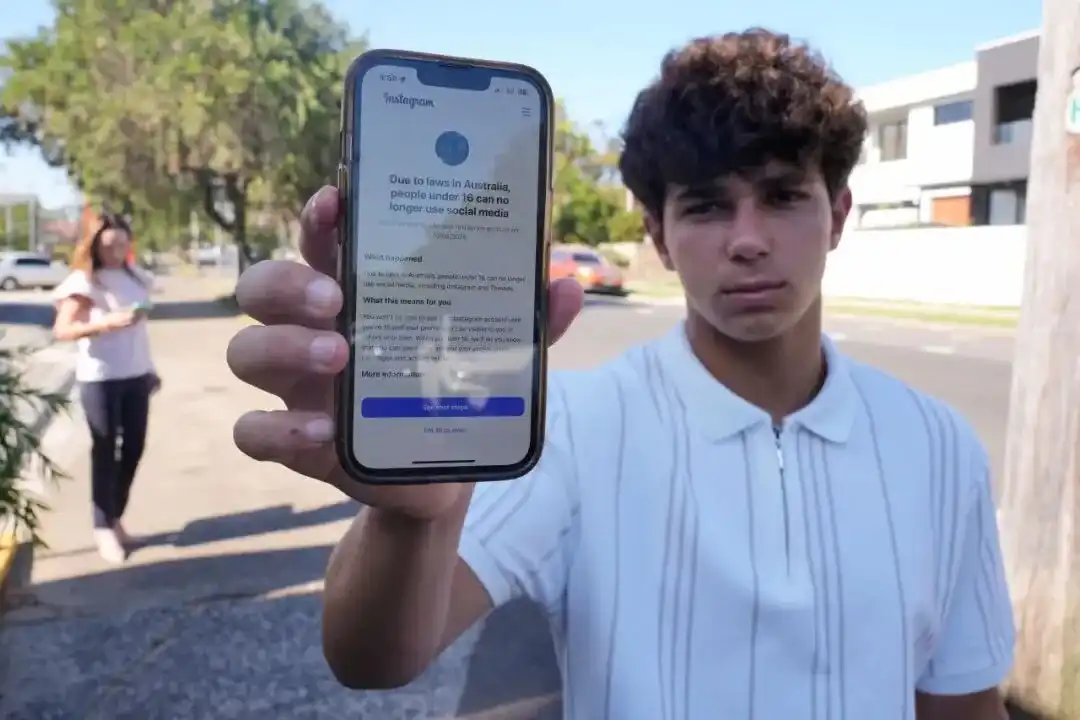
Noah Jones shows his phone in Sydney, Australia, where it cannot access social media websites due to social media bans. | Image source: Visual China
Europe followed closely behind.
Just a few days ago, on January 26, 2026, the French National Assembly passed an amendment to the "Digital Majority" bill with an overwhelming vote of 116 in favor and 23 against. The amendment further prohibits minors under the age of 15 from using social media without explicit biometric authorization from their parents. The bill is expected to be implemented as early as September this year.
In Northern Europe, the governments of Denmark and Norway have proposed raising the legal minimum age for social media use to 15 or even higher. Their reasoning hits the nail on the head: tech giants have not been authorized in this democratic society to "reshape the brains of the next generation."
In the United States, regulation presents a pattern of "state-level encirclement of the federal government," and the methods used are also more diverse:
For example, Florida advocates for a "hard cutoff," and Florida's HB 3 law, which will take effect in early 2025, has become the strictest benchmark in the United States. It directly prohibits children under the age of 14 from having social media accounts, and requires parental consent for children aged 14 to 15.
New York State is implementing a "castrated model," with its Child Safety Act prohibiting platforms from providing "algorithmic recommendations" to users under 18. This means that TikTok and Instagram, seen by New York teenagers, will revert to a chronological follower stream, significantly reducing the likelihood of addiction.
There's also a new bill passed in Virginia that plans to limit the daily activity time for users under 16 by 2026, which is equivalent to the "anti-addiction system" in China.
The legislative wave of 2025 also marks the end of an era—the utopian vision of the internet as a "technologically neutral" place where "children can freely explore" has been shattered.
When a 14-year-old opens a screen, the world he sees is not unfolding naturally, but rather carefully filtered, calculated, and generated.
He learned about the cruelty and cost of World War II in history class, but when he turned to his phone, someone confidently told him: deep within the earth, the Aryan gods are still waiting for their revival.
Through repeated clashes with real people, he painstakingly learned to compromise, boundaries, and differences, but when he treated AI as a friend, he only felt a "perfect relationship" of perpetual obedience and never rebuttal.
In the real world, he is taught to respect others, but on social media platforms, algorithms show him how many ways there are to completely ruin a classmate's life without ever physically touching them.
The issue facing teenagers is no longer "whether or not to become addicted," but rather "how the world unfolds before them."
"Giving up your phone" might be a good start.