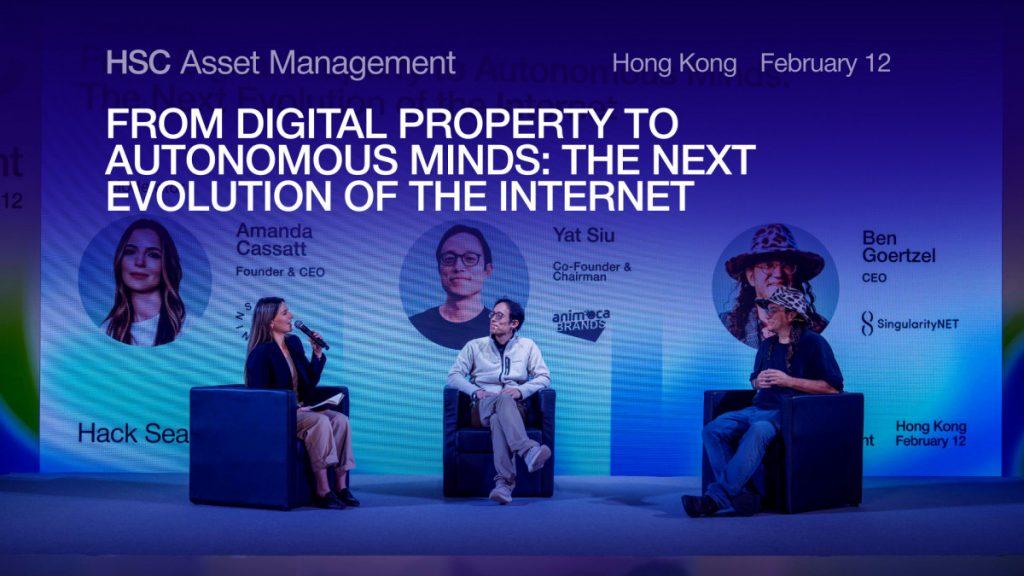
Amanda Cassatt of Serotonin appeared in a fireside chat organized by HSC Asset Management as Yat Siu of Animoca Brands and Ben Goertzel of SingularityNET tried to analyze the transition of the internet to becoming less of a digital property and more of autonomous AI-driven systems.
The essence of the latter is that digital ownership is the basis of Web3, which is a constant thesis of Siu. Assets cannot be traded, monetized, or significantly controlled without ownership. In his opinion, blockchain is neither a form of financial infrastructure nor a system of setting the rights to property in the digital environment. Finance can be a significant application, and ownership can facilitate a wider engagement in networks and economies as well as governance.
This principle is made more important when AI agents start trading without human intervention. In order to exchange value, AI systems need to connect to assets that are permissionless and sovereign and cannot be managed by centralized intermediaries.
Beneficial AGI and Decentralized Control
Goertzel packaged the argument as beneficial AGI. The modern AI market is characterized by big companies that are highly connected with the major governments. Although these entities are meant to provide convenient tools, data, and model control is centralized.
This he compared to open systems like Linux and the early internet, which were technologies that were developed collaboratively and had no single points of control. To him, AI may take the same route of decentralization. Blockchain makes it possible to have distributed governance, shared infrastructure, and systems to ensure that no single participant may monopolize the intelligence systems.
Instead of believing that humanity can ever have a lasting ability to regulate superintelligent AI, Goertzel suggested a more achievable objective of deploying it into the framework of decentralized, participatory ecosystems with varied human feedback.
Data Ownership and Agentic AI
One of the themes recurred in the form of data sovereignty. AI systems operate on data, although the majority of users give it to central platforms. According to the panelists, blockchain can provide the tools that enable individuals to own a thing but provide contributions to a mass intelligence, e.g., tokenization and zero-knowledge proofs.
Siu has accentuated the emergence of agentic AI: user-representing AI agents. Humans would not be using platforms to navigate, but instead, AI agents would retrieve information, transact business, and work with data streams. Under this type of model, the agent is employed by the user but not by the platform.
This change may rebrand the web itself. Old-fashioned browsing can be replaced by AI-mediated interactions in which decentralized infrastructure, token economies, and interoperable protocols run in the background.
Smarter AI as the Adoption Catalyst
Goertzen admitted that decentralization will not in itself be a motivating factor to adoption. In case decentralized AI is inferior to centralized counterparts, users will be performance-conscious. His research at SingularityNET is on integrating large language models, reasoning systems, and evolutionary algorithms to construct more adaptable artificial general intelligence.
According to the panel, the success will be based on value creation, whether via smarter AI or more equitable compensation frameworks. As an example, creators and machines can have their incentives aligned, where creators are rewarded through tokenized systems when their work is used in AI training.
The predictions were varied in a lightning round. Goertzel estimated AGI, or AI, doing all cognitive tasks better than the top humans, as soon as 2027. A more prudent 2037 timeline was given by Siu.
Although the time frames were different, both of them envisaged several competing AI systems as opposed to one dominant intelligence. They did not foresee the end of capitalism but its development, where other forms like universal basic equity would possibly be developed.
The post Decentralized Intelligence: How AI Agents And Web3 Are Reshaping The Internet appeared first on Metaverse Post.