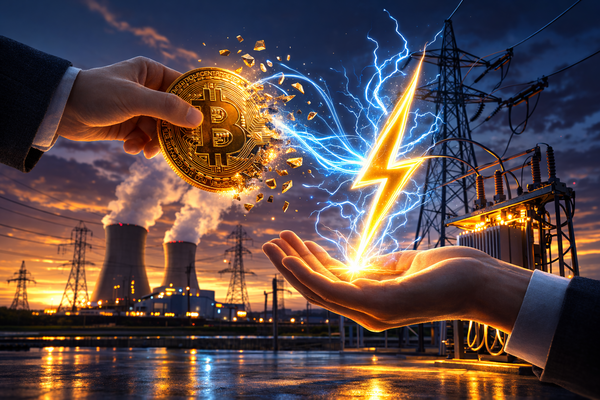
Leopold Aschenbrenner, a former OpenAI researcher and a "scary newcomer" in the artificial intelligence (AI) industry, is attracting market attention by pouring a staggering $1 billion (approximately 1.35 trillion won) into the Bitcoin mining industry. This investment goes beyond simple virtual asset investment and is interpreted as a strategic move to secure the "energy infrastructure" essential for AI computing.
According to recent Securities and Exchange Commission (SEC) filings, Situational Awareness, an investment firm run by Aschenbrenner, has invested a significant portion of its portfolio in Bitcoin mining companies. Key investments include mining companies such as Core Scientific, Iris Energy (IREN), and Cipher Mining, which are currently expanding into AI data center infrastructure.
Industry experts point to "electricity" and "grid access," rather than Bitcoin, as the key drivers behind this massive investment. The analysis suggests that mining companies, which already possess large-scale industrial power infrastructure, are being targeted as "AI hosting partners" to meet the exponentially increasing power demand as AI models become more sophisticated.
While it typically takes three to five years for AI companies to connect new data centers to the grid, existing Bitcoin mining farms already have multi-gigawatt (GW) power facilities and transmission connections, allowing for a relatively quick infrastructure transition.
The timing of the investment is also considered exquisite. With mining profitability under pressure following the 2024 Bitcoin halving, mining companies are rushing to shift their business to AI computing and high-performance computing (HPC) infrastructure. Core Scientific is pursuing a strategy of securing a long-term revenue base through AI data center hosting contracts, and several mining companies are considering similar business transformations.
Ultimately, Aschenbrenner's 1 trillion won bet is seen as an investment that reinterprets the virtual asset mining industry as an "energy supply hub" for the AI era. This demonstrates that blockchain infrastructure is gaining attention as a key asset that can compensate for the physical limitations of the AI industry. Furthermore, some observers believe that the future corporate value of mining companies will likely be determined not only by the size of their coin holdings but also by their "secured power infrastructure."