This "lobster," personally certified by Lei Jun, is not only a radical experiment by Xiaomi in the AI field, but also marks a new era in mobile AI, moving from "passive chatting" to "actively doing work."
Article author and source: Li Yuxia
On March 6th, an announcement on Xiaomi Technology's official Weibo account instantly drew the attention of the tech world—Xiaomi miclaw (nicknamed "Xiaomi Mobile Lobster"), the first mobile AI agent in China, officially began limited closed beta testing. This "lobster," personally endorsed by Lei Jun, is not only a radical experiment by Xiaomi in the AI field, but also marks a new era for mobile AI, moving from "passive chatting" to "actively working" at the system level.
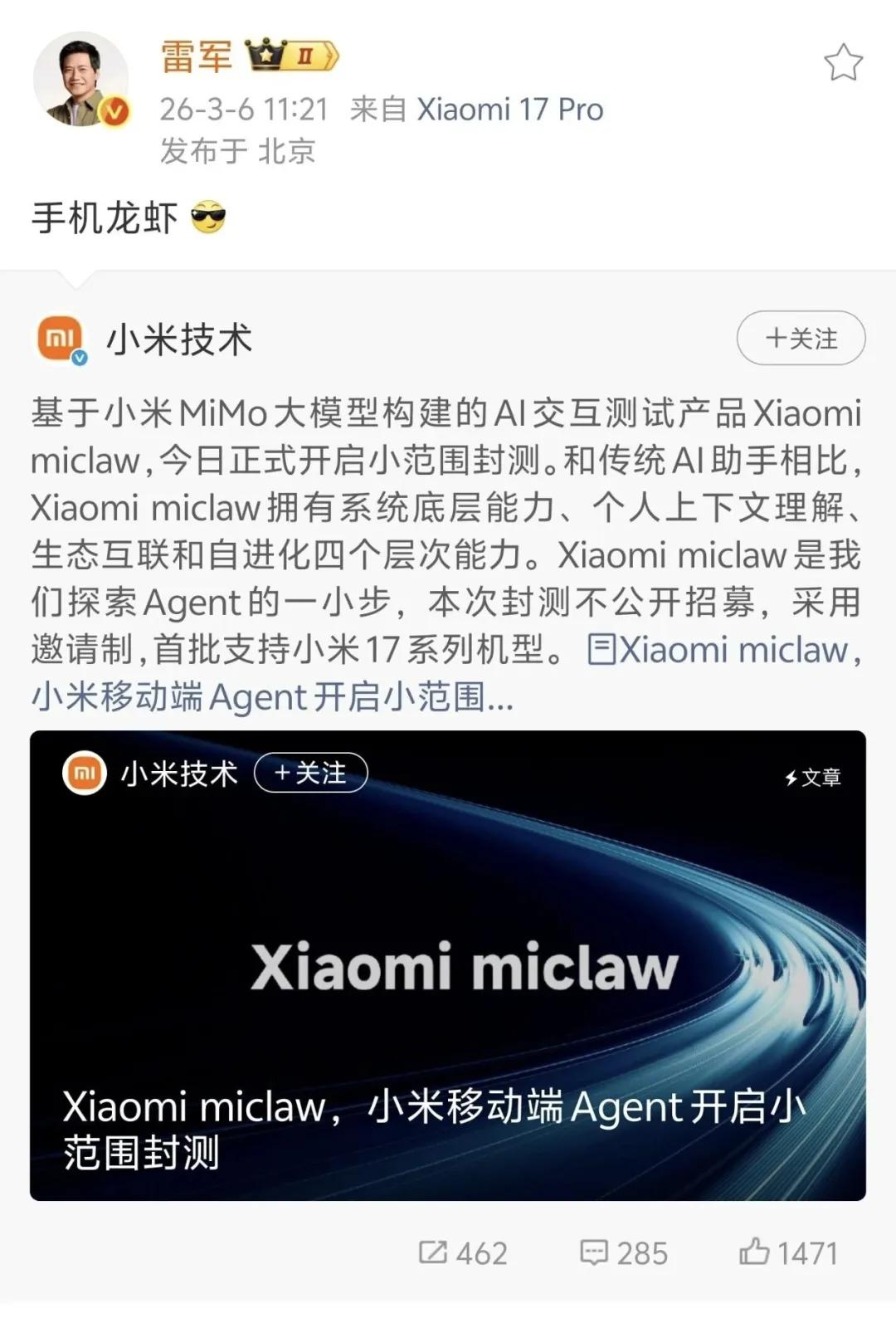
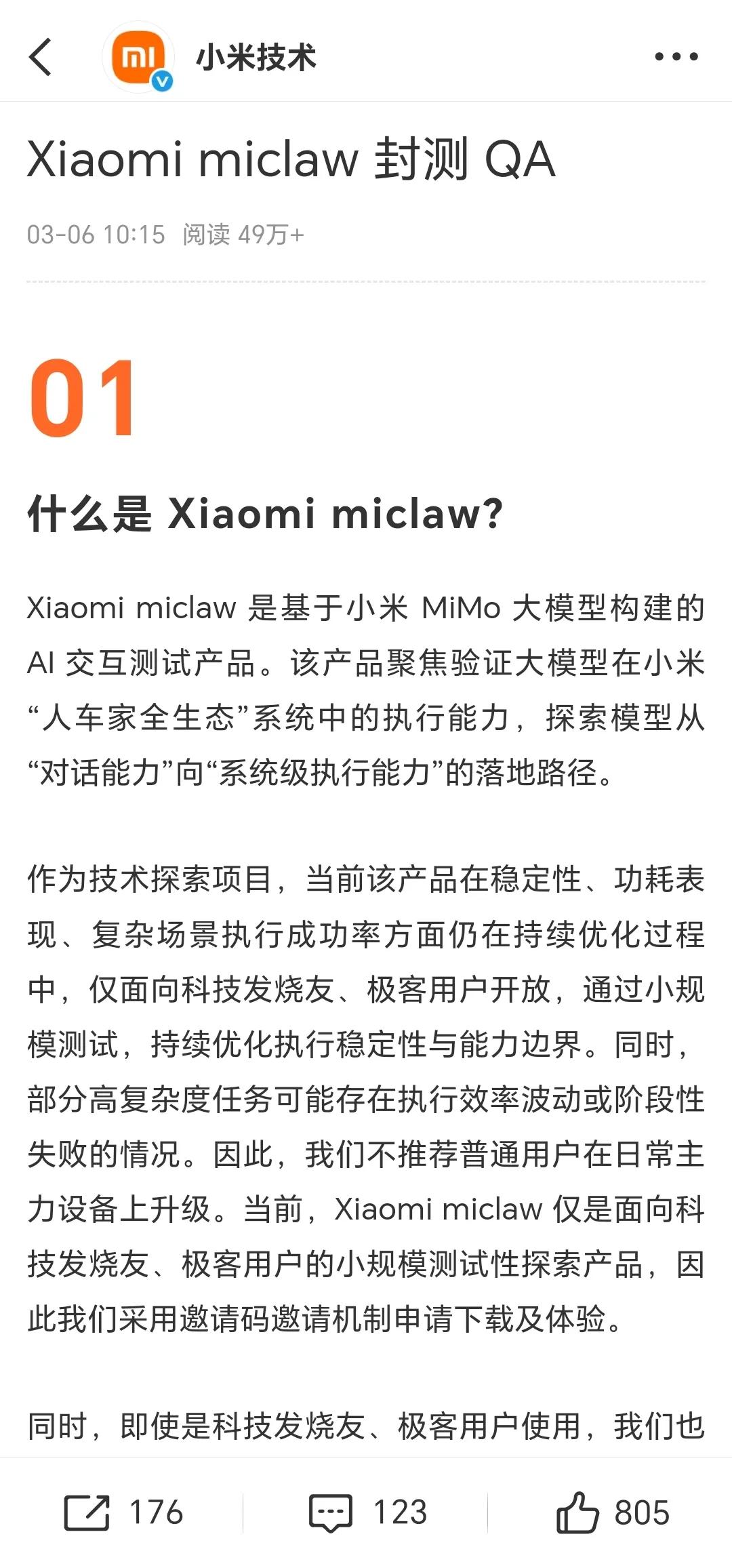
Break free from the confines of the "dialog box" and become the "central dispatcher" of your mobile phone.
For a long time, the AI assistants on our phones have been more like prisoners locked in a "sandbox." No matter how powerful the models are, they can mostly only operate within the scope of their own applications, with core permissions unavailable. This means that AI can only do things like answering questions and searching for information, and it is helpless when it comes to complex operations across applications.
The disruptive nature of Xiaomi miclaw lies in its operation as a system application, granting it access to the phone's core functionality. Built upon Xiaomi's self-developed MiMo big model, it possesses unprecedented low-level system permissions. This means it's no longer just a superficial plugin, but a "master scheduler" capable of delving into the system's core and invoking over 50 system-level tools. From reading and writing SMS messages and launching applications to scheduling system resources, it finally possesses genuine "hands-on capabilities," breaking the awkward situation of traditional AI being merely "theoretical."
From "following orders" to "proactively planning," becoming a "housekeeper" who understands you.
If the underlying permissions gave Xiaomi miclaw its "hands and feet," then the powerful reasoning capabilities of the MiMo big model gave it its "brain." Its most amazing feature is its ability to understand personal context, almost like "mind reading."
It's no longer a tool that requires you to give detailed instructions; instead, it's a concierge that understands your intentions and even anticipates your needs. When you receive a text message confirming a successful ticket purchase, it automatically links to your calendar, checks the weather, and calculates your commute time. It not only creates a business trip schedule for you but also thoughtfully reminds you to "remember to bring an umbrella." Even more commendable is its "memory"—even after performing 20 complex steps consecutively, it still remembers your initial goal and won't "forget what it's doing." It's like a constantly evolving partner, understanding you better the more you use it.
An "adventure" for geeks; ordinary users, please do not "cross the line".
Despite the immense potential shown by this "lobster," Lei Jun and the Xiaomi team have displayed remarkable restraint and caution. They repeatedly emphasized that the Xiaomi miclaw is currently a "cutting-edge exploratory product," open only to tech enthusiasts and geeks through an invitation-only testing program, and strongly discouraged ordinary users from upgrading their main devices.
This is not an exaggeration. As an exploratory project in the early stages of technology verification, it is still undergoing continuous optimization in terms of stability, power consumption, and success rate in complex scenarios. Some challenging tasks may experience fluctuations in execution efficiency or even failure. Lei Jun specifically reminded that even tech-savvy users participating in the testing should back up their data in advance and experience the technology in a controlled environment.
This "small steps, quick progress" strategy is precisely how tech giants demonstrate their responsibility to users. They need the most discerning users to "torture" this nascent AI, to test its boundaries, expose its flaws, and thus accelerate its evolution.
Conclusion
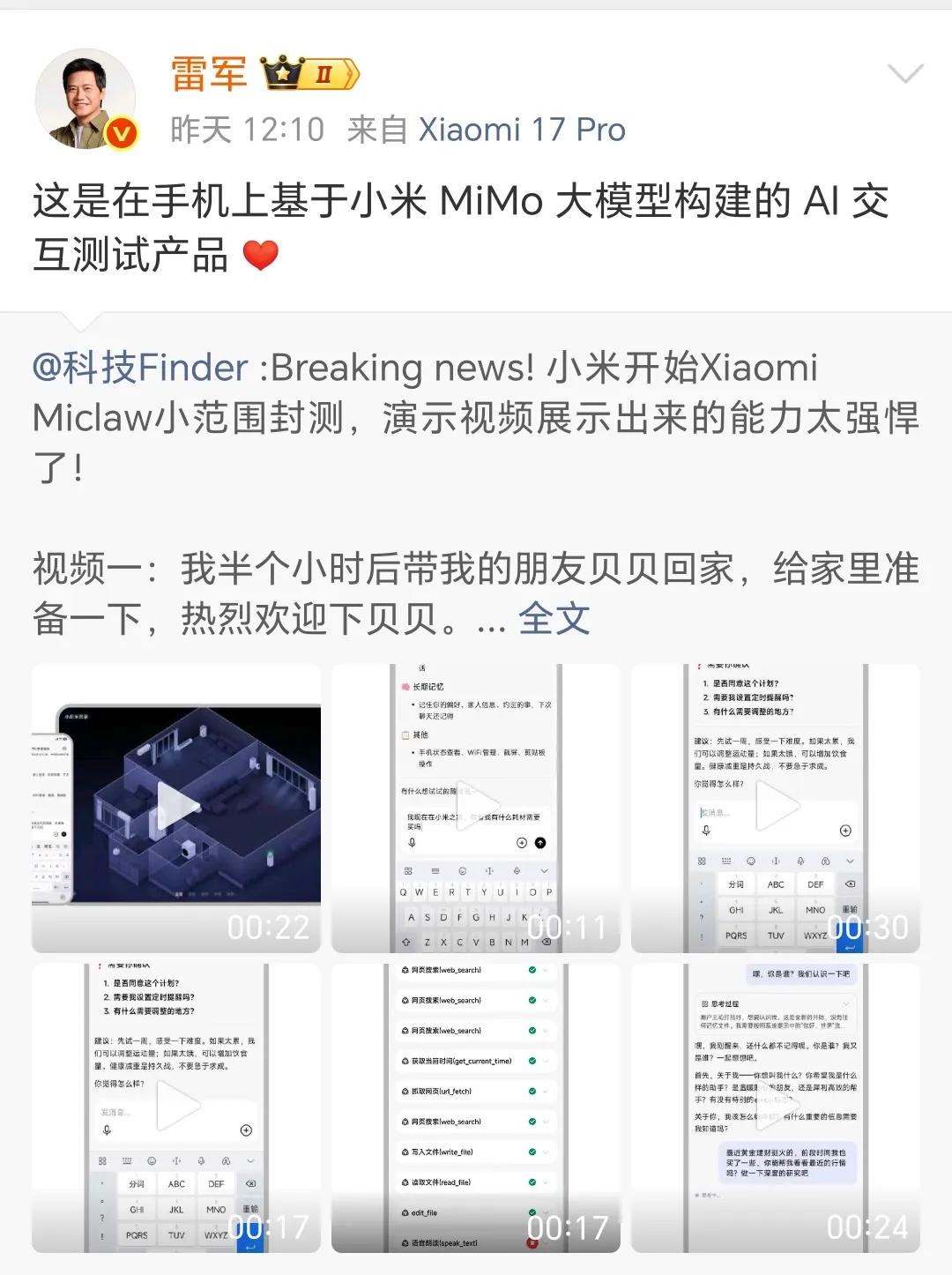
Source: Lei Jun's Weibo
The birth of Xiaomi miclaw is undoubtedly a significant milestone in the history of AI development in China. It not only fills the gap in the domestic mobile "lobster" app market, but more importantly, it paints an exciting picture of the future: AI is no longer cold, impersonal code, but a partner that understands you best, helps you with your worries, and makes your life easier.
The "lobster" that Lei Jun has nurtured may have a hard shell, even a bit rough to the touch, but its core points to an incredibly flexible future. The "agent era" of mobile AI has officially begun with the emergence of this lobster. And we are fortunate to be witnesses to this great transformation.