The AI management dilemma: wanting it all, wanting it all, and wanting it all.
Article author and source: LatePost
Lin Junyang's resignation triggered a series of follow-ups: several Alibaba executives held an emergency discussion overnight; the next day (March 4), Qwen held an all-staff meeting; yesterday morning (March 5), Wu Yongming sent an email to all Qwen employees, stating that he had approved Lin Junyang's resignation; yesterday afternoon, Lin Junyang returned to Alibaba's Beijing office and conducted one-on-one meetings with some team members.
LatePost has exclusively learned that in the early hours of March 4th, Alibaba's management team primarily discussed two issues: how to resolve the problems, and what impact Lin Junyang's departure would have on the company.
They reached a consensus: such behavior is unacceptable, and the company's organizational structure must be upheld.
As far as we know, Alibaba did not respond to Lin Junyang's resignation request when he posted his resignation status.
An Alibaba insider stated, "The rules are untouchable, and he is challenging the company's rules." Here, "rules" refers to the fact that at Alibaba, everyone is a company employee, promotions and demotions are decided by the company, and dissatisfaction can be addressed through normal communication, but one cannot publicly voice their grievances on social media without prior communication; such a precedent cannot be set.
Lin Junyang worked at Alibaba for seven years; this was his first job. His unexpected and sudden departure reflects a management challenge faced by every large company deeply involved in the AI competition.
On one hand, there is the pioneering spirit, super individuals, and extreme efficiency that drive the development of AI; on the other hand, there are the overall goals of a large company and the emphasis on business collaboration. The tension between the two has intensified at Alibaba at this time.
The 48 hours that Lin Junyang submitted his resignation were an unexpected turn of events for both Alibaba and himself.
"I am ashamed to lead everyone anymore." Lin Junyang sent this message in a DingTalk group with more than 100 Qwen members on the afternoon of March 3.
Less than 24 hours earlier, Lin Junyang was still continuing his daily activities as the head of Qwen and the "strongest open source evangelist": working overtime to release new Qwen models and technical reports, promoting the newly launched Qwen 3.5 mini-model series on social media in the early hours of the morning, and forwarding Musk's related comments.
A conversation on the afternoon of March 3rd changed Lin Junyang's trajectory. His sudden and strong desire to resign was likely an unexpected surprise even for him.
It is understood that on the afternoon of that day, Alibaba Cloud CTO Zhou Jingren and Lin Junyang held a video conference to convey the possible adjustments to Qwen. Alibaba traditionally conducts annual performance reviews and organizational restructuring at the end of March each year, and this communication was likely a prelude to changes a month later.
The proposed adjustment was to reorganize the Qwen team, transforming it from a vertically integrated system covering different training processes and modalities into separate horizontal teams for pre-training, post-training, text, image, and speech.
"Lin Junyang was already very emotional during the afternoon meeting," said a person close to the matter.
That afternoon, another event occurred. March 3rd happened to be the last working day for Yu Bowen, the former head of post-training at Qwen. At a "farewell party" convened by HR for the post-training team, the team learned for the first time that Zhou Hao, who would join Alibaba in January 2026, would be involved in managing Qwen's post-training team. Zhou Hao was previously a senior researcher at DeepMind and had led multi-step reinforcement learning for Gemini 3.0.
As far as we know, Lin Junyang was unaware that Zhou Hao had joined the company before this week. Zhou Hao reported to Zhou Jingren, the CTO of Alibaba Cloud and the head of Tongyi Lab.
According to an Alibaba representative, the reason why Zhou Hao's joining the Qwen team was not previously shared was because bringing in overseas talent is a sensitive matter and requires a high level of confidentiality.
Later that afternoon, shortly after Zhou Jingren and Lin Junyang communicated, Lin Junyang posted a message in the Qwen DingTalk group saying "I am ashamed to lead everyone anymore," indicating that he had no choice but to leave.
Up to this point, the entire incident was still within Alibaba. However, Lin Junyang's social media post in the early hours of March 4th directly announced his intention to leave the company to the outside world.
Thirteen hours later, at 1 PM on March 4th, Alibaba held an all-staff meeting for the Qwen team. Alibaba CEO Wu Yongming, CPO Jiang Fang, and Alibaba Cloud CTO Zhou Jingren attended. The team in Hangzhou participated in person, while the teams in Beijing and Shanghai participated via video conference.
"This meeting was originally intended for everyone, but it's been brought forward a little," said Alibaba CEO Wu Yongming. The all-hands meeting lasted about an hour and a half. At the beginning of the meeting, Wu Yongming reiterated that the group would fully support AI in its strategic plan, and then spent most of the time asking and answering questions from the team.
The core issues that Qwen team members are concerned about are:
Is there any room for maneuver regarding Lin Junyang's departure?
Jiang Fang said: The group will try to retain Lin Junyang. After several Qwen members expressed Lin Junyang's importance, Jiang Fang responded that we cannot idolize an individual, nor can we try to retain him irrationally or at any cost. She then asked the team: So what price do you expect to pay to retain Junyang? No one answered this question.
Will there be any team adjustments? Why wasn't Zhou Hao's joining announced beforehand?
Zhou Jingren responded that Zhou Hao's joining was not to replace anyone. The reason Zhou Hao's joining wasn't announced beforehand was because the team was busy training Qwen 3.5 at the time, so there was no prior communication.
Regarding the lack of resources for the Qwen team
Wu Yongming said that he is the most aggressive CEO in China in seeking computing power, and some issues may not have been reported to him in a timely manner.
The team also reported that Qwen 3's coding capabilities were poor, which was related to insufficient training environment and other resources, requiring CPU resources and infrastructure talent support. Zhou Jingren responded that the resource issues and inadequate infrastructure support had "historical reasons."
At the all-staff meeting, Wu Yongming also promised that he would hold meetings with the Qwen team or core Qwen personnel every two weeks to one month to promptly understand their needs or problems. Jiang Fang said that everyone could directly send private messages to Wu Yongming, Jiang Fang, and Zhou Jingren on DingTalk to provide feedback.
At 2 p.m. that day, Lin Junyang posted on his WeChat Moments: "Qwen's brothers, continue as originally planned, no problem."
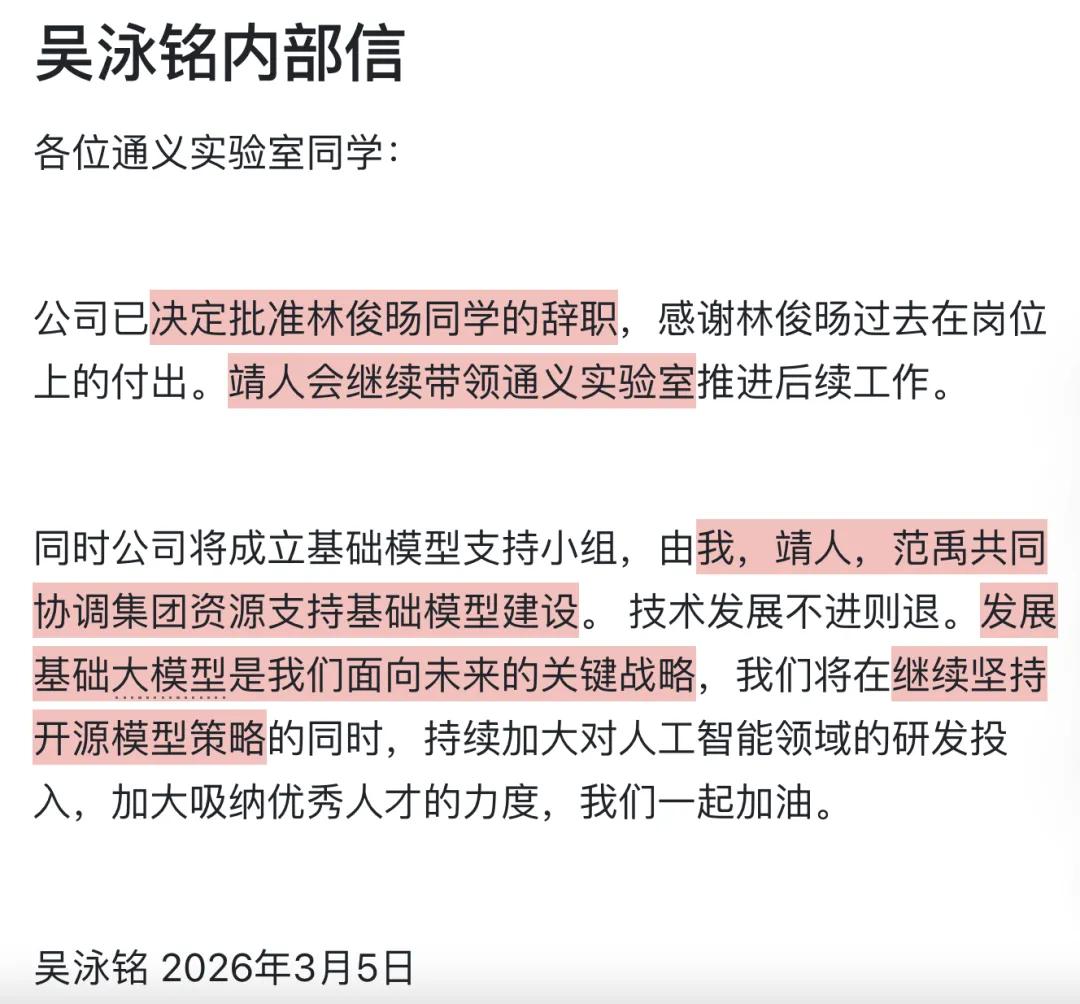
On the morning of March 5th, the day after the all-hands meeting, Wu Yongming sent an email to all Qwen employees, stating that he had accepted Lin Junyang's departure. The email also mentioned that Alibaba would continue to adhere to its open-source model strategy; Zhou Jingren would continue to lead the Tongyi Lab; and Wu Yongming, Zhou Jingren, and Alibaba Group CTO Wu Zeming (Fan Yu) would jointly coordinate group resources to support the construction of basic models.
Lin Chun-yang's departure has triggered a series of external reactions. Google DeepMind's head of developer experience invited Qwen members to join on social media: "If you want to find a new home for building good models and contributing to the open-source community."
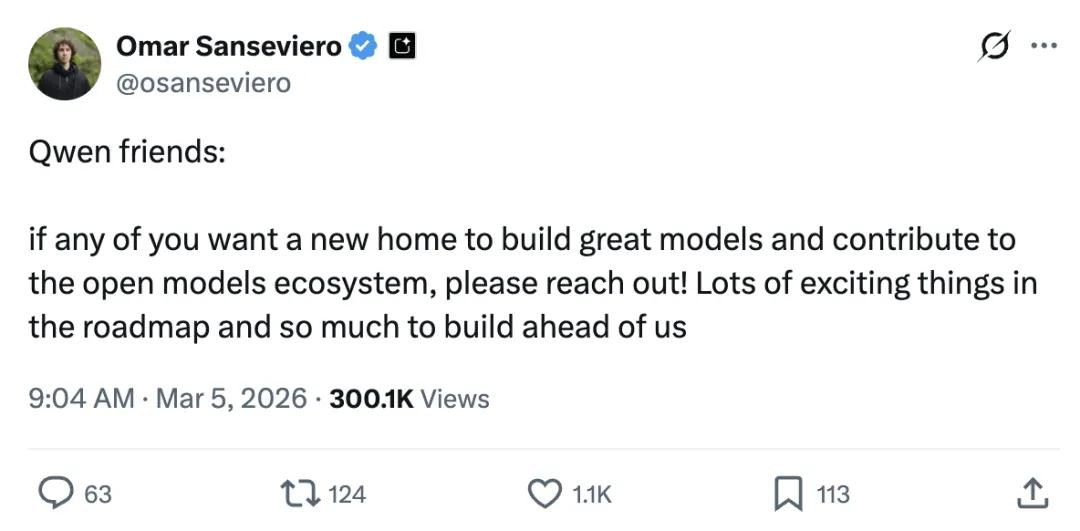
Omar Sanseviero previously worked at Hugging Face and is currently the Head of Developer Experience at Google DeepMind.
Other companies' recruiters stayed up all night the night Lin Junyang announced his resignation, sending job offers to every Qwen team member they knew; a headhunter wanted to contact Lin Junyang and listed specific companies that had openings for him.
Many investors are seeking contact information for Qwen's core personnel, believing that more departures may occur and some may start their own businesses.
When small teams begin to take on larger organizational goals
Since 2023, AI has become a strategic priority for Alibaba. Wu Yongming, the newly appointed CEO, mentioned AI 40 times during his first earnings call as CEO in November of that year. At one point, multiple teams within the Alibaba Group were experimenting with AI; for example, Taotian once had 20 AI teams. From the end of 2022 to the beginning of 2023, most teams at DAMO Academy were reorganized into Tongyi Labs, also aiming to integrate various resources for AI development.
Within this broader context, Qwen is a relatively independent small team that originated from the M6 project of the DAMO Academy's Intelligent Computing Lab before this wave of AI hype. At that time, Zhou Jingren was the head of the Intelligent Computing Lab, while Lin Junyang, who joined Alibaba in 2019, was the first author of the large model M6 released in March 2021.
By early 2023, the M6 team and the NLP team, both at Tongyi Lab, were working on large-scale models for horse racing, each with approximately 500-1000 GPUs of computing power at the start. In the middle of the same year, Tongyi Lab, primarily composed of the M6 team, consolidated its personnel and computing resources. Qwen's core members before this change—Lin Junyang, Liu Dayiheng, Yu Bowen, and Hui Binyuan—formed a new team at this time, with Liu Dayiheng, Yu Bowen, and Hui Binyuan originally working on the NLP team.
As the overall head of the Tongyi Laboratory, Zhou Jingren gave the Qwen team relatively independent space. Several people who had worked at Qwen told us, "We are grateful to Jingren for giving us room to fully utilize our abilities."
At the same time, both Wu Yongming and Zhou Jingren support the Qwen team's open-source idea. This is a major strategic decision that must be approved from top to bottom.
Qwen currently has over 100 members, while the entire Tongyi Lab has over 600 people. The Seed ByteDance model development team currently has over 1,500 people.
On the other hand, while relatively independent, Alibaba Cloud and the Alibaba Group's overall AI strategy did not rely entirely on self-developed basic models. Alibaba's approach at the time was to build AI infrastructure: providing AI cloud, MaaS (Model as a Service) services, and building an ecosystem such as the Magic Model community.
Alibaba has invested in several large model companies in China, providing them with computing power. This has sparked some discontent within the team: computing power is so precious, why supply it in large quantities to external entities?
In mid-2024, ByteDance made a clear decision not to invest in any large-scale model startups, but to concentrate resources on the Seed team to develop its own large-scale model Doubao and support ByteDance's own AI products such as Doubao.
When resources are relatively limited but space is sufficient, team capabilities and drive become key variables. Both of Qwen's leaders, Zhou Chang and Lin Junyang, have a "self-driven, high-intensity work ethic."
Since 2024, the global influence of Alibaba's open-source Qwen series of large models has continued to grow. In October of that year, the number of its derivative models reached more than 80,000, surpassing the earlier open-source Meta Llama series.
Qwen is favored by small and medium-sized startups and research institutions due to its wide range of sizes. Many well-known companies, such as Cursor, use Qwen models for fine-tuning and post-training. Qwen's multimodal open-source series is also the base model chosen by many Chinese embodied intelligence companies. DeepSeek and ByteDance also use Qwen's small-sized models in some research projects.
Zhou Jingren will become an Alibaba partner in 2025, entering Alibaba's highest collective decision-making body; Lin Junyang will become Alibaba's youngest P10-level executive in 2025. Alibaba's management believes that Tongyi Labs has worked hard to maintain the leading position of the Qwen model, "which is no easy feat."
But also in 2025, Qwen, with its greater influence, began to carry more expectations, and the original goals of the small team began to diverge from the overall AI strategy of Alibaba Group.
Alibaba Group is eyeing the commercial growth of AI cloud and the increasingly fierce battle for position among AI super apps in the second half of 2025.
From 2024 to 2025, Alibaba Cloud’s revenue growth rate continued to increase, but the synergy with the base model was not direct: the growth mainly came from the computing power procurement of several large model companies invested by Alibaba, and the cloud service consumption driven by more industry AI applications.
In September 2025, Alibaba Group decided to prioritize the development of the Qianwen App, requiring closer collaboration between the foundational model team and the application team. We understand that the Qwen team did not prioritize supporting the Qianwen App. Furthermore, the Intelligent Information Business Group, responsible for the Qianwen App, also has its own model research team. Some Alibaba insiders believe that the Qwen team's support for other cloud businesses and the Qianwen App is insufficient.
Qwen hopes to continuously train stronger and more efficient models.
Qwen has expanded beyond language to include more modalities, in line with the trend of native hybrid multimodal technology, and has successively released Qwen-image and Qwen-audio. This overlaps with Tongyi Wanxiang (which mainly long generation) and Bailing (which mainly focuses on speech models), both belonging to Tongyi Labs.
Starting in mid-2025, Qwen also began recruiting infrastructure talent. A Qwen team member stated that when Qwen was training a large-scale version of its new generation core model, it found that the Alibaba Cloud PAI team was struggling to provide sufficient infrastructure support. This put the PAI team, which generated revenue for Alibaba Cloud, in an awkward position; if internal businesses didn't use them, it would be even more difficult to prove their capabilities in a highly competitive market.
Meanwhile, the training process for the Qwen 3 series and Qwen 3.5 series released since 2025 has encountered setbacks, with some core capability indicators not being outstanding.
The Qwen 3.5 Max (the largest flagship version in every generation of Qwen), which was originally planned to be released before the holiday, was not ready. The Qwen 3.5 Plus model, which was open-sourced on New Year's Eve, was also regarded as a "half-finished product" by an Alibaba executive.
The small team's independent spirit and pursuit of technological leadership, coupled with the group's expectation of more strategic achievements, the escalating external competitive environment, the current setbacks in model training, and the unexpected personnel upheaval that has stirred up a storm at this moment.
Lin Junyang: An "Atypical" Large Model Team Leader
Among the heads of basic modeling teams at several large Chinese companies, Lin Junyang is a unique figure. He is not a typical "formally trained" professional: his undergraduate degree was in humanities, and his master's degree was in a more technical interdisciplinary field.
Lin Junyang's master's supervisor, Su Qi, an associate professor at the School of Foreign Languages at Peking University, once commented on him: "Students in the humanities and social sciences can also engage in, and do very well in, interdisciplinary research."
Lin Junyang was born in 1993. He studied English Literature at the School of International Relations for his undergraduate degree, while also learning Japanese, Russian, German and French. He was known by his classmates as a "multilingual academic genius".
During his undergraduate studies, he served as the head of the Model United Nations conference for the International Relations program. In an interview with the campus media at the time, he said that his core principle in leading the club was that "the idea is the most important thing," regardless of what the members were responsible for. He also regarded the compact design of the event venue as a unique feature, believing that it would facilitate communication between Model UN teams, improve collaboration efficiency, and reduce unnecessary labor.
After graduating with his bachelor's degree, Lin Junyang was admitted to the School of Foreign Languages at Peking University, where he pursued a master's degree in computational linguistics under the supervision of Su Qi and Sun Xu, an associate professor at the Institute of Computational Linguistics at Peking University. During his graduate studies, he published a total of 11 papers as first author or co-first author and also served as the head of a research project.
Computational linguistics uses computable methods to model language structure and language usage. It requires researchers to understand language itself, as well as master algorithms, data, and modeling skills. In the era of large language models, this field has become a significant source of research talent. When we analyzed the resumes of dozens of researchers at DeepSeek in early 2025, we found that eight of them came from the Institute of Computational Linguistics at Peking University.
After graduating with a master's degree in 2019, Lin Junyang joined Alibaba DAMO Academy, which had only been established for two years, as a senior algorithm engineer, researching natural language processing. At that time, the large-scale model technology roadmap was rapidly taking shape: the Transformer architecture had been proposed for two years, and OpenAI's GPT series models were beginning to demonstrate capabilities beyond expectations.
A year later, two teams within DAMO Academy began researching large language models. One was the AliceMind project, led by senior natural language processing expert Huang Fei; the other was the M6 project, involving Yang Hongxia, Zhou Chang, Lin Junyang, and others, which reported to Zhou Jingren. Ultimately, M6 demonstrated superior performance and became the foundation for the Qwen series models in Tongyi Labs.
Yang Hongxia left Alibaba DAMO Academy in 2022. After the establishment of Tongyi Lab, Lin Junyang was responsible for the open-source work of the Qwen model, reporting to Zhou Chang. It was during this period that he gradually shifted from a role more focused on research and internal collaboration to one that was more visible to the outside world. He began to frequently appear on social media both at home and abroad, promoting the Qwen series of models, explaining model updates, responding to developer feedback, and driving community awareness.
As the Qwen series of models continued to improve and its influence expanded, and as Lin Junyang took over a more central position after Zhou Chang's departure, he gradually became a vibrant and persuasive promoter of Qwen in the technical community.
"He's not the kind of person who's bitter and resentful," said a person close to Lin Junyang. Several large model researchers from different companies have used this word to describe their department heads to us.
The aforementioned person told us that, given the limited resources, Lin Junyang believes the primary task is not to pursue perfection, but to ensure that things can be implemented, to get results first, and then to talk about optimization and iteration.
He doesn't believe that the person in charge must be proficient in every detail of software programming; in his view, what's more important is understanding the underlying "physical logic"—knowing why things work the way they do and knowing how to prioritize.
For this reason, Lin Junyang prefers to set clear "targets" so that a team can do as much as possible and minimize uncertainty, "so that the team does not 'fall into nothingness'."
The AI management dilemma of wanting more, wanting more, and wanting more.
The company emphasizes organization, processes, collective goals, and strategic execution capabilities that allow it to target specific objectives; while frontline AI researchers are among the smartest, most self-driven, creative, and ambitious individuals of our time.
To what extent should a company tolerate individual will? Should AI R&D teams build their own full-stack closed loop? How can R&D-centric teams support the onslaught of commercialization and product competition? There are no standard answers to these difficult questions.
Jerry Tworek, a former OpenAI veteran, recently left the company and said that OpenAI no longer has room for high-risk research. "All major AI companies are facing multiple pressures: driving user growth, bearing the cost of expensive GPUs, and competing to be the first to develop models."
Following the controversy, some management members internally proposed that the company should strengthen its control over executives' personal social media accounts to reduce the "deification" of them. A source close to Alibaba told us, "It used to be an era of openness, but management realized, what if something really goes wrong?"
"If an organization wants to move forward and things need to develop, can't it make adjustments? After some adjustments, using this method is unreasonable anywhere," said an Alibaba employee.
In extreme cases, Alibaba has revealed its bottom line: individual will must be subordinate to organizational needs.
Previously, Lin Junyang enjoyed a space for expression proactively reserved for him by Alibaba. Labeled as "Alibaba's youngest P10," he frequently spoke out on domestic and international social media, both expanding the open-source influence of the Qwen foundational model and serving as the best representative of Alibaba's youthful spirit after 27 years. This significantly changed Alibaba's image in the eyes of its R&D talent. The organization also provided ample flexibility for open-source spirit and technological ideals.
Lin Junyang's departure from his resignation to his public statement on social media occurred within half a day, leaving no room for further communication or response from Alibaba's management. His idea of building a closed loop for Qwen, his desire to concentrate limited resources on model development, and the fact that the Qwen team was temporarily unable to support AI products were also perceived by other Alibaba teams as indicating a lack of collaborative spirit.
Without this unwavering commitment and focus on core objectives, Qwen might have struggled to prove itself from the outset. However, as the team grew larger, Alibaba Group required the foundational model team to assume more roles, and the AI competition entered a new phase, the Qwen team had to recalibrate its goals and adjust its relationships with the company and other teams.
This is a growth challenge faced by the company organization and its young AI technology leaders.
In the past, Alibaba has often been at either extreme of being overly strict or overly lenient. A source close to Alibaba's senior technical leadership said, "Qwen wasn't a peripheral business for Alibaba; rather, it received significant investment from the early stages, even taking priority over some Alibaba Cloud businesses. The later neglect of business operations and the tendency to 'build everything ourselves' stemmed precisely from the privileged mentality and corporate politics that arose from the early focus on investment. If a better balance had been struck between pure research, engineering, and business collaboration from the beginning, things wouldn't have turned out this way."
To some extent, the intense conflict of the past few days was initiated by Alibaba itself. For a large company, controllability has always been a red line.