In just two months, the local AI framework OpenClaw has surpassed Linux to top the GitHub star list! This article reviews the meteoric rise of OpenClaw and the changing trends in the open-source community it reflects.
Article by: Allen
Article source: Synced
Just yesterday afternoon, OpenClaw surpassed all other open-source software projects on GitHub in terms of the number of stars, officially becoming the most popular open-source project in history!
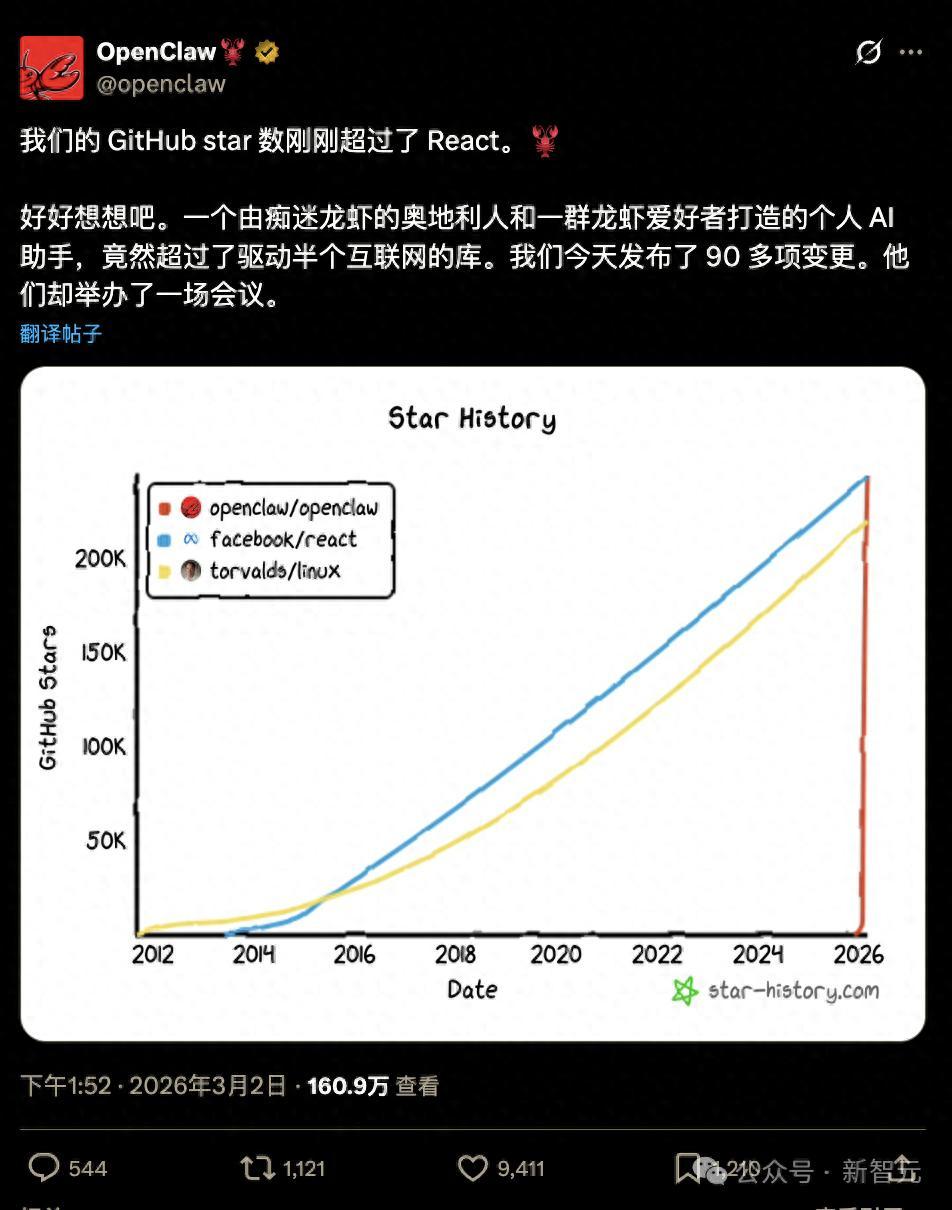
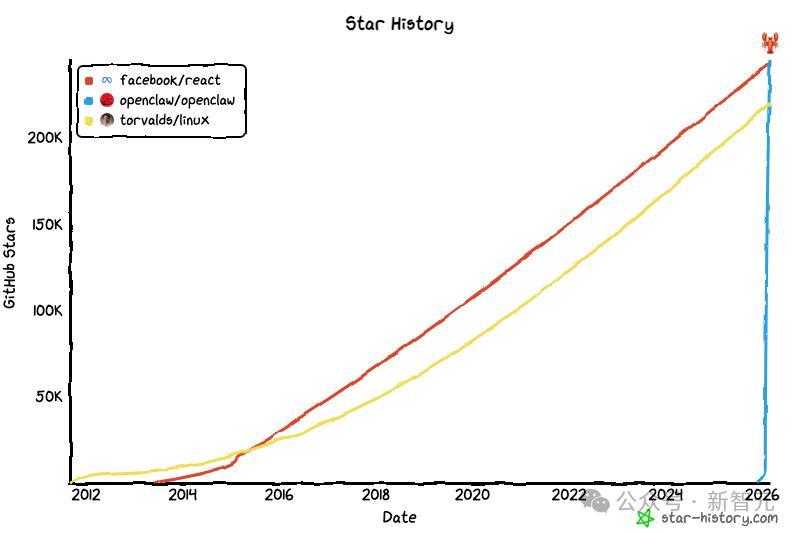
What's even more remarkable is that OpenClaw's data has skyrocketed at an almost vertical rate, surpassing many large-scale infrastructure projects that have been continuously updated for more than ten years, such as Linux and React, in just the first two months of this year!
The inflation of attention
To understand this storm, we need to re-examine the true meaning of "starred" today.
It has long transcended the scope of simple download and daily active user metrics, and has also departed from the context of rigorous technical endorsement.
In the open-source world, clicking a star represents a very low-cost way to show support; it's somewhere between saving, liking, and reading.
The true nature of the rankings is often surprising.
The top spots are often occupied by various resource compilations, tutorials, and book lists (such as the build-your-own-x repository with 470,000 stars), with very little attention paid to basic software.
When you remove these resource repositories and event-type projects and truly examine the basic software that can be installed and run, OpenClaw's rise to the top becomes extremely disruptive.
It took React thirteen years and countless job applications, enterprise architecture choices, and training courses to accumulate over 240,000 stars, representing a very high level of infrastructure penetration.
OpenClaw achieved the same level of success in just one hundred days.
This signifies the complete explosion of the attention economy in the open-source community.
A lobster named Molty is going wild.
To understand the heart of this storm, we need to first understand the essence of OpenClaw.
OpenClaw, launched in November 2025 by Austrian independent developer Peter Steinberger, is positioned as a fully open-source and locally running AI Agent framework.
It completely breaks away from the closed cloud ecosystem and directly connects the large language model to communication tools that people use every day, such as WhatsApp, Telegram, Discord, and even iMessage.
It possesses genuine action capability.
In its eyes, an ordinary user's computer becomes a sandbox where it can do whatever it wants, executing terminal commands, reading and writing files, sending and receiving emails, and even managing schedules on behalf of its owner—all done through natural conversation.
This project has a unique blend of absurdity and humor that belongs to the geek community.
Its mascot is a lobster named Molty, and there's even a slang term in the community that comes from a science fiction TV show: "EXFOLIATE!"
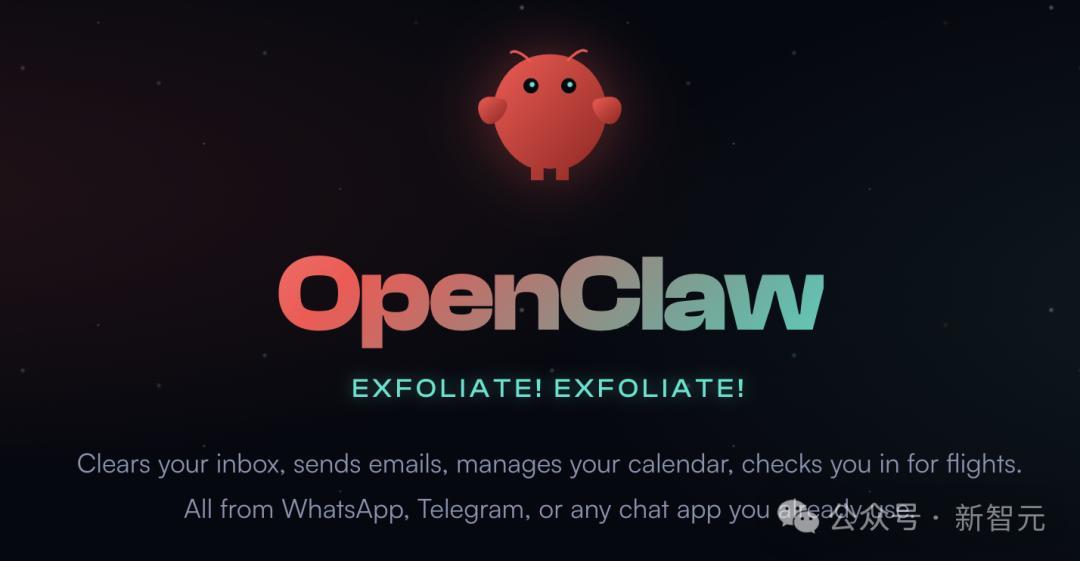
This subculture allowed it to quickly shed its label as a boring software tool and transform into a digital totem.
It went through a dramatic renaming process. Initially named Clawdbot, it was renamed Moltbot after receiving a trademark warning, and finally settled on the wildly successful OpenClaw we know today.
Every controversy, in effect, fuels its viral spread.
On the verge of breaking boundaries and getting out of control
The breakthrough of OpenClaw lies not only in its technological breakthroughs, but also in its extensive reach to a wider audience and its highly dispersed application scenarios.
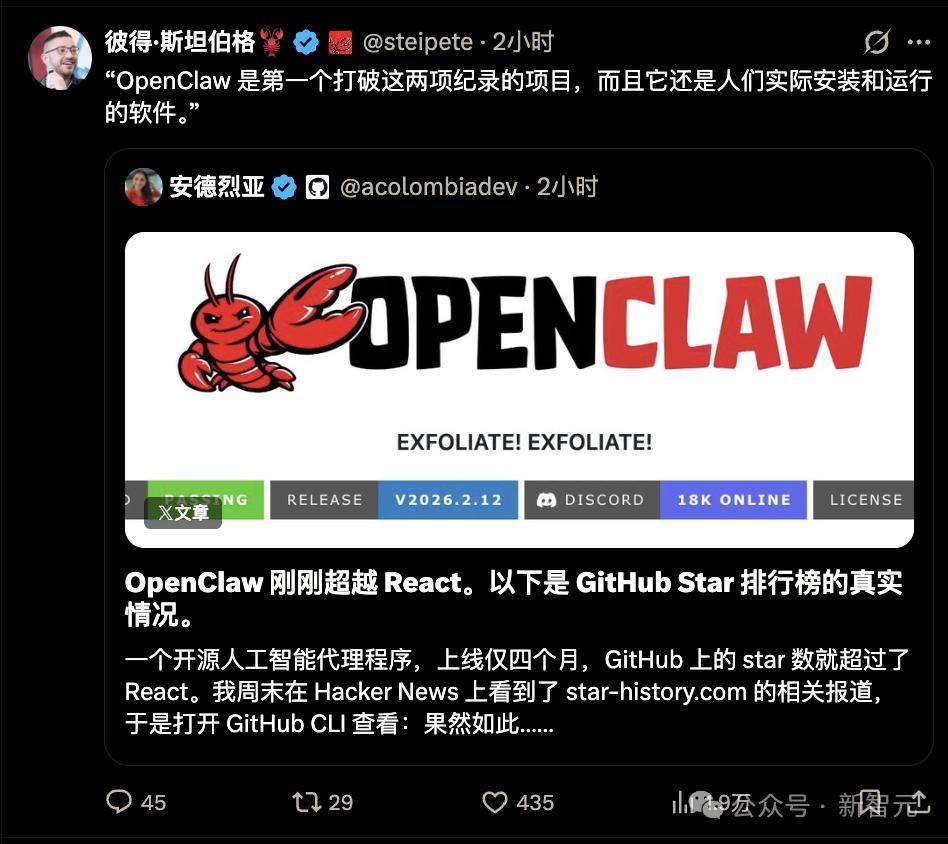
The promotion path of previous generation star projects (such as Vue, Go, and Kubernetes) followed a top-down logic, often with the technical lead making the decision and the team following up.
The spread of OpenClaw has completely transcended technical barriers.
On social networks, you can see two completely different pictures.
A design director on maternity leave uses her phone with one hand to handle all her daily chores, while a mother uses it to automatically plan meals and pick up her children in the WhatsApp family group chat.
Meanwhile, hardcore developers are busy transforming it into a 24/7 automated coding machine.
Along with the fervor came a loss of control in the real world.
Due to granting AI extremely high system privileges, a security crisis known as "ClawHavoc" broke out in the OpenClaw community at the end of January this year.
Attackers used a disguised skill set to infect numerous local instances exposed to the public network with malware.
Subsequently, some tech giants imposed large-scale restrictions on developer accounts that accessed the cloud-based large-scale model backend through the tool, citing abnormal usage leading to service degradation.
Some major Silicon Valley companies have even issued internal directives prohibiting employees from running the program on their work devices.
The dangers, vulnerabilities, and external blockades have not dampened OpenClaw's popularity; on the contrary, they have solidified its status as a truly destructive force.
In the eyes of many, this thrill of walking on the edge of losing control is precisely proof that humanity is truly living in the future.
A watershed moment in history
If you extend the historical leaderboard of GitHub, you will see two completely different eras.
The period from 2013 to 2016 belonged to the era of the Web and cloud native technologies. Those were the golden years when engineers laid the foundation for a more stable internet infrastructure.
Since 2022, we have entered the AI era.
From AutoGPT to LangChain, and now to OpenClaw, the speed at which stars are being collected is becoming increasingly astonishing.
The driving force behind the rise to fame has fundamentally changed.
Engineers download React because of the essential need to build business systems.
When ordinary people turn their attention to OpenClaw, the driving force has become pure curiosity, extreme excitement, and even apprehension about the unknown.
end
Is OpenClaw one of the most important open-source projects on GitHub?
The rational answer remains no.
With 220,000 stars, Linux has been quietly supporting the vast majority of servers and smart devices worldwide, acting as the stable pulse of the internet.
However, by attracting more than 240,000 people to stop and star it in just four months, OpenClaw has proven itself to be the greatest common denominator of current technological sentiment.
References:
https://www.star-history.com/blog/openclaw-surpasses-react-most-starred-software
https://twitter.com/acolombiadev/status/2028568192642383957