 The cryptocurrency market experienced significant volatility in 2026, as rising geopolitical tensions fueled widespread risk-off sentiment. However, one sector continued to experience strong growth.
The stablecoin market surged to record highs in March 2026. This trend suggests that stablecoins are being used for more purposes than just cryptocurrency trading.
Stablecoins reach record market Capital as new use cases emerge.
According to data from defillama , the total market Capital of stablecoins surpassed $313 billion on March 8th , marking an All-Time-High. At the time of writing, this figure stands at approximately $312.99 billion . This milestone reflects the increase in stablecoin issuance and liquidation in the market.
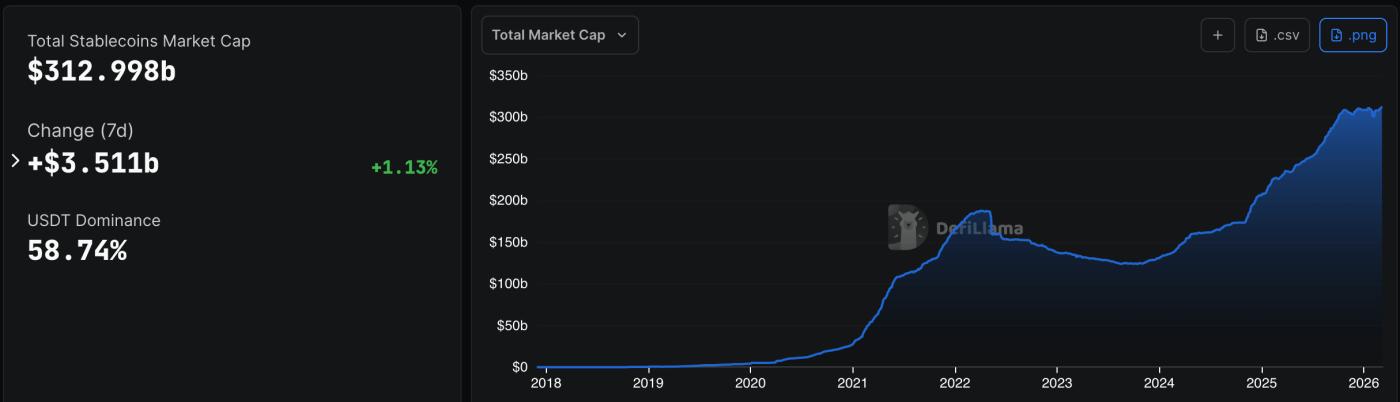
Since the beginning of 2026, the Capital of stablecoins has increased by approximately 1.8% . Analysts often describe stablecoins as the “dry powder” of the crypto market, as investors frequently use them as a base currency for transactions .
As the supply of stablecoins increases, many analysts see this as a signal that new liquidation is flowing into the ecosystem , meaning Capital that investors can quickly deploy to buy crypto assets.
However, this "dry powder" narrative may no longer be entirely accurate . According to Darkfost analysts, net stablecoin inflows into crypto exchange have remained negative since the beginning of 2026 .
Among the major platforms:
Binance is recording net outflows of approximately $2 billion per month.
Bitfinex recorded approximately $336 million.
However, the rate of Capital is slowing down . On February 15th , this figure reached approximately $6.7 billion at Binance and $443 million at Bitfinex .
Nevertheless, large outflows indicate that liquidation is flowing elsewhere . The increase in stablecoin supply not only reflects demand from crypto traders but also shows growing acceptance within the financial ecosystem as a whole .
A report from the International Monetary Fund highlights the growing Vai of stablecoins in cross-border money transfers . A BVNK survey of 4,658 adults in 15 countries found that stablecoins are opening up more financial opportunities in places where traditional payment systems still have many barriers.
The results show that for those receiving payments in stablecoins, approximately one-third of their annual income comes from these assets . Additionally, stablecoins are increasingly being used in business-to-business (B2B) payments .
The report also stated:
"Initially, stablecoins were primarily used for crypto trading, but now they are also used to hedge against inflation in weaker currencies, trade Tokenize stocks, and even invest in GPUs to support the AI revolution ."
Notably, Circle Internet Group and Stripe are developing future-oriented payment systems where automated AI agents can execute transactions using stablecoins . This is XEM as an emerging use case .
One analyst commented:
“There’s only about $24 million in x402 volume over the last 30 days , around 40,000 on-chain AI agents , and $50 million in total agent payment activity . Compared to the $46 trillion in annual stablecoin payment volume , this is small. However, major payment corporations wouldn’t pursue it if they didn’t see a real opportunity.”
These developments suggest that stablecoins are being used far beyond the scope of cryptocurrency transactions . According to Darkfost, if the liquidation currently leaving the market or redirecting back into digital assets is released, the crypto market could witness a new positive uptrend .