Original author: TechFlow TechFlow
The whole world is talking about AI, and the talk about encryption has quieted down considerably on the timeline.
Meanwhile, ETH has been hovering around 2000 for almost two months, and it seems that not many people care about what Vitalik says or does anymore.
However, I recently looked through his X account and found that we're not the only ones affected by AI. A large portion of what he's posted in the past month has been related to AI, even detailing technical solutions.
The most noteworthy proposal is one he co-authored with Davide Crapis, the head of AI at the Ethereum Foundation, on February 11th, titled "ZK API Usage Credits".
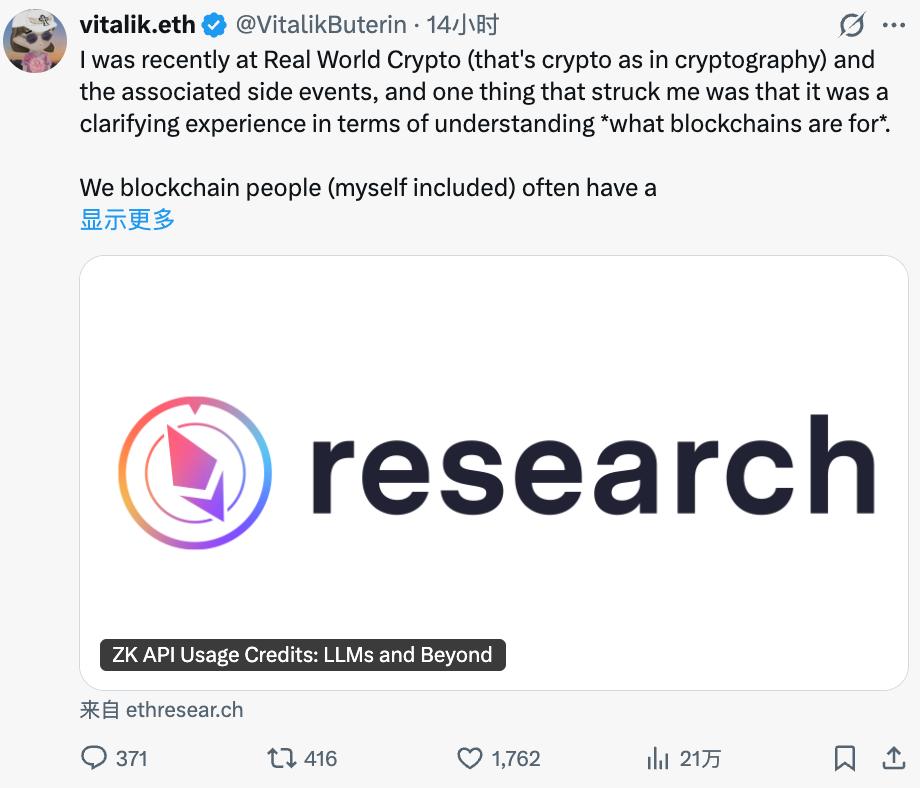
In short: it uses zero-knowledge proofs to allow you to anonymously access large AI models.
Whether you use ChatGPT or call Claude's API, there's only one payment method:
Register an account, link your email address, and link your credit card.
Every conversation and every prompt you send is known to the platform as being from you. What you ask, when you ask it, and how many times you ask it are all linked to your real identity.
Vitalik and Crapis's proposal offers another way.
- A user deposits money into a smart contract, such as 100 USDC.
- The contract will register this deposit in an on-chain encrypted list. Afterwards, each time you call the API, you don't need to reveal your identity; you only need to generate a zero-knowledge proof.
- It proves two things to the service provider: you're on the list, and you have enough balance. But the proof itself doesn't reveal which person on the list you are.
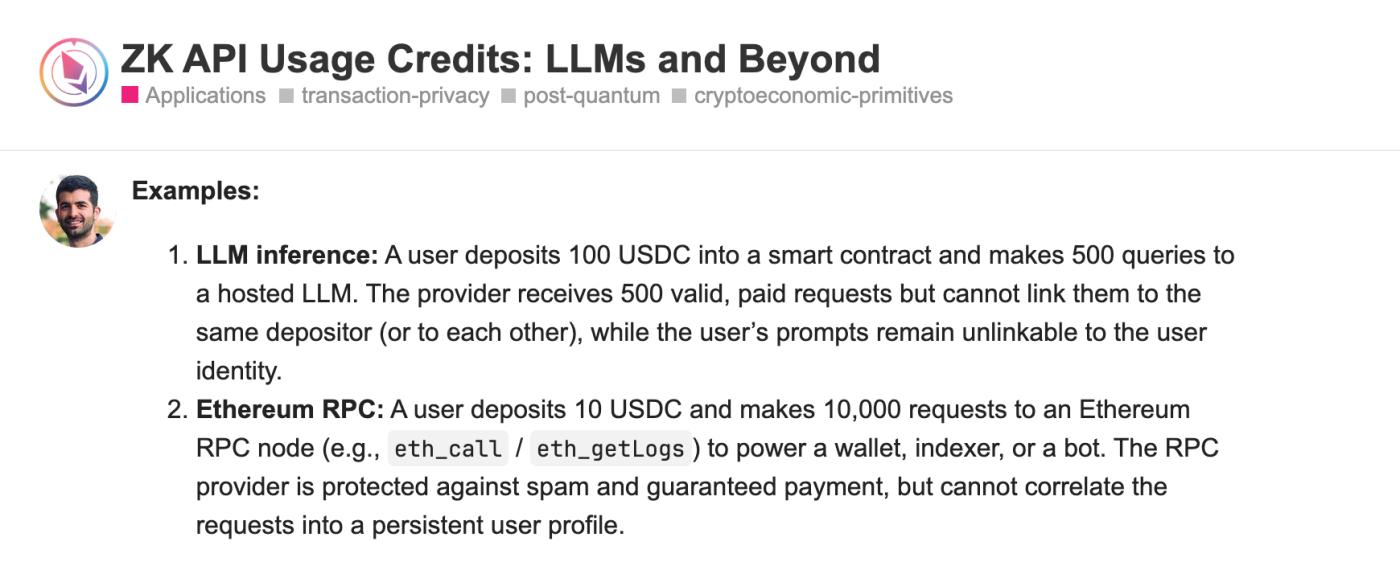
The service provider can receive the money and prevent abuse, but will never know who you are.
You can understand this proposal as one thing: Vitalik believes that in the AI era, users should not have to give up their identity in order to use an AI tool.
This proposal is currently still in the research stage and is far from being implemented. Major model manufacturers may not agree to this approach. At the same time, the comments section of the proposal is full of rebuttals and doubts, with people arguing that AI model manufacturers will always find a way to know your true identity.
However, I believe that the significance of this proposal does not lie entirely in whether it can be implemented.
Privacy is something Vitalik has been working on for a decade. From early support for Tornado Cash to pushing zero-knowledge proofs to become a core technology of Ethereum, this line of work has never stopped. It's just that for the past few years, privacy in the crypto industry has lacked a sufficiently large narrative to support it.
AI fills in the gaps in this story. When you talk to a large model more every day than you talk to anyone else, privacy becomes a real need.
Vitalik Embraces AI
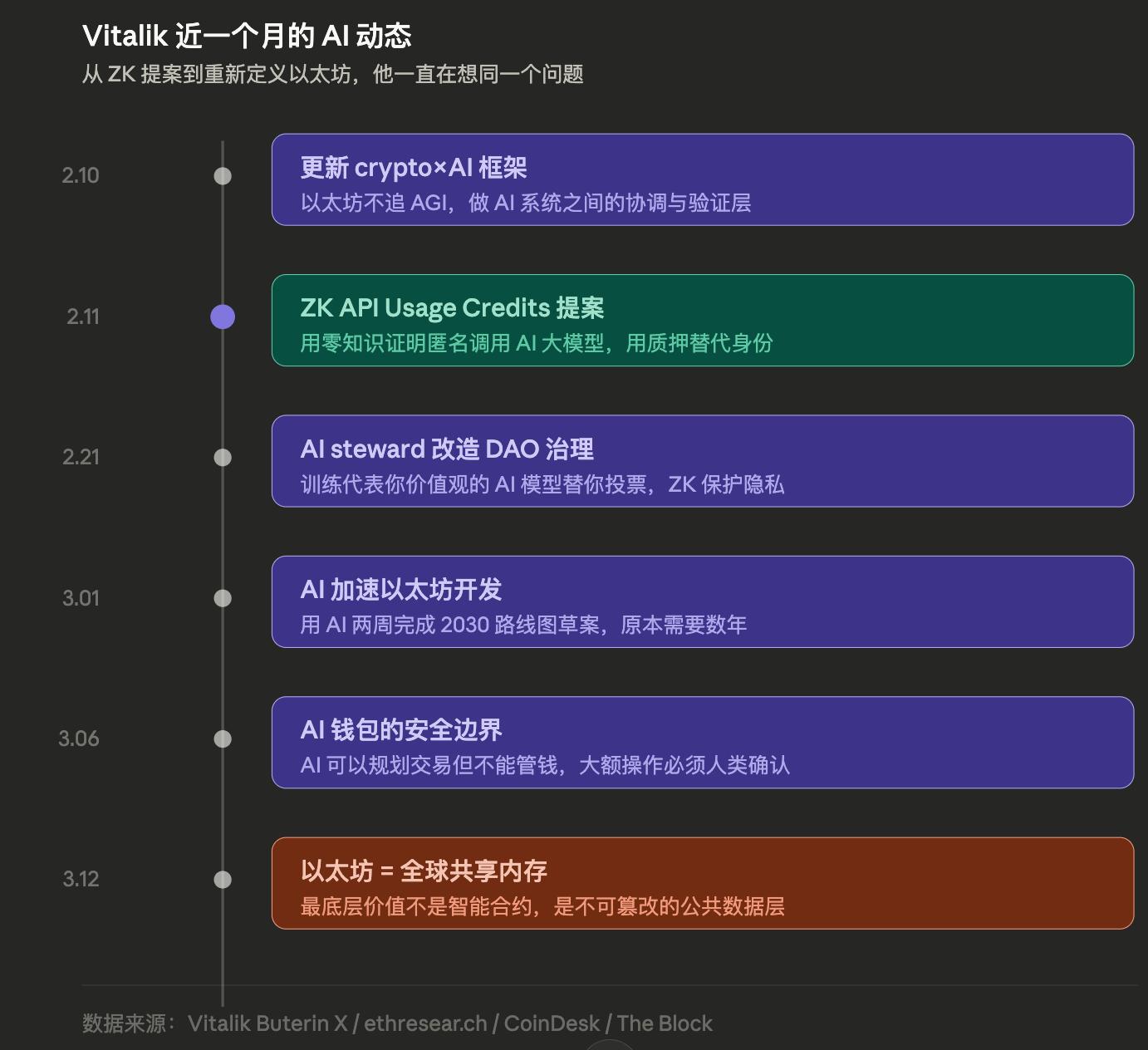
Since February, a significant portion of what Vitalik has posted on X has been related to AI, so much so that it doesn't seem like casual conversation.
Yesterday he posted a long message saying that he recently attended a cryptography conference where people were concerned about privacy, open source, and censorship resistance... but had no interest in blockchain.
He conducted a thought experiment among that group of people:
Forget "we are the Ethereum community," and start from scratch to think about where Ethereum is most useful.
His conclusion is that the most fundamental value of Ethereum is that it serves as a bulletin board— a place where anyone can write, anyone can read, and no one can modify or delete.
In the context of AI, this may be the most important statement Vitalik has made in the past two years.
We are entering an era where creation is infinitely cheap. Text, images, videos, identities—AI can mass-produce them all. When everything can be faked, what will become scarce?
These issues all ultimately point to the same thing: a public, persistent, and irreversible data layer . And a record that no one can tamper with is exactly what Ethereum can do.
Over the past two years, the questions Ethereum has faced can be summarized in one sentence: What is it that no one else can replace?
In retrospect, Vitalik did not answer this question directly.
However, the Ethereum Foundation has done a few unremarkable things in the past year: it assembled a privacy team of 50 people, established a privacy research cluster of nearly 50 people, released the Kohaku privacy framework, and appointed a dedicated AI lead; in its 2026 roadmap, it listed institutional-grade privacy and faster transaction confirmation as top priorities.
Looking back at his intensive output over the past month, it has mostly focused on discussing the privacy and efficiency issues of Ethereum in the context of AI.
I think Vitalik is betting on one thing: the more powerful AI becomes, the more rigid the demand for privacy and verification infrastructure will be. Whether Ethereum can meet this demand is another matter, but he has clearly chosen his table.
ETH is still hovering around 2000. Most people aren't really paying attention to what he's been saying lately.
But perhaps in a few years, when we look back, what we should care about is this very moment.