
Source: Blockworks Research
Author: Kunal Doshi
Compiled and edited by: BitpushNews
Several of the most important narratives in the crypto space are beginning to converge: including the tokenization of real-world assets (RWA), institutional-grade blockchain adoption, privacy infrastructure, and stablecoins as a settlement track.
Canton Network is at the crossroads of these trends and has assembled one of the most powerful institutional players in the industry.
Major financial institutions, including DTCC (Depository & Clearing Corporation of the United States), Nasdaq , Broadridge , and many global banks, have deployed real workflows on the network covering government bond tokenization, repurchase financing, collateral management, and payments.
If this trend continues, Canton could become the coordinating layer for the tokenized finance market, where assets, cash, and collateral move in real time between institutions. As more financial activity flows through the network, the increased volume of coordinated transactions will drive up network revenue and token burning, pushing the network towards deflation.
Key points
The architecture is designed specifically for regulated institutions. Canton supports fine-grained transaction privacy and validator-level controls while maintaining interoperability between applications, addressing key compliance hurdles faced by institutions.
The adoption of a comprehensive institutional financial stack is noteworthy. DTCC is bringing regulated collateral on-chain; Broadridge processes over $7 trillion in repurchase activity monthly; and Nasdaq is integrating Canton with its Calypso risk and collateral management platform.
Network effects can increase coordination activities. As more institutions join and trade with each other, the number of counterparties increases, and more transactions are routed through the "Global Synchronizer," thereby driving higher CC destruction.
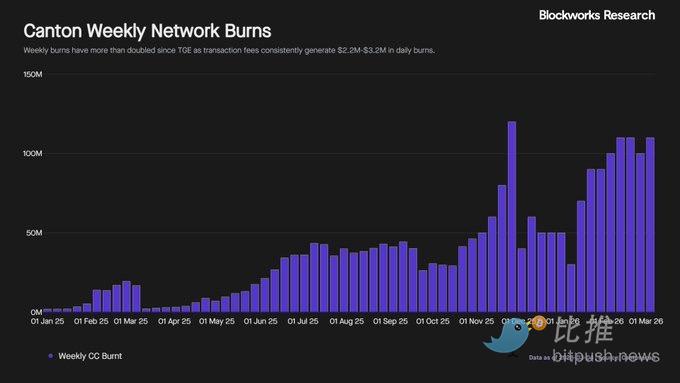
The economics of tokens are increasingly driven by usage. Since the token generation event (TGE), weekly burning has increased by 216%, and the burn-to-mint ratio has risen to 0.90. If activity continues to expand, the network will approach a potential deflationary state.
The valuation is still at a discount relative to its peers. Canton generated the highest revenue (REV) among major L1 networks in February, but its transaction multiple is low, which may reflect the impact of recent inflation and the market's view of it more as a financial infrastructure than a general-purpose public chain.
Regulatory clarity and institutional adoption are key catalysts. The passage of the Clarity Act and the launch of a wider tokenization platform by the DTCC in the second half of 2026 could accelerate institutional adoption and increase the amount of assets and trading volume moving on Canton.
Token concentration remains a potential risk. Approximately 54% of the circulating CC is held by a small number of network participants, although much of this balance is operational rewards rather than speculative holdings.
Pain points of institutional tokenization
Tokenization promises faster settlement, lower reconciliation costs, and more efficient capital utilization. However, in practice, most blockchain designs force institutions to choose between regulatory compliance and the ability to transact across shared networks.
The Basel Committee on Banking Supervision has made it clear that the choice of infrastructure directly impacts regulatory treatment. Banks tokenizing traditional assets must demonstrate strong governance, clear validator control, robust data privacy, and sound operational risk management. Failure to meet these conditions may result in significantly increased capital requirements for tokenization exposure, thereby eroding the economic benefits that tokenization should bring.
Public permissionless blockchains offer interoperability and composability, but transaction data is visible to validators and even the entire market. For regulatory bodies, broadcasting information about liquidity needs, margin changes, or collateral positions is unacceptable. Even anonymous activity can leak commercially sensitive insights. Institutions need to determine who is validating their transactions and who has access to their data.
Private blockchains restrict access but introduce fragmentation. Each network becomes an island, limiting asset liquidity and cross-platform liquidity. Privacy is often achieved at a broad channel level, and the activity seen by participants may still exceed the scope of the "need-to-know" model.
Therefore, institutions face a structural trade-off: public networks lack sufficient control, while private networks lack meaningful interoperability. Canton aims to bridge this gap by combining fine-grained privacy and validator-level control with shared synchronization and atomic settlement across independent applications.
Network Architecture and Privacy Model
Canton separates execution from coordination. Smart contracts written in Daml run on validator nodes operated by participating institutions and application providers. Each organization runs its own validator node, which acts as a gateway to its network and only validates transactions it participates in. This design allows institutions to maintain control over their infrastructure and transaction validation.
The validator connects to a synchronizer, which is responsible for routing and ordering messages among the parties. The synchronizer ensures that multi-party transactions are settled atomically and consistently among the participants. It does not validate transactions and cannot view transaction data because all messages are end-to-end encrypted. The synchronizer only orders the encrypted payload, much like a post office processes sealed envelopes.
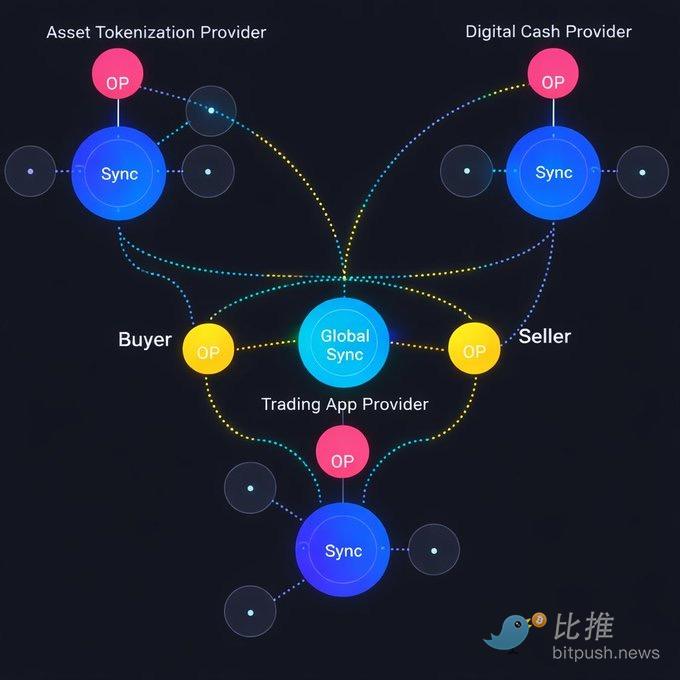
Canton supports multiple synchronizers. The Global Synchronizer is a shared public coordination layer operated by "Super Validators" using Byzantine Fault Tolerance (BFT) consensus. It provides a neutral backbone, allowing independent applications and institutions to interoperate while maintaining the flexibility of the connected ecosystem.
Network participants
Validators: Infrastructure nodes operated by an organization. They store contract states, verify participating transactions, and provide application interfaces for users and services.
Applications: Business logic deployed on validators. They define the contract rules and data permissions for use cases such as stablecoins, buybacks, custody, and tokenized assets.
Super Validators: Operate a global synchronizer and ensure decentralized message ordering for the public network. While validators only verify the transactions they participate in, super validators maintain a shared coordination layer.
Governance is transparent and follows institutional standards through the Canton Foundation. Anyone can view or submit Canton Improvement Proposals (CIPs). Supervalidators operating the global synchronizer vote on key decisions, including upgrades and changes to code and services. The Canton Foundation supports the development and oversight of the global synchronizer, ensuring that governance actions are publicly visible and that members participate. The Foundation runs a node on behalf of its members and participates in governance voting, helping to maintain the neutrality and trust of the network.
Institutional adoption to date
DTCC integrates the Treasury bonds held in custody by the DTC with Canton.
DTCC is a core post-crisis infrastructure provider for the US capital markets. Through its central securities depository subsidiary (DTC), it holds and protects over $100 trillion in assets, including stocks, ETFs, and money market instruments. Its decision to tokenize DTC-custodied Treasury securities on Canton represents a structural step towards bringing core market collateral onto the blockchain.
Following a No Action Letter from the SEC (Securities and Exchange Commission), the DTCC announced plans to mint a subset of DTC-custodied Treasury securities on Canton, with an MVP (Minimum Viable Product) target set for the first half of 2026. These are not synthetic assets; the tokenized Treasuries retain the same CUSIP, meaning they remain legally and operationally the same security within the existing market infrastructure. Participants can use the assets in the traditional system or in tokenized form without altering their legal status.
DTCC also joined Canton as a super validator, operating the infrastructure for the global synchronizer and participating in network governance.
More important than issuance is proven use. A Canton working group, including Bank of America, Circle, Citadel, Cumberland, Société Générale, Tradeweb, and Virtu, has completed live on-chain U.S. Treasury financing for stablecoins. These transactions include weekend buybacks, atomic settlements, and live collateral reuse. DTCC’s initiative brings regulated collateral on-chain, and these transactions demonstrate that these assets can be actively financed and mobilized at institutional scale.
Broadridge: Production-scale institutional buyback
Broadridge's Distributed Ledger Repo (DLR) platform currently processes over $350 billion in transactions daily. Repos are short-term collateralized financing backed by assets such as U.S. Treasury bonds and are a core liquidity engine in global capital markets. This activity is already operational in production on Canton.
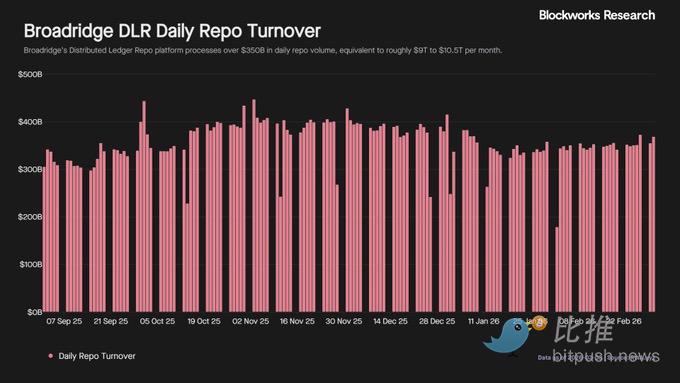
DLR has been operating since 2021, and its user base includes major banks, broker-dealers, and traditional asset management companies. The platform integrates with existing market infrastructure, including custodians, front-end trading systems, and back-end clearing platforms, allowing institutions to join with minimal operational disruption.
Within DLR, key components of the buyback lifecycle are processed on-chain, including the custody of tokenized collateral, the execution of buyback transactions, and the settlement of cash and securities between counterparties. Certain operational processes remain off-chain, such as archival record keeping and updating control of the underlying collateral held in traditional escrow accounts. As the DTCC plans to bring regulated, high-quality collateral directly to Canton, associated buyback financing can also be conducted on-chain, increasing activity on the Broadridge DLR platform.
Nasdaq: On-chain Margin and Collateral Infrastructure
Nasdaq has completed a pilot program connecting its Calypso platform to the Canton Network. Calypso is one of the most widely used institutional systems by global banks and asset management companies for managing risk, margin, and collateral. The pilot demonstrates how on-chain infrastructure can be directly integrated with existing institutional risk systems.
The test was conducted jointly by QCP, Primrose Capital, and Digital Asset. Businesses can automatically calculate margin requirements and move collateral between counterparties on-chain at any time, while continuing to use their existing portfolios and risk systems. For institutions operating across time zones and asset classes, this reduces operational friction and improves capital efficiency.
Nasdaq has also joined Canton as a super validator. This builds on Nasdaq's strategic investment in Digital Asset (Canton's creator), with other investors including BNY (Bank of New York), iCapital, and S&P Global.
Other key institutional partners
Several other global institutions are also building applications on Canton. JPMorgan plans to natively bring JPM Coin to the network for 24/7 institutional cash and collateral settlement. The London Stock Exchange Group (LSEG) is launching its digital clearinghouse on Canton to support real-time after-hours workflows. Lloyds Banking Group executed the UK’s first production-grade tokenized government bond and deposit transaction on the network.
These initiatives have been supported by a growing number of supervalidators operated by organizations such as Digital Asset, Tradeweb, and Cumberland.
Institutional Influence
The announcement of major financial institutions becoming super validators has become a short-term price catalyst. Following the confirmation of DTCC and Nasdaq as super validators, CC outperformed BTC by 54% and 31% respectively in the following two days. This shift likely reflects increased market confidence that globally recognized financial institutions are committing to the network at the infrastructure and governance levels, rather than just the application level.
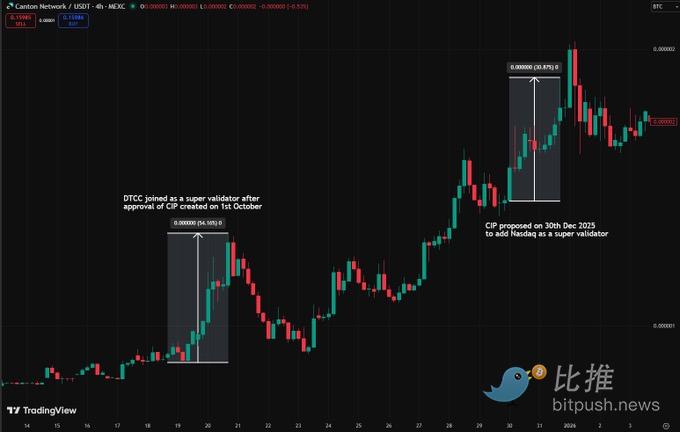
Beyond narrative-driven price fluctuations, these developments could translate into sustained online activity:
Nasdaq's focus is on collateral management. Margin recalculation, collateral pledging, and portfolio adjustments are high-frequency activities. If these workflows are moved on-chain between independent institutions, it will generate continuous coordinated transactions.
DTCC and Broadridge represent the asset and funding layers, respectively. DTCC brings regulated collateral onto the blockchain, while Broadridge has facilitated large-scale buyback financing activities. Tokenizing an asset is a one-off event; the real potential lies in the repeated financing, staking, and reuse of these government bonds among counterparties.
Currently, most of the activities of large institutions run in private synchronization environments, rather than through the global synchronizer. Therefore, these activities have not yet made a substantial contribution to the message flow of the global synchronizer. However, as more independent institutions join and begin trading with each other, the need for coordination will increase. Each new participant expands the number of potential counterparties, enhancing the network effect of the entire system. Transactions spanning multiple validators will be routed through the global synchronizer. As cross-institutional financing and staking activities scale up, the increased message volume will translate into a higher CC burn rate.
Token Economics
Transactions spanning multiple validators are ordered via a global synchronizer, with fees paid by burning CC. Fees are denominated in USD/MB of transaction data but settled in CC using an on-chain conversion rate. These fees are burned rather than paid to validators, thus directly reducing the token supply. This structure allows institutions to pay predictable, USD-based infrastructure costs while linking network usage to token supply dynamics.
Burning Trends: Since TGE, weekly CC burns have increased by 216%, from 46.2 million to approximately 100 million. In USD terms, daily burns have ranged from $2.2 million to $3.2 million in recent weeks. As a percentage of circulating supply, the weekly burn rate has increased from 0.14% to 0.26%, and even exceeded 0.30% in some weeks.
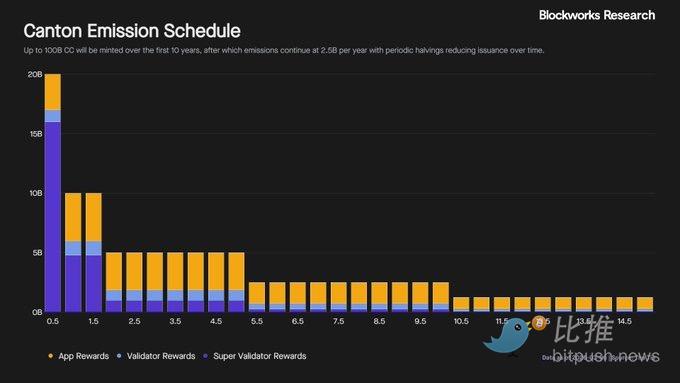
Issuance Model: CC follows a pure earn model. There is no pre-allocation to investors, the team, or the foundation. All tokens are minted through the network. A total of 100 billion CC can be minted over the first 10 years, followed by a fixed annual release of 2.5 billion.
Halving: Periodic halving reduces output over time. The most recent one occurred on January 12, 2026, reducing annual emissions from 20 billion to 10 billion.
Reward Distribution: Newly minted tokens are allocated to applications, validators, and super validators. Over time, the distribution focus has shifted: the allocation share for super validators has decreased from 80% at launch to the current 20%, while application rewards have increased from 15% to 62%. The system is intentionally shifting from early infrastructure incentives to application-driven incentives.
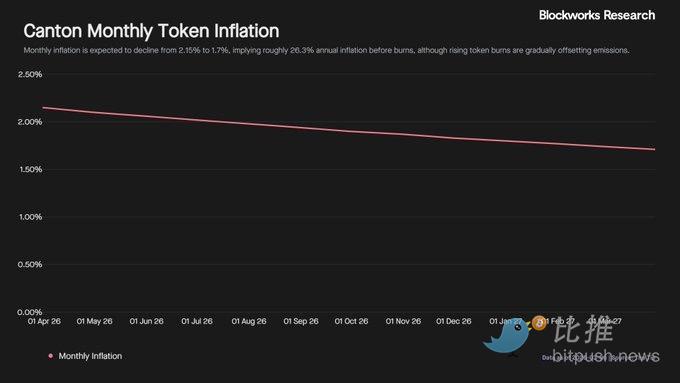
Inflation and Deflation: The current monthly inflation rate has gradually decreased from 2.15% to 1.7% (approximately 26.3% annual inflation). Although still relatively high compared to other L1 currencies, the burn rate is rapidly narrowing the gap. Since TGE, the daily burn-to-cast ratio has increased from 0.16 to 0.90.
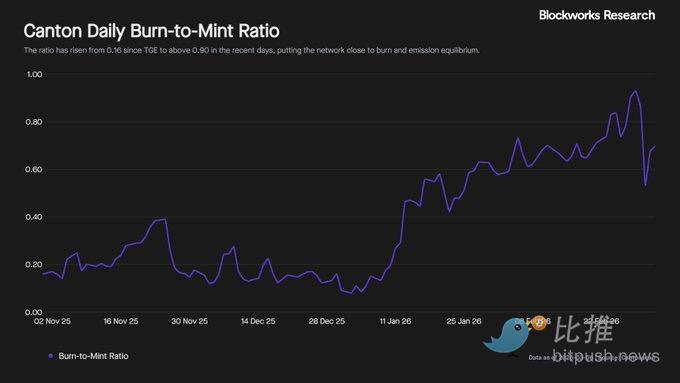
At the current rate, Canton is approaching a point where daily burns equal daily minting. If the burn ratio continues to exceed 1, the network will enter net deflation, which will directly address investors' main concerns.
Active Applications and Emerging Use Cases
Looking at the top 10 apps by reward share, the number of active earners is steadily increasing, indicating a healthy ecosystem. At current prices, approximately $82.2 million in CC is distributed to apps monthly. This creates significant economic incentives for builders, who can also pass rewards to end users to drive liquidity and usage.
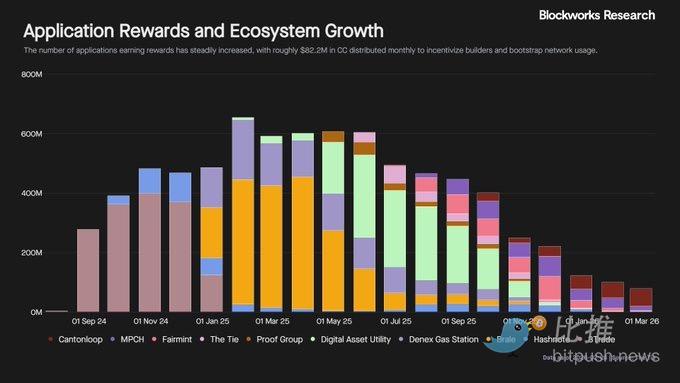
Brale: Currently leading in rewards share. It has built a bridge that converts USDC and USDT into Canton Network's native equivalents, enabling privacy-enhancing institutional-grade payments and settlements. It effectively serves as a gateway for funds within the ecosystem, allowing financial and capital market participants to move cash on-chain without exposing transaction details.
Hashnote (acquired by Circle in January 2025) brings interest-bearing collateral to Canton through USYC (a tokenized reverse repurchase product with over $1 billion in assets under management). USYC can be used for margining, staking, and trading workflows while preserving privacy. Subscription fees are paid in CC, and Hashnote redistributes a portion of the rewards to connected validators.
Other top reward earners include infrastructure and utility services: Denex Gas Station (bandwidth management), Cantara (peer-to-peer billing), Fairmint (on-chain staking), The Tie (analysis services), 5North's Loop (wallet provider), and Digital Asset's DA Utility (asset tokenization standard).
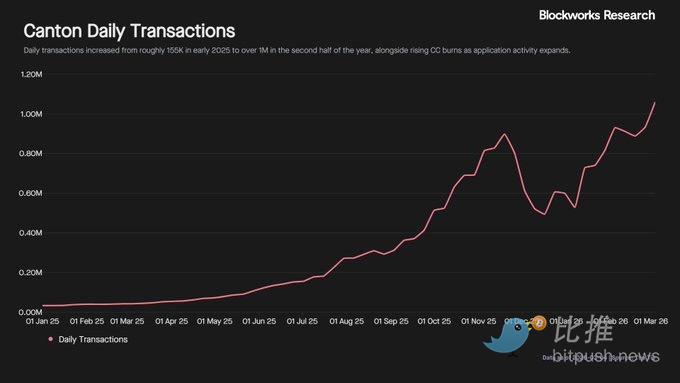
As the application base expands, online activity is increasing dramatically. Daily transaction volume is expected to grow from approximately 155,000 in the first half of 2025 to over 1 million in the second half.
Circle's launch of USDCx is a significant recent development. USDCx is a privacy-preserving stablecoin, backed 1:1 by USDC held in Circle's reserves. Details are only visible to the transacting parties, addressing a major obstacle to institutional adoption of stablecoins.
In February 2026, a multinational company executed its first privacy-preserving on-chain stablecoin payroll payment on Canton. The transaction was backed by Toku (which manages the payroll logic) and Cantor8 (which provides secure employee wallets).
Valuation Analysis
In terms of network revenue (REV) (defined as payments for block space and settlement coordination fees), Canton generated the highest revenue among major L1 servers in February, reaching $74.7 million, approximately 2.8 times that of Solana, which ranked second.
We use the $100 billion supply milestone to be reached in 10 years to estimate the fully diluted valuation (FDV). In practice, Canton's future supply is dynamic due to ongoing destruction.
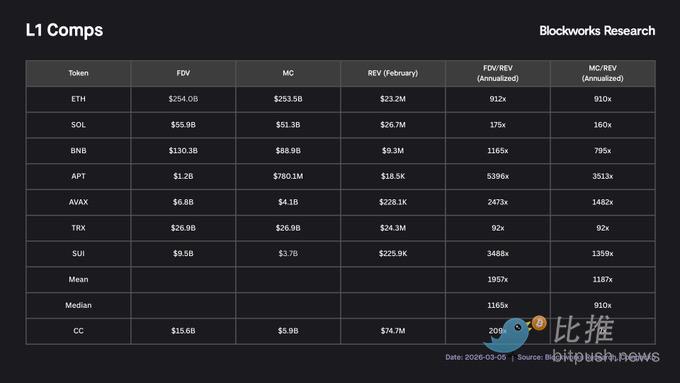
Despite conservative adjustments made to account for future supply expansion, Canton still offers a significant discount to other L1 networks in terms of market capitalization/revenue (MC/REV) and FDV/revenue (FDV/REV) multiples.
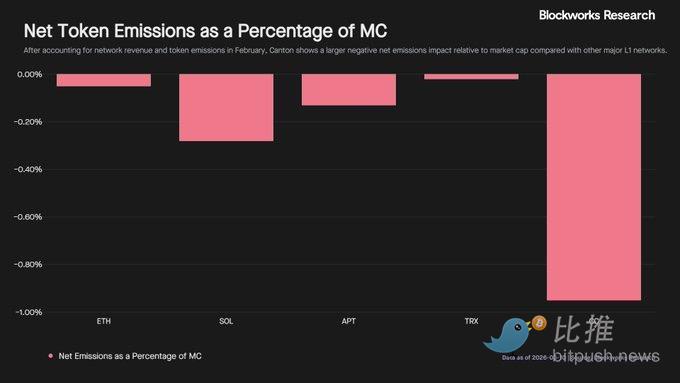
Reason 1: Recent token emissions are high.
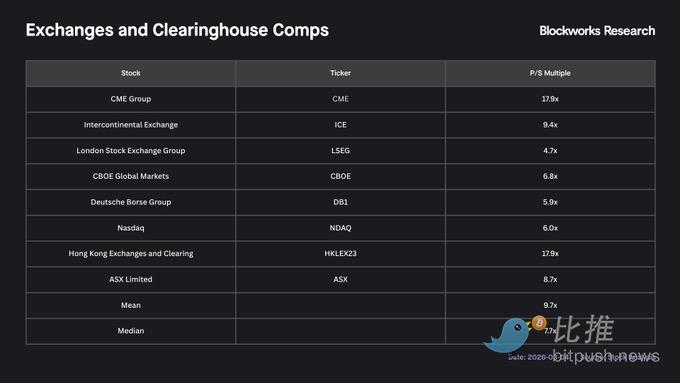
Reason 2: Market interpretation of Canton's role. The market currently views it as financial infrastructure rather than a general-purpose public blockchain. Compared to traditional financial market infrastructure providers such as CME, Nasdaq, ICE, and LSEG (whose trading multiples are typically around 8x), Canton's valuation is more consistent with theirs.
Additional upside potential may arise from the network beginning to support applications that generate sustained on-chain activity, such as prediction markets, perpetual contract trading, and lending markets.
Unhedged: Canton's first privacy-focused prediction marketplace, which has processed over 10 million CCs in transactions.
CantonSwap: A decentralized exchange that has been ranked among the top 25 reward-receiving apps.
Franklin Templeton: His BENJI tokenized money market fund has been launched on the network.
Potential catalysts
The Clarity Act: A potential catalyst for regulation. This legislation will help define how digital assets and blockchain infrastructure are regulated in the United States, reducing uncertainty for banks and clearinghouses. Polymarket currently predicts a 60% chance of it being signed into law in 2026.
Promotion of the DTCC tokenization platform: DTCC plans to launch a production-grade platform in the second half of 2026. If Canton is used as a settlement environment, it will significantly expand the range of assets and trading activity.
Potential risks
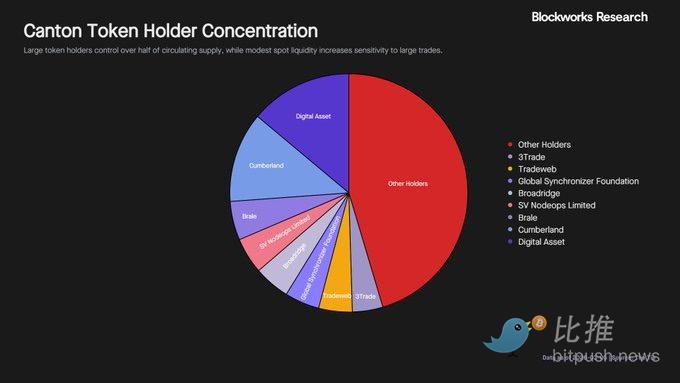
Token Concentration: CC ownership is concentrated in the hands of a few participants. The top reward recipients collectively account for approximately 54% of the circulating supply. If large holders cash out, it could create selling pressure.
Limited market liquidity: As of now, the depth of the Bybit spot market (around -2%) is approximately $350,000; this means that if large holders choose to reduce their positions, even relatively small transactions can significantly impact price movements, thus exacerbating market volatility. However, market liquidity is expected to improve over time if more exchanges list the coin. Since the beginning of the year, exchanges such as OKX and Robinhood have listed CC, which is expected to gradually increase trading depth and broaden market access.
Background Factors: It should be noted that these balances primarily belong to core contributors and infrastructure providers, and are operational rather than speculative. The Canton Foundation recently approved a proposal allowing super validators to lock up a portion of their rewards to maintain validator weight, which helps strengthen long-term consistency and reduces the likelihood of large-scale sell-offs.
in conclusion
Canton represents one of the most reliable attempts to bring traditional financial infrastructure onto the blockchain. Its architecture is designed around institutional needs, and early adoption by organizations such as DTCC, Nasdaq, and Broadridge indicates that the network is gaining traction.
Although many activities are still in their early stages, Canton is likely to become an increasingly central coordinating layer for financial markets as institutional and application activities expand in tandem.
Twitter: https://twitter.com/BitpushNewsCN
BitPush Telegram Community Group: https://t.me/BitPushCommunity
Subscribe to Bitpush Telegram: https://t.me/bitpush