Anthropicn officially announced that the 1M Token Context Window for its Claude Opus 4.6 and Claude Sonnet 4.6 has been fully upgraded from the Beta stage to the official release (GA), and is now available to all users without any price adjustments.
The biggest highlight of this GA is that "no price increase". Opus 4.6 maintains $5 for input and $25 for output (per million tokens), while Sonnet 4.6 maintains $3 for input and $15 for output, and uses a uniform unit price from the 1st to the 1,000,000th token, without tiered billing.
Developers who write programs can cram in source code for larger libraries, hundreds of pages of research reports, or lengthy contract files all at once.
MRCR v2 Benchmark: Opus 4.6 Significantly Outperforms Competitors
Anthropic simultaneously released benchmark results for its long-context capabilities, using the MRCR v2 evaluation framework to test the model's information retrieval and reasoning abilities within extremely long texts:
- Claude Opus 4.6 : 78.3%
- GPT-5.4 : 36.6%
- Gemini 3.1 Pro : 25.9%
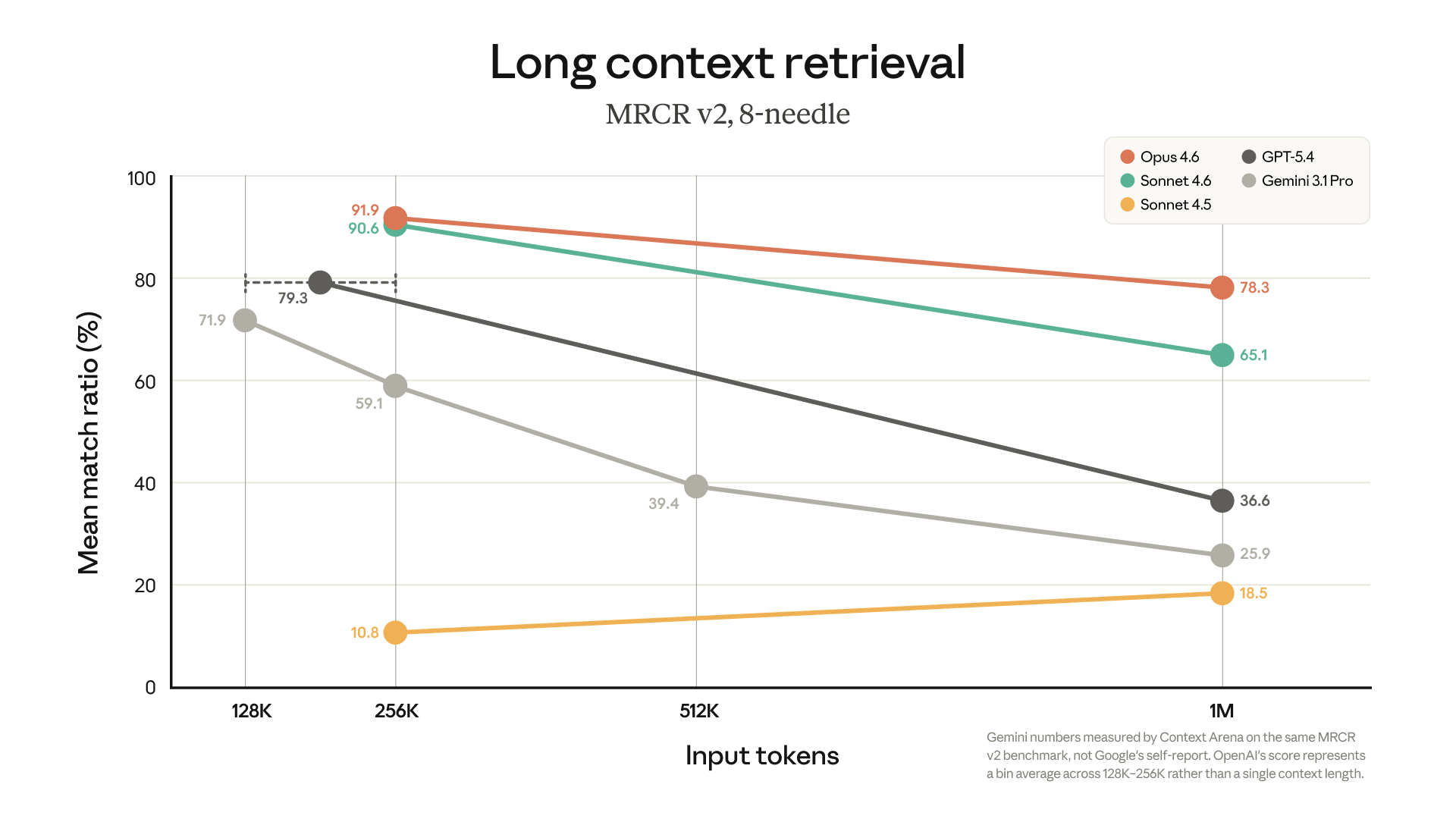
Opus 4.6 scores almost twice as high as GPT-5.4 and far surpasses Google Gemini 3.1 Pro. This is invaluable for enterprise users who need to handle extremely long contracts, legal documents, large codebases, or multi-turn conversations.
While the Gemini series is known for its support of ultra-long contexts of up to 2 million tokens, MRCR v2 results show that there is still a significant gap between the window's "capacity" and its actual "understanding quality." Anthropic clearly hopes to differentiate itself from its competitors in this regard.
Claude Code integrated library analysis, 600-page PDF processed in one go.
At the application level, the million-token context has been fully enabled in the developer tool Claude Code. The official statement emphasizes that this significantly alleviates the context compression issues during large library analysis and log retrieval, eliminating the need for developers to manually truncate input or worry about important information being cut off.
This includes the ability to process up to 600 images or 600 pages of PDF files in a single request. This is ideal for scenarios requiring comparison of extensive technical documents, review of lengthy audit reports, or analysis of the entire source code of an open-source project in one go.

 Related reports