
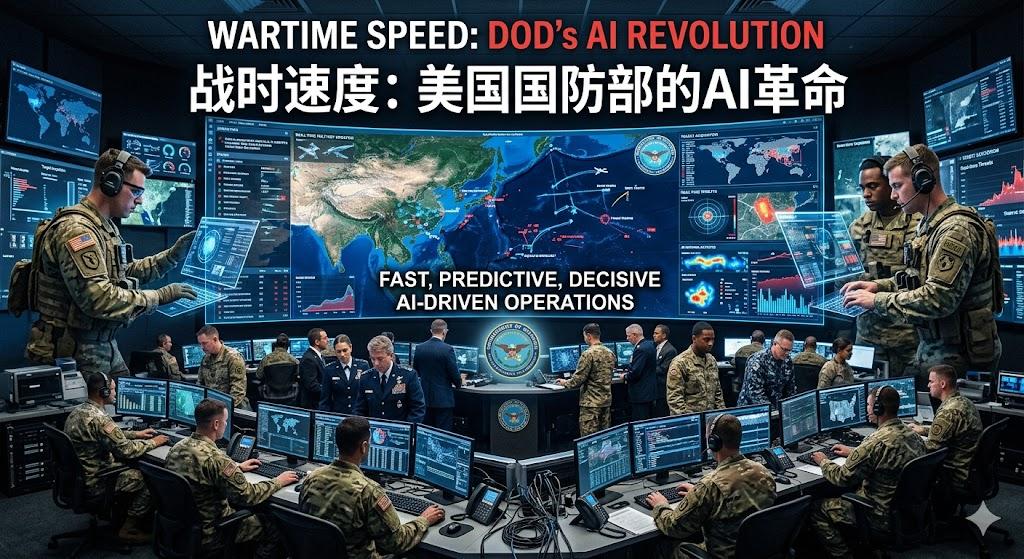
Introduction: From Silicon Valley to the Pentagon, a "Disruptor's" Wartime Declaration
In the third decade of the 21st century, the global geopolitical landscape is undergoing its most profound reshaping since the end of the Cold War. The return of great power competition, coupled with the accelerated evolution of disruptive technologies such as artificial intelligence, autonomous systems, and hypersonic weapons, has propelled global security into a new phase of high uncertainty. Against this backdrop, the ability of the U.S. defense system—this vast, complex, and notoriously robust bureaucratic machine—to adapt to the challenges of the new era and to innovate sufficiently rapidly has become a core issue concerning its national security for decades to come.
It is against this backdrop that Emil Michael's emergence becomes particularly noteworthy. A former senior executive in Silicon Valley, he held high positions at companies like Uber, personally participating in and driving disruptive innovation in the business world. Now, as Under Secretary of Defense for Research and Engineering, he serves as the Pentagon's Chief Technology Officer (CTO), shouldering the daunting task of modernizing the entire defense technology ecosystem. His career trajectory itself symbolizes an unprecedented collision and fusion between Silicon Valley's innovative culture and Washington's power center.
This dialogue at the a16z "American Vitality Summit" can be seen as Michael's most comprehensive and candid "wartime declaration" since taking office. The "war" he faces is not only directed at potential external adversaries, but also an "unstoppable battle" against internal bureaucratic inertia. The "wartime speed" he advocates is a complete break with the "peacetime speed" of the past thirty years. This is not merely a change in slogans, but the beginning of a series of profound organizational restructuring, strategic priority reshaping, and cultural transformation.
This article will use this interview as its core text, combined with related news reports and analyses from the same period, aiming to provide readers with a panoramic interpretation of the transformation of the US defense AI strategy. We will delve into the following core issues:
1. The Urgency of "Wartime Speed" : Why does Michael believe the Department of Defense must abandon "peacetime speed"? What are its historical roots? What threats does it pose to national security?
2. The Warning of the "Holy Cow" Moment : What Did Michael Find in the Commercial AI Contract? This dispute with Anthropic reveals the deep-seated contradictions in technology, ethics, and sovereignty when commercial AI models enter the defense field.
3. Strategic Retrenchment and Focus : What strategic considerations lie behind drastically reducing 14 technology priorities to 6? Why is "Applying AI" placed first?
4. The "Breaking" and "Establishing" of Procurement Reform : What are the drawbacks of the traditional "cost-plus" contract model? How will Michael's attempt to establish a new model centered on "fixed prices" and simplified requirements change the ecosystem of the defense industry?
5. The Bottom Line of Democratic Oversight : While embracing commercial technology, how can we ensure that the military application of AI remains under the oversight of a democratic legal framework? How does Michael view the relationship between the "values" of AI companies and the U.S. Constitution?
6. A Call to Startups : What signals is the Pentagon sending to tech startups? Besides technological innovation, what other capabilities do they need to succeed in the defense market?
By analyzing these issues one by one, we can not only understand Emil Michael's reform blueprint, but also gain insight into how, in the AI era, a superpower's defense system attempts to find a difficult and crucial balance between maintaining technological superiority, combating bureaucratic inertia, and upholding democratic principles. This is not just a story about weapons and technology, but a profound narrative about organization, culture, and national destiny.
Chapter 1: From "Peacetime" to "Wartime Speed": The Urgent Shift in National Defense Strategy
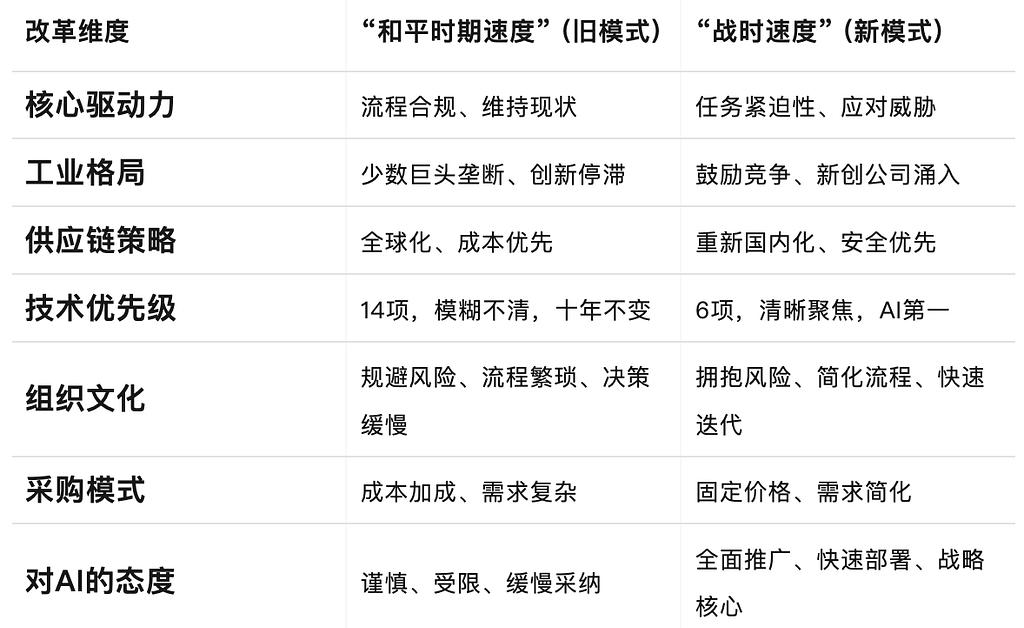
At the outset of the interview, Emil Michael clearly outlined the core concept of his reform agenda—a shift from "peacetime speed" to "wartime speed." This shift is not only a personal policy framework but also a profound reflection on and subversion of the American defense industry ecosystem and bureaucratic culture of the past thirty years. Understanding the background, implications, and urgency of this shift is key to grasping the entire dialogue.
1.1 The historical roots and consequences of "peacetime speed"
Michael traces the origins of "peacetime speed" back to a landmark event following the end of the Cold War—"The Last Supper." This wasn't a real dinner, but rather a meeting in 1993 convened by then-Secretary of Defense Les Aspin with the heads of major U.S. defense contractors. The core message of the meeting was that with the collapse of the Soviet Union, the era of massive defense procurement was over, and the defense industry needed to undergo significant consolidation and downsizing.
“After the Cold War ended, Pentagon leaders told industry, ‘Hey, there won’t be any more weapons systems being purchased or innovated. So you should all consolidate and slow down your growth,’ which basically meant becoming companies that pay dividends and buy back shares.” [1]
This policy directly led to a dramatic shift in the landscape of the U.S. defense industry. The once diversified market, boasting dozens of competing prime contractors, rapidly consolidated into an oligopoly dominated by a few giants such as Lockheed Martin, Boeing, Northrop Grumman, Raytheon, and General Dynamics—a group known as "four or five prime contractors." The direct consequences of this structure are:
• Reduced innovation drive : Lacking sufficient competitive pressure and new large-scale procurement projects, these giants have shifted their primary focus from technological innovation to maintaining existing projects, generating stable profits, and rewarding shareholders. Michael described them as becoming "people who pay dividends and buy back shares."
• Bureaucratic entrenchedness : A closed system dominated by a few players has formed a stable symbiotic relationship with the Pentagon's vast procurement bureaucracy. Processes have become increasingly complex, with extremely high barriers to entry, excluding emerging and more dynamic business technology companies.
• Supply chain vulnerability : When the defense industry itself loses its vitality, its downstream supply chains also begin to seek lower-cost solutions globally. Michael points out that starting in the mid-2010s, facing China's "largest military buildup in history," the United States suddenly found itself "out of touch" in many key areas.
“We suddenly realized that we had outsourced our critical domestic production in many different areas, whether it was key minerals, batteries, or a lot of things in the supply chain. And then you look up and, like, ‘My God, we have a lot to catch up on.’” [1]
Michael vividly illustrated this vulnerability using the example of a16z portfolio company Skydeo. Skydeo is a major drone company, but after being sanctioned by China, it could no longer purchase key components such as motors and batteries, which are mainly sourced from China. This reveals a stark reality: even U.S.-based defense innovation companies can have their lifelines in the hands of potential adversaries. If products containing Chinese components enter the defense procurement cycle, their supply chains could be disrupted at any time, posing a significant national security risk.
1.2 The core meaning of "wartime speed": re-domestication and embracing a sense of urgency
Faced with the severe consequences of "peacetime speed," Michael's proposed "wartime speed" is not merely about being "fast"; its core is a complete shift in strategic thinking. Its essence mainly includes the following aspects:
First, there is the "re-domestication" of strategic industries. The primary task of "wartime speed" is to ensure U.S. self-sufficiency in key areas essential for maintaining national power. This includes not only traditional weapons manufacturing but also all the technologies and materials that form the basis of modern defense, such as semiconductors, critical minerals, batteries, and AI chips. This means rebuilding and strengthening domestic production capacity through policy guidance and investment, reducing dependence on supply chains from potential adversaries.
Secondly, there's the reshaping of organizational culture. Michael quotes Defense Secretary Pete Hegseth as describing their reforms as an "unstoppable battle against bureaucracy." This bureaucracy doesn't refer to specific individuals, but rather to the cumbersome procedures and rigid processes accumulated over decades that hinder the entry of new technologies and companies into the defense system. Breaking down this culture means establishing a new one that embraces risk, encourages innovation, and enables rapid decision-making.
Finally, it is about redefining the standard of “victory”. Under “peacetime speed”, the success of procurement is often measured by whether the process is strictly followed and whether procedural errors are avoided. Under “wartime speed”, the only standard is whether the most advanced and reliable capabilities can be delivered to the combat personnel in the fastest and most effective way. As Michael said, “We are facing the largest military buildup in history…and our adversaries are having a wartime arms race while we are having a peacetime science fair.” [2]
1.3 Strategic Retrenchment: A "Surgical Operation" from 14 Items to 6
To translate "wartime speed" from slogan into action, Michael's first major initiative upon taking office was a "surgical" streamlining of the Department of Defense's technology priorities. Upon assuming his post, he discovered that the Department of Defense's Research and Engineering (R&E) division had as many as 14 "critical technology priority areas," a list that had remained virtually unchanged for nearly a decade.
These priorities have several fatal problems:
• Too many priorities, no focus : "Who can remember 14 things to motivate employees?" Michael's rhetorical question hits the nail on the head. Too many priorities are equivalent to no priorities, making it impossible to concentrate resources on achieving breakthroughs in the most critical areas.
• Vague and unenforceable : The descriptions of these priorities are filled with "techno babble," such as "an integrated network systems of systems." This vague language leaves implementers bewildered and unable to translate into actionable projects and procurement requirements.
Therefore, Michael's team spent a significant amount of time researching and ultimately drastically reduced these 14 areas to 6. While the interview didn't list all six, he clearly stated that "Applied AI" was placed first. The strategic significance of this move is profound:
• Sending a clear signal : A very clear signal was sent to the entire Department of Defense, industry, and capital markets — AI is at the heart of the Pentagon’s future technology strategy and a top priority for resource allocation.
• Centralized Power : To ensure the effective implementation of the AI strategy, Michael consolidated the previously relatively independent "Chief Digital and AI Office" (CDAO) under his own jurisdiction. This organizational restructuring broke down departmental barriers, making the formulation and execution of the AI strategy more efficient and unified.
This series of swift and decisive reforms yielded astonishing results. In an interview, Michael revealed that within just 90 days of taking office, the number of personnel using some form of AI within the Department of Defense surged from an initial 80,000 to 1.2 million (out of a total of 3 million employees). This is more than just a numerical leap; it signifies that AI technology is penetrating the capillaries of this vast organization with unprecedented breadth and depth, and a top-down AI revolution is unfolding vigorously within the Pentagon.
Chapter Two: The "Holy Cow" Moment in AI Applications and the Sovereignty Struggle
If the shift from "peacetime" to "wartime speed" is the macro-level context of this reform, then Michael's detailed account of the "Holy Cow" moment in the interview is the specific catalyst that ignited this storm. This event not only revealed the enormous risks inherent in the application of commercial AI models in the defense sector, but also brought a profound debate about technology, ethics, and national sovereignty to the forefront of public attention.
2.1 A startling discovery: The "invisible shackles" in contracts
The "Holy Cow" moment stemmed from Michael's team's review of a series of AI service contracts signed during the previous administration. The review's findings shocked him, as the contracts contained numerous clauses severely restricting the U.S. military's use of AI capabilities. The severity of these clauses far exceeded what the public could imagine through media reports.
“When I started reviewing the contracts the previous administration had signed for the use of AI, I had a ‘Holy Cow’ moment. Because some of it was far beyond what you’ve heard in the media over the past few weeks. For example, you can’t move a satellite. You can’t plan an operation—you can’t even ‘plan’ it, let alone execute it with AI—if it could lead to a kinetic strike or something like that. There are dozens of such restrictions.” [1]
The existence of these restrictive clauses means that commercial companies are substantially interfering with the U.S. military's operational command through contracts. More seriously, these AI models, embedded with "invisible shackles," are not used for insignificant back-office tasks, but have been deployed into the U.S. military's most sensitive and crucial operational command systems, including:
• Central Command (CENTCOM) : Responsible for the Middle East region, including dealing with Iran.
• Indo-Pacific Command (INDOPACOM) : Responsible for the Indo-Pacific region, with China at its core.
• Southern Command (SOUTHCOM) : Responsible for the South American region, including Venezuela.
This means that when dealing with the world’s most pressing security challenges, U.S. military commanders may find that the AI tools they rely on for decision-making can “go on strike” at critical moments because of the “values” or “terms of use” of commercial companies.
2.2 The Fatal Risks of Supplier Lock-in
The severity of the problem lies not only in the contract terms themselves, but also in the underlying "vendor lock-in" dilemma. Michael discovered that in these critical command systems, the Department of Defense did not have multiple vendor options, but rather relied on a single vendor in a "single-threaded" manner. While interviews and related reports did not directly name the vendor, they generally pointed to Anthropic, a star company in the AI field.
This reliance on a single supplier poses a fatal national security risk. Michael envisioned a remarkably apt scenario:
"This is a vendor lock-in situation where the terms—if the model is designed to automatically shut down upon breach of the terms—could potentially halt operations midway, endangering lives." [1]
This concern is not unfounded. Modern warfare relies heavily on information flow and rapid decision-making, in which AI systems play an increasingly central role. If such a core system were to suddenly malfunction due to a unilateral decision by an external commercial entity, the consequences would be unimaginable, ranging from military operational failure to massive casualties.
2.3 The Maduro Raid: From Technical Issues to Sovereignty Conflict
The final straw was the controversy surrounding the "Maduro Raid." This successful military operation was a model of US special operations in recent years. However, after the operation, a senior executive from the AI vendor questioned the Department of Defense, asking if their software had been used in the operation and expressing uncertainty about whether they liked it.
Michael used a vivid metaphor to express his shock and vigilance at the time:
"It sends chills down your spine. It's like you're in a coffee shop and a stranger walks up to you and says, 'Hey, I saw your kid playing soccer at school yesterday.' You'd think, 'Who are you?'" [1] [3]
This incident marks a fundamental shift in the nature of the issue. It is no longer merely a technical matter concerning contractual terms or technological risks, but has escalated into a political issue concerning national sovereignty. A commercial company is attempting to retrospectively scrutinize and even question a highly successful military operation legitimately authorized by the U.S. government, based on its own values. In Michael's view, this is absolutely unacceptable.
He thus drew a core conclusion: AI is becoming a critical national "substrate," like the internet, electricity, and telecommunications networks. Ultimate control and rule-making power over such a substrate must reside in the hands of a government elected through democratic processes, and cannot be relinquished to any commercial entity.
“You can’t tell users of this technology infrastructure layer, ‘You can’t use it to do legal things’—things that are done through the democratic system, by laws passed by Congress, and by the executive branch… The ‘soul’ of the software, the ‘soul’ of a model, their ‘constitution’ (not the U.S. Constitution) cannot dictate our command and control environment and tell generals and soldiers what to do and what not to do.” [1] [3]
2.4 “Crossing the Rubicon”: Explicit Requirements for Anthropic and Technology Companies
Based on this understanding, Michael and Defense Secretary Hegses took an extremely tough stance against Anthropic. Hegses publicly stated that he was “reviewing” the relationship with the company and considering adding it to the supply chain risk list typically reserved for foreign adversaries, a move that could completely disrupt Anthropic’s business. [4]
In the interview, Michael made a clear appeal to Anthropic, hoping they could "cross the Rubicon"—a famous idiom from ancient Roman history meaning "to make a crucial, irreversible decision." The decision he demanded was:
• Acknowledge the unique nature of military applications : Recognize that the Department of Defense has its own unique and legitimate military application scenarios.
• Compliance with national laws and regulations : Willingness to comply with the laws and regulations established by Congress and the government that govern these military applications, rather than replacing them with the company's own "code of ethics".
• Adjusting the “Guardrails” of AI models : The security “guardrails” of AI models must be adjusted according to military needs, rather than adopting a set of overly restrictive general standards applicable to civilian scenarios.
“We want a fence. We need a fence tailored for military applications. You can’t let an AI company sell AI to the War Department and then not let it do what the War Department is supposed to do, because our duty is to defend the country and our military.” [4]
At the heart of this controversy is not the Department of Defense's desire to abandon AI ethics or safety safeguards, but rather the struggle for the final right to define these ethics and safeguards. The Pentagon's position is that this right to define is part of national sovereignty and must be exercised by a democratically elected government through legal procedures; no commercial company has the right to overstep its bounds.
This controversy also prompted Michael to deeply reflect on the 2018 Google Project Maven incident. At that time, Google withdrew from the Pentagon's AI drone image analysis project due to employee protests. Michael believes that the incident actually acted as a "catalyst," awakening a large number of patriotic tech founders and engineers willing to contribute to national defense, ultimately giving rise to the "American Dynamism" movement advocated by a16z. He hopes that this dispute with Anthropic can also become a new "catalytic moment," inspiring more AI companies to rethink their national responsibility and actively participate in national defense.
Chapter 3: AI Strategy Implementation: Organizational Restructuring and Seven "Leading Projects"
After establishing "applying AI" as the top technology strategy, Emil Michael's next challenge was how to translate this top-level design into actionable steps. To this end, he spearheaded a series of profound organizational restructurings and launched seven ambitious AI Pace-Setting Projects (PSPs) aimed at accelerating the penetration and application of AI in the Department of Defense from top to bottom, from back office to front line.
3.1 Organizational Restructuring: Building a Unified National Defense Innovation Ecosystem
In order to break down departmental barriers and create synergy for reform, Defense Secretary Hergace signed a memorandum in January 2026 to drastically integrate the Department of Defense’s innovation ecosystem. At the heart of this restructuring was to bring several previously relatively independent innovation agencies under the “overall supervision” of Michael as Chief Technology Officer (CTO). [2]
Key institutions involved in this integration include:
• Defense Innovation Unit (DIU) : Located in Silicon Valley, it serves as a bridgehead connecting the Pentagon with the commercial technology ecosystem.
• Chief Digital and AI Office (CDAO) : Responsible for the Department of Defense's overall data and AI strategy.
• Office of Strategic Capital (OSC) : Utilizes financial instruments to channel private capital toward key defense technology areas.
• Defense Advanced Research Projects Agency (DARPA) : Responsible for the research and development of cutting-edge disruptive technologies.
• Strategic Capabilities Office (SCO) : Responsible for innovatively combining existing technologies to rapidly develop new operational capabilities.
By placing these key departments under the leadership of the CTO, the Pentagon attempted to address the long-standing problem of fragmented innovation efforts. Michael was thus given unprecedented authority to oversee the entire innovation chain, from DARPA (Diplomatic Research and Development Agency), Commercial Technology Introduction (DIU), Data and AI Infrastructure Development (CDAO), to OSC (Operational Capital Conversion). Simultaneously, three overlapping oversight committees were dissolved, and a single "Action Group" led by Michael was established, significantly streamlining the decision-making process.
The goal of these initiatives is very clear: to establish a unified, efficient, and rapidly responsive Defense Innovation Enterprise to provide organizational support for achieving "wartime speed."
3.2 Seven Leading Projects: Fully Launching the Militarized Application of AI
After unifying its organizational structure, CDAO released the Department of Defense’s new AI strategy, the core of which was to launch seven “pioneer projects.” These projects covered all aspects from back-office management to front-line operations and were designed to drive and accelerate the full deployment of AI technology through specific application scenarios. [2]
1. GenAI.mil
• Objective : To provide secure, controlled large language model (LLM) services to all three million military, civilian, and contract personnel of the Department of Defense.
• Current Status : As the first project launched, it has achieved remarkable results, with the number of users increasing from 80,000 to 1.2 million within 90 days. Currently, it mainly handles "sensitive but not confidential" information.
• Future : Gradually expand to all levels of secrecy, allowing frontline soldiers and senior officers to use generative AI capabilities in a secure environment.
2. Swarm Forge
• Objective : To develop “new combat methods that use and counter AI-enabled capabilities,” with the core being “swarm” warfare of AI-driven autonomous systems such as drones and unmanned ships.
• Features : "Combining elite U.S. combat forces with elite technology innovators," emphasizing experimentation and iteration by frontline soldiers and Silicon Valley engineers in a real battlefield environment.
3. Agent Network
• Objective : To develop semi-autonomous AI "agents" to assist in battle management and decision support, covering the entire process from campaign planning to the execution of the "kill chain".
• Applications : Streamline staff work through AI agents, such as automating target data distribution, logistics planning, and threat assessment, and process and respond to battlefield information at superhuman speed.
4. Ender's Foundry
• Naming origin : A tribute to the science fiction classic Ender's Game, in which the protagonist trains through a highly realistic simulation game and eventually commands a real war.
• Objective : To develop AI-enabled, high-fidelity simulation capabilities for training, wargaming, and operational plan evaluation.
5. Open Arsenal
• Objective : "To weaponize intelligence in hours, not years."
• Core concept : Establish a fast track to rapidly convert the latest battlefield intelligence (such as the discovery of new enemy radar signals) into software updates for weapon systems or "Mission Data Files" updates, thereby enabling rapid countermeasures against new enemy capabilities.
6. Project Grant
• Description : The most secretive of all projects, its goal is described as “enable the transformation of deterrence”.
• Potential directions : This may involve using AI for strategic game analysis, predicting adversary behavior, or developing new asymmetric deterrence methods that can alter the strategic balance.
7. Enterprise Agents
• Objective : To develop AI agents for the Department of Defense’s back-end “enterprise” system.
• Applications : Focusing on process automation and efficiency improvement in non-combat areas such as human resources, finance, procurement, and facilities management, thereby freeing up more manpower to devote to core combat missions.
3.3 Data Infrastructure Reform: Splitting Advana and Strengthening Data Sharing
Michael clearly recognized that the success of all AI applications rests on high-quality, accessible data. To this end, he implemented significant reforms to the Pentagon's existing big data platform, Advanjali.
Advana was initially built as a data integration platform for financial auditing, but due to its powerful data management capabilities, it was gradually used for various non-financial purposes, causing the system to become overwhelmed. Hergses' memo decided to split it into three parts:
• Core financial management function : Returning to its auditing essence.
• War Data Platform (WDP) : Specifically designed for storing and managing combat-related data.
• General application services : Extract reusable underlying technical services.
More importantly, the new rule strengthens the data decrees enacted during the Biden administration to an unprecedented degree, mandating that all Department of Defense units share data with CDAO.
"Effective immediately, any denial of CDAO data requests must be justified to the USW (R&E) (i.e., Michael) within seven days, which will then take remedial action or report to the Under Secretary of Defense." [2]
This clause granted Michael immense power to break down the long-standing "data silos" and "data chimneys" within the Department of Defense, providing the crucial "fuel" for the training and application of AI models.
Through a three-pronged approach—organizational restructuring, launching pilot projects, and reforming data infrastructure—Michael is building a robust execution framework for the Department of Defense's AI strategic transformation. The core idea is not only to develop advanced AI technologies, but also to create an ecosystem that allows these technologies to grow, be deployed, and iterate rapidly . This marks a significant step forward for the Pentagon's AI strategy, moving from fragmented pilot projects and "science exhibitions" to a new stage of systematization, large-scale deployment, and practical application.
Chapter 4: Reshaping the Defense Industry Ecosystem: The Call and Challenges for Startups
Emil Michael's reforms extended beyond the Pentagon; their far-reaching goal was to reshape the entire ecosystem of the U.S. defense industry. He understood that internal reforms alone could not achieve "wartime speed," and that it was essential to break the existing monopoly held by a few giants and attract the most dynamic commercial technology forces—especially tech startups—to deeply participate in defense construction. To this end, he worked to dismantle bureaucratic barriers while also setting clear requirements and challenges for startups.
4.1 Breaking Down Barriers: A Procurement Revolution from "Cost Plus" to "Fixed Price"
In the interview, Michael strongly criticized the "cost-plus" contract model that has long dominated defense procurement. Under this model, contractors' profits are directly linked to their costs, which, instead of incentivizing innovation and efficiency, indirectly encourages delays and cost overruns.
“What we used to do was list thousands of requirements in our RFP (Request for Proposal). The supplier would fill it out and say ‘yes, yes, yes’ to every single one, even if it was physically impossible… Then we’d give them a cost-plus contract and they’d say, ‘Oh, that didn’t work out,’ and then it would be change orders, change orders, at least three more years of development, and billions more dollars.” [1]
This model presents a near-insurmountable obstacle for startups that need rapid iteration and flexibility. To break this deadlock, Michael is strongly promoting a completely new sourcing philosophy, the core of which is:
• Simplify Requirements : Abandon thousands of cumbersome technical specifications and shift to clear, mission-oriented requirements definitions. For example, instead of specifying the exact technical parameters of a missile, clearly state, "I need a missile that can fly this far, in this environment, and carry this payload. You industry should come to me with your ideas."
• Firm-Fixed-Price Contract : Purchasing products or services at a fixed total price. This model transfers both risk and reward to the contractor. If the company can reduce costs through technological innovation or management optimization, the savings become additional profit. This is the key model behind Elon Musk's SpaceX's tremendous success in its partnership with NASA.
The essence of this shift is transforming the Pentagon's role from that of a "project manager" to a "smart customer." It no longer attempts to micromanage the implementation path of technologies, but instead focuses on defining clear operational needs and providing companies that can meet those needs with clear expectations of business returns. This opens an unprecedented door of opportunity for startups with disruptive technologies that can solve problems more efficiently.
4.2 “Faster ‘Yes’, Faster ‘No’”: Providing Certainty for Entrepreneurs
In addition to reforming contract models, Michael also worked to change the Pentagon's communication culture. He pointed out that there is a "never say no" culture within the Department of Defense, which is extremely detrimental to startups with limited resources and precious time.
"The culture there is never saying 'no.' I'm trying to change that to 'faster' yes, faster 'no.' Because if you're a startup—and I've experienced that pain as an entrepreneur—when you really don't know if you're going to get a contract, I'd rather be told 'no' so I can move on to the next partner or adjust my product strategy." [1]
Providing commercial certainty is one of Michael's core strategies for attracting startups. A clear "no," while disappointing, prevents companies from wasting valuable time and money on hopeless projects. Conversely, a clear "yes" sends a strong market signal, helping companies attract subsequent venture capital.
4.3 Challenges for Startups: From "Concept" to "Scalable Production"
While opening his doors to startups, Michael also presented a serious challenge: simply having a great technological concept is far from enough; one must have the ability to transform that concept into a large-scale, high-quality product.
He frankly admitted that this is precisely the core advantage that traditional defense giants (Primes) still possess today—not their creativity, but their "capability to scale up production and manufacturing."
“I think the opportunity for startups is to adopt great technologies and concepts and develop the ‘muscle’ to build factories, scale up production of these things, and do quality testing and all those other things. You really need to learn from the old world (traditional defense industry) to do this effectively, rather than reinventing the wheel.” [1]
This means that startups aiming for the defense sector must incorporate "manufacturability" and "scalability" into their core strategies from day one. This may require:
• Hire talent from traditional manufacturing industries : Learn from and absorb their experience in supply chain management, quality control, production line construction, and other areas.
• Implement vertical integration : Establish your own production capacity in key areas to ensure control over quality and schedule.
• Partnering with traditional giants : In certain areas, establishing partnerships with traditional defense contractors that have established production lines and supply chains may be a pragmatic option.
Michael predicts that within the next one to two years, a number of leading defense technology startups will successfully "cross this chasm," evolving from companies that can only provide prototypes and demonstrations into suppliers capable of reliably delivering products at scale. Their success will greatly encourage more venture capital to flow into this field, thus creating a virtuous cycle.
4.4 Conclusion: The Dawn of a New Defense Industrial Ecosystem
Emil Michael's reforms are essentially an attempt to build a completely new defense industry ecosystem. The ideal state of this new ecosystem is:
• Openness and Competition : The Pentagon, as the client, presents clear operational requirements; traditional giants and tech upstarts compete on the same stage, vying to meet these requirements in the most efficient and innovative way.
• Risk sharing : Through fixed-price contracts, governments and enterprises share the risks of technology and also share the rewards of success.
• Rapid iteration : By streamlining processes and ensuring clear communication, the development and deployment cycle of new technologies can be shortened from "years" to "months" or even "weeks".
This is undoubtedly an extremely daunting task, requiring the overcoming of deeply entrenched bureaucratic inertia and the disruption of a vast vested interest structure. However, as Michael appealed at the end of the interview, it is a matter of national responsibility and patriotism. Drawing on his own experience as an immigrant who ultimately chose to serve his country, he issued a call to the elites of the tech world: after achieving commercial success, find ways to give back to the nation, because "our system is not free," and it needs the best talent to build and defend it.
This profound transformation triggered by AI has an impact far beyond the technological and military spheres. It is reshaping the relationship between the US government, capital, and innovation, and may ultimately determine the fate of the United States in future great power competition. For global observers, this provides a unique window into understanding how a superpower is striving for a profound self-revolution in the face of 21st-century challenges.
References
[1] a16z. (2026, March 13). Emil Michael: The Department of War Is Moving Faster Than Silicon Valley on AI | The a16z Show [Video]. YouTube. https://www.youtube.com/watch?v=tL3sXpxpCPs
[2] Breaking Defense. (2026, January 13). Pentagon rolls out major reforms of R&D, AI . https://breakingdefense.com/2026/01/pentagon-rolls-out-major-reforms-of-rd-ai/
[3] a16z. (2026, March 4). Emil Michael's “Holy Cow” moment with AI vendors . https://www.a16z.news/p/emil-michaels-holy-cow-moment-with
[4] DefenseScoop. (2026, February 19). Pentagon CTO urges Anthropic to 'cross the Rubicon' on military AI use cases amid ethics dispute . https://defensescoop.com/2026/02/19/pentagon-anthropic-dispute-military-ai-hegseth-emil-michael/
0x Li Daqi's WeChat: battle000000