If the historical script remains unchanged, we should be at the beginning of the digestion phase.
Article author: jk
Article source: Odaily Odaily
On February 28, 2026, the United States and Israel launched a joint military strike against Iran. When the news broke, all major global financial markets were closed, but the cryptocurrency market alone bore the brunt of the pressure and the divergence from safe-haven expectations. Bitcoin plunged nearly 6% in 45 minutes, plummeting from approximately $70,000 reached the previous week to a recent low of $63,038, triggering forced liquidations of approximately $515 million in long positions, and wiping out over $128 billion in the overall cryptocurrency market capitalization. The Crypto Fear & Greed Index immediately fell into the "extreme fear" zone.
Hayden Hughes, managing partner at Tokenize Capital, commented on the day of the strike: "Bitcoin is the only large liquid asset that trades 24/7, so it absorbed all the selling pressure that should have been distributed across stocks, bonds, and commodities. True price discovery will not happen until the U.S. stock market and Bitcoin ETFs reopen on Monday."
For longtime participants in the crypto market, this scene of geopolitical conflict is not unfamiliar.
Over the past four years, the crypto market has undergone three significant geopolitical stress tests, each with varying outcomes. This Odaily from Odaily will review Bitcoin's price movements during these three geopolitical events: the Russia-Ukraine conflict, the Israeli-Palestinian war in Gaza, and the India-Pakistan conflict. It will also consider market performance and analyst predictions during the current US-Israel-Iran war, attempting to unravel the evolving and complex relationship between war and the crypto market.
The Russo-Ukrainian War (2022)
On February 24, 2022, Russia launched a full-scale invasion of Ukraine. Bitcoin plummeted by approximately 8% within hours, dropping from around $37,000 to $34,413. The entire cryptocurrency market capitalization evaporated by about $160 billion within 24 hours. Stock markets also crashed, with investors scrambling to flee risky assets.
However, just four days later, the market saw a dramatic reversal. Bitcoin rebounded by over 14% in a single day, marking its biggest single-day gain in over a year. Within a month, the price had risen by approximately 27% compared to before the intrusion, briefly reaching $47,000.
This rebound, influenced by the war, shows a very clear upward trend in Bitcoin demand. Analysts attribute this rebound in part to Russians attempting to use crypto assets to circumvent sanctions, and to the demand from citizens of Russia and Ukraine transferring assets to cryptocurrencies after their domestic banking systems were disrupted. During that brief window of opportunity, Bitcoin did indeed exhibit certain characteristics of an "anti-establishment currency": in an extreme environment where both sovereign currencies and traditional banks failed, people flocked to Bitcoin, a more stable asset and a better store of value.
However, this trend did not last; in the following months, the Federal Reserve raised interest rates sharply, and the macroeconomic environment reversed dramatically. By the time Terra crashed and FTX collapsed, Bitcoin had fallen to $16,000. The geopolitical premium generated by the Russia-Ukraine war was overwhelmed by a larger cyclical bear market. Three months after the start of the war (end of May 2022), Bitcoin was priced at around $29,000, a net drop of about 20% from before the war.
Israel-Gaza geopolitical conflict (2023)
On October 7, 2023, Hamas launched a surprise attack on Israel, triggering the ongoing geopolitical conflict in Gaza. This time, the crypto market remained largely unmoved.
Bitcoin fell only 0.3% on the first day of the war, closing at approximately $27,844, showing surprising indifference in the face of a regional war that has caused tens of thousands of casualties. On the fourth day after the war began, Bitcoin fell below $27,000, hitting a new low since September, which traders generally attributed to the negative impact of the Middle East conflict on investor sentiment. However, this was only the full extent of the geopolitical conflict's impact on the market, and it subsequently dissipated completely.
Fifty days after the start of the conflict, Bitcoin's performance had far exceeded its initial price, and the war narrative was quickly overshadowed by native crypto market narratives such as ETF approval expectations and the halving cycle. In the following three months, Bitcoin surged from below $27,000 to the $44,000-$49,000 range, primarily driven by the historic approval of a Bitcoin spot ETF by the US SEC in January 2024. The Gaza conflict subsequently lasted for over two years, during which Bitcoin reached an all-time high of $126,173. In other words, with the large-scale entry of institutional investors and ETF funds, Bitcoin's price logic has increasingly been dominated by internal cycles rather than external geopolitical events. Regional wars, even those of devastating scale, are no longer able to shake an increasingly mature financial market.
India-Pakistan conflict (2025)
On May 7, 2025, India launched Operation Sindhur, carrying out missile strikes on militant infrastructure in Pakistan, marking the most intense direct military conflict between the two nuclear-armed nations in decades.
Following the news, Bitcoin briefly fell to around $94,671, and Ethereum slipped to $1,774, but the decline was extremely short-lived. Four days later, both sides announced a ceasefire. The crypto market immediately rebounded, with Bitcoin rising back above $103,000. The market then quickly returned to normal trading patterns; the conflict was so weak that it was almost impossible to find a corresponding trace in Bitcoin's candlestick chart afterward.
Iran: Where are we located, and where are we headed?
The outbreak of the conflict between the US, Israel, and Iran has revealed a point in Bitcoin's history where its foundation was very weak.
Bitcoin has fallen nearly 50% from its all-time high of $126,173 in October 2025, and the entire crypto market has been under pressure since late October 2025. In February 2026, Bitcoin ETFs recorded a net outflow of approximately $3.8 billion, the worst monthly performance since the listing of spot ETFs, with a cumulative net outflow of $4.5 billion year-to-date. Meanwhile, gold ETFs absorbed approximately $16 billion in net inflows during the same period, making the divergence between "digital gold" and real gold one of the most striking macroeconomic trends at the beginning of 2026.
On the day the war began, US President Trump confirmed that the US military had started combat operations against Iran. The entire cryptocurrency market capitalization evaporated by about $128 billion within 24 hours, triggering more than $515 million in forced liquidations.
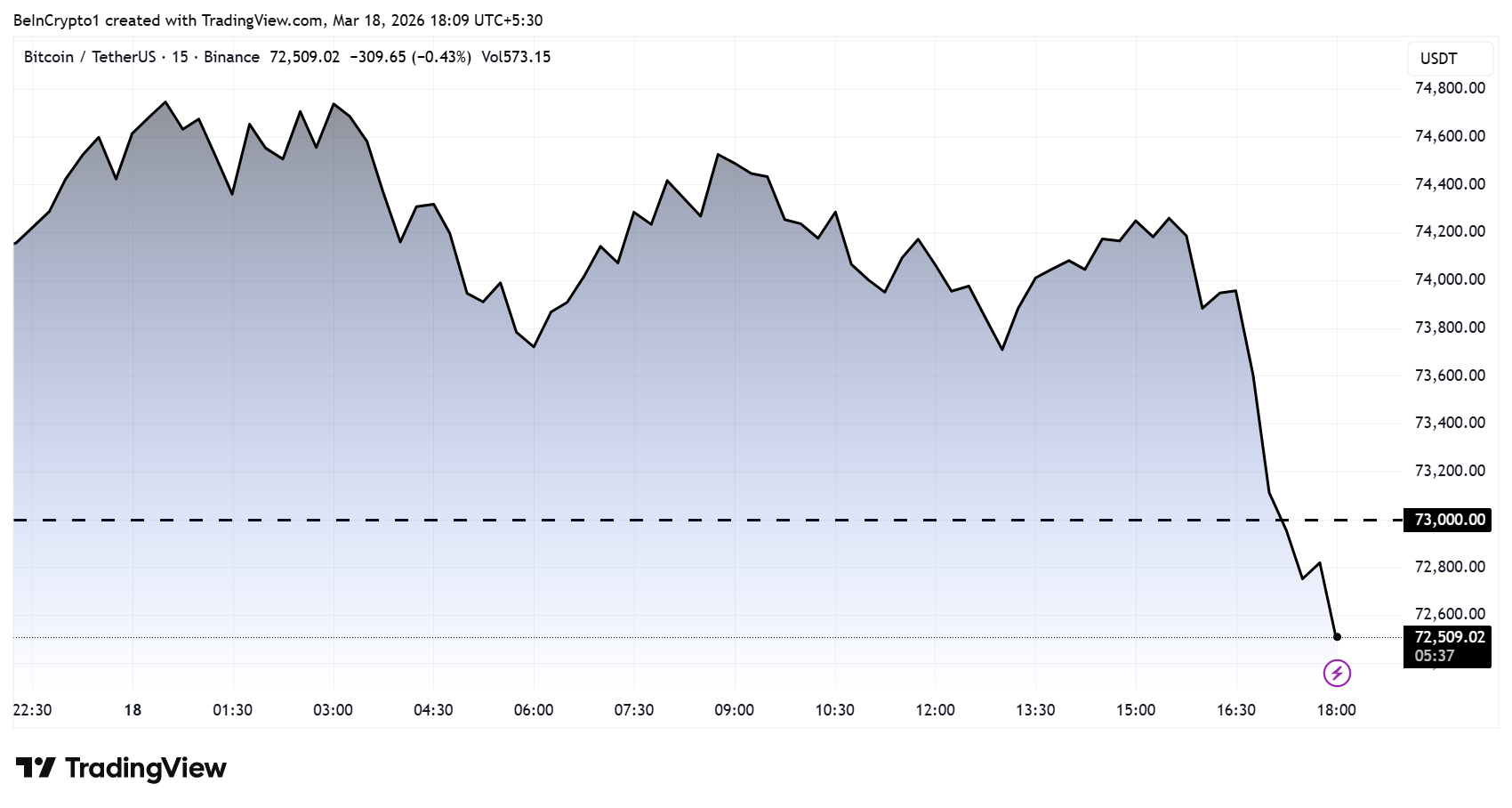
Entering the second week of March, market sentiment improved significantly after US Treasury Secretary Scott Bessant announced that the Trump administration was taking measures to suppress oil prices. On March 13, Bitcoin rose to around $73,800, approaching a one-month high, with a single-day increase of nearly 5%, marking the first Friday trading day with gains since the outbreak of the Iran-Iraq War. On March 16, Bitcoin further rose to approximately $73,882 and broke through the 50-day moving average. This was the first breakout in two months and was seen by analysts as a significant turning point signal for the medium-term trend. As of press time, Bitcoin has rebounded by more than 17% from its low at the start of the war.
Similar to history, but with more variables.
This trend is highly similar to the "script" of previous conflicts—a sharp drop, a rebound, and then consolidation. If the script is exactly the same, then we should be in the process of consolidation right now.
Looking back at the three conflicts over the past four years, one thing is clear: geopolitical events themselves are increasingly unlikely to leave a lasting mark on Bitcoin prices. The Russia-Ukraine war caused a substantial impact not because of the war itself, but because it triggered Western sanctions against Russia, fueled global inflation, and was compounded by two black swan events. The Gaza and India-Pakistan conflicts further demonstrate that even large-scale regional military conflicts, as long as they do not substantially disrupt energy supplies and global monetary policy, will quickly return to their own narrative in the crypto market after a brief period of turmoil.
Whether the current US-Israel-Iran conflict will be an exception hinges solely on oil prices. The Strait of Hormuz carries approximately one-fifth of the world's oil traffic. If it were truly blocked, inflation would reignite, expectations of a Federal Reserve rate cut would completely fail, and the macroeconomic pressure on Bitcoin as a risk asset would far exceed the panic selling at the beginning of the conflict. Conversely, if the conflict remains within its current intensity, oil prices fall, and negotiations resume, then based on historical experience, the impact of this war on Bitcoin prices will gradually dissipate.